
Students of Val Smith’s Theatre Partnership class at Port Dover Composite School will perform The Donnellys: Sticks and Stones on January 13 and 14 at 7 pm at the Lighthouse Theatre in Port Dover. Tickets are $5 and can be bought at the door. For more about what promises to be a lively production, see Daniel Pearce’s story in the Simcoe Reformer.
-
As a side note to Leith Peterson’s “Jamie and Jay’s 1965 Apple Butter Collaboration”, here is more about James Reaney’s adaptation of Little Red Riding Hood, one of three marionette plays commissioned by Jay Peterson for the Western Fair in September 1965. Greg Curnoe created the Red Riding Hood marionettes and they are now part of the collection at Museum London. Jack Chambers made a film of the play (Little Red Riding Hood (1965)), which is available from the London Public Library.
Riding Hood pulled no strings in ‘65
By James Stewart Reaney © 2003
(Note: This article originally appeared in The London Free Press, Sunday September 7, 2003, page T6.)
Western Fair in 2003 has goat milking, cooking demos, racing pigs, a world-class Neil Diamond impersonator and much more.
For all that, this year’s fall classic has nothing as subversive as Little Red Riding Hood. In 1965, the fair’s lures included a marionette version of the children’s folk tale – a subversive version.
Subversive? Little Red Riding Hood? Yes, Red, on film, still looks unconventional. Back in the 1960s, a big, bad wolf with U.S. flags for ears and a little H-bomb for company stirred the pot a little. Still does.
The fair’s Little Red Riding Hood was avant enough to boast marionettes and sets devised by Greg Curnoe, the late London artist. It was Curnoe’s concept to cast the Wolf as a U.S. imperialist predator and use the Vietnam-charged imagery of the day. Red, the wolf and the other marionettes are being donated to Museum London by Curnoe’s wife Shelia. They will be a terrific addition to the collection.
After its run at the fair, Red Riding Hood was filmed by another London artist, the late Jack Chambers. A copy of Chambers film is available on video from the London Public Library. A viewing of Chambers’ simple, direct and beautiful version last week brought back Western Fair memories and showed off Red’s arty side.
The plot is familiar. On her way to grandma’s house, Little Red Riding Hood is lured off the path into the forest. The evil wolf beats Red to granny’s, swallows up the old woman and then devours Red, too. Granny and Red are saved by a valiant huntsman who slays the wolf. Red – and the children in the audience – learn a valuable lesson about sticking to the straight and narrow.

From Jack Chambers’ 1965 film, Red Riding Hood and her mother. Red was one of three marionette plays developed by my father and others for the 1965 fair. He’s the James Reaney credited as the “story adapter” in the Chambers film.
London writer and archivist Leith Peterson has mentioned the role played by her mother, Jessie (Jay) Peterson, in commissioning Red and other marionette works for the fair.
“Mom saw these shows as not just entertainment for children, but for adults as well. Red Riding Hood caused quite a bit of controversy because of its anti-Vietnam War message,” Peterson has written. Then a Western Fair board member, Jay Peterson was involved in helping create marionettes for other shows.
At the fair, it seemed dad and the others in the Red troupe were battling expectations that marionettes were the glossy creations seen on prime-time TV. Glossy is not the word for the stars of Red. They were really for prime Chambers, not TV.
The Free Press of September 1965 said Red “is another idiom again” – contrasting it with the other marionette plays at the fair. It calls Curnoe “a strong exponent of pop art” and says his “puppets have all been created out of ordinary kitchen utensils.”
As it says in the library catalogue, these Curnoe creations were “unusual marionettes… Red Riding Hood herself is a block of (brightly painted) wood with a red plastic sandpail for a hood and a (plastic) sieve fastened in front for a basket.”

From Jack Chambers’ 1965 film, Red Riding Hood and her grandmother. Other characters were assembled from bits and pieces Curnoe had on hand. Granny was “just a teapot” with a teapot lid for a cap because she drank a lot of tea. The kids loved the teapot granny, even if adults saw her as “just a teapot.”
The Chambers film catches Red’s crazy humour. Courtesy of Curnoe, the huntsman had one of those toy guns that make a great rrrrrrr sound when fired. In the film, the huntsman is ready to shoot the buttons off anybody.
In the film’s first five minutes, he fires at a marionette of a hired-man, a character from another of the plays on the bill [Victor Nipchopper from Apple Butter]. The hired man is only there to set the scene and introduce Red’s cast.
Later, the huntsman fires at Red after asking her to put the cake intended for her grandma on her head. The gun-crazy huntsman wonders if she has ever heard of “Wilhelm Tell.” Bang, bang, bang. Rrr, rrr, rrr.
Red is terrified. There is a hole in her hood, she gasps.
“I guess your mother made it oversize,” the huntsman blandly says before pursuing the wolf.

From Jack Chambers’ 1965 film, the Huntsman and Red Riding Hood. Seeing Red and company at the fair was magical. The young UWO [Western University] types and others pulling the strings were all friendly. John and Gillian Ferns, Chris Faulkner, Jill Bradnock, Ellen Richardson and Alvin Waggener are listed in the film credits. Hearing John’s booming voice and listening to granny singing a Welsh hymn –possibly the voice of his wife, Gillian – recalls an era when town and gown were smaller and closer.
They all worked hard. Red and the other shows were not just a matter of pulling a few strings. Some days, there were four marionette presentations at the Labbatt theatre. Most days, it was hot and noisy. It was never dull on either side of the stage.
Through all that, the collaboration of Curnoe, Chambers and many others endures.
Almost 40 years later, this made-in-London gem is still the best way to see Red.

September 1965 performance of Red Riding Hood at London’s Western Fair. Photo by Arnim Walter. -
In 1965 James Reaney created three marionette plays: Apple Butter, an original work, and two adaptations, Red Riding Hood and Aladdin and the Magic Lamp. Leith Peterson describes how her mother, Jay Peterson, came to commission the plays and help create the marionettes. The plays were performed by James Reaney and friends at the Western Fair in September 1965 in London, Ontario.
Jamie and Jay Peterson’s 1965 Apple Butter Collaboration
Presentation by Leith Peterson for “Remembering Jamie,” July 7, 2008, Aeolian Hall. Prepared July 6, 2008 © Leith Peterson, 2003-2008
My mother, Jay Peterson, and Jamie [James Reaney] had a lot in common. Both were highly creative people who were good at getting projects not only off the ground, but also seeing them through to fruition. Mom, Jamie and Colleen teamed up on a number of adventures over the years, but the focus of this presentation will be Jamie and my mother’s 1965 Apple Butter collaboration.
In his 1990 Theatrum article entitled “Stories on a String,” Jamie said “…Jay Peterson was a cultural pillar of the town and she persuaded the Fair board to commission a marionette show from me…They actually gave me some money – one third of which went towards a tent, but the rest I salvaged to pay artists and manipulators for designs, puppets, theatre facades, as well as hours of gruelling work rehearsing, learning, and finally for ten days in mid-September, performing from 10 a.m. to 9 p.m. on the fairgrounds…Most of the manipulators were my graduate students. We still talk about those very happy, very busy days in the fall of 1965.”

From 1963 to 1970, my mother was a director of the Western Fair, so this is the fair Jamie is referring to. Apple Butter was one of three marionette productions commissioned for the 1965 fair. Greg Curnoe’s anti-Vietnam war piece called Red, and Jamie’s Aladdin rounded out the trio. My mother saw these shows as not just entertainment for children, but for adults as well.
Jamie described his Apple Butter effort as a “new venture. What I wanted to do in this fairy tale – where an orphan boy triumphs over the cruelties of his guardian – was to create a puppet hero for Southwestern Ontario similar to Russia’s Petrouchka and France’s Guignol.”

Hester Pinch, Solomon Spoilrod, and Apple Butter. (Inspired by the original set designed by James Anderson.) 
Victor Nipchopper from Applebutter makes an appearance in the prologue to Red Riding Hood. Red Riding Hood says: “You’re not in my story, Victor Nipchopper!” (The Red Riding Hood marionettes and set were designed by Greg Curnoe.) The Apple Butter marionettes were made at my grandfather’s old print shop at Leith, Ontario. In his diary entry for August 23, 1965, Jamie chronicles my mother driving the Reaney family up to stay at the Peterson cottage, which was close to the print shop. Then on August 29, Jamie pens that his sister Wilma picked up the Reaneys and took them back to London. There is a wonderful photo of the Reaney family, including John and Wilma, on the front steps of the Peterson cottage. Jamie is holding Apple Butter.
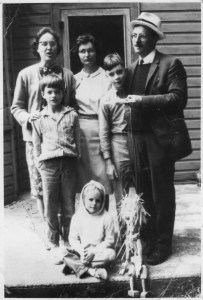
The Reaneys with Apple Butter, August 1965. Photo by Jay Peterson. I was at camp at the time the Reaneys were at Leith. However, Colleen, James, and Susan have provided details. In addition, I have asked my brothers, Stuart and Donald, for their input. Stuart remembers the Reaneys being at Leith and hanging out with James and John, but his only clear recollection is of James trying to convince him that the Dave Clark Five were better than the Beatles.
My brother Donald was just six at the time, but he enjoys reminiscing about “the making of Apple Butter and Moo Cow and how amazingly creative an effort it was.” He recalls all the Reaney children being there, including Susan, who was closest in age to him. What really stuck in his mind was Apple Butter and company hanging on the clothesline to dry. He described the whole experience as “pretty amazing.”
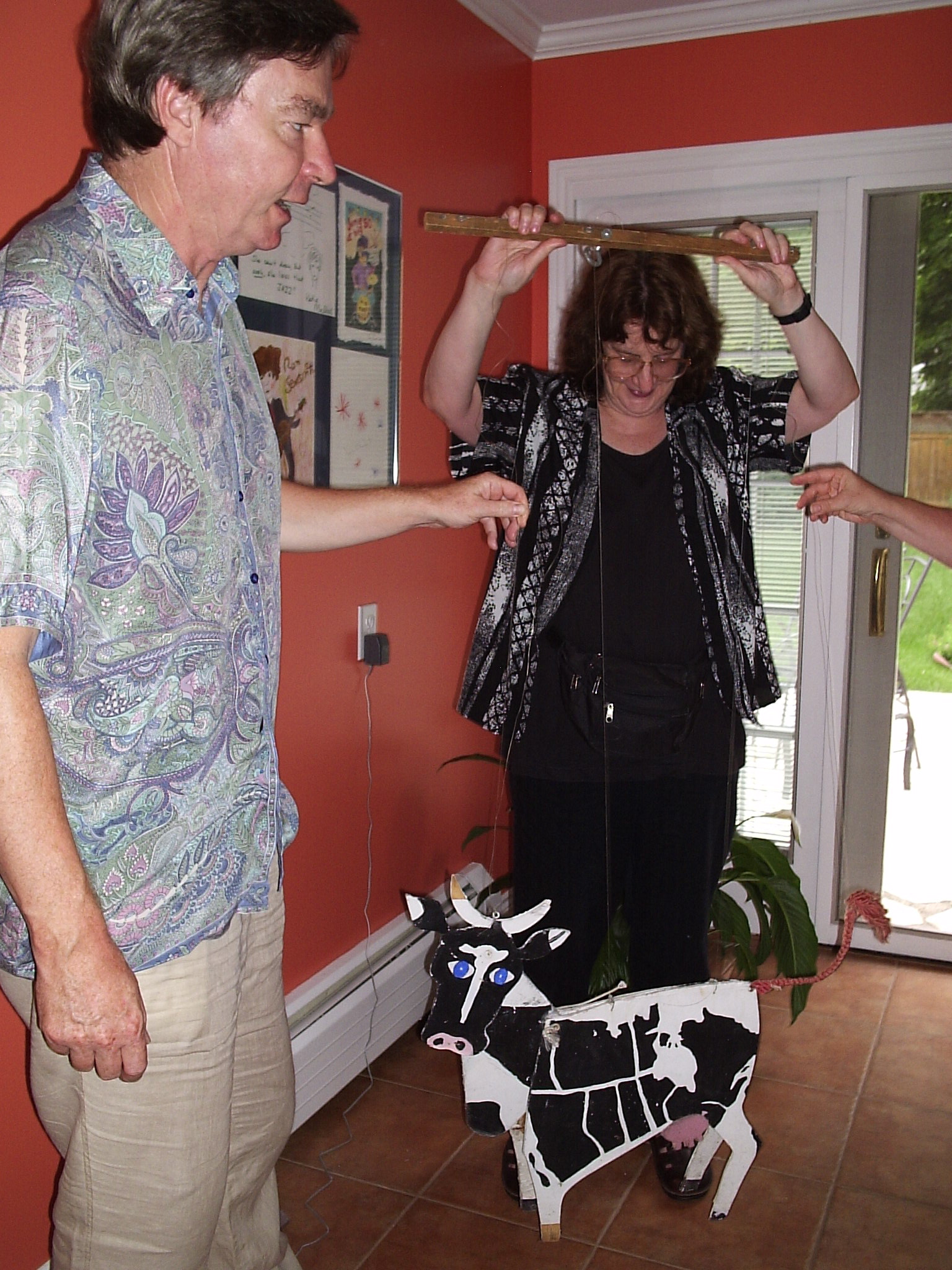
Jamie created Apple Butter, Treewuzzle and Rawbone. My mother made the heads as well as the papier-mache hands for the adult characters. Mom also designed Moo Cow — an impressive-looking bovine, with the map of Canada on one side, built into the Holstein’s black and white markings.

Leith Peterson shows off Moo Cow, August 2008. Photo by Susan Wallace. Jamie said that at the Apple Butter production in the Western Fair tent, “babies who cried for everything else shut up for Moo Cow, while backstage visitors enquired after Rawbone with a great deal of respect.”
Apple Butter went on to further acclaim in other locations. After the Woodstock production, Jamie enthused that “children practically accompanied Apple Butter right to the station.” In his 1968 biography of Jamie, Alvin Lee noted that Apple Butter was an adaptation from a simple folklore story “with a built-in appeal to the young, as the enthusiastic responses of hundreds of children have shown.” And there was also a built-in appeal for adults, including my mother and Jamie, who had so much fun bringing it all together.
James Stewart Reaney, James Reaney’s son, adds this news of Apple Butter and friends:
January 15, 2009
Apple Butter and Friends are on their way to the Canadian Museum of Civilization
I’m happy to know other people love Apple Butter, one of the marionettes created by my father in 1965, as much as I do. Apple Butter and several other marionettes from the 1965 play by dad were collected today & are en route to the Canadian Museum of Civilization. One of the marionettes, Moo Cow, was created by the late Jay Peterson, who helped clear the way for these remarkable characters to play the 1965 edition of the fair. The marionettes, including Apple Butter himself, have undergone some modifications since they first put their strings in front of the public. But it’s a real honour to see such interest & I know dad would be proud.
My only regret is that Jim Anderson’s magnificent set for Apple Butter disappeared somewhere over the years. It was a classic look at a Souwesto home.

James Reaney’s childhood home near Stratford, Ontario -
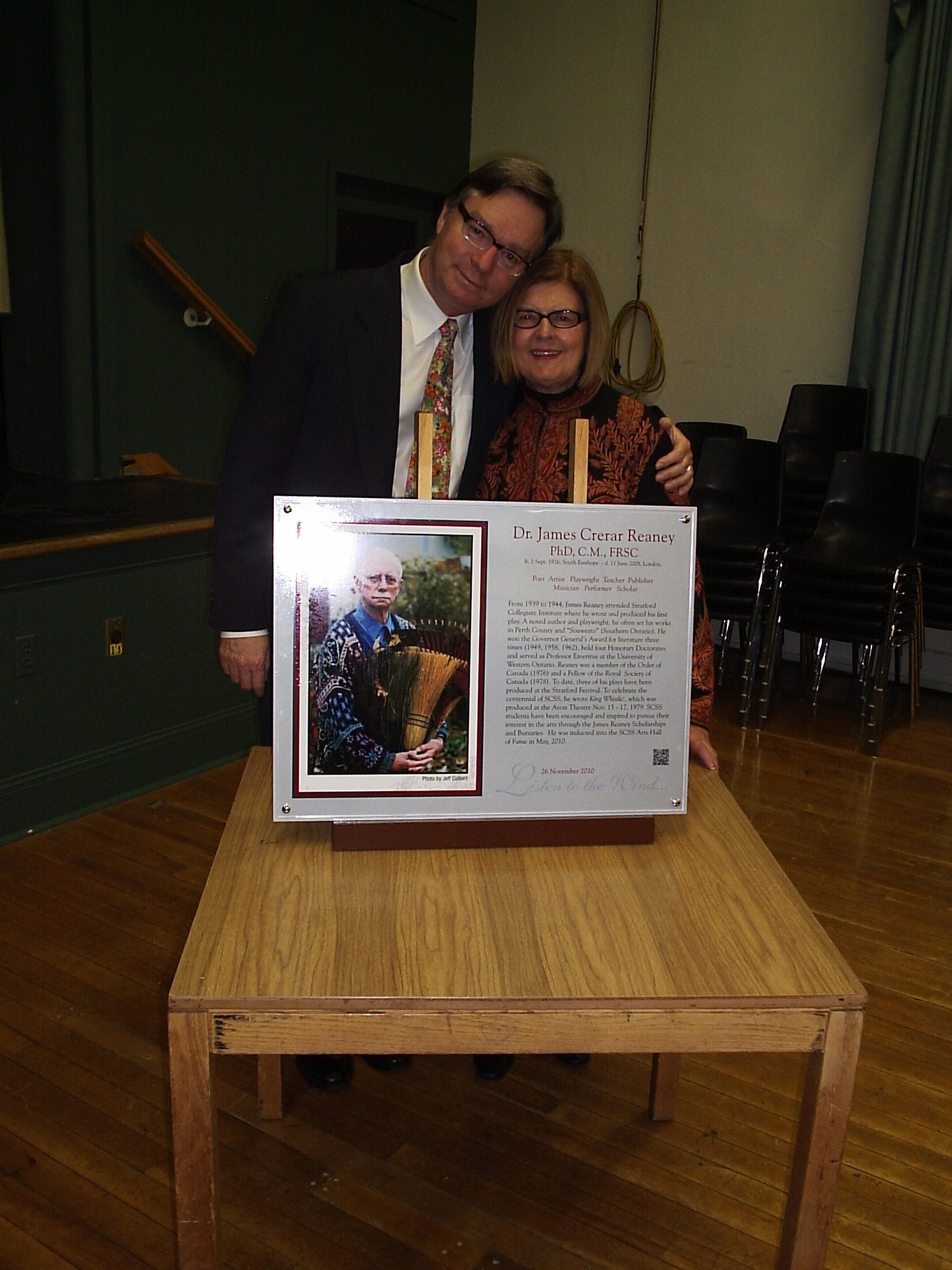
Stratford Central Secondary School’s new James C. Reaney Auditorium
Thank you all for coming to Friday night’s ceremony at Stratford Central Secondary School to dedicate its old auditorium, now the school’s drama centre, in honour of alumnus James Reaney.
The students gave a wonderful performance of Mimi Lights the Candle, a 1926 Christmas play by Edith Isham Coulter that James Reaney and his classmates put on at the school in 1943. As well as the carols in Mimi, students also sang “The Girls at Swift’s,” a song from King Whistle!, a play James Reaney wrote for the school’s centennial in 1979.
Special thanks to Stephanie Nescier for her excellent direction, and to Anne Swerdfager and the other members of the original 1979 cast of King Whistle! for singing along.
Thanks also to Ron Dodson for organizing this event, and to Lois Tarr, James Reaney’s classmate, for keeping her copy of Mimi Lights the Candle all these years. We know Dad would have been thrilled to be honoured in this way and to see you all enjoying the play.
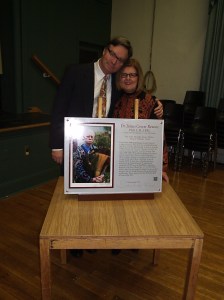
James Stewart Reaney (James Reaney’s son) and his wife Susan Wallace

James Stewart Reaney with Lois Tarr 
November 26: The play was performed on the main floor and the audience was seated on the stage and around the performers. (Photo by Leith Peterson) A scene from the play:
On Christmas Eve, Laura, Mimi’s long-absent mother, returns home.
Mimi: But you came!
Laura: Yes, because it was Christmas. My money was nearly gone,
but I managed to pay my fare here. And then Mimi’s candle drew me.
November 26, 2010: Stratford Central Secondary School students in a scene from Mimi Lights the Candle. Photo by Wilma McCaig. 
November 26, 2010: Carollers from Mimi Lights the Candle, Stratford Central Secondary School. Photo by Wilma McCaig. -
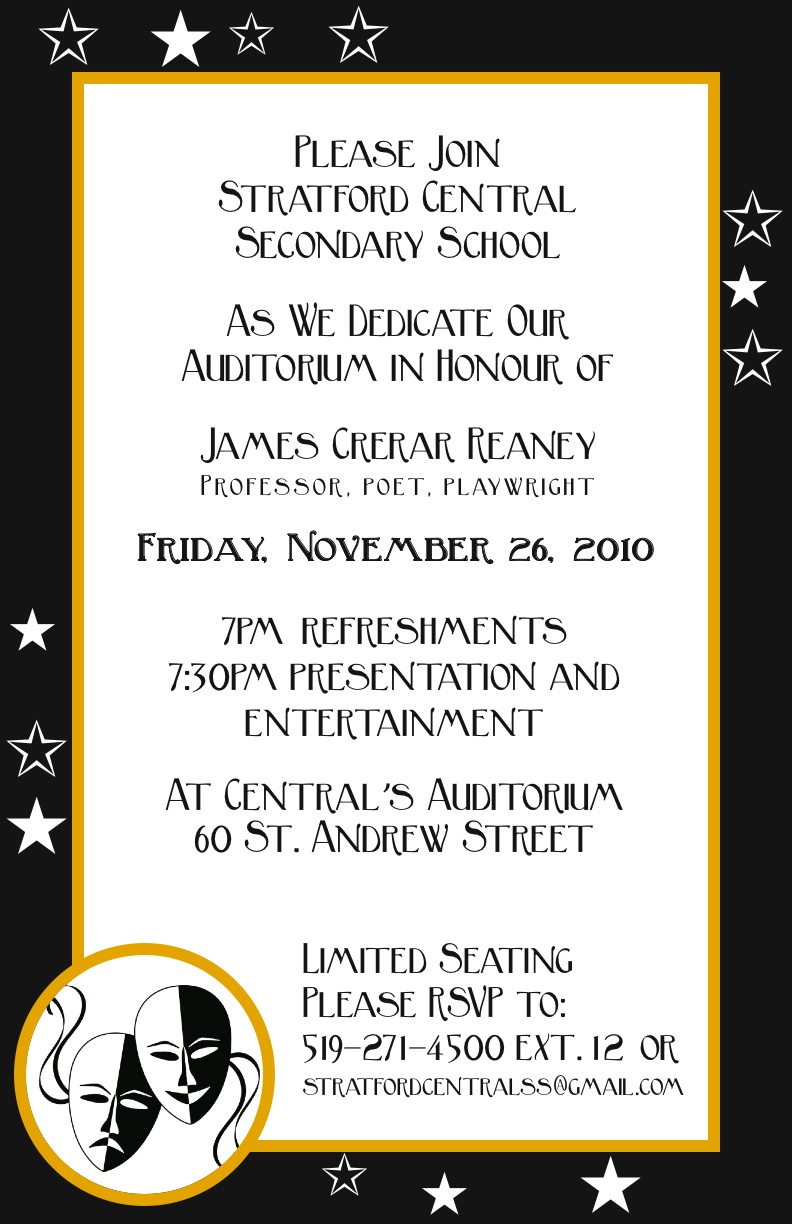
On November 26 in Stratford, Ontario, please join us for a gala celebration at Stratford Central Secondary School to dedicate the James C. Reaney Auditorium. The evening will begin with a brief reception at 7:00 p.m. and the program will begin at 7:30 p.m.
James Reaney attended Stratford Central from 1939-1944. To honour his achievements as a poet and playwright, the school made him its first inductee into its Arts Hall of Fame on May 6, 2010.
As part of the evening’s celebrations, students will perform a scene from Mimi Lights the Candle, a school Christmas play written by Edith Isham Coulter in 1926, which James Reaney and classmates performed in 1943 when he was a student. Thank you Lois Tarr, a former classmate of James Reaney’s, for preserving your copy of the script all these years!

Admission is free, but seating is limited. Please reserve a seat by sending an email to stratfordcentralss@gmail.com or calling 519.271.4500 and asking for Diane Yausie, Head Secretary.
Stratford Central Secondary’s address is 60 St. Andrew Street, and the auditorium is located on the second floor near the front entrance to the school.
There is limited parking behind the school, and there are quite steep stairs at both the front and back of the school. Hope to see you there!

-
Thank you all for coming to the lecture on Sunday afternoon to hear Colleen Thibaudeau, James Reaney’s widow, talk about their early days together and read from some of his works.
For those of you who were unable to attend, Stratford Beacon Herald reporter Mike Beitz wrote about Thibaudeau’s talk here.
Our thanks also to the organizers of the lecture at the Stratford Public Library, Charles Mountford, Anne Marie Heckman, and Sam Coghlan. Colleen Thibaudeau especially appreciated all the help she has had from her family and others; she couldn’t have done it without you.
One of James Reaney’s poems that Colleen Thibaudeau read was “White Grumphies, white snow” from Souwesto Home, published by Brick Books.
“White Grumphies, white snow…”
The students of Agricultural Diploma, their fathers
Grow square miles of blue flowering flax near
Pilot Mound and square miles of yellow mustard which
I saw as I drove out from Minnesota,
Well knowing that in the fall, in the autumn,
We would be teaching them Robert Penn Warren’s
Understanding Poetry, Austen’s Pride and Prejudice,
Somerset Maugham, Joseph Conrad, Emily Dickinson.As I climbed the stairs to their classroom
Over the Rupertsland Agricultural Auditorium,
Prepared to teach them “I heard a fly buzz when I died,”
I heard them splitting desk into kindling
For a bonfire in a waste paper basket where they
Burnt the texts on the course one by one,
Rainbow-coloured poems and prose they burnt,
Book by book, as I taught them.
As verbal virgins they were tougher
Than such pastoral nymphs as Diana or urban ones
Such as Athena.However, a day or two later, taking a random stroll
Across the winter campus, I saw,
Around the corner of the Swine Barn, a herd
Of white, white pigs being driven into the barn
By my Aggie Dip students each with
A very proper and even beautiful pig-driving stick.
Was it their mid-term test in pig-herding?
It must have been.The whiteness of the piggies against the whiteness of the snow
Presented them with optical problems.
They had trouble seeing me as well.
In fact not one of them did, for I
Was wearing this poem.James Reaney, 2005
My editor, Stan Dragland, wishes me to explain “White Grumphies, white snow.” They are white pigs herded by agricultural students on a snowy day.

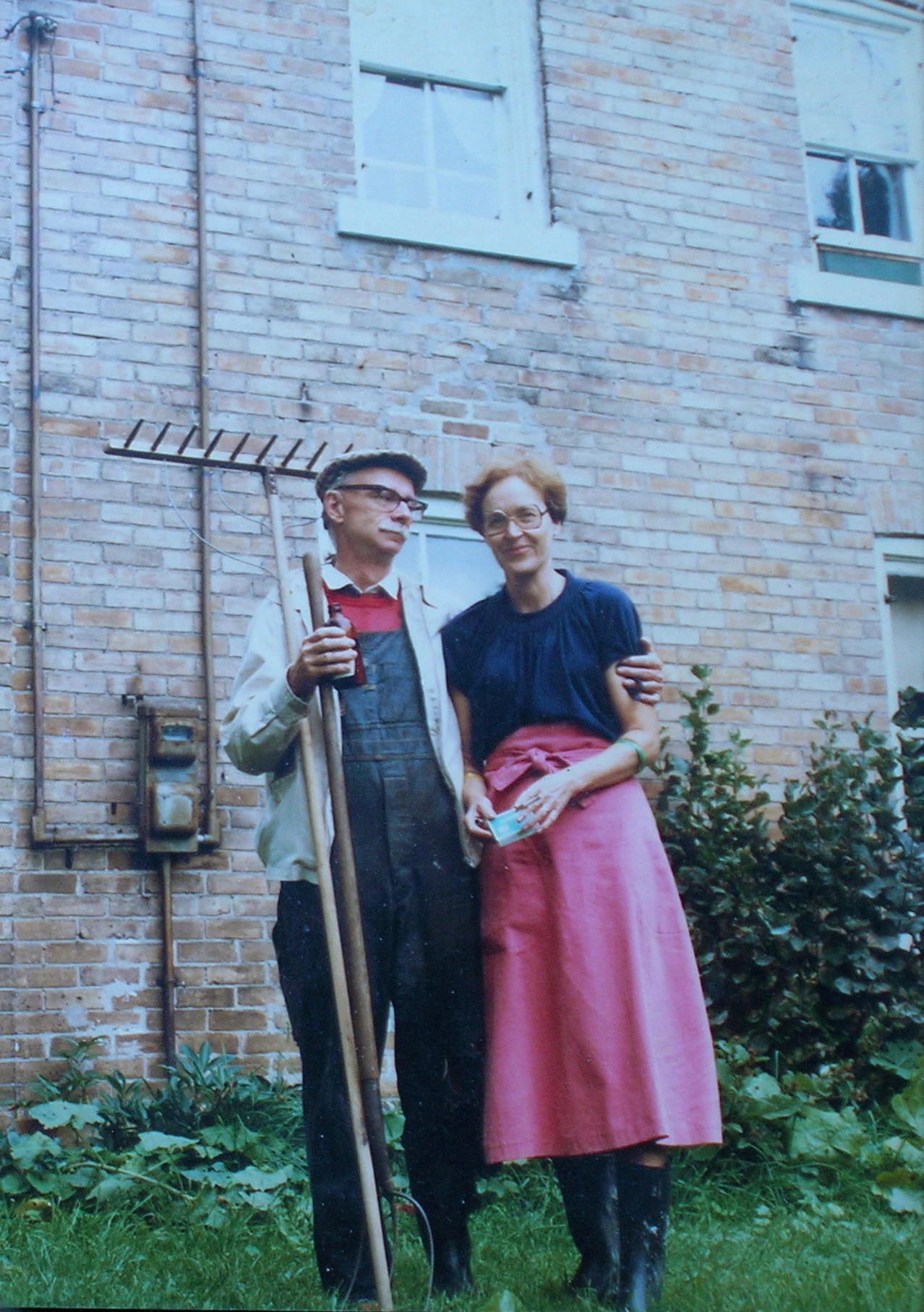
James Reaney and Colleen Thibaudeau near Stratford, Ontario, 1982. -
Join us on October 17 at 3 pm at The Stratford Public Library Auditorium in Stratford, Ontario, to hear poet Colleeen Thibaudeau speak at the first annual James Reaney Memorial Lecture.
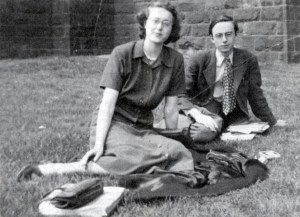
Colleen Thibaudeau and James Reaney, 1949 The annual lecture is a new project being developed by The Stratford Public Library and Poetry Stratford; it will feature a talk by a person who is knowledgeable about the life and work of Stratford poet and playwright James Reaney and of writing in the Southwestern Ontario region, which is such a strong element in Reaney’s writing.
Colleen Thibaudeau, Reaney’s widow and a poet and short story writer in her own right, was born in Toronto and raised in St. Thomas, Ontario. Educated at the University of Toronto, her M.A. thesis was on contemporary Canadian poetry. She married Reaney in 1951. Her books include Lozenges: Poems in the Shapes of Things (1965), Ten Letters (1975), My Granddaughters Are Combing Out Their Long Hair (1977), The Martha Landscapes (1984), The Artemesia Book (1991) and The “Patricia” Album (1992). Her involvement with all aspects of Canadian Literature has been long and deep. She has been associated with Canadian small presses and The League of Canadian Poets since the mid 1960s. Thibaudeau lives in London, Ontario.
James Reaney and Colleen Thibaudeau near Stratford, 1982. Photo by C.H. Gervais The Stratford Public Library is located at
19 St. Andrew Street,
Stratford, Ontario
N5A 1A2
-
If you’re in Toronto tonight, there will be a special reading of James Reaney’s One-Man Masque as part of the Nuit Blanche performances at St. Thomas’ Church. Larry Beckwith, Artistic Director of Toronto Masque Theatre, sends this update:
I am writing with an update of information about my involvement in Saturday night’s Nuit Blanche performances at St. Thomas’ Church as part of the “Pillars of Fire” exhibit.
A number of artists and performers are showcasing their work from 6:57 pm on Saturday to sunrise the following morning. Muscians and TMT friends involved include Alison Melville’s “Bird Project” the Windermere String Quartet, Brass Conspiracy, Ashiq Aziz’ “Classical Music Consort”, the Larkin Singers and the Sonore Percussion Trio.
I will be giving a special reading of James Reaney’s One-Man Masque at approximately 12:30 am. (This performance has been moved up from the previously-announced 2:00 am slot!).
I hope to see you there!
Pillars of Fire
Saint Thomas’s Anglican Church
383 Huron Street
scotiabank nuit blanche
Oct 2, 2010: 6:57 pm to sunrise
Zone A Independent Project – Scotiabank Nuit Blanche
Light emerges from darkness, as the mesmerizing beauty of fire allows us to transcend the night. See video, installation, performance and interactive artworks inspired by the transient and eternal nature of fire. Come celebrate your creative fire!
-
Fifty years ago this month, James Reaney published the first issue of Alphabet, a literary magazine featuring poetry, stories, art, essays, and reviews. Reaney edited Alphabet: A Semi-Annual Devoted to the Iconography of the Imagination from 1960-1971. He published poetry by Margaret Atwood, Jay Macpherson, Al Purdy, Milton Acorn, bp Nichol, and Joy Kogawa, among many others, and kept in touch with writers across Canada.
Here is the cover of the first issue, which was designed by Allan Fleming.

Alphabet Number One, September 1960 Contributors to the first issue were John Robert Columbo, Daryl Hine, Edward Kleiman, Hope Arnott Lee, Jay Macpherson, M. Morris, Norman Newton, John Peter, Richard Stingle, and Colleen Thibaudeau.
Here is the first editorial James Reaney wrote for Alphabet:
EDITORIAL
Perhaps the drive behind this magazine might be found in the following cluster: (a) The most exciting thing about this century is the number of poems that cannot be understood unless the reader quite reorganizes his way of looking at things or ‘rouses his faculties’ as Blake would say. Finnegans Wake and Dylan Thomas’ ‘Altarwise by owl-light’ sonnet sequence are good examples here. These works cannot be enjoyed to anywhere near their fullest unless one rouses one’s heart, belly and mind to grasp their secret alphabet or iconography or language of symbols and myths. A grasping such as is involved here leads to a more powerful inner life, or Blake’s ‘Jerusalem’s wall.’ Besides which it’s a hell of a lot of fun. It seems quite natural, then, in this century and particularly in this country, which could stand some more Jerusalem’s wall, that there should be a journal of some sort devoted to iconography. After all Ernst Cassirer defines man as a symbol-making animal.
But (b) there had to be more than this general feeling of our time. There had to be the particular pressure of friends, teachers and even scoffers also interested in symbolism in one way or another. I can remember about twelve years ago at Toronto feeling the final clutch of the so-called scientific world. Metaphors seemed lies. Poetry seemed to have no use at all. The moon looked enchanting through the trees on Charles Street, but the enchantment was really nothing but an illusion of clouds and fantasy covering up a hideous pock-marked spherical desert. When I told this part of my problem to a friend, whose work appears in this issue, he showed me a passage from the Marriage of Heaven and Hell which had the effect of starting me back to the belief I had held as a child that metaphor is reality. Those were the months when young men and women sat up all night reading Fearful Symmetry which had just come out. I think I have been present at more conversations about the Fall than even Adam could have thrown a certain withered apple core at, and assuredly more speculations concerning Leviathan than Job scratched his boils to. Here in your hands lies one of the effects of those conversations — a small secret looking book devoted to the proposition that it is very interesting mankind should answer the terrors of the inner and the outer world with a symbolic fruit and an iconic sea-beast. Interest increases with exploration. This attitude is to me one of the most stimulating areas of intellectual life in Canada. A traveller from abroad would immediately pick it out. Ils ont parlé toute la nuit de baleines blanches! So base a mag on this fact, actually personally observed, this fact of our cultural life. It’s a sturdy fact too; why else so much opposition? The tactics of the anti-symbol, anti-anagogy gang could only be described by making up titles for their mags, such as: Anti-Rot, ExeJesus, Values, The Lampman Review and True Feelers. However.
And (c) there was the desire to do the same delightful thing I had watched here and now, also Northern Review, do: publish real poems and real stories in a format and an area of subtle zoning that created a memorable effect (as distinct as a taste) on readers and also ‘placed’ the poems and stories to their advantage. This must by one of the happiest of civilized activities, akin to the proper arrangement of flowers. It was Kleiman’s story I first felt I must see published; it was so imaginative and no one was doing a thing about it. No really live focus appeared to put the story in until a juxtaposition, mind and social, occurred: Jay Macpherson read a paper on myth at the English Club (part of it appears on pages within) and afterwards there was a party at an apartment on Yorkville. Here Hope Lee told the stories about being a twin that we’ve also printed. It suddenly came to me that here was proof that life reflected art. The myth of Narcissus reaches out and touches with a clarifying ray the street scene where the two human beings glide by also in the toils of reflection. That’s how poetry works: it weaves street scenes and twins around swans in legendary pools. Let us make a form out of this: documentary on one side and myth on the other: Life & Art. In this form we can put anything and the magnet we have set up will arrange it for us.
Two years later (printing lessons, typesetting, waiting for t’s to come from Toronto, balancing trays of type on buses rolling in blizzards) here it is.
Winnipeg, July 1960.
-

Richard Stingle, a long-time friend and colleague of James Reaney, has kindly given us permission to share his talk about A Suit of Nettles, which he presented at the book launch on May 25, 2010 in London, Ontario. (A new edition of A Suit of Nettles is available from The Porcupine’s Quill.)

Richard Stingle at the London Public Library on May 25, 2010 A learned poet writes A Suit of Nettles
By Richard M. Stingle, May 25, 2010
In 1948, Jamie, Colleen and I were graduated from the Honours English programme at the University of Toronto, a programme that was centred on learning in several different areas of the Humanities. Ironically, in that same year of 1948, a history of English literature, edited by A. C. Baugh, included a study of eighteenth-century literature in which George Sherburn states that
“At the beginning of Alexander Pope’s career a hostile critic could assure him: ‘You have not that sufficient learning necessary to make a poet.’ The idea of learning as essential to a poet perished in the eighteenth century. Stephen Duck, the thresher poet, Anne Yearsley, the milkmaid and Thomas Chatterton all aspired to the role of natural genius — and to the grief of possible sponsors seemed deficient in quality.”
Even Robert Burns sang:
“Gie me a spark o’ Nature’s fire,
That’s a’ the learning I desire;
Then, though I drudge thro dub and mire
At pleugh or cart,
My Muse, tho hamely in attire,
May touch the heart.But surely Sherburn overstated the case in saying that learning was no longer essential. As Jay Macpherson has rightly said, Jamie was “of the learned kind of poet.” The tension between those in the learned tradition and those who confine poetry to the theme and language of the inspired “common man” has continued for two centuries and sometimes within the same poet. Wordsworth may champion the language such as men do use but proceeds to pull out all the stops of the epic in The Prelude and The Excursion. Tennyson’s preface The Epic has one character destroying his own attempt at epic, “Why take the style of those heroic times” (34), “And why should any man/Remodel models” (35-36). But Tennyson immediately proceeds to remodel Morte d’Arthur and later the whole Arthurian epic in Idylls of the King. William Morris also remodeled Nordic epic in his Sigurd the Volsung and Yeats, Joyce, Pound and Eliot continued this process as well. And Jamie was, as Germaine Warkentin has also affirmed, a learned poet.
A Canadian poet said once of Jamie that he was a poet (especially in the lyrical first volume of The Red Heart), but Northrop Frye killed him. This was nonsense. Frye and Jamie were both products of the old Honours programme at the University of Toronto. In Honours English, the student took nine courses in each year and reinforced his central study (English) with courses in three other Honours areas: in Frye’s case, Latin, Greek and Philosophy; in Jamie’s case, Latin, Greek and History. Both men were also very competent in playing the piano. I remember Jamie’s playing Bach, Debussy and his own “Penny Arcade.” And Jamie was painting while Frye was writing on painting in Canadian Forum. It is true that at first Jamie thought that the Modern era was slighted in the Honours programme (as it was) and that concepts were emphasized over the metaphors of mythos (as they were), but when Jamie went to teach at the University of Manitoba in 1949, he filled out what he had found lacking. He eagerly read Frye’s Fearful Symmetry, studied Blake and was writing furiously and telescoping his development in forms from lyric to epic to drama. When, a couple of years later, I joined him teaching in Winnipeg, Jamie was developing as a learned poet, and beginning to work with John Hirsch and Tom Hendry. Like Virgil, Spenser and Pope, who all began by writing pastoral eclogues, he was beginning to write dialogues combining romance and satire in his remodeling of Spenser’s Shepherd’s Calendar and, like Virgil, Spenser and Pope, he proceeded to writing epic works. In A Suit of Nettles, he was already becoming more complex, in entwining the eclogue with that very Canadian genre, the beast-fable, used by Ernest Thompson Seton, Sir Charles D. Roberts and others, the most recent being Yann Martel. As in the Canadian version of the form, Jamie’s geese remain geese as well as acting out human ideas, as Jim Westergard’s engravings in the new issue show. Jamie was, of course, adapting the folk-tale of The Seven Swans of the Brothers Grimm for the central metaphor of Branwell’s suit of nettles and the unchanged swan’s wing.
In the mid-fifties Jamie went back to Toronto, to strengthen his professional position with a Ph.D., but even more to bring all that he had learned and experienced earlier into Frye’s liberating idea that all literature is made out of literature, all art out of art. As Frye wrote in Myth and Freedom (1985): “But we can never understand the poet’s authority without Vico’s principles of verum factum, that reality is in the world we make and not in the world we stare at” (122). Frye’s modal criticism (Romance, Irony, Tragedy and Comedy) allowed Jamie to shape and contain what he knew into circles that become so important in Jamie’s work. He studied Blake with Frye, and wrote his Ph.D. dissertation, “Spenser’s Influence on Yeats,” under Frye’s direction.
Within the whirling circle of the year in A Suit of Nettles are circles within which speakers with opposed visions of language and poetry contend, as in the “July” eclogue in which Anser, the “progressive” teacher, derides Valancy (Isabella Valancy Crawford of Paisley) for praising Strictus, the teacher in her youth who taught his goslings knowledge of science, myth, history, biblical patterns and metaphors and the novels of Bronte and the poetry of Milton. Anser scornfully replies “how useless so far as the actual living of life is concerned.” In the “August” eclogue, this approach is reinforced in Jamie’s attack on Scrutumnus (representing F. R. Leavis) as the literary critic who is behind Anser’s point of view — a confining of literary experience to the “felt experience” of essentially rudimentary feeling and language. Reaney, of course, could also depict what A Suit of Nettles presents as Scrutumnus’ ideal of “Pigs in the sties of Venus,” but Jamie refused to confine his poetry or limit his language to one level. Jamie could present a flower in a corner fence on the farm more precisely than Tennyson could his “flower in the crannied wall” and as precisely as any Imagist poet. But he moves out to include all levels of experience and, instead of limiting language to the simplest level, brings all levels of language into multiple relations through complex counterpoint.
Many of his central metaphors are circles revolving within the cycle of the year on an Ontario farm (Jamie’s farm near Stratford). At the fall fair (Stratford Fall Fair) the circle of Western philosophy revolves in the merry-go-round and on the ferris wheel the creation myths of mankind rise and fall. It is not surprising that Jamie rejoiced in the visions of wheels within wheels a-turning in the Book of Ezekiel, Chapter I.
The dominant stanza of A Suit of Nettles is the Spenserian Sestina, but Jamie is encyclopaedic in his use of other stanzas as well. So is he in his use of metrical variation from the alliterative pounding of Beowulf, as in the “Drunken Preacher’s” sermon in “September” —
Lo, it was the last supper, I leader from gutter
Tell you tall and short tinkery folk gathered.
What did those white souls eat while their Lord talked:
I don’t know indeed I don’t, maybe sandwiches.— to the light graceful elegiac song of dimeters and trimeters of the first poem in “October” —
Sing to us for the frost
Is closing the pond,
The elms their leaves have lost
And the singing birds are gone.— and through other variants such as hexameter and pentameter, as in the “May” Eclogue. I think that Jamie, like Wagner, was striving to achieve a “Gesamtkunstwerk,” a union of all the arts, the expression of all creativity, and he certainly wrote through form after form and finally reached drama and opera to find such appropriate encyclopaedic media. In A Children’s Story, the latest novel by A. S. Byatt, two characters are also striving to realize Wagner’s desire:
Anselm Stern said what was needed was music like Richard Strauss. No, no, said Steyning, something fairy-like, something between “Greensleeves” and The Ring of the Nibelungs (515).
And sometimes we hear in Jamie’s work this intricate, encyclopaedic sound, and hear it first in A Suit of Nettles. Certainly we hear it clearly in The Donnellys, in Gyroscope and in Crazy to Kill.
In Imprecations in 1984, Jamie pronounces a resounding series of curses through three female voices, those of “Edith Sitwell, Judith Donnelly, and a whore on Queen St. in Toronto.” From their energy, the speaker-poet derives the power to lay waste to those who abuse the planet and their fellow creatures, those who destroyed the Honours programme at Toronto, those traitorous teachers who tell their students not to memorize anything and rely on their own opinion, and those who use the political power of the Ministry of Education to expel poetry from the schools. Note the emphasis upon the Honours programme — I think that I shall read that section —
Oh ye hippies and merry draft dodgers who in the sixties
Came to University College stampeding my dear old professors,
Mobbing them till they scrapped the old Honours English Course,
And gave you anything at any time:
No down payment on Emily Bronte; Virginia Woolf now,
Beowulf later on. Communitas delenda est!
May you in Heaven be presented with harps tuned in this order:
A 2 octaves below Middle C, next F natural 5 octaves above High C …— and note, as well, the emphasis on the duty of the genuine student to connect with the learned tradition. Twenty-six years after A Suit of Nettles, in Imprecations, Jamie is remaining true to the original power of A Suit of Nettles, and for another 24 years after that, he continued to proclaim its truths. And I have continued to be through all these years overwhelmed by the honour Jamie did me 52 years ago by dedicating A Suit of Nettles — “To RMS” — to me.

1950: Richard Stingle, Bob Patchell, and James Reaney


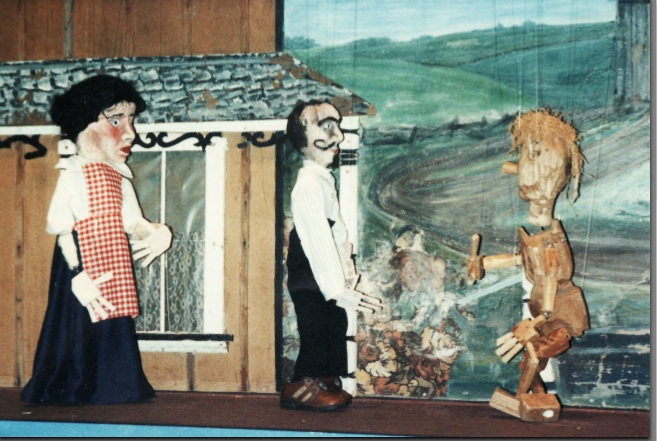





 James Reaney