Skip to content
  • About
    • Awards
  • Publications
    • Books in print
  • Contact

James Reaney

  • Happy 50th, Alphabet!

    September 18th, 2010

    Fifty years ago this month, James Reaney published the first issue of Alphabet, a literary magazine featuring poetry, stories, art, essays, and reviews. Reaney edited Alphabet: A Semi-Annual Devoted to the Iconography of the Imagination from 1960-1971. He published poetry by Margaret Atwood, Jay Macpherson, Al Purdy, Milton Acorn, bp Nichol, and Joy Kogawa, among many others, and kept in touch with writers across Canada.

    Here is the cover of the first issue, which was designed by Allan Fleming.

    Alphabet Number One, September 1960

    Contributors to the first issue were John Robert Columbo, Daryl Hine, Edward Kleiman, Hope Arnott Lee, Jay Macpherson, M. Morris, Norman Newton, John Peter, Richard Stingle, and Colleen Thibaudeau.

    Here is the first editorial James Reaney wrote for Alphabet:

    EDITORIAL

    Perhaps the drive behind this magazine might be found in the following cluster: (a) The most exciting thing about this century is the number of poems that cannot be understood unless the reader quite reorganizes his way of looking at things or ‘rouses his faculties’ as Blake would say. Finnegans Wake and Dylan Thomas’ ‘Altarwise by owl-light’ sonnet sequence are good examples here. These works cannot be enjoyed to anywhere near their fullest unless one rouses one’s heart, belly and mind to grasp their secret alphabet or iconography or language of symbols and myths. A grasping such as is involved here leads to a more powerful inner life, or Blake’s ‘Jerusalem’s wall.’ Besides which it’s a hell of a lot of fun. It seems quite natural, then, in this century and particularly in this country, which could stand some more Jerusalem’s wall, that there should be a journal of some sort devoted to iconography. After all Ernst Cassirer defines man as a symbol-making animal.

    But (b) there had to be more than this general feeling of our time. There had to be the particular pressure of friends, teachers and even scoffers also interested in symbolism in one way or another. I can remember about twelve years ago at Toronto feeling the final clutch of the so-called scientific world. Metaphors seemed lies. Poetry seemed to have no use at all. The moon looked enchanting through the trees on Charles Street, but the enchantment was really nothing but an illusion of clouds and fantasy covering up a hideous pock-marked spherical desert. When I told this part of my problem to a friend, whose work appears in this issue, he showed me a passage from the Marriage of Heaven and Hell which had the effect of starting me back to the belief I had held as a child that metaphor is reality. Those were the months when young men and women sat up all night reading Fearful Symmetry which had just come out. I think I have been present at more conversations about the Fall than even Adam could have thrown a certain withered apple core at, and assuredly more speculations concerning Leviathan than Job scratched his boils to. Here in your hands lies one of the effects of those conversations — a small secret looking book devoted to the proposition that it is very interesting mankind should answer the terrors of the inner and the outer world with a symbolic fruit and an iconic sea-beast. Interest increases with exploration. This attitude is to me one of the most stimulating areas of intellectual life in Canada. A traveller from abroad would immediately pick it out. Ils ont parlé toute la nuit de baleines blanches! So base a mag on this fact, actually personally observed, this fact of our cultural life. It’s a sturdy fact too; why else so much opposition? The tactics of the anti-symbol, anti-anagogy gang could only be described by making up titles for their mags, such as: Anti-Rot, ExeJesus, Values, The Lampman Review and True Feelers. However.

    And (c) there was the desire to do the same delightful thing I had watched here and now, also Northern Review, do: publish real poems and real stories in a format and an area of subtle zoning that created a memorable effect (as distinct as a taste) on readers and also ‘placed’ the poems and stories to their advantage. This must by one of the happiest of civilized activities, akin to the proper arrangement of flowers. It was Kleiman’s story I first felt I must see published; it was so imaginative and no one was doing a thing about it. No really live focus appeared to put the story in until a juxtaposition, mind and social, occurred: Jay Macpherson read a paper on myth at the English Club (part of it appears on pages within) and afterwards there was a party at an apartment on Yorkville. Here Hope Lee told the stories about being a twin that we’ve also printed. It suddenly came to me that here was proof that life reflected art. The myth of Narcissus reaches out and touches with a clarifying ray the street scene where the two human beings glide by also in the toils of reflection. That’s how poetry works: it weaves street scenes and twins around swans in legendary pools. Let us make a form out of this: documentary on one side and myth on the other: Life & Art. In this form we can put anything and the magnet we have set up will arrange it for us.

    Two years later (printing lessons, typesetting, waiting for t’s to come from Toronto, balancing trays of type on buses rolling in blizzards) here it is.

    Winnipeg, July 1960.

  • A learned poet writes A Suit of Nettles

    July 29th, 2010

    Richard Stingle, a long-time friend and colleague of James Reaney, has kindly given us permission to share his talk about A Suit of Nettles, which he presented at the book launch on May 25, 2010 in London, Ontario. (A new edition of A Suit of Nettles is available from The Porcupine’s Quill.)

    Richard Stingle at the London Public Library on May 25, 2010

    A learned poet writes A Suit of Nettles

    By Richard M. Stingle, May 25, 2010

    In 1948, Jamie, Colleen and I were graduated from the Honours English programme at the University of Toronto, a programme that was centred on learning in several different areas of the Humanities.  Ironically, in that same year of 1948, a history of English literature, edited by A. C. Baugh, included a study of eighteenth-century literature in which George Sherburn states that

    “At the beginning of Alexander Pope’s career a hostile critic could assure him: ‘You have not that sufficient learning necessary to make a poet.’  The idea of learning as essential to a poet perished in the eighteenth century.  Stephen Duck, the thresher poet, Anne Yearsley, the milkmaid and Thomas Chatterton all aspired to the role of natural genius — and to the grief of possible sponsors seemed deficient in quality.”

    Even Robert Burns sang:

    “Gie me a spark o’ Nature’s fire,
    That’s a’ the learning I desire;
    Then, though I drudge thro dub and mire
    At pleugh or cart,
    My Muse, tho hamely in attire,
    May touch the heart.

    But surely Sherburn overstated the case in saying that learning was no longer essential.  As Jay Macpherson has rightly said, Jamie was “of the learned kind of poet.”  The tension between those in the learned tradition and those who confine poetry to the theme and language of the inspired “common man” has continued for two centuries and sometimes within the same poet.  Wordsworth may champion the language such as men do use but proceeds to pull out all the stops of the epic in The Prelude and The Excursion.  Tennyson’s preface The Epic has one character destroying his own attempt at epic, “Why take the style of those heroic times” (34), “And why should any man/Remodel models” (35-36).  But Tennyson immediately proceeds to remodel Morte d’Arthur and later the whole Arthurian epic in Idylls of the King.  William Morris also remodeled Nordic epic in his Sigurd the Volsung and Yeats, Joyce, Pound and Eliot continued this process as well.  And Jamie was, as Germaine Warkentin has also affirmed, a learned poet.

    A Canadian poet said once of Jamie that he was a poet (especially in the lyrical first volume of The Red Heart), but Northrop Frye killed him.  This was nonsense.  Frye and Jamie were both products of the old Honours programme at the University of Toronto.  In Honours English, the student took nine courses in each year and reinforced his central study (English) with courses in three other Honours areas: in Frye’s case, Latin, Greek and Philosophy; in Jamie’s case, Latin, Greek and History.  Both men were also very competent in playing the piano.  I remember Jamie’s playing Bach, Debussy and his own “Penny Arcade.”  And Jamie was painting while Frye was writing on painting in Canadian Forum.  It is true that at first Jamie thought that the Modern era was slighted in the Honours programme (as it was) and that concepts were emphasized over the metaphors of mythos (as they were), but when Jamie went to teach at the University of Manitoba in 1949, he filled out what he had found lacking.  He eagerly read Frye’s Fearful Symmetry, studied Blake and was writing furiously and telescoping his development in forms from lyric to epic to drama.  When, a couple of years later, I joined him teaching in Winnipeg, Jamie was developing as a learned poet, and beginning to work with John Hirsch and Tom Hendry.  Like Virgil, Spenser and Pope,  who all began by writing pastoral eclogues, he was beginning to write dialogues combining romance and satire in his remodeling of Spenser’s Shepherd’s Calendar and, like Virgil, Spenser and Pope, he proceeded to writing epic works.  In A Suit of Nettles, he was already becoming more complex, in entwining the eclogue with that very Canadian genre, the beast-fable, used by Ernest Thompson Seton, Sir Charles D. Roberts and others, the most recent being Yann Martel.  As in the Canadian version of the form, Jamie’s geese remain geese as well as acting out human ideas, as Jim Westergard’s engravings in the new issue show.  Jamie was, of course, adapting the folk-tale of The Seven Swans of the Brothers Grimm for the central metaphor of Branwell’s suit of nettles and the unchanged swan’s wing.

    In the mid-fifties Jamie went back to Toronto, to strengthen his professional position with a Ph.D., but even more to bring all that he had learned and experienced earlier into Frye’s liberating idea that all literature is made out of literature, all art out of art.  As Frye wrote in Myth and Freedom (1985):  “But we can never understand the poet’s authority without Vico’s principles of verum factum, that reality is in the world we make and not in the world we stare at” (122).  Frye’s modal criticism (Romance, Irony, Tragedy and Comedy) allowed Jamie to shape and contain what he knew into circles that become so important in Jamie’s work.  He studied Blake with Frye, and wrote his Ph.D. dissertation, “Spenser’s Influence on Yeats,” under Frye’s direction.

    Within the whirling circle of the year in A Suit of Nettles are circles within which speakers with opposed visions of language and poetry contend, as in the “July” eclogue in which Anser, the “progressive” teacher, derides Valancy (Isabella Valancy Crawford of Paisley) for praising Strictus, the teacher in her youth who taught his goslings knowledge of science, myth, history, biblical patterns and metaphors and the novels of Bronte and the poetry of Milton.  Anser scornfully replies “how useless so far as the actual living of life is concerned.”  In the “August” eclogue, this approach is reinforced in Jamie’s attack on Scrutumnus (representing F. R. Leavis) as the literary critic who is behind Anser’s point of view — a confining of literary experience to the “felt experience” of essentially rudimentary feeling and language.  Reaney, of course, could also depict what A Suit of Nettles presents as Scrutumnus’ ideal of “Pigs in the sties of Venus,” but Jamie refused to confine his poetry or limit his language to one level.  Jamie could present a flower in a corner fence on the farm more precisely than Tennyson could his “flower in the crannied wall” and as precisely as any Imagist poet.  But he moves out to include all levels of experience and, instead of limiting language to the simplest level, brings all levels of language into multiple relations through complex counterpoint.

    Many of his central metaphors are circles revolving within the cycle of the year on an Ontario farm (Jamie’s farm near Stratford).  At the fall fair (Stratford Fall Fair) the circle of Western philosophy revolves in the merry-go-round and on the ferris wheel the creation myths of mankind rise and fall.  It is not surprising that Jamie rejoiced in the visions of wheels within wheels a-turning in the Book of Ezekiel, Chapter I.

    The dominant stanza of A Suit of Nettles is the Spenserian Sestina, but Jamie is encyclopaedic in his use of other stanzas as well.  So is he in his use of metrical variation from the alliterative pounding of Beowulf, as in the “Drunken Preacher’s” sermon in “September” —

    Lo, it was the last supper, I leader from gutter
    Tell you tall and short tinkery folk gathered.
    What did those white souls eat while their Lord talked:
    I don’t know indeed I don’t, maybe sandwiches.

    — to the light graceful elegiac song of dimeters and trimeters of the first poem in “October” —

    Sing to us for the frost
    Is closing the pond,
    The elms their leaves have lost
    And the singing birds are gone.

    — and through other variants such as hexameter and pentameter, as in the “May” Eclogue.  I think that Jamie, like Wagner, was striving to achieve a “Gesamtkunstwerk,” a union of all the arts, the expression of all creativity, and he certainly wrote through form after form and finally reached drama and opera to find such appropriate encyclopaedic media.  In A Children’s Story, the latest novel by A. S. Byatt, two characters are also striving to realize Wagner’s desire:

    Anselm Stern said what was needed was music like Richard Strauss. No, no, said Steyning, something fairy-like, something between “Greensleeves” and The Ring of the Nibelungs (515).

    And sometimes we hear in Jamie’s work this intricate, encyclopaedic sound, and hear it first in A Suit of Nettles.  Certainly we hear it clearly in The Donnellys, in Gyroscope and in Crazy to Kill.

    In Imprecations in 1984, Jamie pronounces a resounding series of curses through three female voices, those of “Edith Sitwell, Judith Donnelly, and a whore on Queen St. in Toronto.”  From their energy, the speaker-poet derives the power to lay waste to those who abuse the planet and their fellow creatures, those who destroyed the Honours programme at Toronto, those traitorous teachers who tell their students not to memorize anything and rely on their own opinion, and those who use the political power of the Ministry of Education to expel poetry from the schools.  Note the emphasis upon the Honours programme — I think that I shall read that section —

    Oh ye hippies and merry draft dodgers who in the sixties
    Came to University College stampeding my dear old professors,
    Mobbing them till they scrapped the old Honours English Course,
    And gave you anything at any time:
    No down payment on Emily Bronte; Virginia Woolf now,
    Beowulf later on.  Communitas delenda est!
    May you in Heaven be presented with harps tuned in this order:
    A 2 octaves below Middle C, next F natural 5 octaves above High C …

    — and note, as well, the emphasis on the duty of the genuine student to connect with the learned tradition. Twenty-six years after A Suit of Nettles, in Imprecations, Jamie is remaining true to the original power of A Suit of Nettles, and for another 24 years after that, he continued to proclaim its truths.  And I have continued to be through all these years overwhelmed by the honour Jamie did me 52 years ago by dedicating A Suit of Nettles — “To RMS” — to me.

    1950: Richard Stingle, Bob Patchell, and James Reaney
  • The Iconography of the Imagination: The Art of James Reaney

    June 6th, 2010
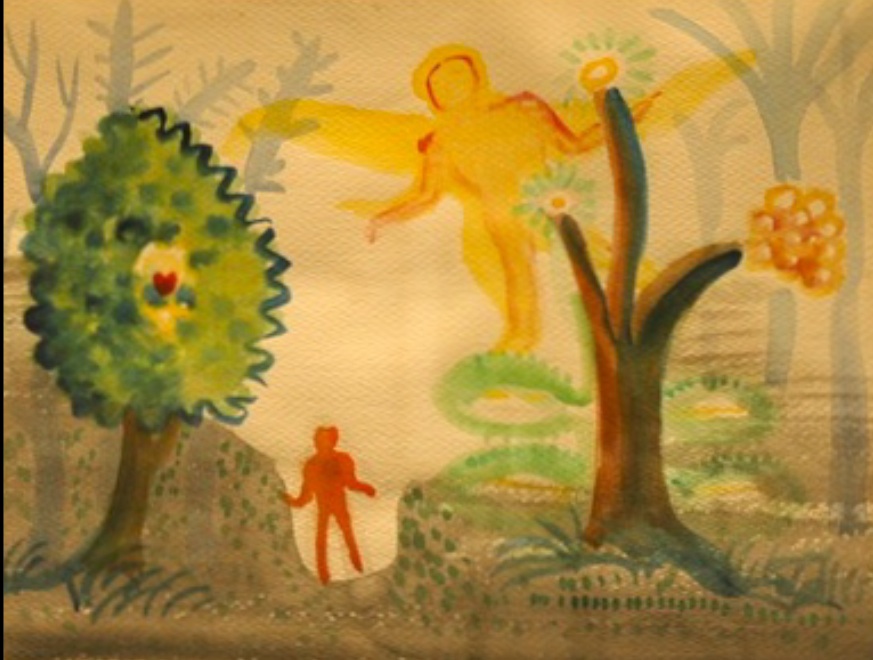
    James Reaney’s watercolour painting “David Willson Meets an Angel in the Forest”, 1962 (Photo courtesy Linda Morita, McMichael Canadian Art Collection)

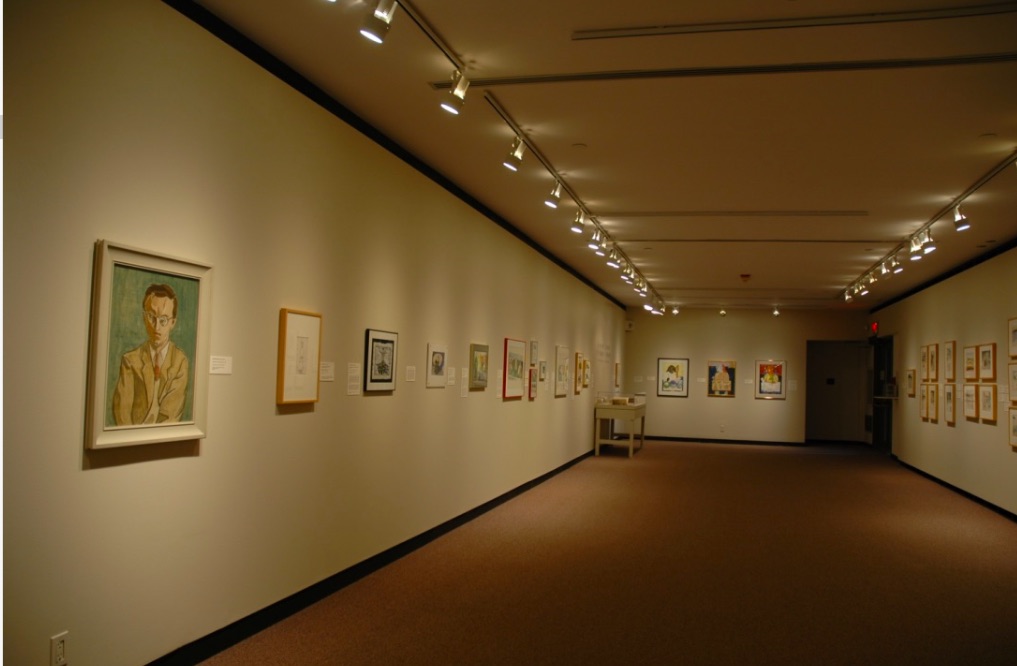
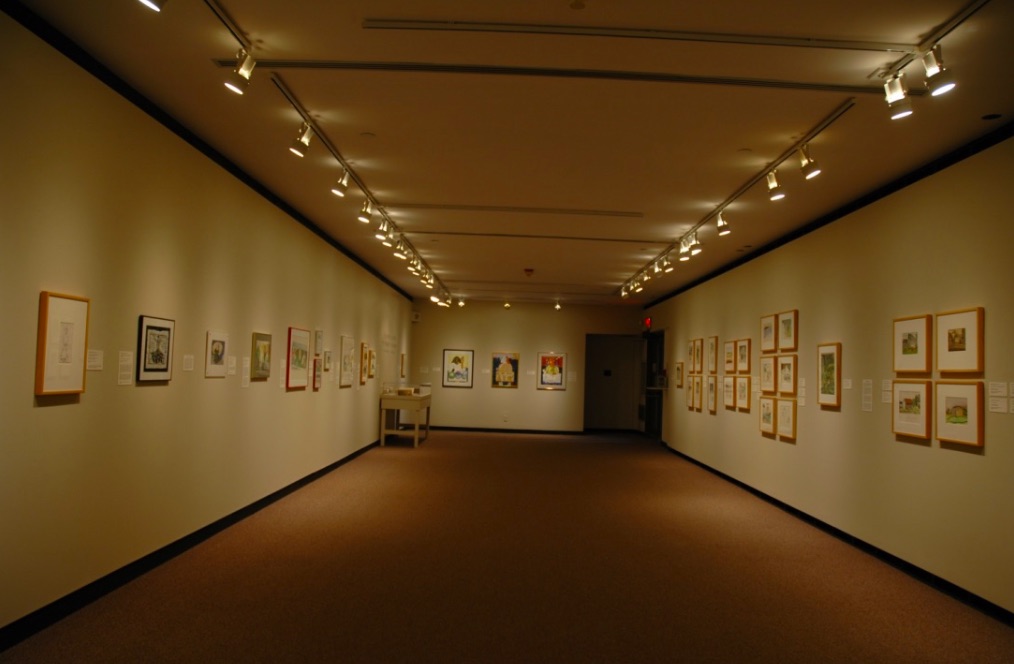
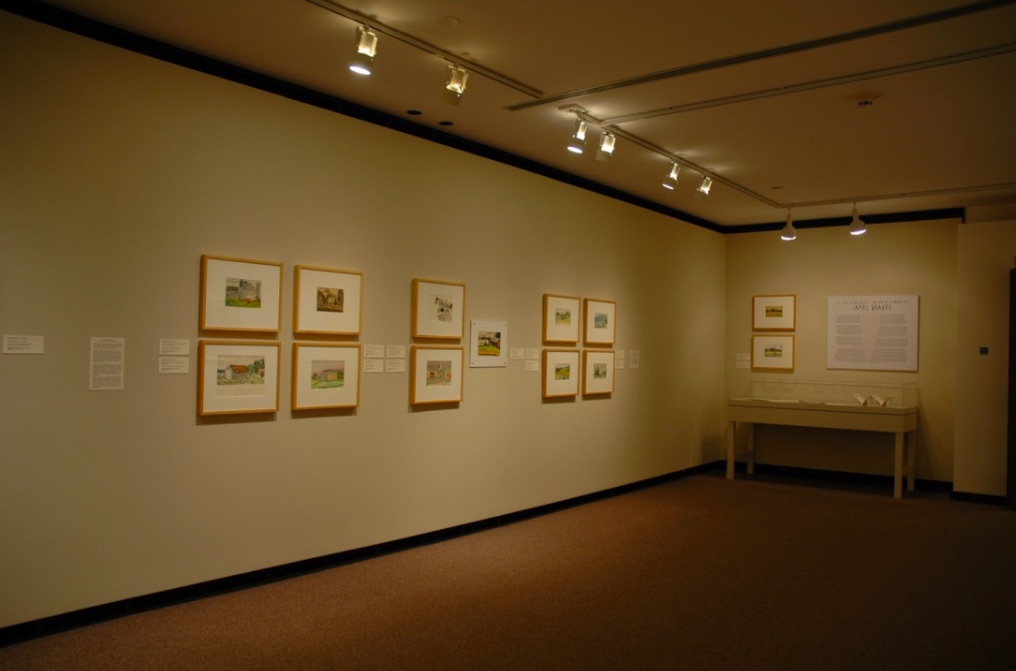
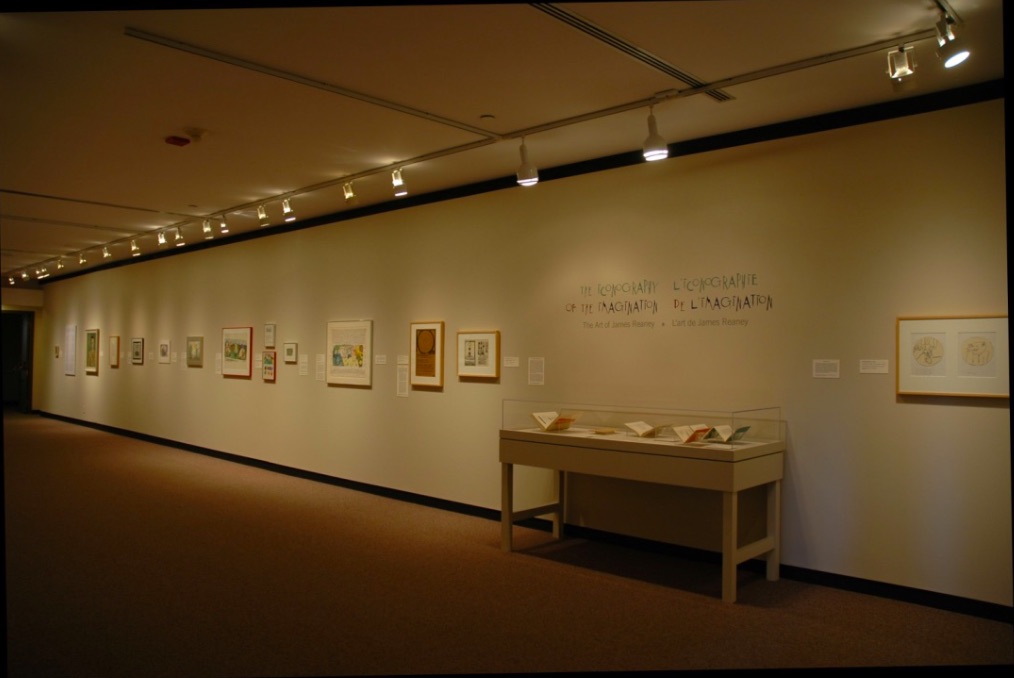
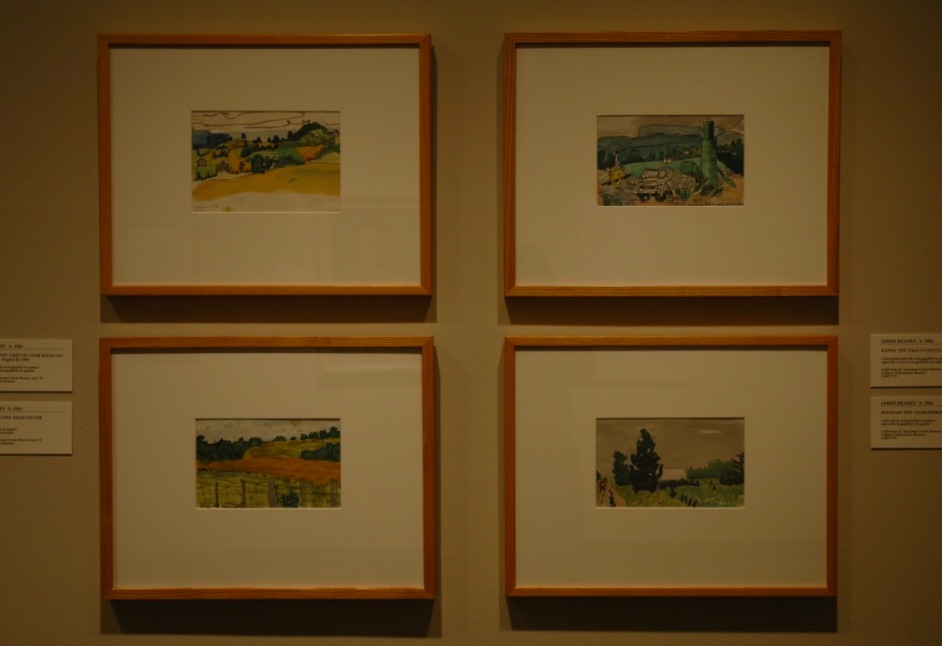
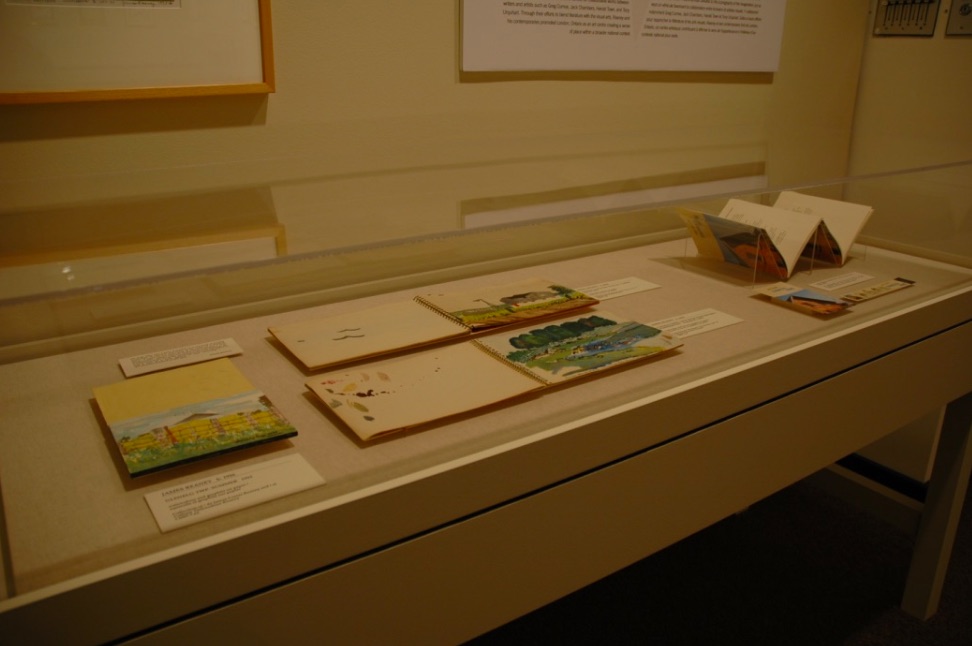
    Seen in the context of Reaney’s writing, this exhibition probes ideas of play, home, regionalism, symbolism, and the interplay between text and image. Through sketches, drawings, and paintings of emblems, figures and archetypes, as well as the Canadian landscape, the exhibition explores the themes most prevalent in his writings. (From the Spring Exhibitions invitation, McMichael Canadian Art Collection, April 17, 2008)

    The Iconography of the Imagination:
    The Art of James Reaney

    McMichael Canadian Art Collection, Kleinburg, Ontario
    January 26 to May 18, 2008

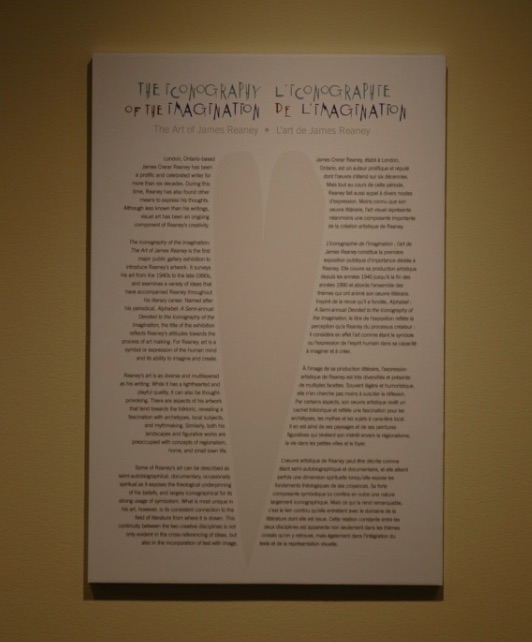
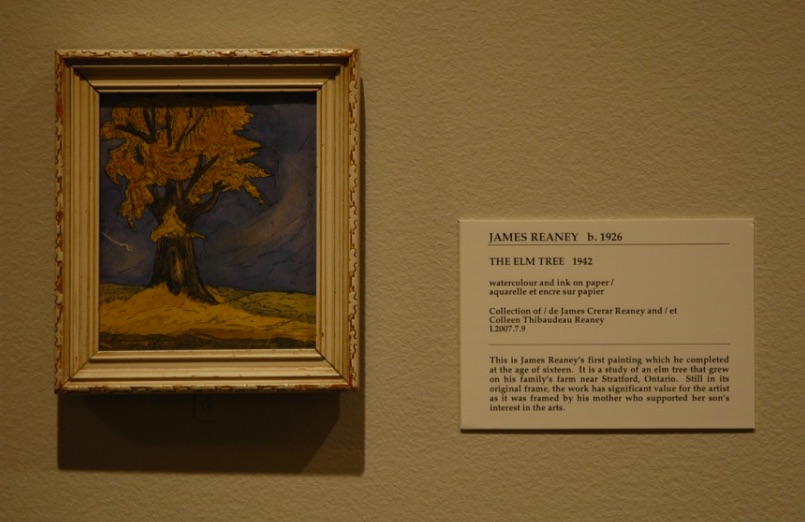
    London, Ontario-based James Crerar Reaney has been a prolific and celebrated writer for more than six decades. During this time, Reaney has also found other means to express his thoughts. Although less known than his writings, visual art has been an ongoing component of Reaney’s creativity.

    The Iconography of the Imagination: The Art of James Reaney is the first major public gallery exhibition to introduce Reaney’s artwork. It surveys his art from the 1940s to the late 1990s, and examines a variety of ideas that have accompanied Reaney throughout his literary career. Named after his periodical, Alphabet: A Semi-annual Devoted to the Iconography of the Imagination, the title of the exhibition reflects Reaney’s attitudes towards the process of art making. For Reaney, art is a symbol or expression of the human mind and its ability to imagine and create.

    Reaney’s art is as diverse and multilayered as his writing. While it has a lighthearted and playful quality, it can also be thought-provoking. There are aspects of his artwork that tend towards the folkloric, revealing a fascination with archetypes, local subjects, and mythmaking. Similarly both his landscapes and figurative works are preoccupied with concepts of regionalism, home, and small town life.

    Some of Reaney’s art can be described as semi-autobiographical, documentary, occasionally spiritual as it exposes the theological underpinning of his beliefs, and largely iconographical for its strong usage of symbolism. What is most unique in his art, however, is its consistent connection to the field of literature from where it is drawn. This continuity between the two creative disciplines is not only evident in the cross-referencing of ideas, but also in the incorporation of text with image.

    Note from Susan Reaney: This text was written by Tom Smart, Director at the McMichael Canadian Art Collection, 2006-2010. The images below were taken by Linda Morita, Librarian and Archivist at the McMichael Canadian Art Collection, and are used by permission.

    〈〈〈 ♦♥♦ 〉〉〉 To view the images in sequence, click on one of the images below and then click on the left and right arrow keys.

    Photographer:  Linda Morita, 2008
    Photos courtesy of the McMichael Canadian Art Collection.

  • A Suit of Nettles book launch

    May 28th, 2010

    Thank you all for coming to our launch for the new edition of A Suit of Nettles on May 25.

    Special thanks to London actor Jeff Culbert, for capturing the spirit of the geese characters, and to Richard Stingle, long-time friend and colleague of James Reaney, for his thoughts about the poem and the poet.

    Thanks also to our wonderful hosts, the London Public Library, who made us all feel at home.

    From the January eclogue:

    January

    With the other geese within the goosehouse
    There lived, I know not how, various kinds
    Of geese: some like a cat, some like a mouse,
    Some like a groundhog and some like lions,
    Some like two straight parallel lines,
    Others more circular in character,
    Some shallow and some deep as mines,
    Others than chaos far more muddier,
    And whether you should parcel fast or loose
    Some could not be but simply described ‘Goose’.

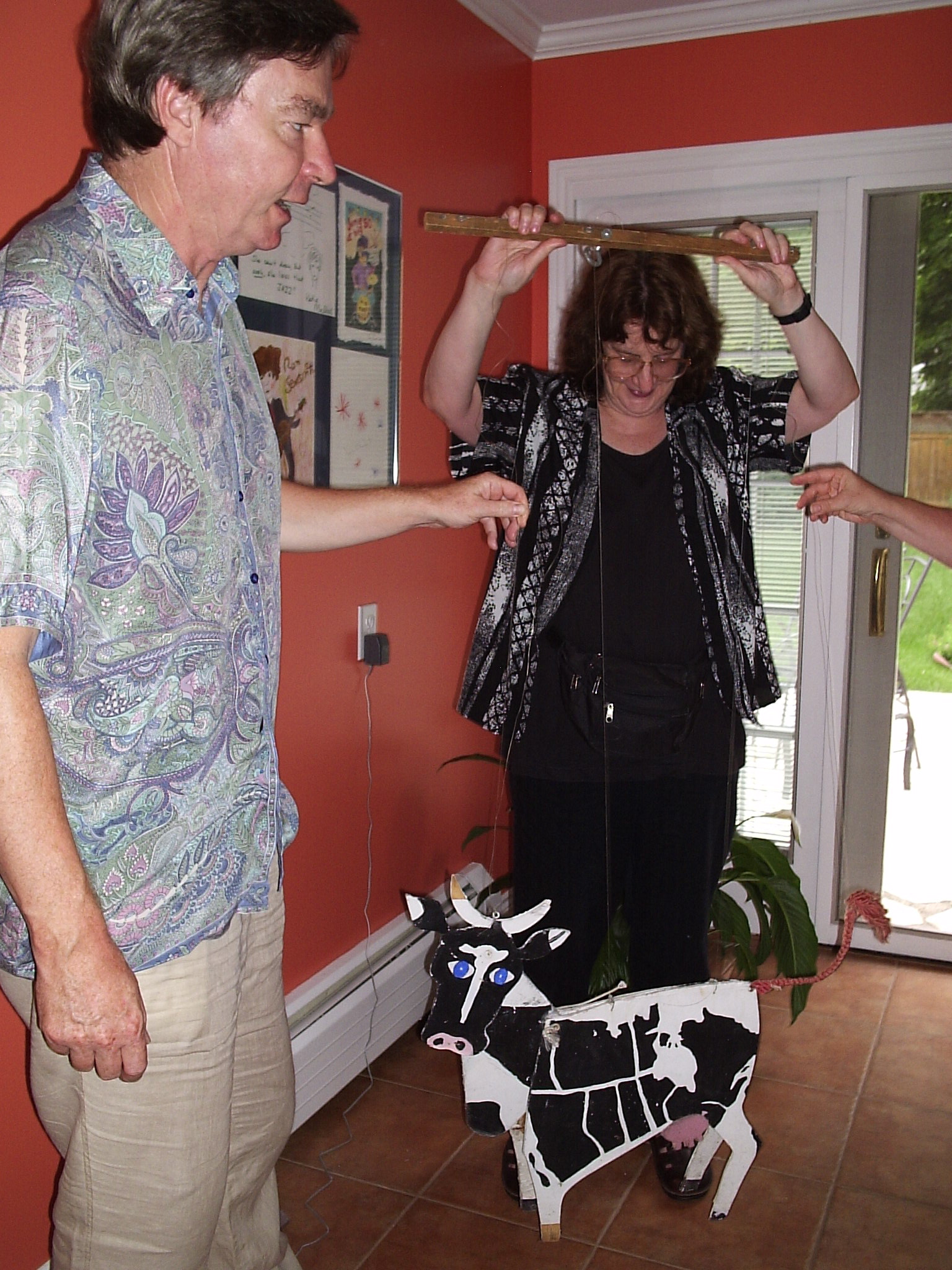
    Jeff Culbert animates Branwell, George, and Dorcas from    A Suit of Nettles
    Richard Stingle shares his thoughts on the poem.
    Prize winners collect their Jim Westergard engraving from  A Suit of Nettles.
  • May 25: A Suit of Nettles book launch at the Central Library

    May 25th, 2010

    Tonight at the Central Library in London, Ontario, join us at 7 pm for an evening of  poetry to celebrate the new edition of A Suit of Nettles.

  • May 6 Arts Gala at Stratford Central Secondary

    May 11th, 2010

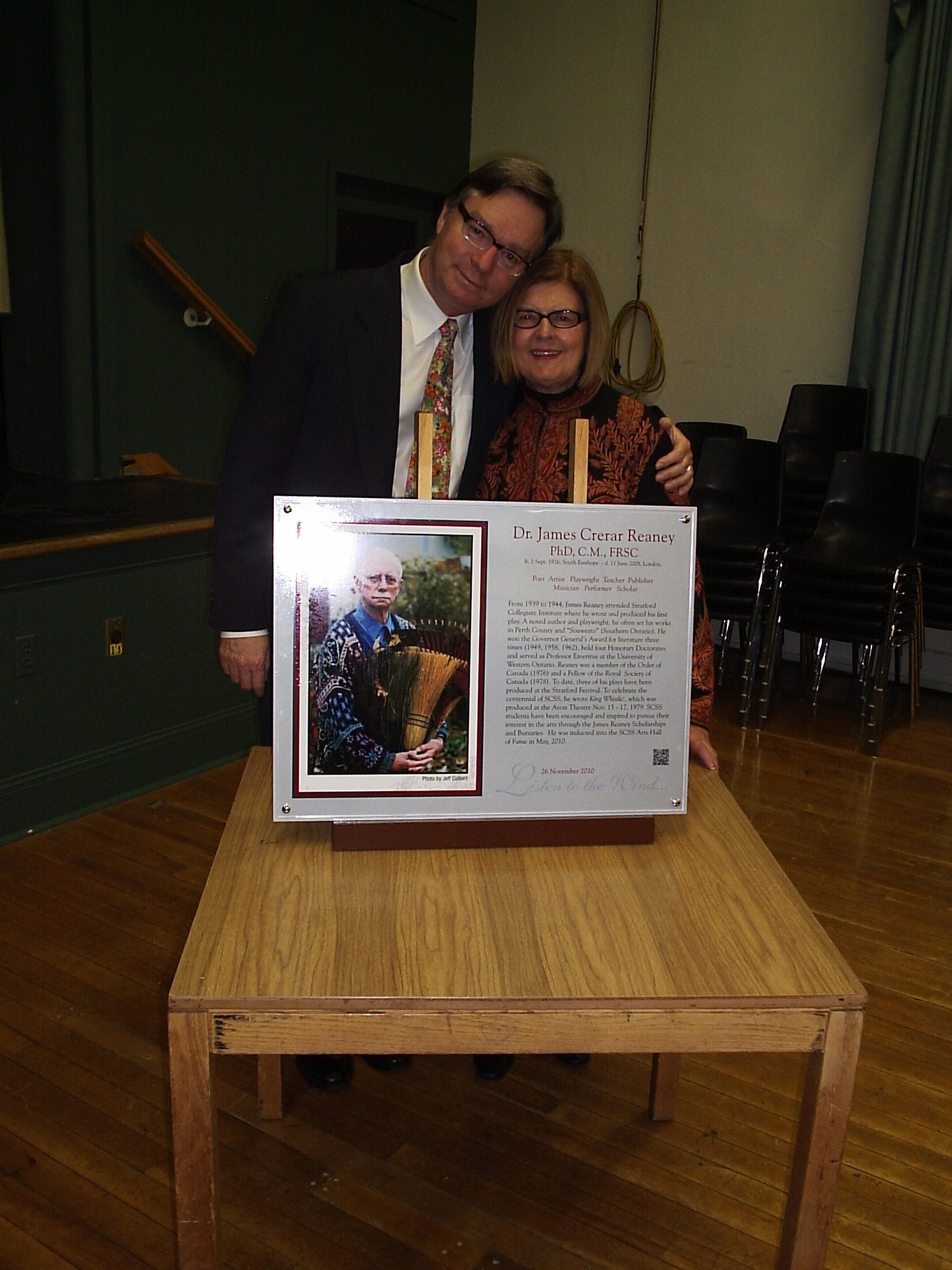
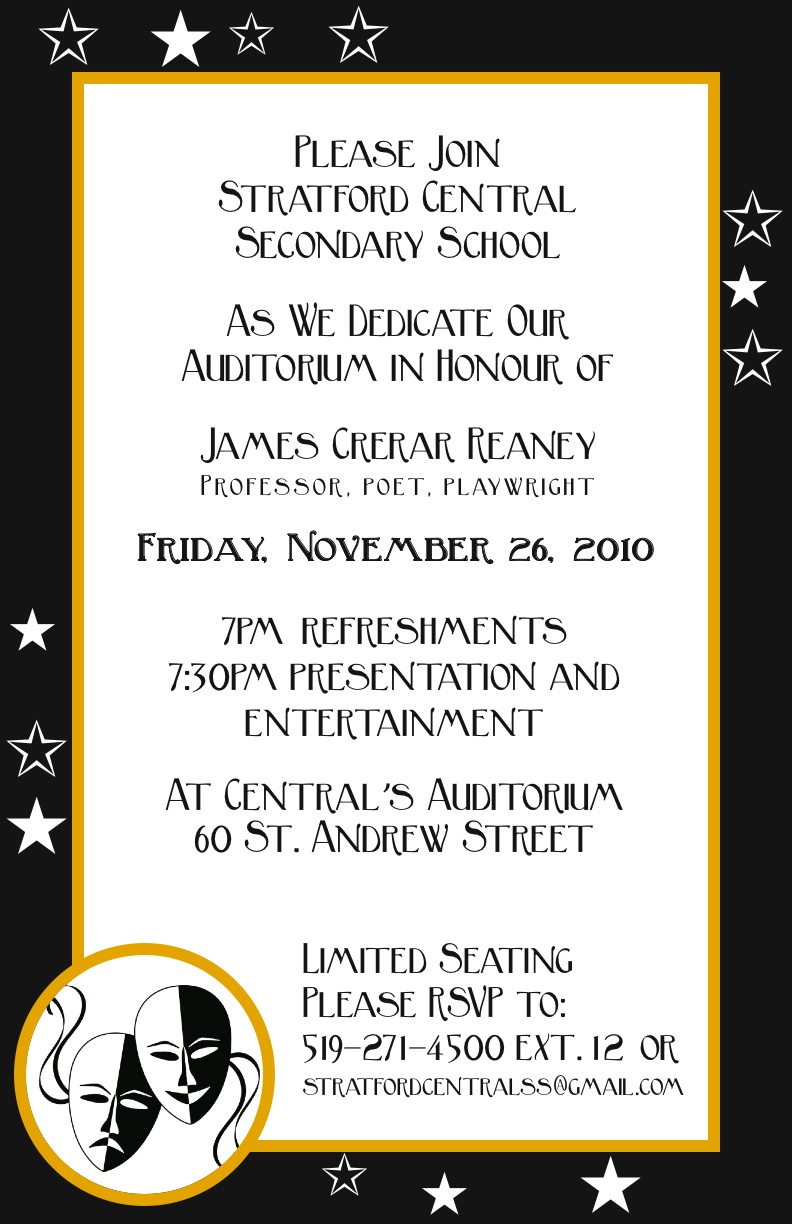
    On May 6 in Stratford, Ontario, Stratford Central Secondary School welcomed poet and playwright James Reaney as the first inductee to the school’s Arts Hall of Fame. James Reaney went to high school there from 1939-1944.

    Reaney’s family, including his sister Wilma McCaig and his brother Ron Cooke, attended the induction ceremony at Central last week. In honour of the occasion, students staged the opening scene of James Reaney’s play, Colours in the Dark. James Stewart Reaney (James Reaney’s son) gave thanks on behalf of the Reaney family. “This kind of recognition, I know, would have touched Dad deeply,” he said.

    James Stewart Reaney and Rick Cooke with the bicycle from Colours in the Dark.

  • Reaney Days in May

    May 1st, 2010

    Here are three Reaney events in May:

    On May 6 in Stratford, Ontario, Stratford Central Secondary School will host an arts gala evening to launch the school’s new Arts Hall of Fame and celebrate its first inductee, James Crerar Reaney, who went to high school there over 60 years ago. Over the years, James Reaney maintained ties with the school and led workshops there for two of his plays, King Whistle and Alice Through the Looking Glass.

    May 6, 7, and 8, in Strathroy, Ontario, Evelyn D’Oria and the students of Strathroy District Collegiate Institute will present James Reaney’s adaptation of Alice Through the Looking Glass. There will be three evening performances of the play starting at 7:00 pm, and a matinee on Saturday at 2:00 pm.

    On May 25 in London, Ontario, the new edition of James Reaney’s A Suit of Nettles will be launched at the London Central Library, 7:00 pm. This long poem won the Governor General’s Award for Poetry in 1958. The new edition, published by The Porcupine’s Quill, is charmingly illustrated with woodcuts by Jim Westergard.


  • A Suit of Nettles: April

    April 18th, 2010

    A new edition of A Suit of Nettles, James Reaney’s set of pastoral eclogues inspired by Edmund Spenser’s The Shephearde’s Calendar, is available from The Porcupine’s Quill. A book launch and reading to celebrate the new edition will be held in May.

    From the April eclogue, here are Valancy’s lines from the bardic contest celebrating Spring.

    April

    VALANCY

    Your limbs are the rivers of Eden.
    From the dead we see you return and arise,
    Fair girl, lost daughter:
    The swallows stream through the skies,
    Down dipping water,
    Skimming ground, and from the chimney’s foul dusk
    Their cousins the swifts tumble up as the tusk
    Of roar day
    In bright May
    Scatters them gliding from darkness to sun-cusp.

    Your face unlocks the bear from his den.
    The world has come into the arms of the sun.
    What now sulky earth?
    All winter you lay with your face like a nun,
    But now bring forth
    From river up boxdrain underground
    Fish crawling up that dark street without sound
    To spawn
    In our pond
    Young suckers and sunfish within its deep round.

    Your body is a bethlehem.
    Come near the sun that ripened you from earth
    Pushing south winds
    Through lands without belief till this pretty birth
    The faithful finds:
    Fanatic doves, believing wrens and orioles
    Devoted redwinged blackbirds with their calls,
    Archilocus alexandri,
    Melospiza georgiana,
    All surround you with arched cries of Love’s triumphals.

    Your mind is a nest of all young things, all children
    Come to this meadow forest edge;
    Put her together
    From this squirrel corn dogtooth young sedge
    And all this weather
    Of the white bloodroots to be her skin
    The wake robin to be her shin
    Her thighs pockets
    Of white violets
    Her breasts the gleaming soft pearly everlasting.

    For her limbs are the rivers of Eden;
    Her face unlocks
    The brown merry bear from his den,
    From his box
    The butterfly and her body is a bethlehem
    Humming
    With cherubim
    And her mind is a cloud of all young things, all children.

    ***

    James Reaney, 1958

    A Suit of Nettles won the Governor General’s Award for Poetry in 1958.

  • Elizabeth Reaney visits the James Reaney Canadian Centre at Gujarat University

    April 15th, 2010

    On April 6-7, Elizabeth Reaney, James Reaney’s granddaughter, visited the James Reaney Canadian Centre at Gujarat University in Ahmedabad, India. Elizabeth was able to see the Centre’s collection of Canadian literature donated by James Reaney in 1992, and meet some of the students who are using it in their studies.


    Dr. Ranjana Harish, Director of the Centre, welcomed Elizabeth and assured her that the collection is  well maintained and a valuable resource for scholars and students studying Canadian literature. Elizabeth was pleased to see that the some of the books include her grandfather’s wry marginal comments.

    James Reaney visited India in January 1996 and spoke at the Canadian Studies Conference at Kerala University in Trivandrum. He enjoyed a performance of his play, Wacousta, put on by students, and he also painted this watercolour of his visit to the beach near Trivandrum on the Indian Ocean.

    Watercolour sketch by James Reaney, January 1996 in Trivandrum


  • A Flower Is A Star: photo by Marilyn Cornwell

    February 1st, 2010

    Photographer Marilyn Cornwell remembers being in a production of James Reaney‘s play Colours in the Dark and being inspired by the line “A flower is a star”:

    I was a student at Brock University from 1969-73 in the English Department with a Theatre Major in the Drama Division. I became familiar with James Reaney’s work at Brock, as the Drama Division was very committed to Canadian playwrights. In 1970, I was in a production of Colours in the Dark mounted by the Drama Division.

    When I photographed this clematis, I immediately thought of that simple but powerful line in Colours in the Dark – A flower is a star.  This image is my  visual version of his metaphor.  I named it as a tribute to him and his work.

    Thank you, Marilyn, for sharing your memory of the play and your beautiful photo.

    A Flower Is A Star by Marilyn Cornwell

←Previous Page
1 … 16 17 18 19 20
Next Page→
  • June 10-14: AlvegoRoot presents James Reaney’s Take the Big Picture

    June 10-14 at Fanshawe Pioneer Village, Alvegoroot Theatre presents Take the Big Picture, a two-act play based on James Reaney’s 1986 children’s novel. Director Adam Corrigan Holowitz describes his adaptation as a story about a family in conflict with the modern world: The story:The Delahay family is more than a little off balance and seventeen-year-old…

  • James Reaney’s home in London now a Forest City Fact

    In celebration of London’s bicentennial, the City of London launched the first Forest City Facts earlier this week at Gibbons Park on the Thames River. Each lawn sign displays a short historical fact about London people, places, and events. In partnership with the London and Middlesex Historical Society and other local history groups, Forest City…

  • James Reaney’s A Suit of Nettles: April

    To celebrate National Poetry Month, here is the “April” eclogue from James Reaney’s long poem A Suit of Nettles. April ARGUMENT: With Duncan as judge the geese hold a bardic contest in honour of Spring. [DUNCAN  RAYMOND  VALANCY] Here is a kernel of the hardest winter wheat Found in the yard delicious for to eat.…

Blog at WordPress.com.

Loading Comments...

    • Subscribe Subscribed
      • James Reaney
      • Already have a WordPress.com account? Log in now.
      • James Reaney
      • Subscribe Subscribed
      • Sign up
      • Log in
      • Report this content
      • View site in Reader
      • Manage subscriptions
      • Collapse this bar