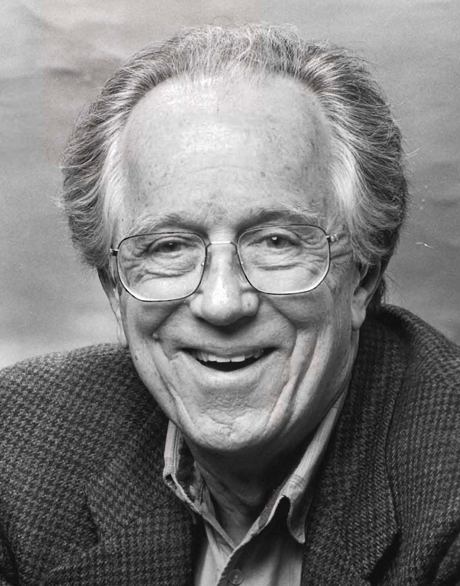
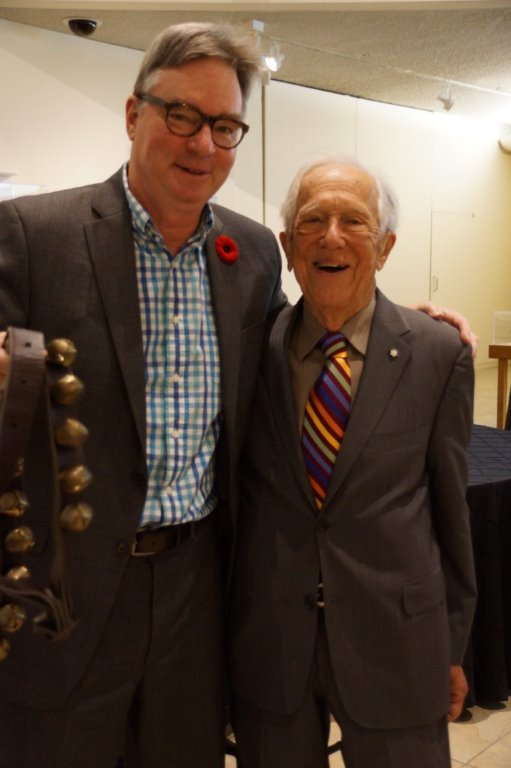
February 23, 2017 — The University of Toronto Opera Division honoured composer John Beckwith with an evening of music from four of his operas — The Shivaree, Night Blooming Cereus, Crazy to Kill, and Taptoo! — all with librettos by James Reaney. The concert was held at the Arts and Letters Club of Toronto.
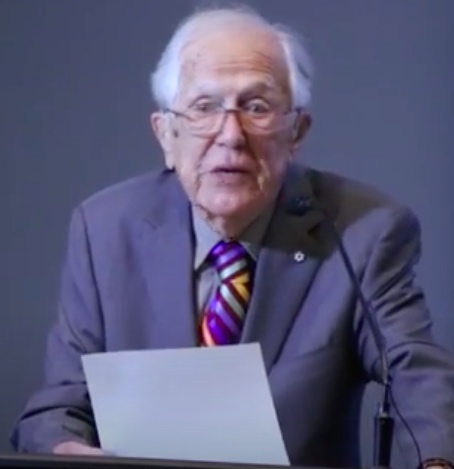
On March 8, the University of Toronto Faculty of Music held a 90th birthday celebration for former dean John Beckwith, and he presented a lecture on Canadian music since 1967. Congratulations on your 90th, John!
More concerts featuring John Beckwith’s music are planned:
On March 23, his Fractions for microtonal piano and string quartet (2006) will be performed at Schulich Hall, McGill University.
On April 28, New Music Concerts in Toronto will present a program he is curating, featuring his Avowals (1985) and the premières of two mixed instrumentation chamber works: Quintet (2015) and Calling (2016).
( ( ( o ) ) ) Archived recordings of John Beckwith’s music, including several Beckwith-Reaney works, are available for streaming on the Composer Showcase at the Canadian Music Centre.
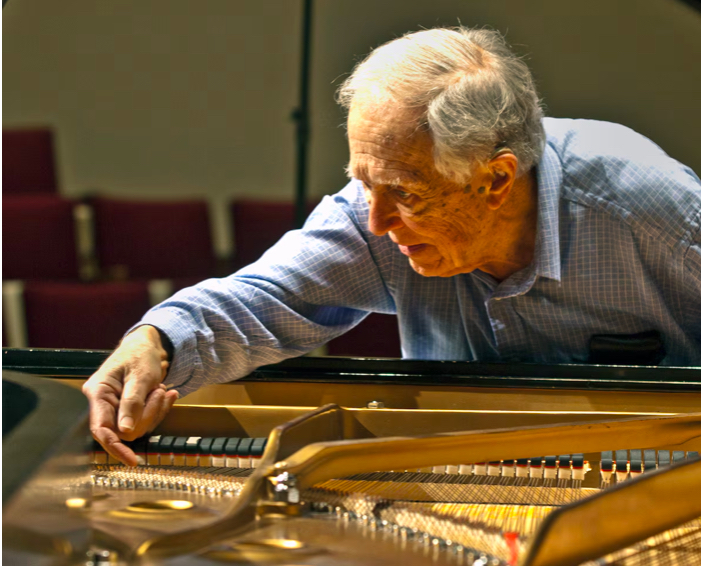
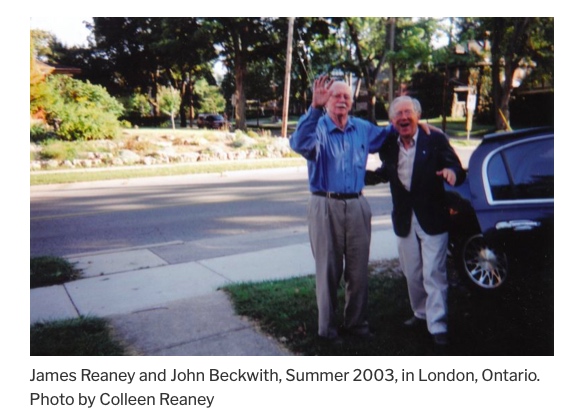
John Beckwith in rehearsal at Walter Hall in Toronto in 2010 (courtesy wikipedia)
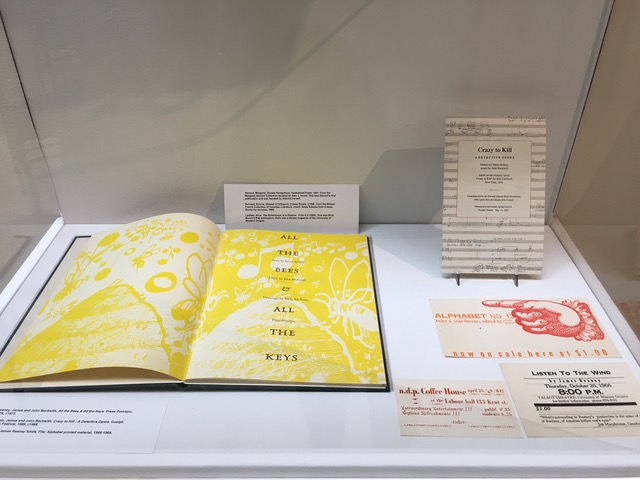
November 5, 2016 — Western Archives display of James Reaney’s writing prepared by archivist Amanda Jamieson. (Photo courtesy Elizabeth Reaney)
We hope to see you all again next year when author and curator Tom Smart will give a talk on James Reaney’s visual art.
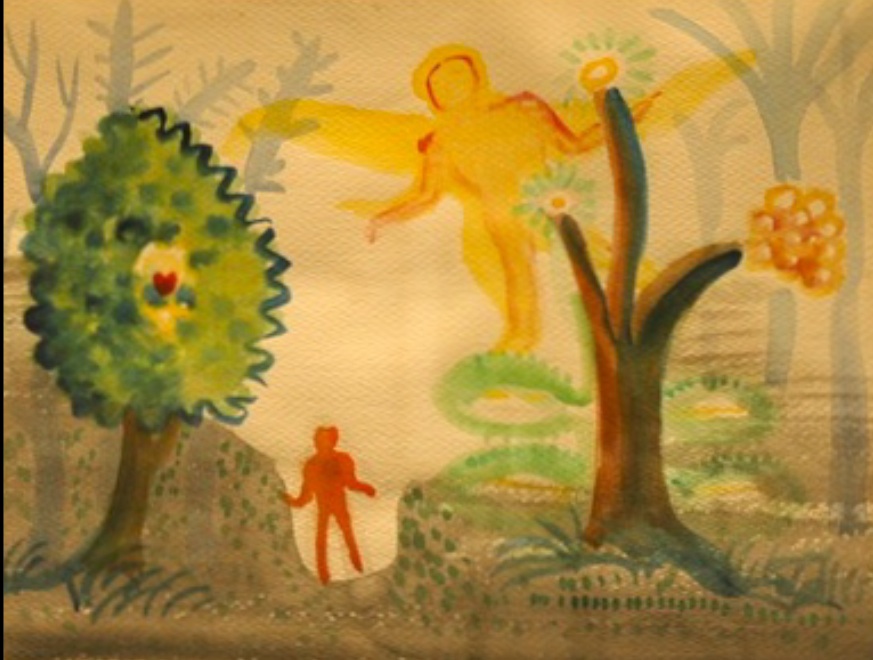
James Reaney’s watercolour painting “David Willson Meets an Angel in the Forest”, 1962 (Photo courtesy Linda Morita, McMichael Canadian Art Collection)
John Beckwith and James Reaney became friends during their student days at the University of Toronto in 1946, and a shared love of music drew them to collaborate on several operas, plays, and musical collages. Four operas Night Blooming Cereus(1959), The Shivaree (1982), Crazy to Kill (1988), and Taptoo! (1994) are among the most notable.
Archived recordings of several Beckwith-Reaney works are available for streaming at the Canadian Music Centre‘s Composer Showcase.
When: Saturday November 5 at 4:30 pm
Where: Museum London, 421 Ridout Street North, London, Ontario
Admission is free; James Stewart Reaney, James Reaney’s son, will introduce the speaker.
Our thanks to Wordsfest and the London Public Library for their support of this event. The annual lecture series celebrates the life and work of Southwestern Ontario poet James Reaney, who was born on a farm near Stratford, Ontario.
From John Beckwith’s 1997 book, Music Papers: Articles and Talks by a Canadian Composer (page 219): Page from James Reaney’s draft of the libretto for Night Blooming Cereus, with notes on the central character, Mrs. Brown (Faculty of Music Library, University of Toronto).
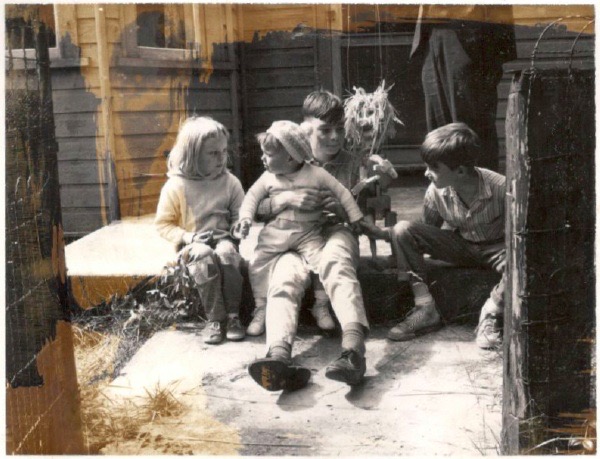
August 23-29, 1965 in Leith, Ontario — Family friend Leith Peterson shares this Polaroid photo taken by her mother, Jay Peterson (1920-1976), who invited James Reaney and family up to her cottage at Leith to create the marionettes for James Reaney’s children’s play Apple Butter.
Here are the Reaney children (James, John, and Susan) and Jay’s niece Elizabeth Tinker with new-made marionette Apple Butter, soon to make his stage debut at the Western Fair in London (September 3-12, 1965).
August 1965 in Leith, Ontario: From left to right: Susan Reaney (age 6), James Stewart Reaney (age 12 1/2) holding Elizabeth Tinker (age 16 months), and John Andrew Reaney (age 11). James Reaney (age 38) holds Apple Butter. (Photo by Jay Peterson courtesy Leith Peterson.)
James Reaney and family in 1965 in Leith, Ontario. Standing left to right are the adults: Colleen Reaney, Wilma McCaig (Jamie’s sister), and James Reaney. The children are John Andrew Reaney, James Stewart Reaney, and Susan Reaney (beside Applebutter). Photo by Jay Peterson.
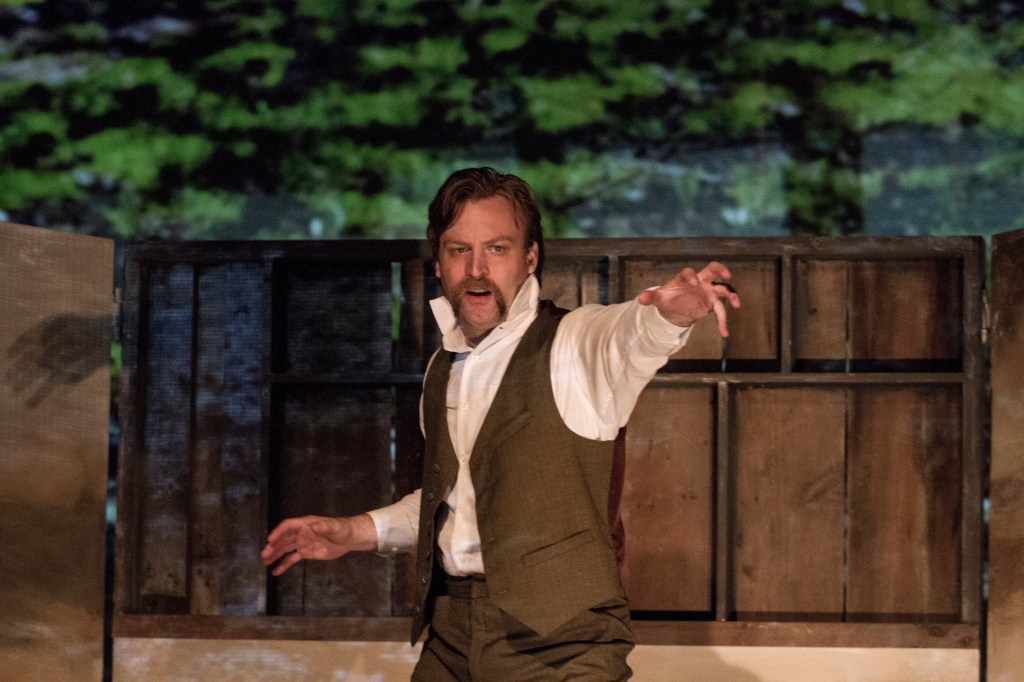
Gil Garratt as Robert Donnelly in “The Last Donnelly Standing” at the Blyth Festival August 4 to September 2, 2016 (Photo by Terry Manzo courtesy The Blyth Festival.)
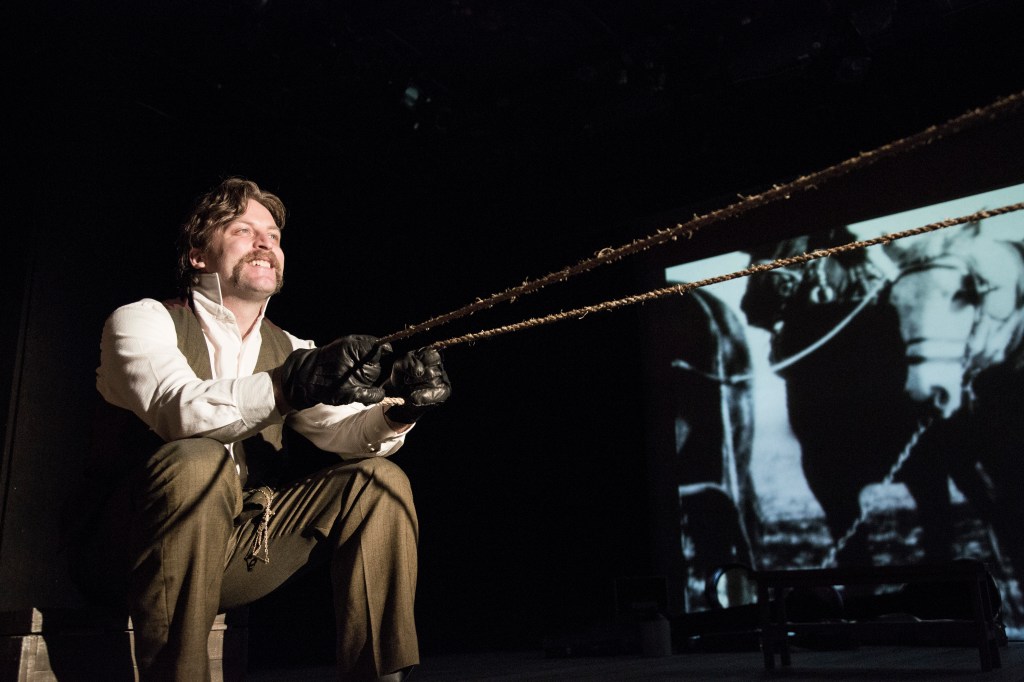
Co-creator Gil Garratt stars as Robert Donnelly in this one-man show, a fitting sequel to Paul Thompson’s epic Outdoor Donnellys, presented at the Blyth Festival in 2001, 2002, and 2004.
Gil Garratt as Robert Donnelly in “The Last Donnelly Standing” (Photo by Terry Manzo courtesy The Blyth Festival.)
In The Donnelly Documents: An Ontario Vendetta, James Reaney notes that “what follows here is an account of the events that culminated in the killing of the ‘somewhat notorious Donnelly family’ [4 February 1880] and what happened to the survivors, William and Robert Donnelly, up to their departure from Lucan in 1883. Indeed, subsequent events merit another volume: their arrival in their new home in Glencoe; the fact that the Donnelly brothers retained their father’s farm in Biddulph; that in 1905, Robert came back to live in Lucan, along with his nephew, James Michael, son of the ill-fated Michael Donnelly…” (See The Donnelly Documents: An Ontario Vendetta, page xv.)
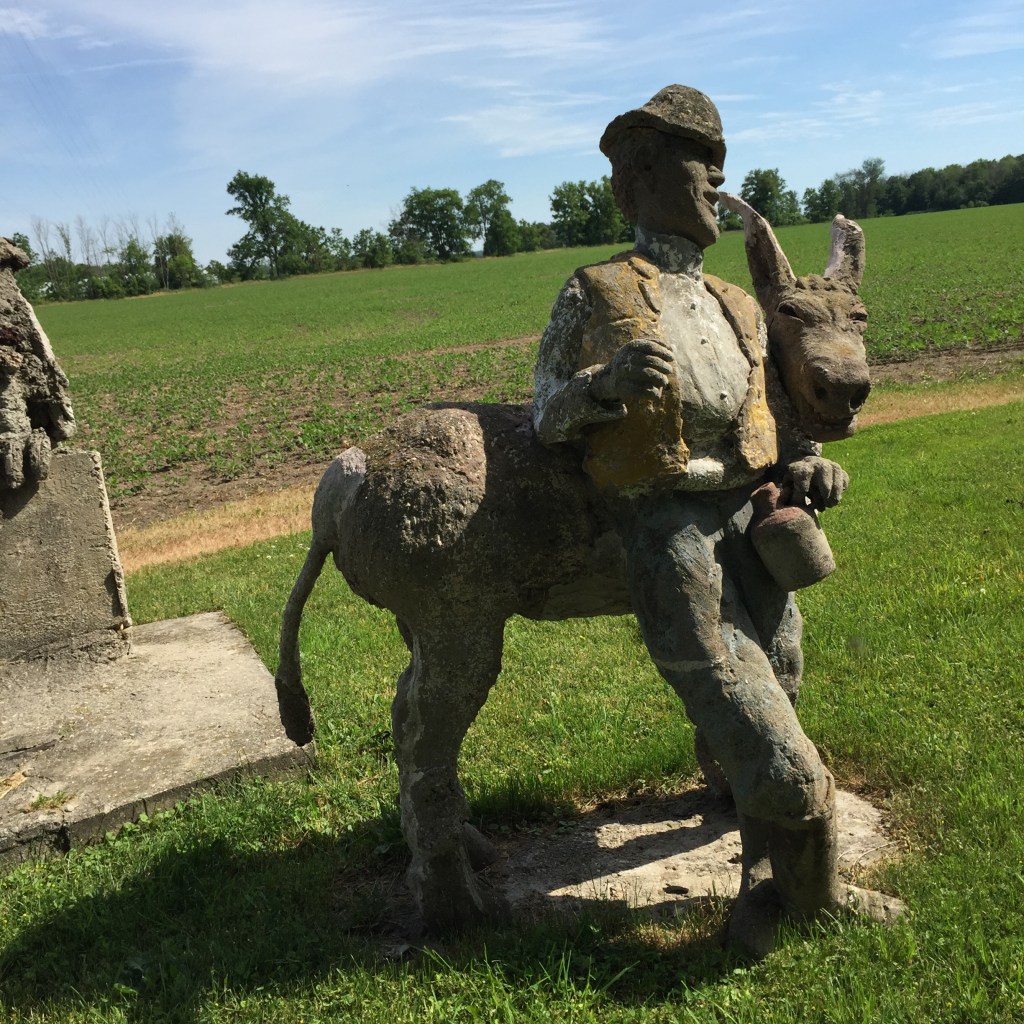
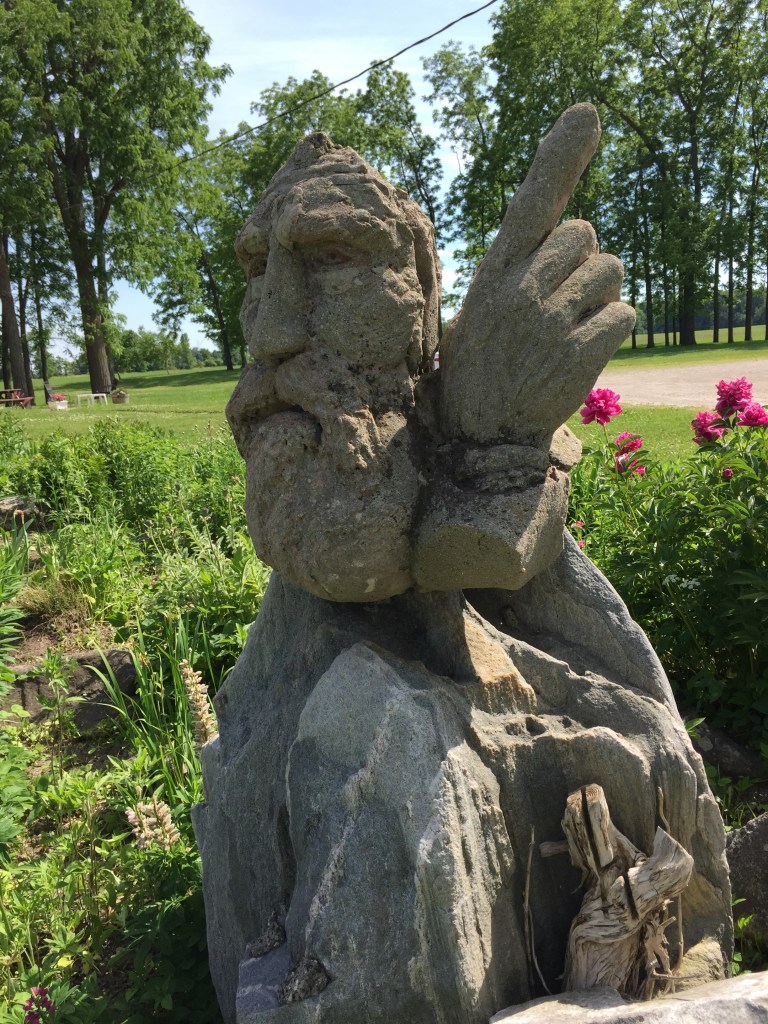
June 2016 near Goderich, Ontario, Cement sculptures by George Laithwaite (1871-1956). (Photos courtesy JS Reaney.)
In Act II of James Reaney’s play Colours in the Dark, two boys visit the mysterious Mr. Winemeyer, a sculptor hermit. George Laithwaite (1871-1956), a farmer near Goderich, Ontario, created cement sculptures around his farm and is the inspiration for the character Mr. Winemeyer.
Here is an excerpt from Act II, Scenes 3 and 4, where the two boys visit the old hermit, Mr. Winemeyer, and see his sculptures.
[…]
BOY 1: Where’d you get the peacock feather, Mr. Winemeyer?
HERMIT: Had a pet peacock once when I was a boy. A big old sow we had had a peeve about it – and one day caught it in the orchard and devoured it. This – was all that was left of my beautiful bird. Sticking out of that beast’s mouth.
BOY 1: holding the feather And nothing else has happened to you lately?
HERMIT: Well – yes – this happened. I happened to be out in the yard scraping out my frying pan when coming down through the air I saw – a falling star.
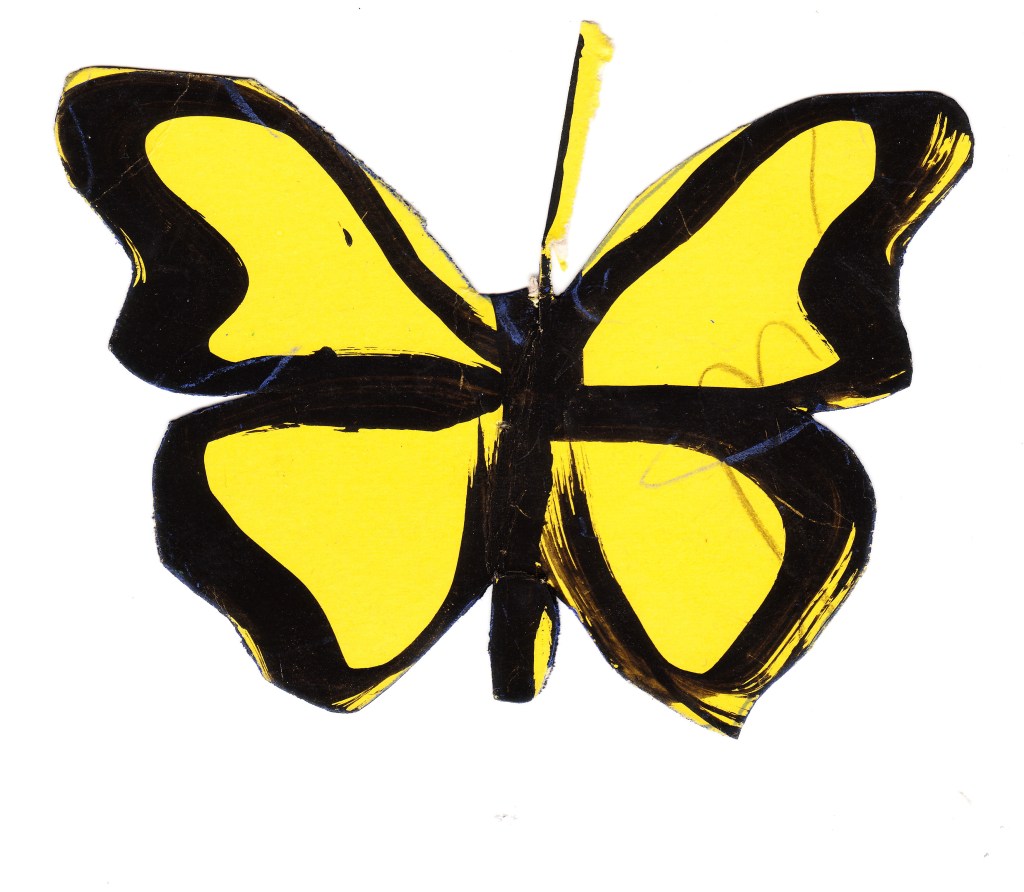
It does. It is yellow.
BOY 2: What are you going to do with this falling star, Mr. Winemeyer?
June 2016 near Goderich, Ontario, “Moses” sculpture by George Laithwaite (1871-1956). (Photos courtesy JS Reaney.)
4. CEMENT SCULPTURES
SCREEN: Actual slides of the Goderich, Ontario, primitive sculptor Laithwaite – his cement figures.
HERMIT: Come out with me to the orchard and see my latest cement sculptures.
On cue, the sculpture slides appear. They could also be mimed by the Company.
Now here’s Sir John A. at the plow!
Here’s Snow White and the Seven Dwarfs. That’s the only film I’ve ever seen and the only one I’ll ever see. You can’t go any higher than that in film art.
BOY 2: Who’s this?
HERMIT: That’s the infant Riel suckled by the buffalo Manitoba.
BOY 1: What’s this one doing, Mr. Winemeyer?
HERMIT: I finished that last April — that’s Mackenzie King cultivating the rows of compromise. Now – here is where I’m using this falling star. Here’s Good – in a terrible combat with his brother Evil – over – this.
He places the star between the statue-actor’s hands. The star has now become a lump of rock.
BOY 2: Could I have a piece of that star?
HERMIT: Why sure. These two projecting knobs will never be missed. Both have a piece.
BOYS: Gee, thank you, Mr. Winemeyer.
We hear music. The Windlady appears with her Rain Doll.
HERMIT: Now there’s a good subject for a piece of sculpture.
BOYS: What, Mr. Winemeyer?
HERMIT: The Wind and the Rain.
He and his statues fade slowly. BOY 1 starts playing the bicycle spokes. BOY 2 goes back and says:
BOY 2: Mr. Winemeyer – was the pig your brother? Were you the peacock?
Mr. Winemeyer shakes his head.
SCREEN: Centre panel shows a large star.
Goderich, Ontario — Sir John A. Macdonald sculpture by George Laithwaite.
♦ For more about James Reaney’s imaginative use of George Laithwaite’s sculptures, see James Stewart Reaney’s article,Concrete sculptures still ‘play’ well.
♦ For a delightful tour of George Laithwaite’s sculptures (summer and winter!), see Harrison Engle’s film “Legacy” (1960?), which features commentary by Laithwaite’s family and J.H. Neill, then Curator of the Huron County Pioneer Museum.
Colours in the Dark by James Reaney is available fromTalonbooks.
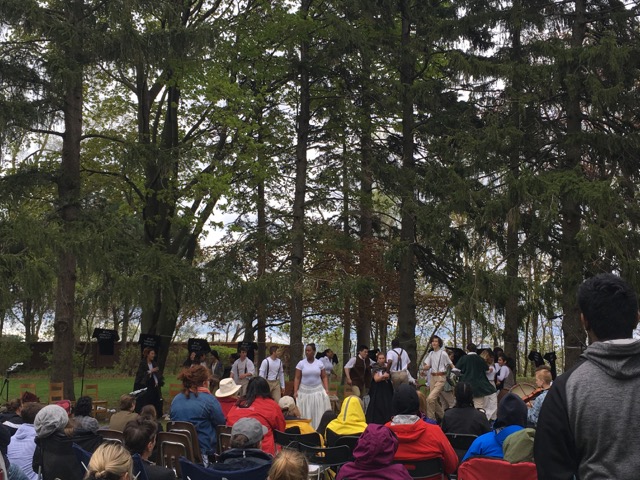
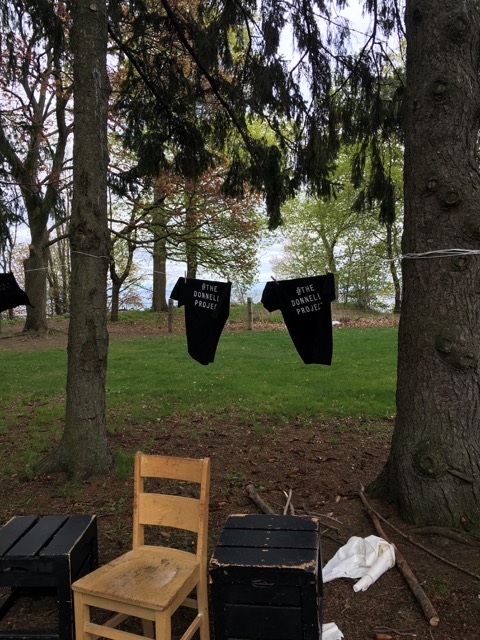
Congratulations to the students of R.H. King and Agincourt Secondary Schools and students from the University of Toronto Scarborough for their wonderful outdoor performance of “The Donnelly Project”, a special adaptation of three scenes from James Reaney’s Sticks and Stones: The Donnellys Part I.
Adapted by Tarragon Theatre’s Playwright-in-ResidenceKat Sandler, “The Donnelly Project” gives drama students from Scarborough the chance to explore an early Tarragon Theatre script. The Tarragon Theatre celebrates its 45th anniversary this year, and James Reaney’s Sticks and Stones: The Donnellys Part I was first performed there on November 24, 1973.
For more about the event, see Tarragon Theatre’s “East of Tarragon” education program and Scarborough Project Inaugural Year 2016 #thedonnellyproject.
Photos courtesy Elizabeth Reaney, Saturday May 14 at the Scarborough Arts Park, 1859 Kingston Road, Scarborough, Ontario.
This month, Alice resumes her journey across Canada as James Reaney’s adaptation of Lewis Carroll’s Alice Through the Looking-Glass opens at the Edmonton Citadel’s Shoctor Theatre on February 27 to March 20.
Christine Brubaker continues as the director of this Alice revival, and Ellie Heath plays Alice. The show was a hit at the 2014 Stratford Festival and has now toured across Canada in Ottawa, Charlottetown, and Winnipeg.
To purchase tickets, call 1-888-425-1820 (780-425-1820) or order online here.
Alice Through the Looking-Glass director Jillian Keiley with actors playing Alice across Canada: Gwendolyn Collins (Winnipeg), Ellie Heath (Edmonton), Trish Lindström (Stratford Festival) and, seated, Natasha Greenblatt (Ottawa and Charlottetown). Photographed in the Palm Room of Spadina House, Toronto, June 2015.
James Reaney’s adaptation of Lewis Carroll’s Alice Through the Looking-Glass opens at the Manitoba Theatre Centre at the John Hirsch Mainstage this month on November 25 to December 19.
Alice Through the Looking-Glass at the Manitoba Theatre Centre, November 25 to December 19, 2015
Christine Brubaker is the director of the Manitoba Theatre Centre’s production. After Winnipeg, Alice’s next stop is the Citadel Theatre in Edmonton, February 27 to March 20, 2016.
To purchase tickets, call 1-877-446-4500 (204-942-6537) or order online here.
♦Not to be missed! Special “Monday Mix”pre-show chat on December 7
♦ “Talkback”post-show Q&A on December 1, 8, 15, and 16
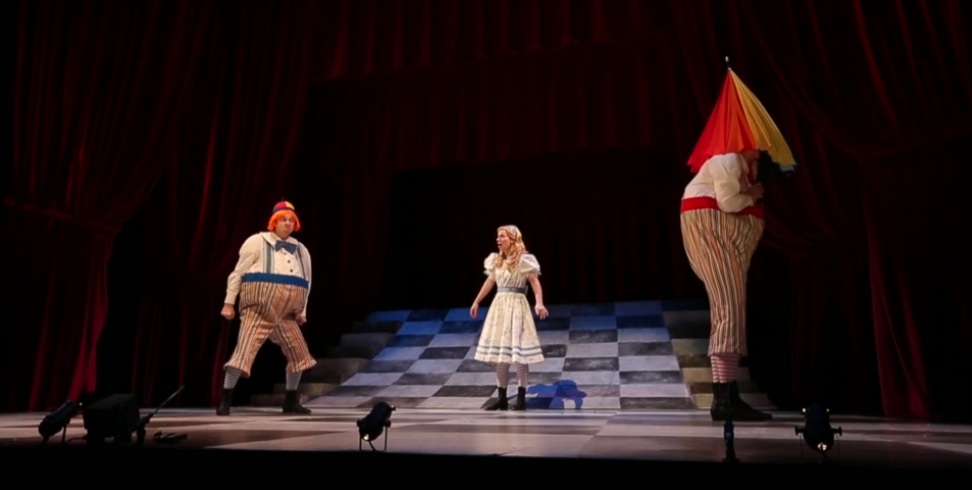
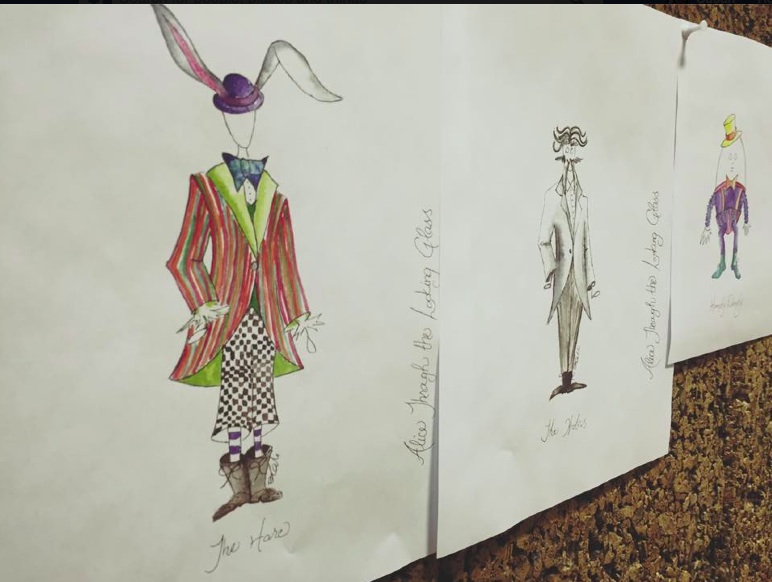
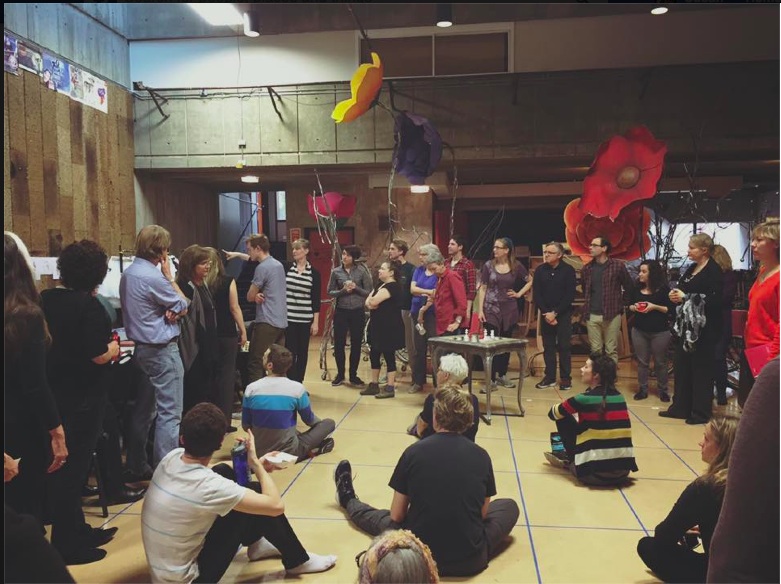
Gwendolyn Collins as Alice, Tristan Carlucci as Tweedledum, and Aaron Pridham as Tweedledee in Alice Through the Looking-Glass. (Photo courtesy Royal Manitoba Theatre Centre)Sunday September 26, 2015 in Winnipeg: Special guests play chess with Alice (Gwendolyn Collins) down at The Forks (Culture Days 2015).Alice Through the Looking-Glass costume designs by Bretta Gerecke, courtesy Royal Manitoba Theatre Centre.November 3, 2015: The cast of Alice Through the Looking-Glass, courtesy Royal Manitoba Theatre Centre.
Thank you all for coming to the Stratford Public Library on Sunday October 18 to hear Thomas Gerry speak on “Theatrical Features of James Reaney’s Emblem Poems”. Professor Gerry focused in particular on the metaphor of perspective in James Reaney’s “Egypt” emblem poem.
“When we were taught [as children] to draw railway tracks as meeting at a point, our world views shrank and were subjected to artificial limits. This analysis of perspective explains for readers of Reaney’s emblems a good deal about the emblems’ style. They require their readers to ‘make a visionary correction’, and to see the world, in Blake‘s word, as ‘infinite’. — Thomas Gerry in The Emblems of James Reaney, page 73.
“Egypt” by James Reaney. First published in Poetry (Chicago) 115.3, December 1969.
Professor Gerry explained the tradition of the emblem poem in literature and its use of allegorical meaning to rouse the faculties. He also compared the pyramid structure from “Egypt” to the “family tree pyramid” poem that appears in James Reaney’s play Colours in the Dark:
It takes
Two parents
Four Grandparents
Eight Great grandparents
Sixteen Great great grandparents
Thirty-two Great great great grandparents
Sixty-four Great great great great grandparents
One hundred and twenty-eight Great great great great great grandparents
Two hundred and fifty-six Great great great great great great grandparents
Five hundred and twelve Great great great great great great great grandparents
One thousand and twenty-four Great great great great great great great great grandparents
He then led us in performing the poem and explained how “the pyramid shape recurs as an emblematic feature of the play” (The Emblems of James Reaney, page 84).
October 18, 2015, Stratford Public Library Auditorium
Thank you, Thomas Gerry, for your spirited lecture, and thank you also to the staff of the Stratford Public Library — Sally Hengeveld, Julia Merritt, Krista Robinson, and Robyn Godfrey — for your support of this event.
October 18, 2015 — Susan Reaney, Susan Wallace, Thomas Gerry, and James Stewart Reaney (Photo by Elizabeth Reaney)
Next year’s speaker will beJohn Beckwith, composer, who collaborated with James Reaney on many musical works. The annual lecture is a project developed by The Stratford Public Library and Poetry Stratford, and features a talk by a person who is knowledgeable about the life and work of Stratford poet and playwright James Reaney and of writing in the Southwestern Ontario region, which is such a strong element in Reaney’s writing.
Here are photographs from our happy afternoon near Stratford, courtesy Elizabeth Reaney: