Skip to content
  • About
    • Awards
  • Publications
    • Books in print
  • Contact

James Reaney

  • James Reaney’s “The Baby”

    April 22nd, 2014

    The Baby

    Small babe, tell me
    As you sat in your mother’s cave
    What did you build there,
    Little baby mine?

    Sir, I made the tooth
    I invented the eye
    I played out hair on a comb-harp
    I thought up the sigh.

    I pounded the darkness to
    Guts, Heart and Head:
    America, Eurasia and Africa
    I out of chaos led.

    I fought the goblins
    For the heart;
    ‘Twas a jewel they desired,
    But I held it.

    I fought off the rats
    From the guts.
    They nibbled but I
    Smashed the mutts.

    I choked the bat so intent
    For the diamond of my mind;
    I caught him in the ogre’s cellar
    The tub of blood behind.

    And the darkness gave me
    Two boneless wands or swords:
    I knew not their meaning then
    Whether traps or rewards.

    One was the vorpal phallus
    Filled with jostling army,
    Henhouse and palace
    Street crowds and history.

    Two was the magic tongue
    Stuffed with names and numbers,
    The string of song,
    The waker from fallen slumbers.

    My mother opened her grave,
    I sprang out a giant
    Into another cave
    Where I was a seed again.

    Hapless and wriggly small
    As in my father’s groin:
    My Shakespeare’s tongue a wawl
    And impotent my loin.

    The sun-egg I must reach
    Was steeples far away,
    The world that I must name
    Was shapeless, sneaky gray.

    Is it wonder then I rage
    An old man one hour old,
    A bridegroom come to a bride
    Careless, unready and cold.

    My wedding cake’s still in the field;
    My bride is ninety and maggoty;
    My groomsmen glaring hangmen;
    My bridal bed bouldery.

    Small babe, tell me
    As you sit in your mother’s cave
    What did you build there,
    Little baby mine?

    James Reaney, 1959

    “The Baby” is part of a sequence of poems from James Reaney’s play One-man Masque, first performed by the author on April 5-6, 1960 at the Hart House Theatre in Toronto. You can also find the poem in The Essential James Reaney (2009), available from The Porcupine’s Quill.

    Listen to Jeff Culbert read “The Baby” here:

    One-man Masque https://www.youtube.com/watch?v=LqCtrEC8ZF4

    Jeff Culbert in One-Man Masque, Grand Theatre McManus Studio, London, Ontario, 2002

    One-man Masque (1960) is available in Two Plays by James Reaney, along with Gentle Rain Food Co-op (1997), published by Ergo Books in 2003.
  • James Reaney’s The Chough

    April 2nd, 2014

    The Chough

    The chough, said a dictionary,
    Is a relation of the raven
    And a relative of the crow.
    It’s nearly extinct,
    But lingers yet
    In the forests about Oporto.
    So read I as a little child
    And saw a young Chough in its nest,
    Its very yellow beak already tasting
    The delicious eyes
    Of missionaries and dead soldiers;
    Its wicked mind already thinking
    Of how it would line its frowsy nest
    With the gold fillings of dead men’s teeth.
    When I grew older I learned
    That the chough, the raven and the crow
    That rise like a key signature of black sharps
    In the staves and music of a scarlet sunset
    Are not to be feared so much
    As that carrion bird, within the brain,
    Whose name is Devouring Years,
    Who gobbles up and rends
    All odds and ends
    Of memory, good thoughts and recollections
    That one has stored up between one’s ears
    And whose feet come out round either eye.

    James Reaney, 1949

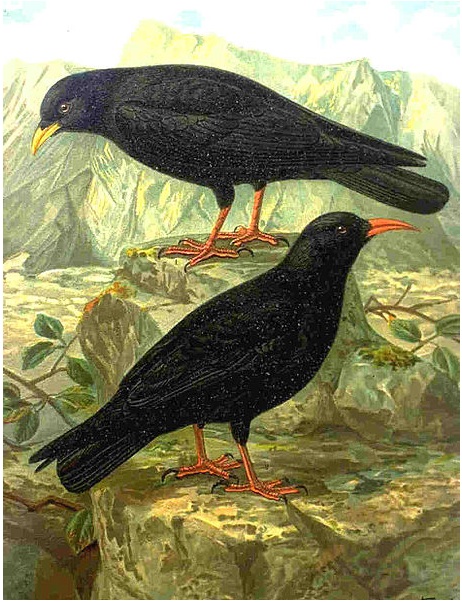
    The Yellow-billed or Alpine Chough and the Red-billed Chough of the Corvidae family. Illustration by Johann Friedrich Naumann (1780–1857) courtesy Wikipedia.

    “The Chough” is from James Reaney’s first book of poems The Red Heart (1949), and it also appears in The Essential James Reaney (2009), available from The Porcupine’s Quill.

  • Alice Through the Looking-Glass at Stratford Festival May 31 to October 12

    January 19th, 2014

    This spring the Stratford Festival will present James Reaney’s adaptation of Lewis Carroll’s Alice Through the Looking-Glass at the Avon Theatre in Stratford, Ontario.

    Alice will be directed by Jillian Keiley, an award-winning director from St. John’s, Newfoundland. Cast members include Trish Lindström as Alice, Cynthia Dale as the Red Queen, Dion Johnstone as the White King, Tom McCamus as the March Hare, and Brian Tree as Humpty Dumpty.

    To purchase tickets, call 1-800-567-1600 or order online here.

    Dion Johnstone, Trish Lindstrom, and Cynthia Dale in Alice Through the Looking-Glass, May 31- October 12, 2014 in Stratford, Ontario.

    Notes on James Reaney’s adaptation

    In 1991, David William, then Artistic Director of the Stratford Festival, commissioned James Reaney to adapt Alice Through the Looking-Glass for the stage.  James Reaney recalls the many months writing and rewriting the play and attending workshops:

    “So, as the preparatory workshop with the Young Company started in the fall of 1992, my adaptation had pretty well shaken down into its present shape except that a great deal of my commentary and suggestions were kept as part of the rehearsed reading shown to Richard Monette and David William and invited guests so that I myself actually read my mental landscapes of Looking-glass in fear and trembling since the many rewrites and keeping this and dropping that produced landmines for cues […]

    Mr Monette took to the story as played that night in late October and also to its trajectory away from the Third Stage to the Avon with a cast [that included] Douglas Rain as Humpty and Barbara Bryne as the White Queen, both actors who had in 1967 appeared in my first Stratford play, Colours in the Dark.”

    —From the Foreword to Lewis Carroll’s Alice Through the Looking-Glass: adapted for the stage by James Reaney, pages 12-14, The Porcupine’s Quill, 1994.

    James Reaney’s adaptation of Alice Through the Looking-Glass premiered at the Stratford Festival in 1994 and was revived in 1996. The play is available in Reaney Days in the West Room: Plays of James Reaney, David Ferry, ed., Playwrights Canada Press, 2008.

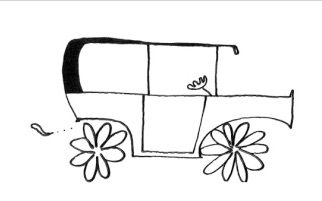
    Illustration by James Reaney, 1994. “I am very proud to have helped with such a delightful show with designers, magician, composer, actors, director, and backstage staff who have seen to it that Carroll’s magic text and verbal wit is made all the more powerful.” James Reaney, Foreword, 1994, page 15.

  • James Reaney’s “Maps” from Souwesto Home

    January 8th, 2014

    Maps

    To go where I first saw maps
    Is almost too simple perhaps.
    Find Pork Street or Hessestrasse
    And come up McKone’s sideroad past Cardwell’s
    Till you hit Elmhurst School
    Where time is reckoned by a Pequenaut clock
    Manufactured in Kitchener, alias Berlin.
    And space is taught by gray green windows
    Unrolled from their special “map” cupboard
    And hung upon the wall with us looking up
    At continents Mercatorized,
    Anything British vermilionized,
    With funny stripes for Palestine
    And Egypt, Iraq, Persia and Danzig,
    Places only half imperialized,
    Or spheres of influence;
    However, just over the map cupboard,
    Was a wall of continuous windows
    That contained my uncle’s fields,
    When school was over
    Basically my way home landscape.
    It was a map too!
    Its scale was an inch to an inch,
    A mile to a mile.
    There was no map to guide me home
    Save this one and a path.
    Teaching itself, white with snow, gray sky,
    Blurred tree sticks, ditch, swamp,
    Forest, meadow, yard, home.
    Inside my school — the whole world
    In a round globe, or flat maps;
    Outside our school — a part of the world
    Too big to be taught.

    James Reaney, 2005

     “Maps” is from Souwesto Home, a collection of James Reaney’s poems from 2005 and published by Brick Books. Listen to Jeff Culbert perform “Maps” here.

    The Elmhurst School mentioned in “Maps” was a one-room schoolhouse where James Reaney attended elementary school from 1933-1939. Elmhurst School was northeast of Stratford, Ontario, and about one mile from the farm where James Reaney grew up. In his autobiography (1992), James Reaney describes his walk to school:

    “To go to school, I left the house by its formal front door, not much used, going by a hall dresser whose combination chest with seat-lid was filled with powerfully sweet-smelling grass seed. The way to public school lay first through the relic of a Victorian dooryard, uncut locust hedge reaching up farther every year, four apple trees shaded by big maples where once, very early (1870) had been a garden. Then, the gables of the house still visible behind me, a field, the edge of a bush [woods] and swamp, Cardwell’s flats — difficult to cross with high water after floods — and a ditch across which my father had sort of established a floating, single log bridge.”

    (This excerpt is from James Crerar Reaney, Contemporary Authors Autobiography Series, Volume 15, page 297, Gale Research Inc., Detroit, 1992.)

    James Reaney off to Elmhurst School in 1936
    The pupils of Elmhurst School with their teacher, Miss Helen Coveney, in 1936. James Reaney (age 10) is in the top row, third from the left.
  • David Ferry’s lecture on Directing Reaney

    December 3rd, 2013

    Thank you all for joining us on October 20 for the Fourth Annual James Reaney Memorial Lecture to hear David Ferry’s talk on “Directing Reaney: From Black Feet to Main Street.”

    Forty years ago on October 20, 1973, David Ferry began rehearsals for the Tarragon Theatre’s production of James Reaney’s Sticks and Stones: The Donnellys Part I. Earlier that summer, director Keith Turnbull and James Reaney workshopped the play in Halifax with actors David Ferry, Patricia Ludwick, and Jerry Franken, along with other actors from the Neptune Theatre.

    David spoke about his experiences both acting in and directing the Donnelly trilogy, including The St. Nicholas Hotel and Handcuffs. Questions from the audience included what attracts actors to the plays, what are the prospects for future professional productions, and whether each play truly stands alone outside of the trilogy.

    David Ferry’s lecture on James Reaney, October 20, 2013 at the Stratford Public Library

    Many thanks to the organizers of the lecture at the Stratford Public Library — Charles Mountford, Anne Marie Heckman, and Sam Coghlan — for your continued support of this event.

    Next year’s speaker will be Tim Inkster, publisher at Porcupine’s Quill. See you then!

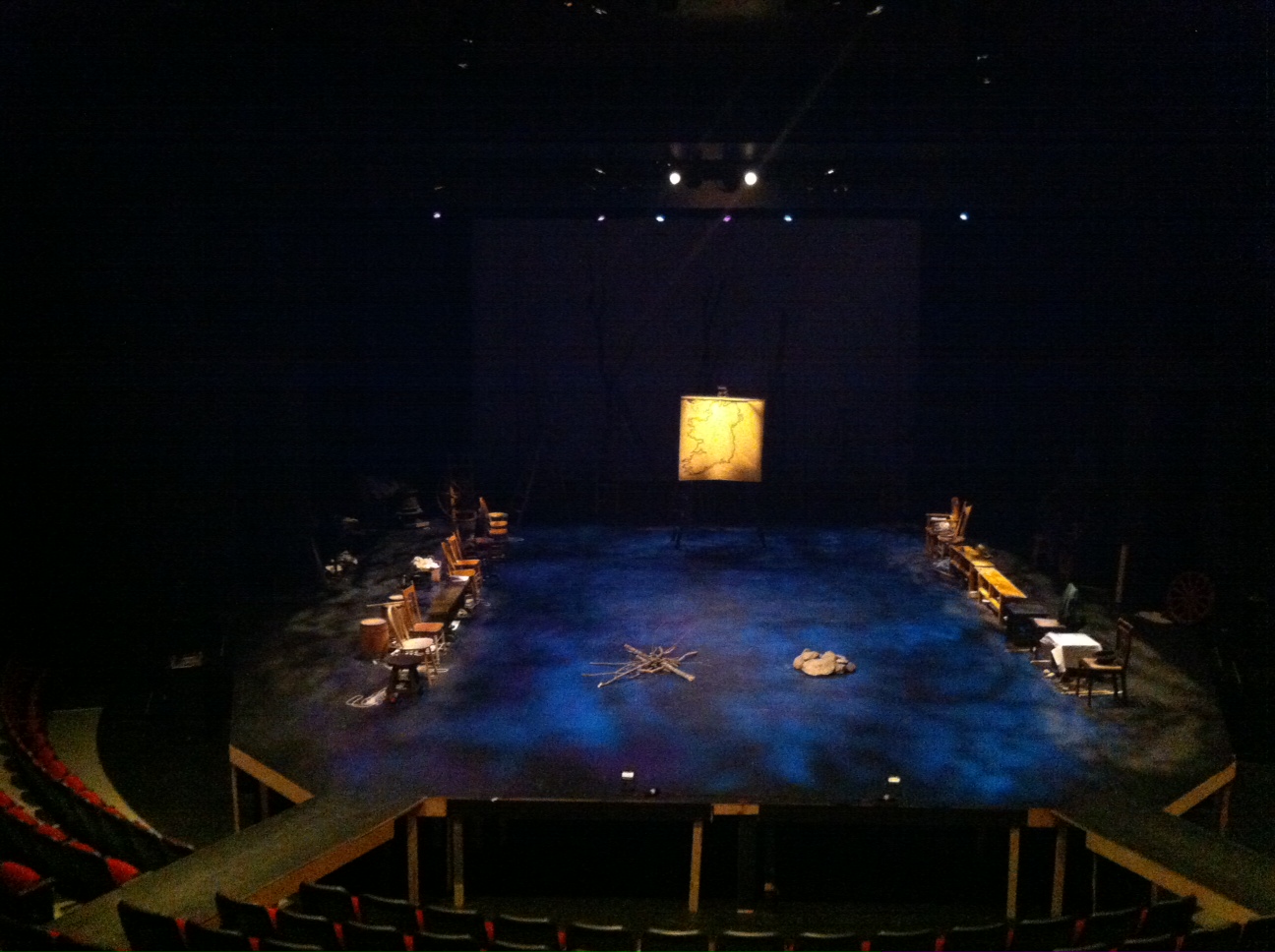
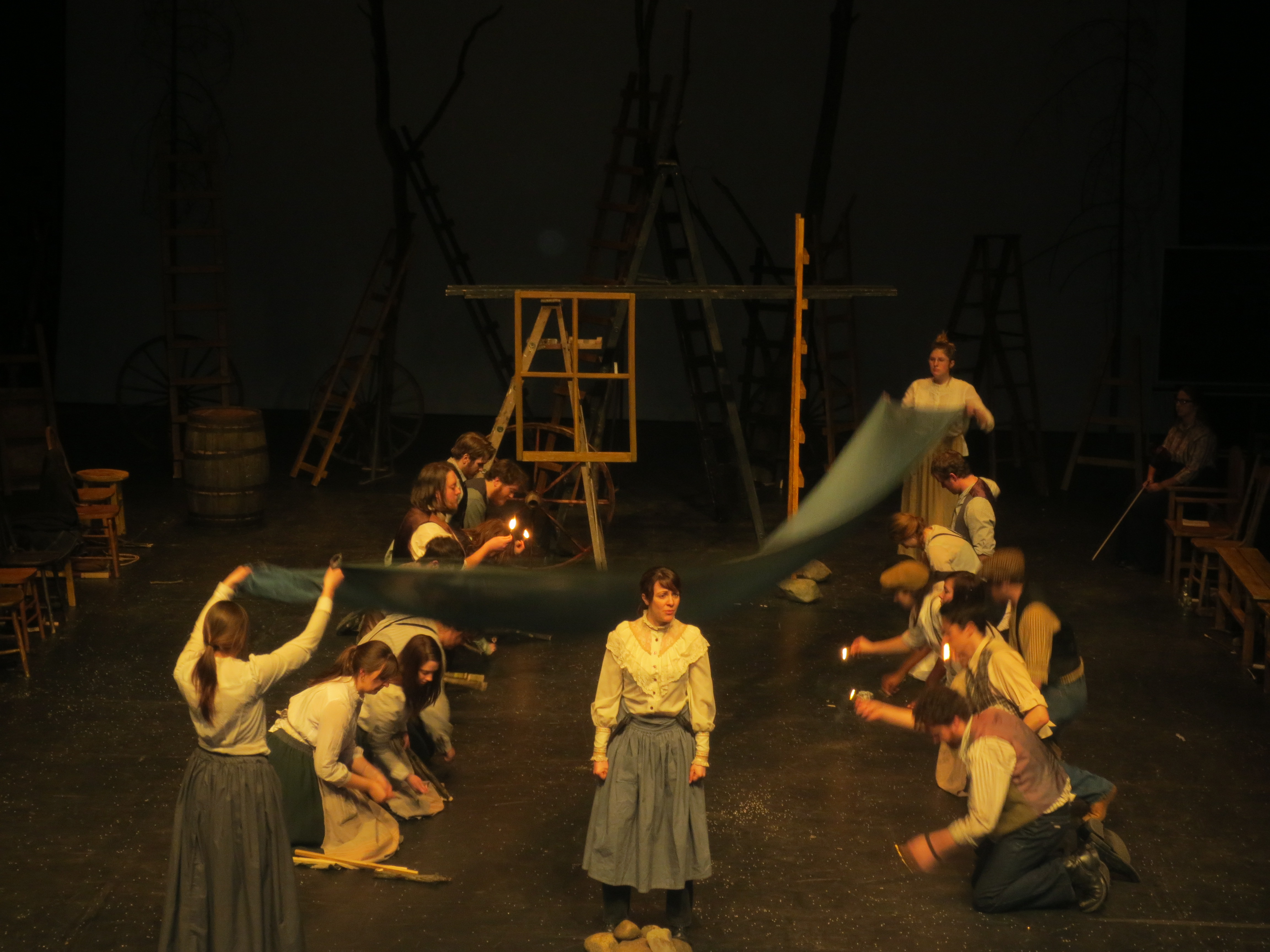
    Here are photos David Ferry shared from his production of Sticks and Stones at Bishop’s University in March 2013.

    March 2013: Set for Sticks and Stones at Bishop’s University
    March 14, 2013: Sticks and Stones at Bishop’s University
    March 14, 2013: Sticks and Stones at Bishop’s University


  • The Emblems of James Reaney: October 17 at the London Public Library

    October 10th, 2013

    On October 17 at the London Public Library (7:00 pm), Thomas Gerry will speak on his new book The Emblems of James Reaney.

    Former doctoral student of James Reaney’s and now professor of literature at Laurentian University, Thomas Gerry explores the history of the literary emblem, and explains the meanings behind ten of James Reaney’s emblem poems.

    “The Tree” and “The Riddle” are two of Reaney’s emblem poems featured in The Emblems of James Reaney:

    “The Tree” by James Reaney. First published in Poetry (Chicago)
    “The Riddle” by James Reaney. First published in Armadillo 2 1970.

    On the same evening, Tom Smart, author and former executive director of the McMichael Canadian Art Collection, will read from his new book Jack Chambers’ Red and Green. Red and Green is a collection Jack Chambers (1931-1978) made of hundreds of quotations that set out his ideas on art and the nature of reality.

    Both The Emblems of James Reaney and Jack Chambers’ Red and Green are available from The Porcupine’s Quill.


     For more about the book launch, see JBNBlog‘s review.

  • James Reaney Memorial Lecture October 20 in Stratford

    October 2nd, 2013

    Join us on Sunday, October 20 at 2:30 pm at The Stratford Public Library Auditorium in Stratford, Ontario, for a talk by actor and director David Ferry on “Directing Reaney.”

    David Ferry was one of the original cast members of James Reaney’s The Donnellys Part I, Sticks and Stones, which was first performed in 1973 at the Tarragon Theatre in Toronto, Ontario.  He has won Dora Mavor Moore Awards for both his acting and directing, and recently directed James Reaney’s Sticks and Stones at Bishop’s University in March 2013.

    The annual lecture is a project developed by The Stratford Public Library and Poetry Stratford, and features a talk by a person who is knowledgeable about the life and work of Stratford poet and playwright James Reaney and of writing in the Southwestern Ontario region, which is such a strong element in Reaney’s writing.

    The Stratford Public Library is located at

     19 St. Andrew Street,

     Stratford, Ontario

     N5A 1A2.

  • James Reaney’s Department Store Jesus

    September 9th, 2013

    Department Store Jesus

    May I help you? You want a Jesus?
    We have a different style for each of our four
    Floors, for
    Example, in the basement we stock the demonic Jesus
    with the hardware & the mousetraps and the col
    -chicum bulbs & the rat poison.
    Demonic Jesus, yes—
    As portrayed in Martin Scorsese’s film where Christ giggles,
    An efficient young carpenter apprenticed to his dad,
    Helps his father make crosses for the Romans to use.
    As portrayed in a Handmade film bankrolled by one of the Beatles
    He says: “Blessed are the Cheesemakers”
    And his much more attractive rival is a well-endowed male,
    Amiable, but not too interested in changing the world,
    Named Brian.

    Now, let’s take the escalator
    To the First Floor where you may prefer
    Christ as He really was,
    Classified with Kodak film, notions, perfumes,
    Stationery & Men’s Wear.
    This historical Jesus is made up of verifiable only facts,
    Of which there are practically none;
    Do you know there is a serious doubt that he even existed,
    But finding his grave would help.
    They’ve just found that of Caiaphas, the Chief Priest of his time.
    The archeologists are busy.
    Water-walker, speed baker & fisher? Virgin birth?
    We’ve scrubbed him clean of all that midrash rubbish.
    After all, can you cure leprosy, blindness & death
    That easily?
    Meanwhile, a monastery in Turkey has coughed up
    A rather interesting Gnostic scrap with regard to
    A hitherto obscure passage—Mark IX: 51, 52.
    At last our suspicions about his sexuality may be—
    Explained.

    Let us take the Elevator to the Second Floor
    Where the Christ of the creeds & the New Testament
    Is still available
    (Buyers, not many lately)
    Among the patterned china, the records for gramophones,
    The furniture & dining room suites.
    Now this model was born to a Virgin, raised the dead,
    Often corpses not so recently deceased,
    Bent reality with his magic, died,
    Then, like Snow White, came alive again:
    Dared to be a crucified wretch on a cross;
    Somehow destroyed & renewed a large empire,
    Is, no doubt, our only hope for translating us out of here.
    But, you know, we get a lot of returns
    And customers asking for something really true this time,
    Not so exciting & poetic, more real.

    A man who walks on rain
    Is too great a stretch for their brain.
    Others say they are more than happy, but you can tell
    They’re not by the funny look in their eyes,
    And, of course, we provide a booklet, one of many,
    Just in case your difficulty is, say, the Ascension,
    Speaking of which, let us climb these stairs
    Up to the roof of this Department Store.

    On the roof of this Department Store
    Having a cigarette on his break,
    I saw a young floorwalker
    Leaning against the elevator shaft.
    By the sudden flash, I recognized Him,
    Yes, by the moment glimpse
    Of the nailmarks
    On His hands.

    James Reaney, 2005

    “Department Store Jesus” is from Souwesto Home, a collection of James Reaney’s poems from 2005 and published by Brick Books. Listen to Jeff Culbert perform “Department Store Jesus” here.

    James Reaney, 1995
    Photo by Marion Johnson
  • James Reaney’s “Grand Bend” from The Great Lakes Suite

    August 2nd, 2013

    Grand Bend

    It is the rutting season
    At Grand Bend
    And the young men and the women
    Explode in each other’s arms
    While no chaperons attend.
    By this furious activity
    Of the loin
    No children are conceived
    For they have avoided this.
    While the sun
    Sprays everyone with iodine
    And old men sit
    Upon the dirty beach
    With great bellies big
    Not with child
    But with creamed asparagus
    And to somewhat more disgust
    Someone has spilt a bottle of scent.
    Crazily the cheap sweetness
    Leaps through the air
    Making some think of something decaying
    And others of stenographers in the rain
    And another to say giddily,
    “How violent, at Grand Bend this year,
    How violent the violets are!”

    James Reaney, 1949

    “Grand Bend” is from The Great Lakes Suite, a series of poems James Reaney wrote in 1949 in The Red Heart, his first collection of poems.

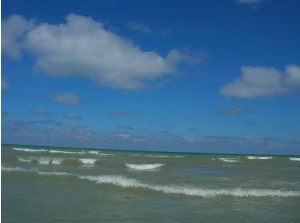
    Lake Huron near Grand Bend, Ontario, July 10, 2013

  • Devil’s Artisan 72: A new home for Alphabet’s Nolan proof press

    June 8th, 2013

    Devil’s Artisan Issue 72, Spring/Summer 2013

    Issue 72 of Devil’s Artisan features Gasperau Press owner Andrew Steeves’ account of his journey in September 2012 from Black River, Nova Scotia to Linotype U, a symposium on the art of linotype printing, in Denmark, Iowa. On the way there and back he visited as many letterpress print shops as he could, including The Porcupine’s Quill in Erin, Ontario.

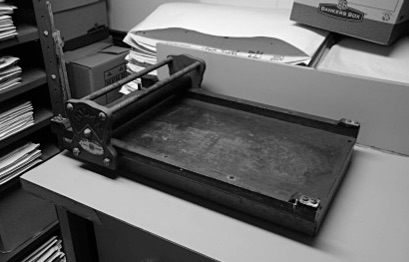
    Tim [Inkster] took me over to the PQL warehouse (located in the basement of the building next door) to show me what he felt should be the first press photographed on my journey. Not his own Heidelberg KORD 64 offset press (the model also used at Coach House Books in Toronto and at Gaspereau Press), but rather a small Nolan proof press that once belonged to the poet James Reaney. Reaney is perhaps best known as the editor of Alphabet, an innovative literary journal he published in London, Ontario, between 1960 and 1971. Early issues of the publication were set and printed by Reaney himself, though it is doubtful that this particular little press was used in the production of the journal for anything besides proofing type. I was glad of Tim’s suggestion, for it would turn out that Nolan proof presses would keep popping up everywhere along my route.

    James Reaney’s Nolan proof press at The Porcupine’s Quill in Erin, Ontario

    Andrew Steeves is the co-owner of Gaspereau Press in Kentville, Nova Scotia. Tim Inkster of The Porcupine’s Quill is the publisher of several titles by  James Reaney, including A Suit of Nettles, The Box Social and Other Stories, and The Essential James Reaney.

    Illustration by James Reaney from Twelve Letters to A Small Town (1962)

←Previous Page
1 … 10 11 12 13 14 … 19
Next Page→
  • James Reaney’s emblem poem “The Farm”

    The Farm ( ( ( 0 ) ) ) For more about James Reaney’s poems and a look back at the family farm where James Reaney grew up, see the 1971 TVOntario documentary “James Reaney” in the Canadian Writers series. The Farm There was a farm divided in two1/2 of it surly brick maker ownedswale…

  • AlvegoRoot Theatre presents two Reaney plays in 2026

    2026 — James Reaney’s centenary year — is off to a good start with two plays based on his work from London’s AlvegoRoot Theatre. On February 20-21, AlvegoRoot presents two encore performances of Sleigh Without Bells: A Donnellys Story —  a short story by James Reaney from The Box Social and Other Stories (1996). Adam Corrigan Holowitz reprises his solo…

  • James Reaney’s Entire Horse

    Entire Horse Poems Written About The Donnellys To AssistThe Renewal of The Town Hall at Exeter, Highway #4 * IAround Borrisokane, in Eire, the roads twistAfter cowherds with willow gads, after wise woman’s spells,After chariots and the widest go-around found in a mare’s skin.But in Biddulph, Canada, in Mount Carmel’s brooder stove, St Peter’s fields,The…

Blog at WordPress.com.


Loading Comments...
 

    • Subscribe Subscribed
      • James Reaney
      • Already have a WordPress.com account? Log in now.
      • James Reaney
      • Subscribe Subscribed
      • Sign up
      • Log in
      • Report this content
      • View site in Reader
      • Manage subscriptions
      • Collapse this bar