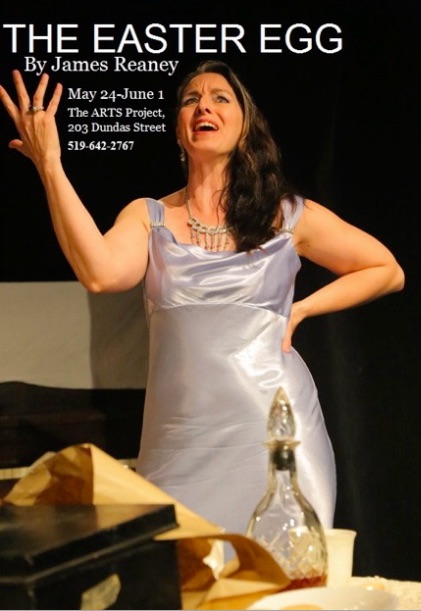
On May 24 to June 1 in London, Ontario, come and see the AlvegoRoot Theatre Company’s presentation of James Reaney’s play The Easter Egg.
The AlvegoRoot Theatre Company presents James Reaney’s The Easter Egg, May 24-June 1
The Easter Egg is directed by Jason Rip, and the performers are Kim Kaitell, Adam Corrigan Holowitz, Maya Wong, Demis Odanga, and Chris McAuley.
Jason Rip is a former student of James Reaney’s and an admirer of his work: “I feel very fortunate to have known Mr. Reaney. My ideas about him and his unique way of looking at the world — alternately whimsical and threatening, dignified yet naughty, with an emphasis on the importance of play — have infused this production. I still remember him hiding behind the curtains in University College Tower, waiting to pounce out and scare students. ‘GOTHIC NOVEL!’ he’d shout before doubling over with giggles. James Reaney is the bard of Souwesto. I will never turn down a chance to direct or appear in his work.”
When:May 24, 25, 29, 30, 31 and June 1 at 8pm; May 25 and June 1 at 2 pm Where:The Arts Project, 203 Dundas Street, London, Ontario
To buy tickets, call519-642-2767;Adults $15, Students and Seniors $10.
Pamela Terry Beckwith (1926-2006) directed James Reaney’s The Killdeer in 1960. He always referred to her as “my first director,” and he dedicated his second play, The Easter Egg, to her. She directed the first production of The Easter Egg for the Alumnae Theatre in November 1962.
Here are James Reaney’s thoughts about The Easter Egg from the Preface to the anthology Masks of Childhood (New Press, 1972, pages v-vi):
Behind Easter Egg literally lies a collection of glass Easter eggs I made from 1945 to 1955, aet. 19 and over. Found my first one in a store on Harbord Street, an old grocery and sundries store out of the 1910 era.[…] In Stratford, Le Souder’s Second Hand Store also kept getting a supply as attics from the eighties and nineties descended to the auctioneer’s gavel. Have never been quite sure of their cultural use; I think they were given to children at Easter. Some of them are as small as hen’s eggs and I have heard of these being used as nest eggs; others are large — a bit larger than a goose egg. Could they have been made at the Hamilton Glass Works? […] Milk glass blown or moulded, painted with flowers, rabbits, chickens (a cherub hatching out of one I didn’t buy), glowing with trapped pearly light — such glass cannot fail to set the story-telling instinct free. So a godmother gives a boy a glass Easter egg; he is drowning in an evil world and the present could float him to a shore. Someone steals the egg and the boy goes under a wave of word-blindness and numbness. Fourteen years later the Easter egg is found again and….
Bethel and her setting were suggested by stories told at an academic party in Kingston; stories about the past on a campus somewhat farther east. Nearby Garden Island supplied the ghost story of a girl tied to a fence for stealing a twig of small fruit. To my astonishment I ran across the basic for the story in the London Times,* 9 October, 1846 (No. 84). I think the heading is ‘Gooseberry Case on Garden Island’ and the owner of the gooseberries had the child brought up in court for stealing one! Confinement beneath a cellar door rather than tying to a fence was the cruelty practised.[…] I know perfectly well that in real life no one marries somebody because she got him to kill a bat; but here, in this story, they do you see.
*[London, Ontario, or London Minor as it was sometimes called.]
Actor and director Jeff Culbert performedOne-man Masqueand directed James Reaney’s 1997 playGentle Rain Food Co-opon November 21-30, 2002 at the Grand Theatre (McManus Studio) in London, Ontario. In the preface to his book,Two Plays, James Reaney shared his enthusiasm for Jeff Culbert: “His superb work as both director and performer moved the audiences at seven performances… to stand-ups, tears, laughter, and exclamations. There were even screams for the last image of One-man Masque when Jeff took a tray of five candles, lit them, and balanced the tray on his head! It was electrifying.”
On April 12-27 in Toronto, The Alumnae Theatre Company will present James Reaney’s play The Killdeer, which was first produced by the Company in January 1960. The Killdeer is part of Alumnae Theatre’s “Countdown to One Hundred,” as Alumnae Theatre moves closer to celebrating its first century.
For director Barbara Larose, the play is “a story of growth and coming of age, with elements of love and innocence, a search for identity, and a courtroom drama that arises from a murder mystery.” Sound designer Rick Jones’s score, inspired by John Beckwith’s original music from the 1960 production, also includes “magical elements” — a gypsy motif for Madam Fay, bird cries, and the storm.
When: April 12-27 at 8 pm, Wednesday to Saturday
Sunday matinee at 2 pm on April 14 & 21 Where:ALUMNAE THEATRE COMPANY, 70 Berkeley Street, Toronto, Ontario M5A 2W6
Tel: 416-364-4170 Tickets: Wednesday: 2 FOR 1 ($20)
Thursday, Friday & Saturday: $20
Sunday Matinee: PWYC
“Killdeer” drawing by James Reaney, 1986
Pamela Terry (1926-2006), who directed The Killdeer in 1960, was a member of the Alumnae Theatre and directed its first production of Waiting For Godot in 1957. She and her husband, composer John Beckwith, were friends of James Reaney’s, and she encouraged him to write The Killdeer and persuaded the Alumnae Theatre to produce it. John Beckwith put together a background score for The Killdeer, and in his book, Unheard Of: Memoirs of a Canadian Composer, he describes how he composed the score: “… following Pamela’s directorial suggestions, I improvised musical cues at the piano, as she and I devised various muting devices after the model of John Cage’s ‘prepared piano’” (see page 256).
Inwhich I Put On My Mother’s Old Thé Dansant Dress
“Yes,” said Janos, “you can put on a costume!”
So I go for a favourite, my mother’s old thé dansant dress
(black georgette and hand-made lace). When I was a child
I looked through snowy windows, seeing her leave
for “Tea For Two.” Leaves whirled, the hem dragged
in the mud when granddaughters sortied out for Hallowe’en;
and then I rescued, laundered, aired, and pressed
(black georgette and hand-made lace). Now it’s a humid Sunday
in the scorching summer of ’88. Jamie retreats to the doorway.
Janos, taking the photos, says, “Nearly done now.”
I think, my whole life-span is in this dress.
And, as I strew these words,
rose petals are falling from the matching hat she made.
The essay is a revised and updated excerpt from D.I. Brown’s MA thesis, ‘A History and Index of Alphabet Magazine’, which he submitted to the Department of English at McMaster University in April 1973.
“… But, like all of Reaney’s work, the idea of Alphabet was never abandoned. It became absorbed into the collective body of his imaginative output, and many of the ideas tried in the magazine became parts of Reaney’s new work.”
(Devil’s Artisan, Issue 71, page 60)
Alphabet Number One, September 1960
James Reaney printing at the Alphabet Press print shop at 430 Talbot Street in London, Ontario (mid-1960s). Credit: London Free Press/Sun Media Corporation.
As part of his research, D.I. Brown conducted taped interviews with James Reaney in the fall of 1971. The full version of Brown’s thesis can be viewed online at: digitalcommons.mcmaster.ca
Actor and director David Ferry is a Guest Artist at Bishop’s University in Sherbrooke, Quebec, and he sends this good news about his work with the students of Bishop′s Drama Department:
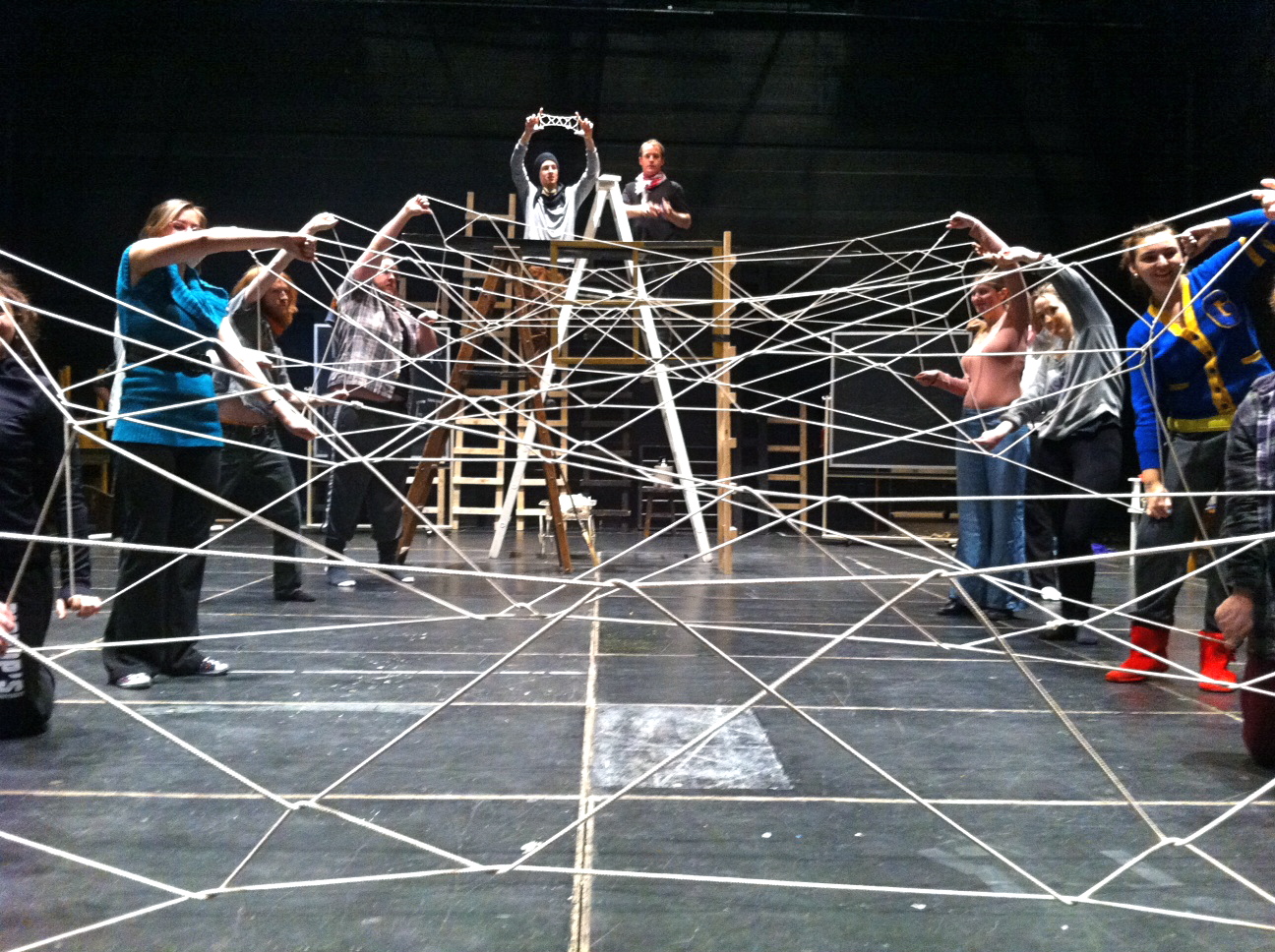
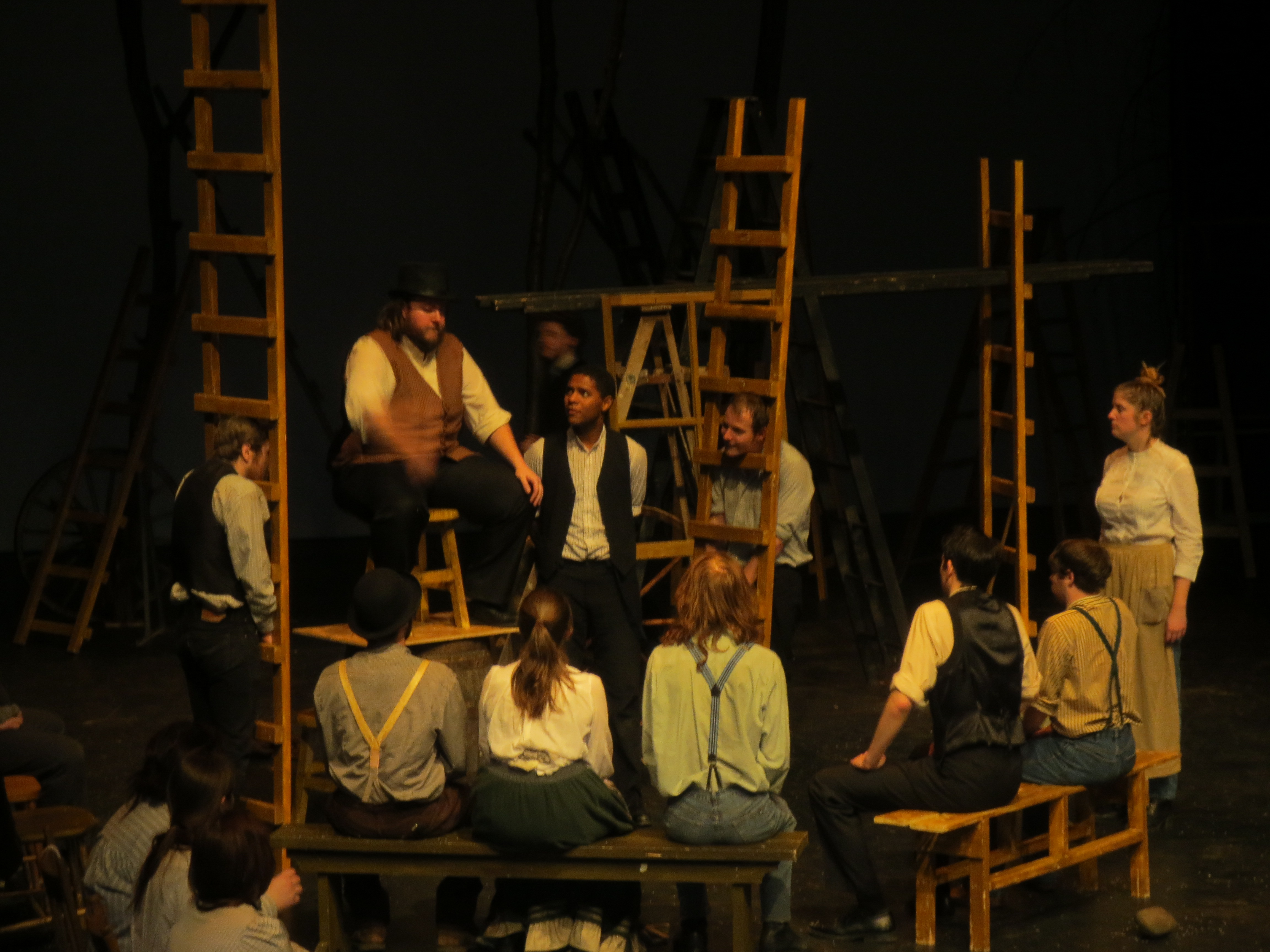
Here′s a photo [from a scene in Act I] for your website — this is the first time we all got the Jacob′s ladders together in rehearsal!
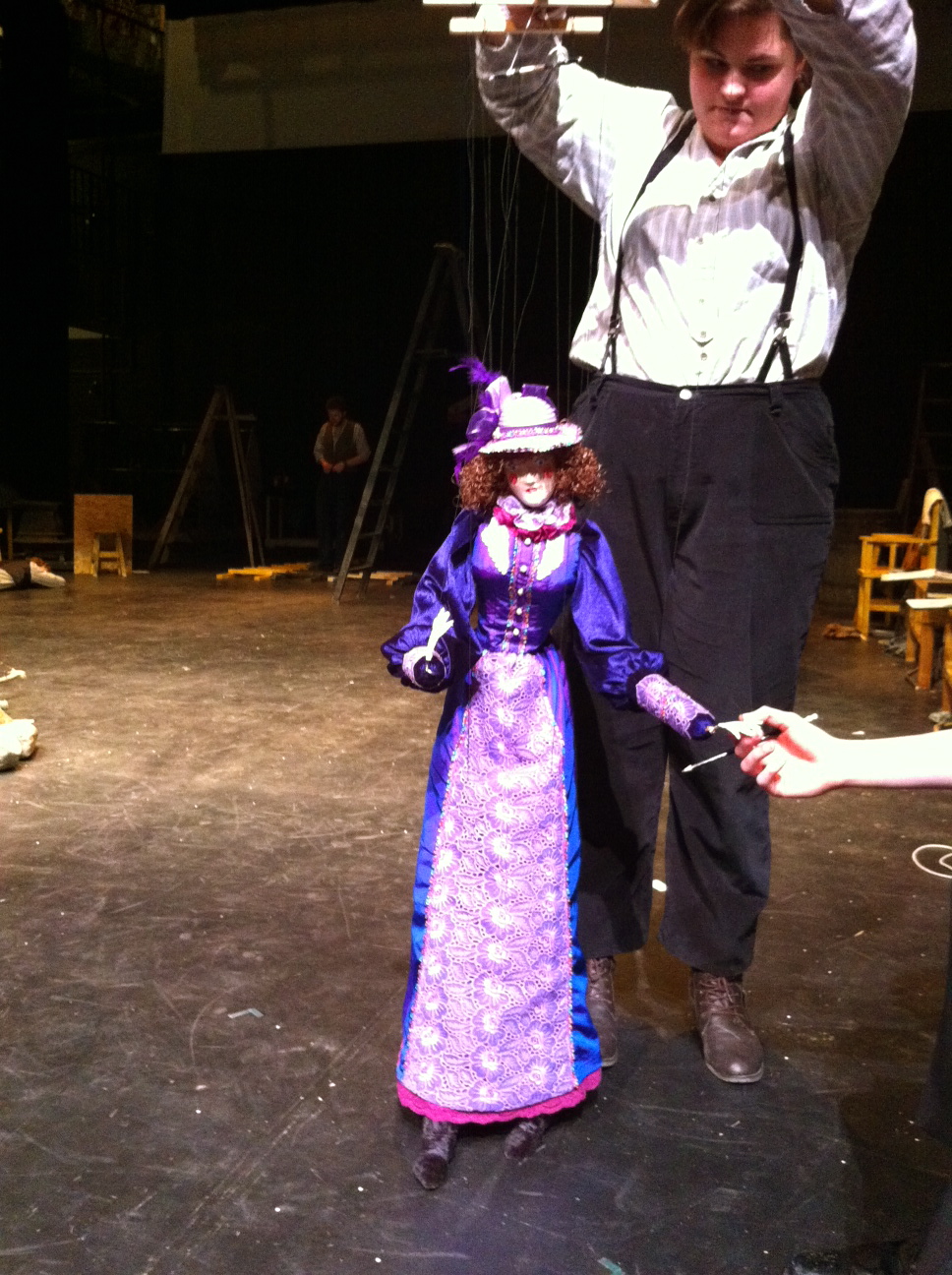
March 2013: Rehearsals for Sticks and Stones at Bishop’s University. From Act II, Marionette for Lady Head: “I’m not just idly curious, Edmund. I wish to see her.”
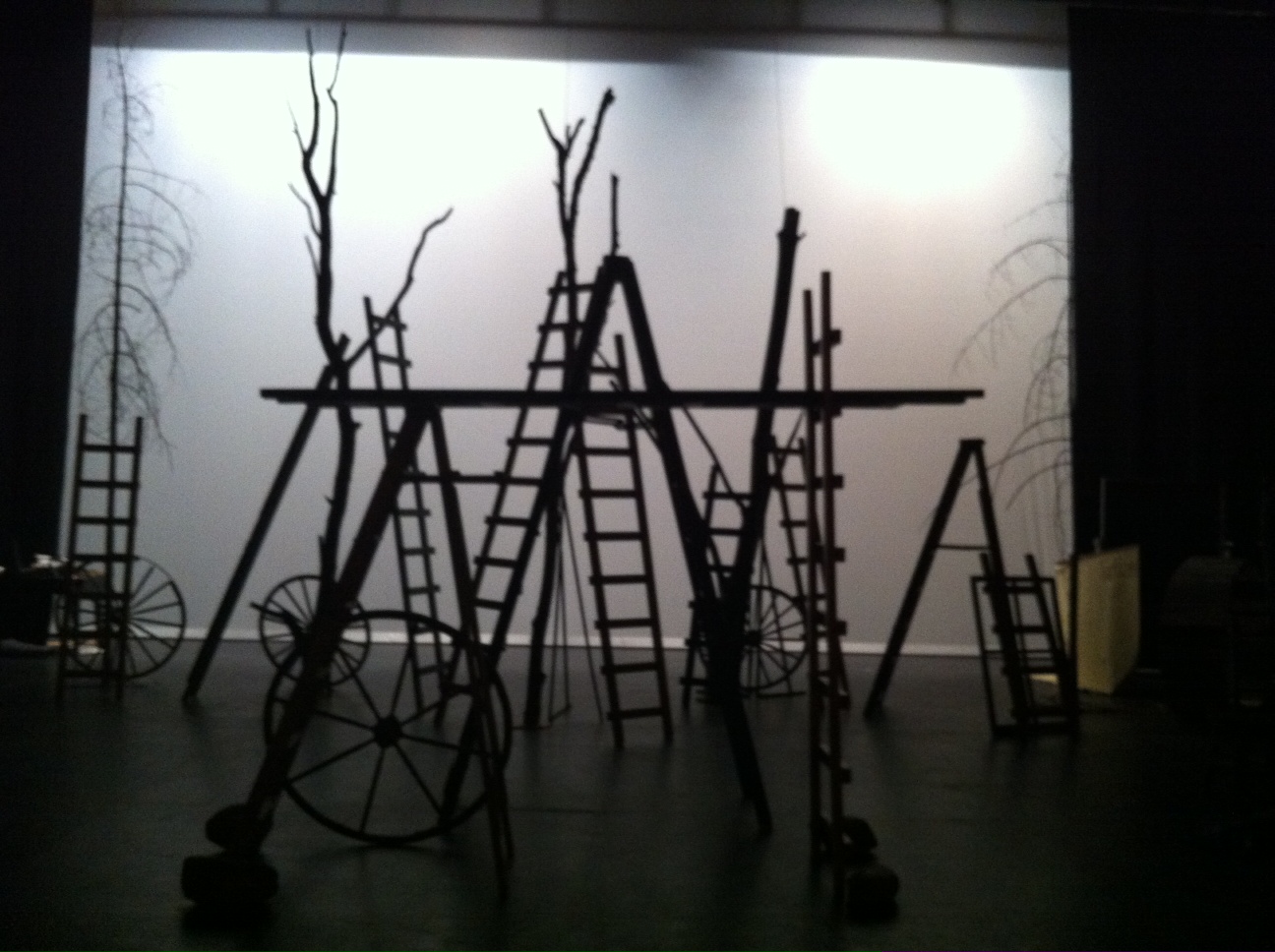
March 2013: Set for Sticks and Stones at Bishop’s University
James Reaney′sSticks and Stones will be presented from March 14-18 at Bishop’s University. Our best wishes to the director, cast, and crew for a successful production!
Update March 17, 2013:David Ferry had this to say about the play’s opening night:
—Well it was a smash opening… gotta say the students so embraced the piece.
And ironically… we lost an actor day before opening, so guess who went on as Pat Farl and Donavan and others?
It was so weird saying those lines, dancing that fight (all off book by the way) in that play 40 years later, which I had also directed.
At the end of the third act dream sequence, after Mrs Donnelly says “Jennie, your father and I will never leave Biddulph.” we freeze frame on that snap shot and then from the gods two dead oak leaves float to the ground…”dead leaf, float light”
It is a special moment.
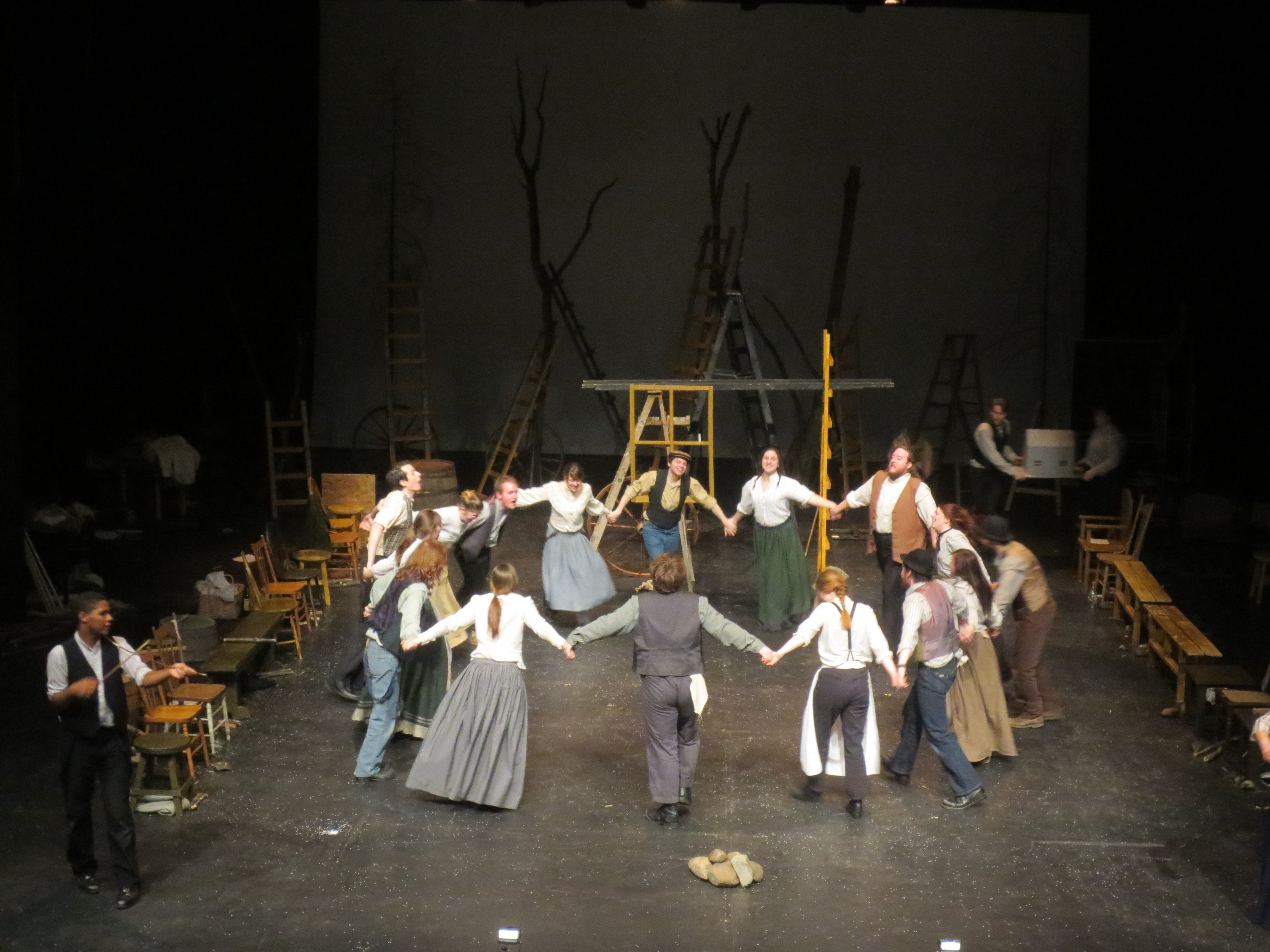
March 14, 2013: Sticks and Stones at Bishop’s University
March 14, 2013: Sticks and Stones at Bishop’s University
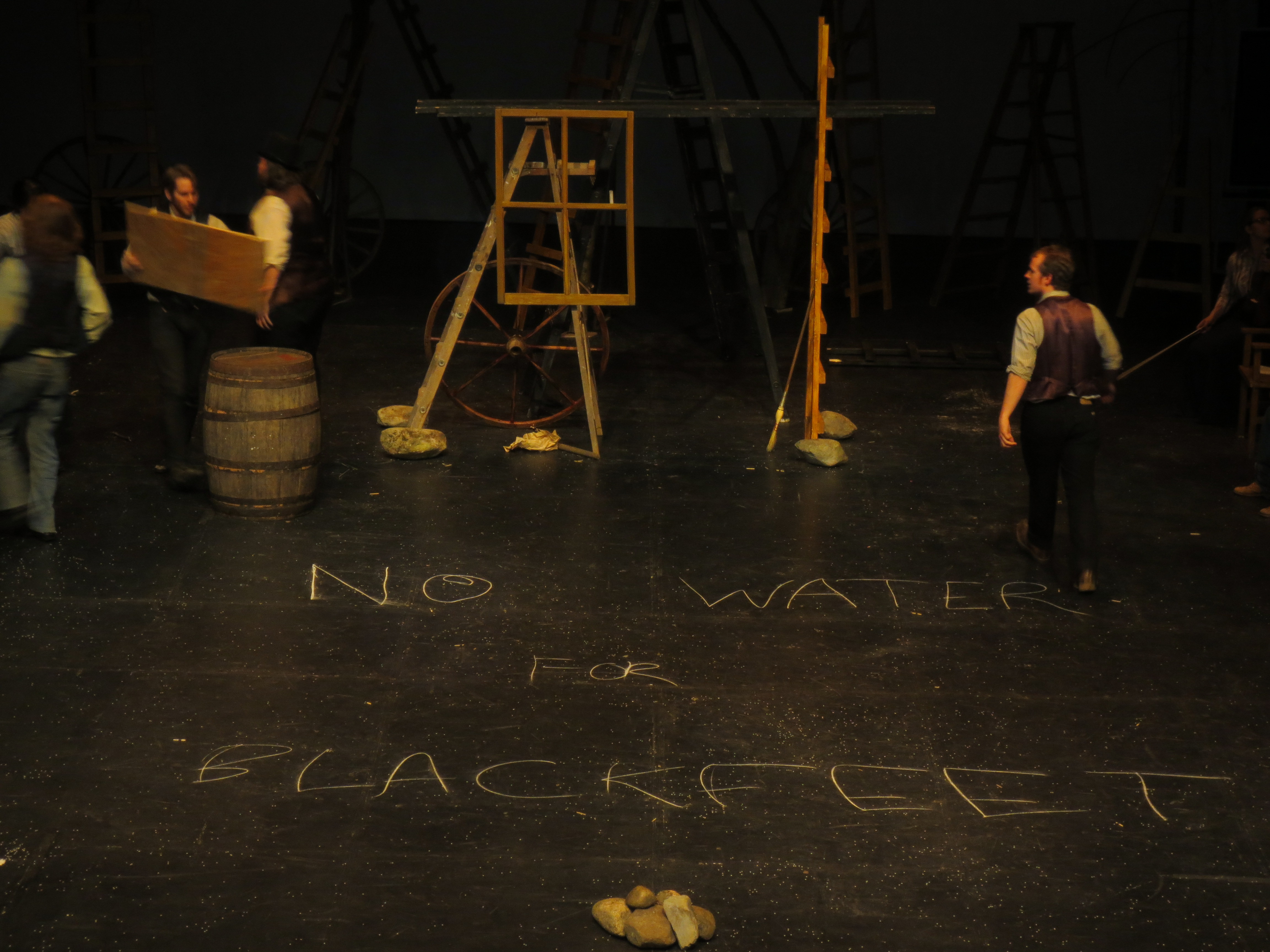
March 14, 2013: Sticks and Stones at Bishop’s University: No water for Blackfeet!
March 14, 2013: Sticks and Stones at Bishop’s University
Here are David Ferry’s program notes from Sticks and Stones:
James Reaney’s famous “Donnelly Trilogy” is arguably the greatest piece of English Canadian dramatic writing to have ever been produced in our professional theatre. Along with Michel Tremblay’s “Les Belles-soeurs” it became one of the few truly breakthrough pieces in our Canadian theatrical his/herstory. Certainly it was the crowning achievement in Reaney’s storied career.
A three time Governor General Award winning writer (winning for both poetry and drama) Reaney was really, like George Ryga, of the post Second World War generation of playwrights that cleared the land for the younger generation of playwrights that followed.
When “Sticks and Stones, The Donnellys, Part One” first opened at Tarragon Theatre in Toronto in 1973, its effect on the theatrical life of the city and country was profound. As the Toronto Star opined, it was “just plain overwhelming.” Its success led to the production of the next two parts of the trilogy the following season at Tarragon, “St. Nicholas Hotel” and “Handcuffs”, and then all three plays toured from sea to sea.
As a young actor in that original “Sticks and Stones” forty years ago, I was in so many ways formed as an artist by that experience, and I still self-identify as a Reaney-ite. Doing the Donnelly plays certainly confirmed me in my nationalism. A close look at the plays will reveal what a breathtaking view Reaney had of his country. He doesn’t merely write about an infamous event in our past… the slaughter of the Donnellys by vigilantes in 1880s South Western Ontario… he writes about the creation of a new world and how the tendrils of the old world wrapped around its ankles and tried to pull, pull it down. Back into the past.
In “Sticks and Stones” Reaney champions a family led by an extraordinary woman (Judith Donnelly) of vision and spirit. The play becomes in no small part a champion of this proto-feminist heroine.
While many of the Donnellys’ neighbours came with them from Ireland to settle in Biddulph County (around the town of Lucan,) few of them had the courage, nobility and determination of the Donnellys to create a new life that turned its back on the sectarian violence and prejudice of the Old Sod. Judith and James Donnelly were determined to start a new life that rejected the rules of the old world.
They chose their friends not by political allegiance or faith but by the strength of that person’s integrity and spirit. They set out to build a farm and a family that could grow without limitations. They taught their children to hold their heads up high. And the children did.
The Donnelly story, in Reaney’s hands, tells us of the evolution of a nation… starting with the agrarian society of those early farmer immigrants from Ireland, moving through the development of early commercialism and industry, to a political culture where the Church and political parties divided and conquered to form a modern Canada.
Reaney’s stage craft in telling HIS story is every bit as startling as his analysis of the evolution of Southwesto society.
As early as 1964 Reaney called for a National theatre that should be created in big wooden-floored rooms across the country; likely Orangemen halls or Masonic temples or Fisherman Union halls on non-meeting nights. He discussed in his 1960s journal “Alphabet” an approach ‘towards a poor theatre’ (before Grotowski) as well as an ’empty space’ and ‘Holy Theatre’ (before Brook). His plays broke through the fourth wall of Naturalism very early on in Canadian theatre, and his plays such as “Listen to the Wind” and ” Colours in the Dark” (Stratford Festival) are the antithesis of the kitchen sink naturalism of David French and others.
His Theatre is one influenced by three ring circuses, Beijing opera, Walt Disney films, puppet plays and children’s tickle trunks and magical make believe.
His stage is filled with the iconography of ladders, wheels, spinning tops, cats cradles, sticks and stones.
It may be challenging for you, the Audience, to make sense of Reaney’s story in a linear way.
It is, perhaps, best to sit back and allow the images and poetry to wash over you and overwhelm you.
Reaney once wrote that the writer’s objective should be to scratch though the bark of “local” in order to arrive at the “universal.”
With “Sticks and Stones” I believe Reaney arrived. In spades.
David Ferry was one of the original cast members of James Reaney’s The Donnellys Part I, Sticks and Stones, which was first performed at the Tarragon Theatre in Toronto, Ontario on November 24, 1973.
Recently David edited a collection of plays by James Reaney for Playwrights Canada Press: Reaney Days in the West Room: Plays of James Reaney. Seven of James Reaney’s plays are in the book, including The Killdeer, Names and Nicknames, Listen to the Wind, The St. Nicholas Hotel, Gyroscope, Alice Through the Looking-Glass, and Zamorna!
Join us March 1-9 at The ARTS Project Theatre, 203 Dundas Street in London, Ontario for the world premiere of Adam Corrigan Holowitz‘s play Colleening, a play celebrating the life of late poet Colleen Thibaudeau (1925-2012).
With original music by Stephen Holowitz and Oliver Whitehead, Colleening is a collage of poetry, personal letters, spoken word and song that lets us discover Colleen through her own words.
The ARTS Project Theatre, 203 Dundas Street
March 1, 2, 6, 7, 8, and 9 at 8 pm March 2 and March 9 at 2 pm
To order tickets, call The Arts Project Box Office at 519-642-2767
Admission is $15; Students and Seniors: $10
Germaine Warkentin, Professor Emeritus of English at the University of Toronto, presented this paper on James Reaney’s A Suit of Nettles on January 7, 2011 at the 126th Annual Conference of the Modern Language Association in Los Angeles, California. It is reproduced here by permission of the author.
Modern Language Association, Los Angeles, January 7, 2011; “Spenser as the Poet’s Poet”
“Out of Spenser and the Common Tongue”:
James Reaney’s “A Suit of Nettles” (1958)
Germaine Warkentin, University of Toronto
James Reaney may be the best poet you never heard of. We all know enough about Milton, Stevens, and Merrill to engage in the conversation of this session, but apart from the Canadians here and a few Americans aware of my interest, I can guarantee that Reaney, who died in 2008, is a name unknown to you. In Canada I would not have to say this. Between 1950 and 1970 Reaney wrote prodigiously outside of the modernist framework then dominating Canadian poetry, and endured being unfashionable – too learned, too mythopoeic, too fixated on his home territory around London and Stratford Ontario. There was no cultural “Arcadianism” like that of the 1580s behind A Suit of Nettles. But Reaney was a playwright as well, busy developing a major career in the Canadian theatre, the masterpiece of which is his encyclopedic trilogy (1974-75) on the Black Donnellys, a legendary 19th century family who were at murderous odds with their Southern Ontario neighbours. It was the achievement of his plays that led more recent audiences back to the poems. I confess an interest – in 1972 I edited Reaney’s poems in a volume that helped turn the tide. Reaney was an amazing man: the most learned Canadian poet before Anne Carson, a civic icon in and around London and Stratford, a deeply responsible member of the professoriate at the University of Western Ontario, and a licensed mischief.
All Reaney’s characteristic features come together in the sequence of twelve poems known as A Suit of Nettles, which won the Governor-General’s Award for Poetry in 1958, and in various editions has remained in print for at least half of the 52 years since its publication; it was recently re-issued. A Suit of Nettles is based on Spenser’s Shepherd’s Calendar, though with a difference: its twelve eclogues, a brilliant display of Reaney’s virtuoso poetic technique, are set in an Ontario farmyard, and the figures who converse in its eclogues – Branwell, Dorcas, Mopsus, Effie and Fanny, Valancy, Scrutumnus – are all barnyard geese. What do they talk about? Love and its frustrations, poetic inspiration and the lack of it, pedagogy, literary criticism (Scrutumnus, not much disguised, is F.R. Leavis), Canadian history, and the turning year, which will bring most of them to the farmyard kitchen and the Christmas oven.
First, that virtuosity, in a brief rain of quotations:
The ending of the invocation to the Muse of Satire:
Here, lady, almost blind with seeing too much,
Here is the land with spires and chimneys prickly …
Has no one seen the country where your cure has cursed?
It is a land with upturned privies with occupants inside them
Crawling out through new tops like astonished moths
Bursting from their unusual, foul cocoons.
The January eclogue introducing the geese:
With the other geese within the goosehouse
There lived, I know not how, various kinds
Of geese: some like a cat, some like a mouse
Some like a groundhog, and some like lions,
And some like two straight parallel lines.
The September eclogue when (hee! hee!) farmhouse boy and girl hastily marry:
By parents strong pegged young Peter and Ann
Were wedded in welter by waspish minister
In the same eclogue, the drunken preacher’s sermon on the Last Supper:
What did those white souls eat while their Lord talked:
I don’t know, indeed I don’t, maybe sandwiches.
And He said haughtily head up to the twelve,
“I’ll ask you assafoetidae1 again I will,
Isn’t there one, one disciple with the spunk to betray me?”
And finally the opening lines of “February,” which I must quote entire to this group, for reasons which will be evident – one of the most beautiful things Reaney ever wrote:
The sun begets, the moon bears, tides away
Rush into coastal caves: “Men do bear not”
(The Courtier) “their children for a day,”
But women longer, for a nine-moon trot;
The young cub forms like a dim loose star-knot
In the lioness as down the sun sets,
Night wobbles in, and spirit goslings sought
To dance this month through the small small eyelets
Of birth before birth, death before death pinned
Resolved & tight in each large goose egg’s centre inned.
Which brings us of course to Spenser.
Reaney wrote A Suit of Nettles at breakneck speed in 1956-57 on sabbatical from the University of Manitoba. Bringing his wife Colleen Thibaudeau (also a fine poet) and two small boys to Toronto, he was desperately trying to take all his courses for the PhD, and write his thesis, and write A Suit of Nettles all in two packed years, and he did it – courses, thesis, and poem sequence.2 The thesis was supervised by Northrop Frye, and was called “The Influence of Spenser on Yeats.” Critics of A Suit of Nettles (including myself) have generally assigned its mythopoeic richness to the influence of Frye, who was just then publishing Anatomy ofCriticism. Certainly Reaney’s writing at that point took a sharp turn away from the narcissistic minor “symbolisme” of his earliest book The Red Heart (1949) towards the encylopedic power of all his later writing. He never ceased to honour Frye, but his own learning (he had begun as a classicist) gave him a very rich instrument on which to play that tune. And at the University of Toronto in the 1940s and 50s he was surrounded by distinguished Spenserians and Miltonists, Frye of course, but also people like ASP Woodhouse and Arthur Barker. Thinking about Spenser was one of the things Toronto did to you in those days.
And thus the thesis, which has much to say about Spenser, though oddly little on TheShepherd’s Calendar. In it Reaney argues that the early Yeats failed to understand Spenser; in the preface to his anthology of Spenser (1906) Yeats depicted Spenser as “torn between … the aestheticism of the Bower of Bliss and the morality of the Seven Deadly Sins.” But as Yeats developed, “he no longer regards [him] … as having an imperfect, divided genius but as a poet who has successfully fused the two worlds of aesthetics and morality into an imaginative synthesis.”3 Like Reaney himself five decades later, in his own poetry Yeats had “exhausted the possibilities of the ornamental and sensuous.” The catalyst for a solution was his friendship with Lady Gregory, who “gave his imagination its moral and practical turn.”4 Yeats’ very Spenserian “The Shepherd and the Goatherd” draws on the interplay between Spenser’s Astrophel and The Doleful Lay of Clorinda for a vision balancing the two opposing states of consciousness, and seeks equilibrium by as Yeats puts it, “measuring out the road that the soul treads / When it has vanished from our natural eyes.”
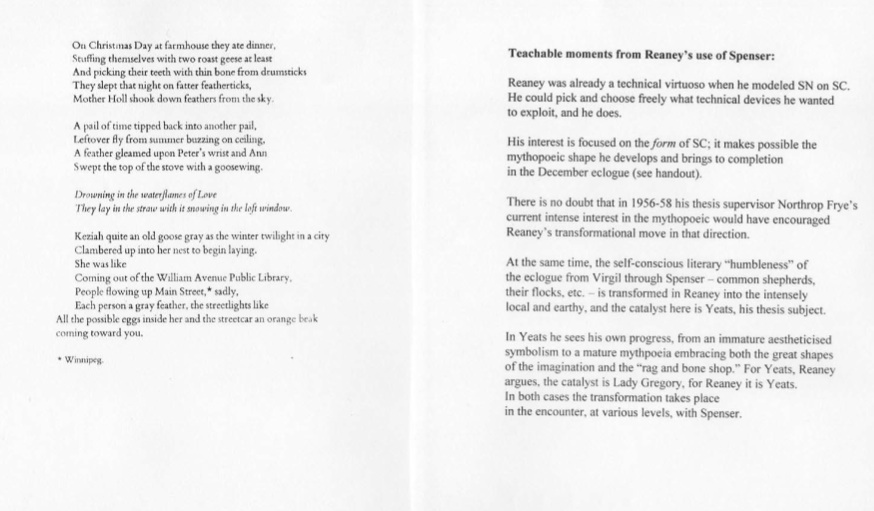
Reaney too seeks this equilibrium, as the fine reflection on mutability in his December eclogue, on your handout, shows. He does so by challenging us to bridge the seeming gap between the Spenserian model of the pastoral eclogue and the Ontario barnyard. He found his bridge in Yeats, who he writes “delighted in grotesque contrasts; the sharper and the more vinegary they are, the better they express his system. One thinks of the very filthy swineherd in ‘A Full Moon in March’ set over against the very haughty Queen. But the comic, filthy swineherd is an extremely sacred person. I think that Yeats must have been attracted by the gaiety of the contrast.”5
Reaney didn’t write a Faerie Queene to succeed his pastoral eclogues. Instead he wrote a major dramatic cycle, the trilogy of Donnelly plays, in which the encyclopedism Spenser empowered in him took a very different form. Once Reaney, using his thinking about Yeats’ relationship with Spenser, had worked out for himself a concept of equilibrium, he was free to employ virtually any genre to give it voice. Yeats gives him access to “the gaiety of the contrast,” and we get the puzzled Ontarians peeping out of their overturned privies. But Spenser gives him the structure, one so solid it could even provide him at the end of “December” with the ourobouros of the yellow-beaked Winnipeg streetcar, signalling the fuller meaning of his exile from the east. By 1960 he was home again in Ontario, himself a “poet’s poet,” energizing for the next forty years an entire poetic and theatrical community.
***
Endnotes
1. Asafoetida: a herb that smells disgusting when raw but is not offensive when cooked.
2. Richard Stingle, to whom A Suit of Nettles is dedicated, confirms that Reaney had said nothing about plans for such a work before he left Winnipeg (R.M. Stingle, personal communication, 8 November 2010). Alvin Lee, the Beowulf scholar who was Reaney’s contemporary in graduate school and later wrote a book about him in the Twayne series, confirms that courses, exams, thesis, and suite of poems were all completed in a manic two years (Alvin Lee, personal communication, 20 November 2010).
3. James Reaney, “The Influence of Spenser on Yeats,” University of Toronto doctoral thesis, defended May 14, 1958; from the author’s abstract.
4. Reaney actually says this with respect to Leicester’s influence on Sidney, as reflected in an image from The Ruins of Time of the unclean fox taking over the noble badger’s den that turns up a number of times in Yeats.
5. Reaney, “The Influence of Spenser on Yeats,” 43.
The following pages were also included in Professor Warkentin’s presentation:
James Reaney (1926-2008); the “December” eclogue, from A Suit of Nettles (1958)
Teachable moments from Reaney’s use of Spenser
Copyright Germaine Warkentin, 2011. Reproduced with permission of the author.
Althouse College students in London, Ontario will present James Reaney’s adaptation of Lewis Carroll’s Alice Through the Looking-Glass at Althouse College at the University of Western Ontario on February 13-16 at 8 pm. Tickets are available from the Grand Theatre Box Office, the Faculty of Education, and Western Connections.
Best wishes to the Althouse 2013 Production Team for a rousing performance — see you there!
Alice Through the Looking-Glass at Althouse College in London, Ontario, February 13-16, 2013
Update February 14, 2013 from Susan Wallace:A wonderful show… excellent dance numbers and some fine physical comedy from the White Knight, quite hilarious. Four different Alices, showing her path to maturity as she travels to Queenhood. For more details, seeJBNBlog: Just Ask Alice Through the Looking-Glass.
Martha Henry, long-time performer and associate of the Stratford Festival, has written to James Stewart Reaney with news of this special event:
I thought you might like to know that the Birmingham Conservatory, which is the training program at the Stratford Festival that I’m in charge of at the moment, is doing a reading on Sunday night, January 27th, of The Killdeer. We do these readings throughout the five months the Conservatory is in situ, from mid-September to mid-February every year. I give the actors the category (Jacobean, German, Restoration, American, etc. etc.) and they do everything else. They read plays of the period, they choose the play they want to do, they cast, rehearse and produce it themselves and then read it in the Lobby of the Festival Theatre at 7:30 in the evening.
Your Dad’s play comes from the (no kidding!) “Canadian Classic” category, which – although the other categories change from year to year – we always end with. I’m thrilled that they’ve picked The Killdeer and Ann Stuart, the Conservatory Coordinator, suggested you might like to know – or even might like to come! We would be thrilled if you could, needless to say. Even if this isn’t convenient, I wanted you to know it was happening. They are as excited as if they’d discovered the play themselves……which, in a fashion, they have!
These readings are open to the public and we have a lot of loyal patrons who are grateful for some winter activity – especially those who have retired to Stratford because of the Festival – and consistently come to see what their young favourites are doing.
Please join us if you can. If that’s not possible, we will think of you on the evening of the 27th.
Martha Henryappeared in the first production of James Reaney’s Names and Nicknames in 1963 at the Manitoba Theatre Centre in Winnipeg, Manitoba, and also the first production of Colours in the Dark at the Stratford Festival in July 1967. Both plays were directed by John Hirsch (1930-1989).
The Killdeer was first performed on January 13, 1960, by the University College Alumnae Society at the Coach House Theatre in Toronto. The Alumnae Theatre will present a new production of The Killdeer, April 12-27, 2013 in Toronto.
January 27, 2013: Update from Susan Wallace:“We’ve just come back from Stratford where we saw the most amazing rehearsed reading of Jamie’s The Killdeer in the lobby of the Festival Theatre.
Ruby Joy, niece of our friend Robin McGrath, was Madam Fay, and she was outstanding. She also co-directed the production. No sets, they just sat on chairs and used lecterns when they stood to read their parts, but what a story they told. It was more alive than any other production I’ve ever seen of the play, and what great jokes, told with perfect timing!
We talked at length to Ruby and the other actors, who are part of the Birmingham Conservatory. Martha Henry was there as the boss lady and she got us arranged into a photo. She was full of praise for her trainees and for Jamie and his play.”
Thank you again, Martha Henry and the performers of the Birmingham Conservatory!
All the best for your work in the future. ♦♥♦
For more about this performance of The Killdeer, see JBNBlog.
#Jamie2026 in Stratford September 1, 2026 – Thank you, dear family and friends, for joining us at the Stratford Perth Museum for Jamie’s (James Reaney’s) 100th birthday. Your tales of Jamie – some from Jamie, some from others – made this a day to remember. Special thanks to Betty Jo Belton, Jerry Prager, Alice and Tim…
Our year-long celebration of James Reaney’s centenary — #Jamie2026 — continues in September. On Tuesday September 1, 1-3 pm, join us for what would have been James Reaney’s 100th birthday at the Stratford Perth Museum. There will be a pop-up exhibit celebrating his life and work and a chance for family and friends to share memories. Tea and coffee will be served, and…
On Tuesday September 1st, come join us for what would have been James Reaney’s 100th birthday in Stratford at the Stratford Perth Museum. James Reaney was known as “Jamie” to friends and family, and we have been calling our year-long celebration of his centenary #Jamie2026. There will be a pop-up exhibit celebrating his life and…