James Reaney’s thoughts on putting on your own version of Lewis Carroll’s Alice Through the Looking-Glass:
Is There Life After Alice? That is, after you’ve seen the show, what do you do when you get home? … Once when I was eight, I had a parallel experience to the one you may have just had, of watching a professional production, authentically acted with exuberance and supported by sophisticated design and fabulous illusions and compelling direction. My theatrical experience wasn’t a play though. In those days, Stratford was not as lucky as it is nowadays, but what it was was my very first circus — Ringling Brothers — an absolutely enthralling show, unforgettably enchanting. The only reaction you could have was to go home and put on your own circus, in this case with my cousins and whatever the farm could muster. Cows as elephants? Of course, you couldn’t rival the production you had just seen, but what you could do was with your own simplicity rival its feeling, and the attempt turned me into an artist. I don’t see this as an improbable effect of the show you have just seen and I hope that the various first steps I have described in paralleling its effects and impacts may lead some of you to a lasting love of theatre and art…
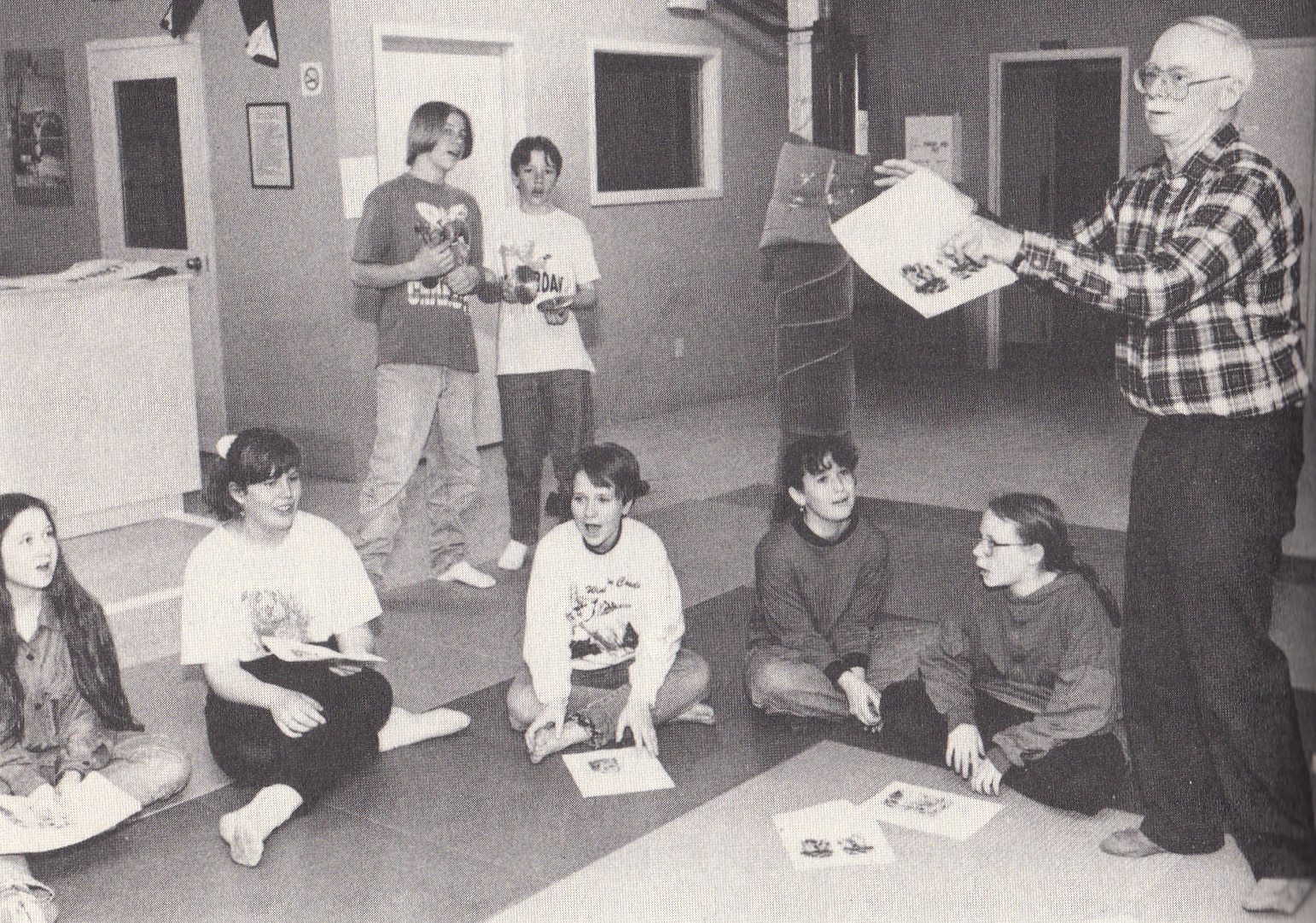
James Reaney leading an Alice workshop at Stratford Central Secondary School (Stratford Collegiate) in 1994. Photo by Scott Wishart, Stratford Beacon Herald.
Jillian Keiley’s new production ofAlice Through the Looking-Glasscontinues this summer at theStratford Festival, May 31 to October 12. To buy tickets, contact the box office at1.800.567.1600 or visit stratfordfestival.ca
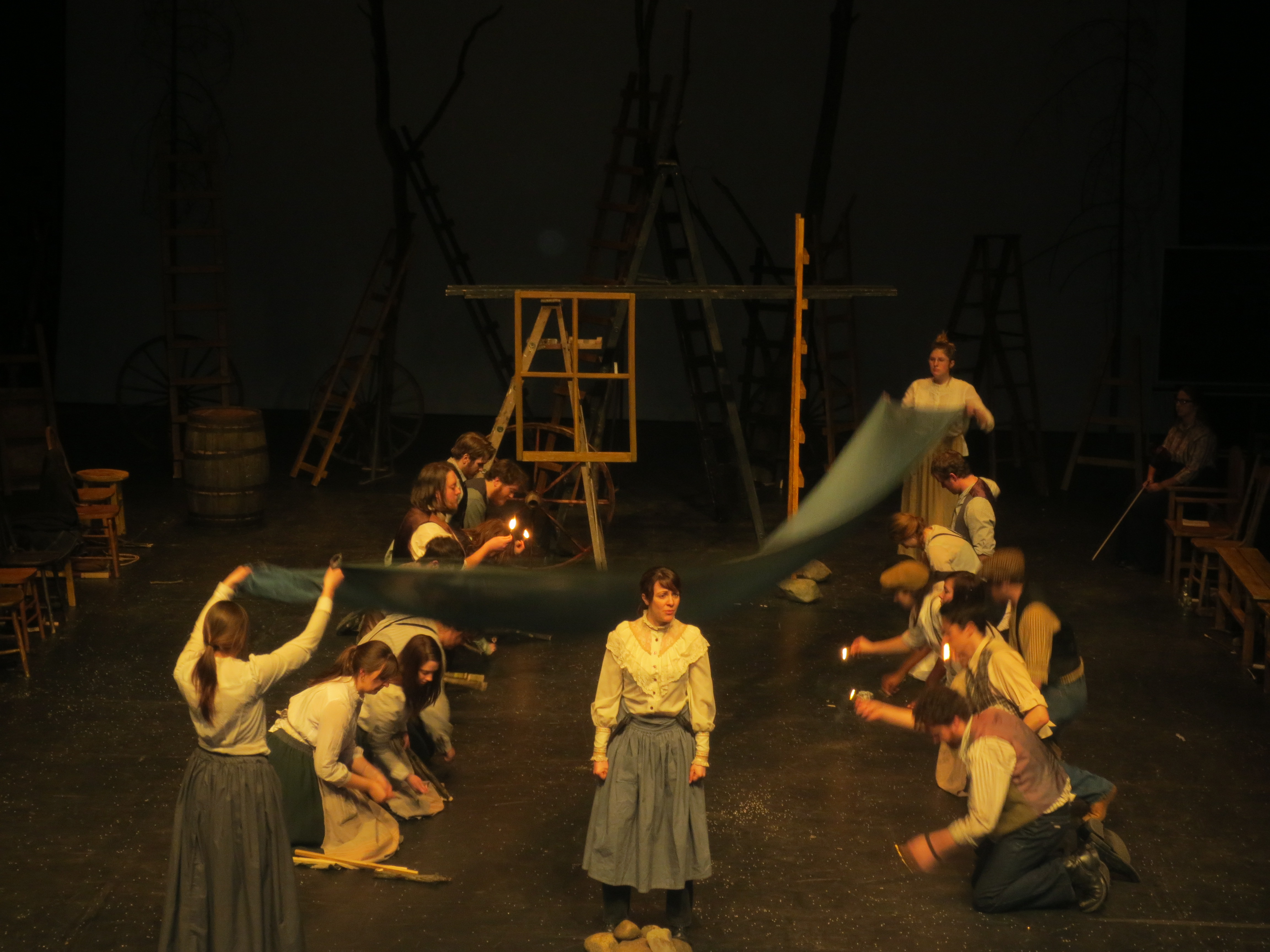
Trish Lindström as Alice in “Alice Through the Looking-Glass”, May 31 to October 12 at the Avon Theatre in Stratford, Ontario.“Alice’s Dinner Party” scene from Alice Through the Looking-Glass, Avon Thetare, Stratford, Ontario 2014. Photo courtesy The Stratford Festival.
To celebrate the new Stratford Festival production of James Reaney’s adaptation of Lewis Carroll’s Alice Through the Looking-Glass, the Porcupine’s Quill is offering a chance to win a free copy of the book!
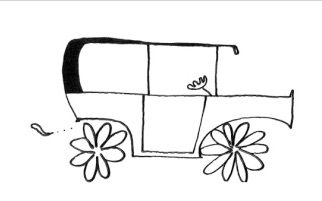
Page 15: Alice rehearsal drawing by James Reaney, 1993.
Jillian Keiley’s new production ofAlice Through the Looking-Glasscontinues this summer at theStratford Festival, May 31 to October 12. To buy tickets, contact the box office at1.800.567.1600 or visit stratfordfestival.ca
Trish Lindström as Alice in “Alice Through the Looking-Glass”, May 31 to October 12 at the Avon Theatre in Stratford, Ontario. (Ruby Joy is the Alice Double.)“Alice’s Dinner Party” scene from Alice Through the Looking-Glass, Avon Thetare, Stratford, Ontario 2014. Photo courtesy The Stratford Festival.
Join us on Monday June 9 at 7 pm at the London Public Library for a lecture by James Stewart Reaney (James Reaney’s son) about the founding of Alpha Centre, an arts space devoted to drama where many of James Reaney’s “Listeners’ Workshops” were held. James Reaney described the new space and the activities there in Issue 13 of Alphabet (June 1967):
“[…] Just out of range — that part of Talbot Street across Dundas where a newly painted green door has appeared leading to newly founded Alpha Centre — in part a fulfullment of the editorial for Alphabet (4) — devoted to drama in Canada. This is “the bare long room” up above a store — it’s an old Legion Hall. Here Listeners’ Theatre Workshop has been meeting with its new kind of play theatre — children and young people pretending to be mirrors chromosomes marionettes, trees, rivers, — the Victoria Boat Disaster. Here Jack Chambers has been working on his Viet Nam film [Hybrid (1966)] transposing images of roses with those of burnt children. Here all of Paradise Lost and all of Blake’s Jerusalem were read at a sitting — experiences that showed me new depths in these poems….” [Alphabet Issue 13, June 1967, Editorial, page 2]
Note from Susan Reaney: My brother James is the first speaker in the library’s new series of local talks — Terrific Tales of London and the Area. If you remember the green door at 389 Talbot Street, come to the Stevenson & Hunt Room at the London Public Library (Central Branch) on Monday June 9th at 7 pm to share your stories. (The Alphabet Press printing shop was not far from Alpha Centre on the second floor of the Dixon Building, 430 Talbot Street.)
James Reaney and family in 1965 in Leith, Ontario. Standing left to right are the adults: Colleen Reaney, Wilma McCaig (Jamie’s sister), and James Reaney. The children are John Andrew Reaney, James Stewart Reaney, and Susan Reaney (beside Applebutter). Photo by Jay Peterson.
“As children take inspiration from their own lives, Bretta and I have planned a world as created by the child Alice – full of bicycles and toy wagons, kites and chessboards,” says Ms Keiley. “But since this world is through the looking-glass, bicycles have giant trees growing out of the handlebars, red toy wagons inspire a flotilla for the Queen’s entrance, and the kings and queens of chessboards join all the characters from Alice’s mounds of books. Our goal is to tap into that wonderful world of seven-year-olds, where anything is not only possible but likely, and the only thing you can reasonably expect is the unexpected.”
The show runs May 31 to October 12 at the Avon Theatre in Stratford, Ontario. For tickets, contact the box office at 1.800.567.1600 or visit stratfordfestival.ca
For more about the Alice opening show, see JBNBlog.
Trish Lindström as Alice in “Alice Through the Looking-Glass”, May 31 to October 12 at the Avon Theatre in Stratford, Ontario.
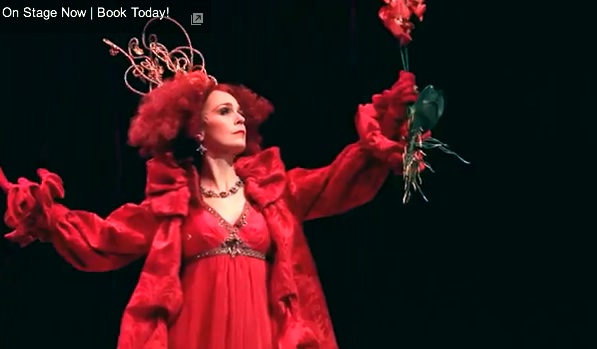
Cynthia Dale as The Red Queen in “Alice Through the Looking-Glass,” May 31 to October 12, 2014
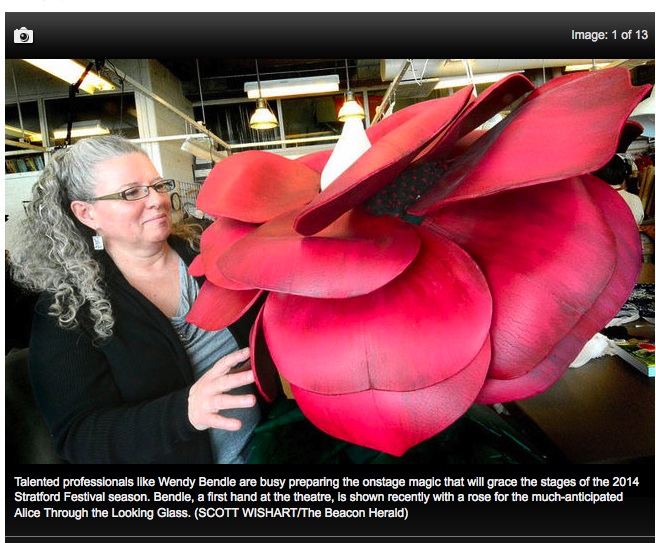
Flower from Alice Through the Looking-Glass, April 5, 2014. Courtesy Stratford Beacon Herald.
“Alice” events at the Stratford Festival Forum
Several Forum events and activities offer a chance to explore Alice Through the Looking-Glass, including Alice Adventure Lunches, a themed meal and activity to ignite your child’s imagination before the magic unfolds on stage; Adapting Alice, a panel discussion including Jillian Keiley and Peter Hinton, playwright for the Shaw Festival; and Acting Up: Alice, a drama workshop in which 8- to 10-year-olds use costumes to explore scenes and characters from the play.
Alice Through the Looking-Glass is a Schulich Children’s Play presentation and produced in association with Canada’s National Arts Centre.
At the May 5, 2014 preview performance of Alice Through the Looking-Glass, Chris Spaleta from Seaforth, Ontario was presented with a lifetime pass for two for being the Stratford Festival’s 26 millionth patron!
May 5, 2014: Chris Spaleta with the cast of Alice Through the Looking-Glass. Photo courtesy Stratford Beacon Herald.
Alice will be directed by Jillian Keiley, an award-winning director from St. John’s, Newfoundland. Cast members include Trish Lindström as Alice, Cynthia Dale as the Red Queen, Dion Johnstone as the White King, Tom McCamus as the March Hare, and Brian Tree as Humpty Dumpty.
To purchase tickets,call1-800-567-1600 or order online here.
Dion Johnstone, Trish Lindstrom, and Cynthia Dale in Alice Through the Looking-Glass, May 31- October 12, 2014 in Stratford, Ontario.
Notes on James Reaney’s adaptation
In 1991, David William, then Artistic Director of the Stratford Festival, commissioned James Reaney to adapt Alice Through the Looking-Glass for the stage. James Reaney recalls the many months writing and rewriting the play and attending workshops:
“So, as the preparatory workshop with the Young Company started in the fall of 1992, my adaptation had pretty well shaken down into its present shape except that a great deal of my commentary and suggestions were kept as part of the rehearsed reading shown to Richard Monette and David William and invited guests so that I myself actually read my mental landscapes of Looking-glass in fear and trembling since the many rewrites and keeping this and dropping that produced landmines for cues […]
Mr Monette took to the story as played that night in late October and also to its trajectory away from the Third Stage to the Avon with a cast [that included] Douglas Rain as Humpty and Barbara Bryne as the White Queen, both actors who had in 1967 appeared in my first Stratford play, Colours in the Dark.”
—From the Foreword to Lewis Carroll’s Alice Through the Looking-Glass: adapted for the stage by James Reaney, pages 12-14, The Porcupine’s Quill, 1994.
James Reaney’s adaptation ofAlice Through the Looking-Glasspremiered at the Stratford Festival in 1994 and was revived in 1996. The play is available inReaney Days in the West Room: Plays of James Reaney, David Ferry, ed., Playwrights Canada Press, 2008.
Illustration by James Reaney, 1994. “I am very proud to have helped with such a delightful show with designers, magician, composer, actors, director, and backstage staff who have seen to it that Carroll’s magic text and verbal wit is made all the more powerful.” James Reaney, Foreword, 1994, page 15.
Thank you all for joining us on October 20 for theFourth Annual James Reaney Memorial Lecture to hear David Ferry’s talk on “Directing Reaney: From Black Feet to Main Street.”
David spoke about his experiences both acting in and directing the Donnelly trilogy, including The St. Nicholas Hotel and Handcuffs. Questions from the audience included what attracts actors to the plays, what are the prospects for future professional productions, and whether each play truly stands alone outside of the trilogy.
>>> Read the full version of David Ferry’s 2013 lecturehere.
David Ferry’s lecture on James Reaney, October 20, 2013 at the Stratford Public Library
Many thanks to the organizers of the lecture at the Stratford Public Library — Charles Mountford, Anne Marie Heckman, and Sam Coghlan — for your continued support of this event.
Next year’s speaker will be Tim Inkster, publisher at Porcupine’s Quill. See you then!
Here are photos David Ferry shared from his production of Sticks and Stones at Bishop’s University in March 2013.
March 2013: Set for Sticks and Stones at Bishop’s UniversityMarch 14, 2013: Sticks and Stones at Bishop’s UniversityMarch 14, 2013: Sticks and Stones at Bishop’s University
Former doctoral student of James Reaney’s and now professor of literature at Laurentian University, Thomas Gerry explores the history of the literary emblem, and explains the meanings behind ten of James Reaney’s emblem poems.
“The Tree” and “The Riddle” are two of Reaney’s emblem poems featured in The Emblems of James Reaney:
“The Tree” by James Reaney. First published in Poetry (Chicago)“The Riddle” by James Reaney. First published in Armadillo 2 1970.
On the same evening, Tom Smart, author and former executive director of the McMichael Canadian Art Collection, will read from his new book Jack Chambers’ Red and Green. Red and Green is a collection Jack Chambers (1931-1978) made of hundreds of quotations that set out his ideas on art and the nature of reality.
Both The Emblems of James Reaney and Jack Chambers’ Red and Green are available from The Porcupine’s Quill.
For more about the book launch, see JBNBlog‘s review.
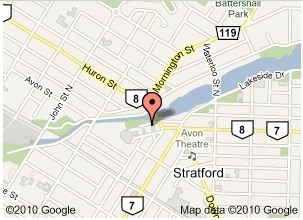
Join us on Sunday, October 20 at 2:30 pm at TheStratford Public Library Auditorium in Stratford, Ontario, for a talk by actor and director David Ferry on “Directing Reaney.”
David Ferry was one of the original cast members of James Reaney’s The Donnellys Part I, Sticks and Stones, which was first performed in 1973 at the Tarragon Theatre in Toronto, Ontario. He has won Dora Mavor Moore Awards for both his acting and directing, and recently directed James Reaney’s Sticks and Stones at Bishop’s University in March 2013.
The annual lecture is a project developed by The Stratford Public Library and Poetry Stratford, and features a talk by a person who is knowledgeable about the life and work of Stratford poet and playwright James Reaney and of writing in the Southwestern Ontario region, which is such a strong element in Reaney’s writing.
Issue 72 of Devil’s Artisan features Gasperau Press owner Andrew Steeves’ account of his journey in September 2012 from Black River, Nova Scotia to Linotype U, a symposium on the art of linotype printing, in Denmark, Iowa. On the way there and back he visited as many letterpress print shops as he could, including ThePorcupine’s Quill in Erin, Ontario.
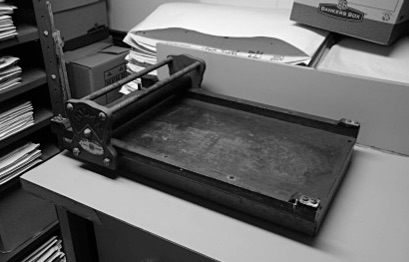
Tim [Inkster] took me over to the PQL warehouse (located in the basement of the building next door) to show me what he felt should be the first press photographed on my journey. Not his own Heidelberg KORD 64 offset press (the model also used at Coach House Books in Toronto and at Gaspereau Press), but rather a small Nolan proof press that once belonged to the poet James Reaney. Reaney is perhaps best known as the editor of Alphabet, an innovative literary journal he published in London, Ontario, between 1960 and 1971. Early issues of the publication were set and printed by Reaney himself, though it is doubtful that this particular little press was used in the production of the journal for anything besides proofing type. I was glad of Tim’s suggestion, for it would turn out that Nolan proof presses would keep popping up everywhere along my route.
James Reaney’s Nolan proof press at The Porcupine’s Quill in Erin, Ontario
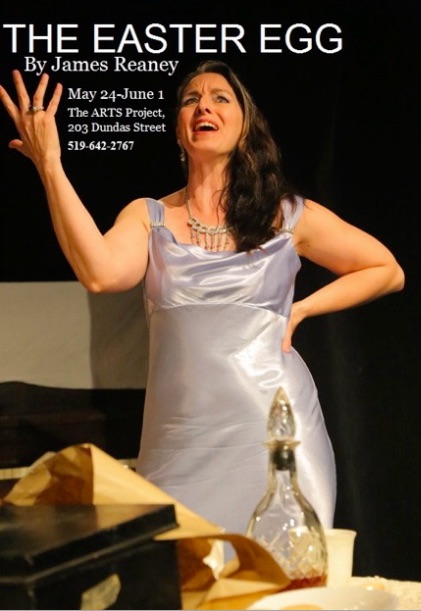
On May 24 to June 1 in London, Ontario, come and see the AlvegoRoot Theatre Company’s presentation of James Reaney’s play The Easter Egg.
The AlvegoRoot Theatre Company presents James Reaney’s The Easter Egg, May 24-June 1
The Easter Egg is directed by Jason Rip, and the performers are Kim Kaitell, Adam Corrigan Holowitz, Maya Wong, Demis Odanga, and Chris McAuley.
Jason Rip is a former student of James Reaney’s and an admirer of his work: “I feel very fortunate to have known Mr. Reaney. My ideas about him and his unique way of looking at the world — alternately whimsical and threatening, dignified yet naughty, with an emphasis on the importance of play — have infused this production. I still remember him hiding behind the curtains in University College Tower, waiting to pounce out and scare students. ‘GOTHIC NOVEL!’ he’d shout before doubling over with giggles. James Reaney is the bard of Souwesto. I will never turn down a chance to direct or appear in his work.”
When:May 24, 25, 29, 30, 31 and June 1 at 8pm; May 25 and June 1 at 2 pm Where:The Arts Project, 203 Dundas Street, London, Ontario
To buy tickets, call519-642-2767;Adults $15, Students and Seniors $10.
Pamela Terry Beckwith (1926-2006) directed James Reaney’s The Killdeer in 1960. He always referred to her as “my first director,” and he dedicated his second play, The Easter Egg, to her. She directed the first production of The Easter Egg for the Alumnae Theatre in November 1962.
Here are James Reaney’s thoughts about The Easter Egg from the Preface to the anthology Masks of Childhood (New Press, 1972, pages v-vi):
Behind Easter Egg literally lies a collection of glass Easter eggs I made from 1945 to 1955, aet. 19 and over. Found my first one in a store on Harbord Street, an old grocery and sundries store out of the 1910 era.[…] In Stratford, Le Souder’s Second Hand Store also kept getting a supply as attics from the eighties and nineties descended to the auctioneer’s gavel. Have never been quite sure of their cultural use; I think they were given to children at Easter. Some of them are as small as hen’s eggs and I have heard of these being used as nest eggs; others are large — a bit larger than a goose egg. Could they have been made at the Hamilton Glass Works? […] Milk glass blown or moulded, painted with flowers, rabbits, chickens (a cherub hatching out of one I didn’t buy), glowing with trapped pearly light — such glass cannot fail to set the story-telling instinct free. So a godmother gives a boy a glass Easter egg; he is drowning in an evil world and the present could float him to a shore. Someone steals the egg and the boy goes under a wave of word-blindness and numbness. Fourteen years later the Easter egg is found again and….
Bethel and her setting were suggested by stories told at an academic party in Kingston; stories about the past on a campus somewhat farther east. Nearby Garden Island supplied the ghost story of a girl tied to a fence for stealing a twig of small fruit. To my astonishment I ran across the basic for the story in the London Times,* 9 October, 1846 (No. 84). I think the heading is ‘Gooseberry Case on Garden Island’ and the owner of the gooseberries had the child brought up in court for stealing one! Confinement beneath a cellar door rather than tying to a fence was the cruelty practised.[…] I know perfectly well that in real life no one marries somebody because she got him to kill a bat; but here, in this story, they do you see.
*[London, Ontario, or London Minor as it was sometimes called.]