Tim Inkster at The Porcupine’s Quill tells us that The Essential James Reaney, edited by Brian Bartlett, is now available in e-book format. A Suit of Nettles is also available as an e-book.
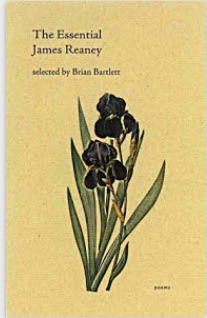
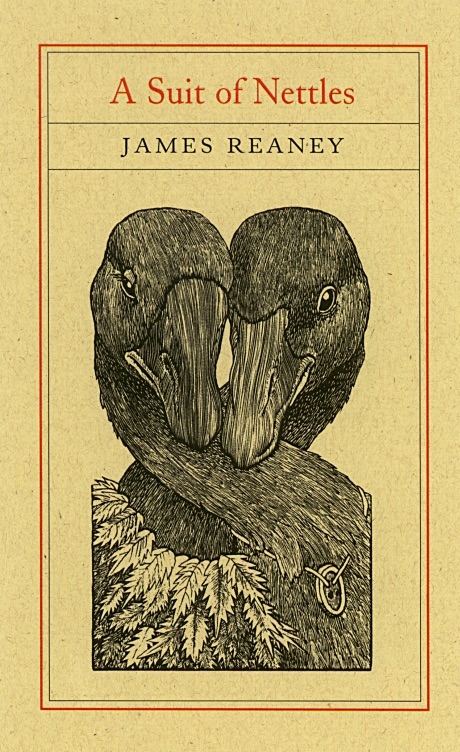

Tim Inkster at The Porcupine’s Quill tells us that The Essential James Reaney, edited by Brian Bartlett, is now available in e-book format. A Suit of Nettles is also available as an e-book.

Yes we are that too: we are everything who feel it.
Everything that has meaning has the same meaning as angels: these
hoverers and whirrers: occupied with us.
…
When the band of the moment breaks there will come angelic
recurrence.
— Colleen Thibaudeau Reaney, from “This Elastic Moment”
All the best for the holidays and for 2012
Congratulations to the singers and musicians who performed James Reaney and John Beckwith’s opera “Crazy to Kill” last weekend in Toronto, November 11-12, a Toronto Masque Theatre production. Here’s a rave review from some members of your enthusiastic audience:
We thought the production was fantastic! The opera singers can truly add “puppeteers” to their CV’s.
Loved the way everyone moved about the stage — when Agatha slowly drifted past us, it made us part of the story. A great set, with many levels (“rings”).
Loved the opening sewing scene when Agatha mimed the old treadle — and the sound effect, a great idea! Also loved her expressive face peering through the bed pillow — another great idea.
The two musicians, Greg Oh (piano) and Ed Reifel (percussion), sounded like a full orchestra. We loved how they were in costume and part of the story!
You must all be exhausted, but also pleased that it was such a success. Jamie would have been delighted.
Thank you again,
Susan, James, and Elizabeth

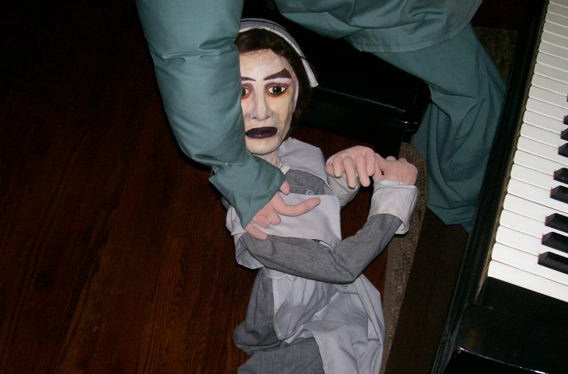


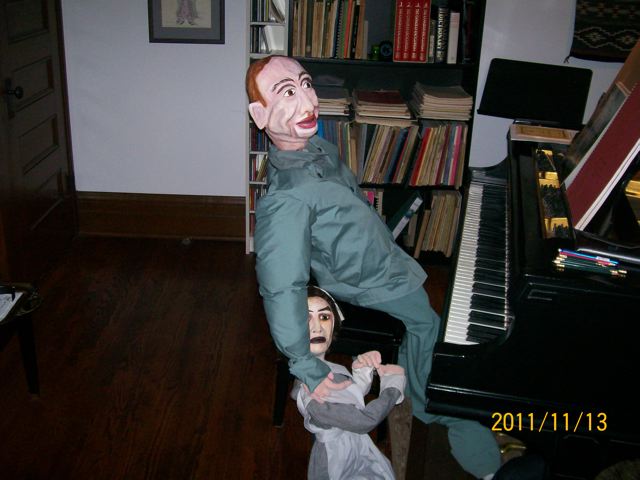
This month Toronto Masque Theatre presents James Reaney and John Beckwith’s opera Crazy to Kill, which was first performed in 1989.
Based on Ann Cardwell’s 1941 mystery novel about a series of murders in a mental asylum, the opera has 22 roles and requires three singers, two actors, and 18 puppets. In this production, David Ferry directs mezzo-soprano Kimberly Barber as Agatha, soprano Shannon Mercer as Mme. Dupont, Doug MacNaughton as Detective Fry, and actors Ingrid Doucet and Brendan Wall.
Crazy to Kill
Friday, Nov. 11 and Saturday, Nov. 12, 2011 at 8:00 p.m.
Pre-show chat with Artistic Director Larry Beckwith: 7:15 p.m.
Enwave Theatre at Harbourfront Centre
231 Queen’s Quay West
Tickets: $40 regular/$33 senior/$20 under 30
Thank you all for coming to the lecture on Sunday afternoon to hear composer Peter Denny talk about his collaboration with James Reaney on Terrible Swift Sword, an experimental modern opera. Denny played recordings of some of the music, which requires singer-actors who can improvise melodies to go with Reaney’s words.
Marian Johnson, producer and stage manager of the play, also spoke about her memories of the 1991 week-long workshop production. Actors Dale Bell and Joanne Lubansky read scenes from the play between General Beauregard and Letitia Beauregard.
Our thanks also to the organizers of the lecture at the Stratford Public Library, Charles Mountford, Anne Marie Heckman, and Sam Coghlan.
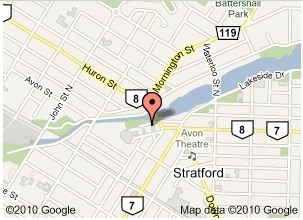
Join us on Sunday, October 16 at 2:30 pm at The Stratford Public Library Auditorium in Stratford, Ontario, for a talk by composer Peter Denny at the second annual James Reaney Memorial Lecture. Denny, a long-time friend, will speak about his collaboration with James Reaney on Terrible Swift Sword, an experimental modern opera.
James Reaney presented Terrible Swift Sword in a 1991 workshop at the Blyth Festival. The story, set in the defeated South at the end of the American Civil War, parallels the story of King Saul and David. Like the story, the music is also layered, built around a community production of Handel’s oratorio Saul.
In his lecture, Peter Denny will talk about the creative elements behind the 1991 performance of Terrible Swift Sword. He will play recordings of some of the music, and read from the script and from the Biblical source.
The annual lecture is a project developed by The Stratford Public Library and Poetry Stratford, and features a talk by a person who is knowledgeable about the life and work of Stratford poet and playwright James Reaney and of writing in the Southwestern Ontario region, which is such a strong element in Reaney’s writing.
The Stratford Public Library is located at
19 St. Andrew Street,
Stratford, Ontario
N5A 1A2
Four rural landscape paintings by James Reaney are part of the Pastorale exhibition at Museum London from July 16 to October 9, 2011. The paintings feature views of the Canadian farm and are chosen from the Museum’s permanent collection.
Drawing and painting were a “constant” in James Reaney’s life, and these landscape paintings grew out of a desire to “keep a record” of the world he knew (see Jean McKay’s article,“What on earth are you doing, Sir?” ArtScape, Issue 5, June 2006, 10). Here is a painting James Reaney made in Oxford County in 1978.

Here is a poem James Reaney wrote about the 1939 Royal Visit to Canada by Their Majesties King George VI and Queen Elizabeth.
When the King and Queen came to Stratford
Everyone felt at once
How heavy the Crown must be.
The Mayor shook hands with their Majesties
And everyone presentable was presented
And those who weren’t have resented
It, and will
To their dying day.
Everyone had almost a religious experience
When the King and Queen came to visit us
(I wonder what they felt!)
And hydrants flowed water in the gutters
All day.
People put quarters on the railroad tracks
So as to get squashed by the Royal train
And some people up the line at Shakespeare
Stayed in Shakespeare, just in case—
They did stop too,
While thousands in Stratford
Didn’t even see them
Because the Engineer didn’t slow down
Enough in time.
And although,
But although we didn’t see them in any way
(I didn’t even catch the glimpse
The teacher who was taller did
Of a gracious pink figure)
I’ll remember it to my dying day.

For more about the 1939 Royal Visit, see the Special Trains page at Library and Archives Canada.
The Royal Visit is included in James Reaney’s first collection of poems The Red Heart (1949). The poem also appears in James Reaney’s 1967 play Colours in the Dark, where it follows an actual letter a child wrote to his father describing how the Royal train failed to slow down on that day (see Act I Scene 13).
Congratulations to actor David Ferry, who wrote to us earlier this month to share this good news:
June 7/11
I wanted to let you know that today I was honoured with the 2011 Barbara Hamilton Award for excellence in the performing arts. This is one of the five special Dora Mavor Moore awards presented annually at the announcement of the DORA nominations. I am thrilled to be selected by the jury for this honour and humbled to join the extraordinary group of past recipients, all of whom I know or knew and have worked with (as I did with Barbara Hamilton) – a true sign of aging I think.
I have been blessed in the past with eight DORA nominations and have won DORAs for Best Actor, Best Director, and Lighting Design. And doubly fortunate, I was nominated again for Best Actor for my performance in “Blasted” last fall. My wife Kyra Harper was nominated as best actress for her fine work in “Vincent River,” which makes me more happy than does my own fortune.
And yesterday I was awarded the Best Actor in the inaugural Toronto Theatre Critics’ Awards for “Blasted.” So thrice blessed.
Congratulations, David, and best wishes for continuing success in the years to come!
David Ferry was one of the original cast members of James Reaney’s The Donnellys Part I, Sticks and Stones, which was first performed at the Tarragon Theatre in Toronto, Ontario on November 24, 1973. Here are fellow actors Jerry Franken and David Ferry together in the poster from the Tarragon production.


David Ferry has also recently edited a collection of plays by James Reaney for Playwrights Canada Press: Reaney Days in the West Room: Plays of James Reaney. David’s book includes seven of James Reaney’s plays: The Killdeer, Names and Nicknames, Listen to the Wind, The St.Nicholas Hotel, Gyroscope, Alice Through the Looking-Glass, and Zamorna!
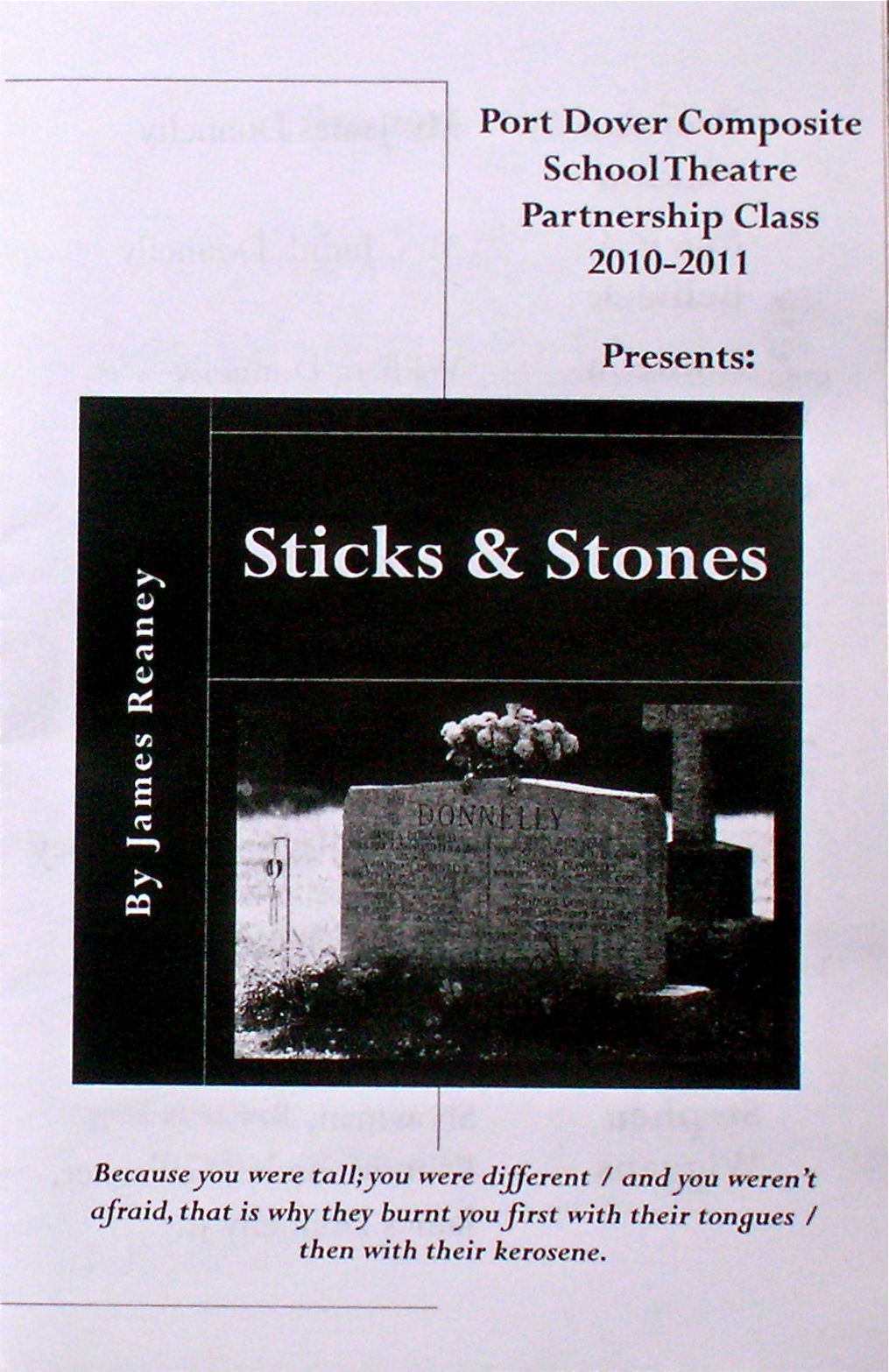
Congratulations to Mrs. Val Smith and her Theatre Partnership class at the Port Dover Composite School on their very successful performance of Sticks and Stones in Port Dover on January 13th and 14th. Val Smith encouraged the cast by pointing out that this was “the most beautiful and most difficult text they had ever dealt with or would ever deal with in high school.”

The students succeeded in both mastering the text and conveying the story to others. “This has been an experience they will remember for the rest of their lives,” says their teacher.
To celebrate National Poetry Month, here is the “April” eclogue from James Reaney’s long poem A Suit of Nettles. April ARGUMENT: With Duncan as judge the geese hold a bardic contest in honour of Spring. [DUNCAN RAYMOND VALANCY] Here is a kernel of the hardest winter wheat Found in the yard delicious for to eat.…
The Farm ( ( ( 0 ) ) ) For more about James Reaney’s poems and a look back at the family farm where James Reaney grew up, see the 1971 TVOntario documentary “James Reaney” in the Canadian Writers series. The Farm There was a farm divided in two1/2 of it surly brick maker ownedswale…
 James Reaney