• About
    • Awards
  • Publications
    • Books in print
  • Contact

James Reaney

  • James Reaney: Reflections on Shelter, Food, and “When the Great Were Small”

    January 1st, 2017

    In his November 2016 lecture on “James Reaney and Music”, composer John Beckwith recalls James Reaney writing that “My experiences of opera were scrubbing kitchen floors on Saturday and hearing the Met broadcasts as I did.” What did Reaney mean, John wondered, his kitchen had more than one floor?

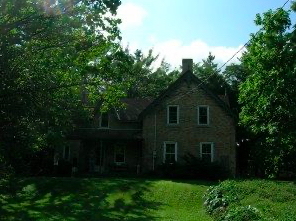
    James Reaney’s childhood home near Stratford, Ontario — Summer Kitchen entrance.

    Yes, it turns out that “scrubbing kitchen floors” plural is accurate because the farmhouse where James Reaney was born in 1926 had two kitchens – a summer kitchen used May through October in the newer part of the house, and a winter kitchen used November through April in the older part of the house.

    In his 1992 autobiography*, James Reaney reflects on “Shelter” and his first home:

    [From his diary:] “Tuesday, January 3, 1939 – Wind: east, a sleety and very cold wind. Weather: very cold, snow deep, hard to get around.” Two months before we would have moved the stove and ourselves into the winter kitchen; a constant house-in-winter image, therefore, was passing through the summer kitchen, all cold and deserted, on the way to the pump or the barn. […] [p. 297]

    On the topic of “Food”, he describes making toast in the summer kitchen:

    “The summer kitchen would be filled with smoke resulting from our toasting of thick bread slices over, top of stove lifted, lids and all, open fire. As we sat down to breakfast, the kitchen was transformed by big, blue sun ladders coming in the east windows and slanting down to the linoleum.” [p. 296]

    “Asked to name first foods that impressed me almost to the point of saying ‘dietary gods,’ I should have to say OATMEAL, MILK, WATER, TOAST. By many a mile, oatmeal comes first although the hard, hard water from our hundred-foot well is hard to beat.” [p. 295] […]

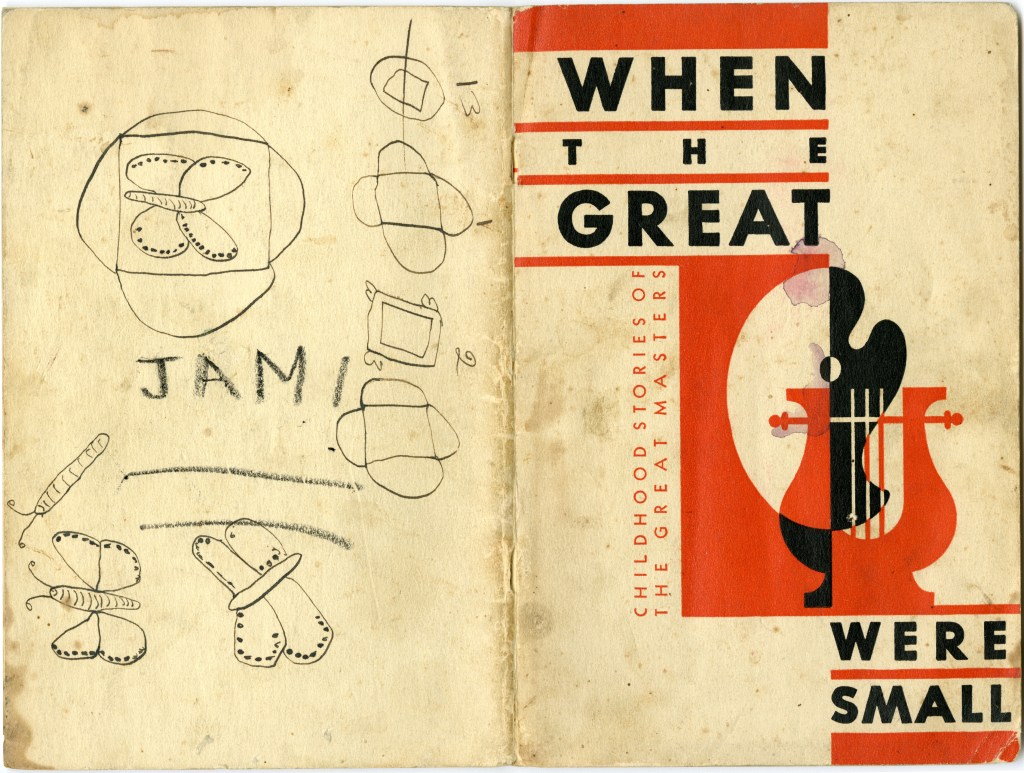
    Now, the farm actually produced oats, a beautiful crop to watch turning from blue-green mist to yellow curved spikelets to dead-white ripe spilling into the granary from the threshing machine pipe. But the pursuit of status symbols prevented us from slipping backwards into primitivism, and my parents shopped for either Quaker Oats (not instant, long cooking; instant is an abomination) or rolled oats (plain brown paper bag). Sometimes in summer (see Alice Munro) we hereticized to Puffed Oats, shot from a cannon and supported by a radio serial called “Sunny Jim.” We even backslid to Kellogg’s Cornflakes or even Rice Krispies – again a radio programme tugged at us, in this case Irene Wicker’s “Singing Lady”; and for a box top from either of the above you could obtain a booklet called When the Great Were Young [sic] – stories of Michelangelo, Giotto, Bach − filled with notions of how to escape if need be from the farm one day. […] [p. 296]

    James Reaney’s boyhood copy of “When the Great Were Small: Childhood Stories of the Great Artists and Musicians as Told By Kellogg’s Singing Lady”, 1935 booklet for The Singing Lady radio programme, copyright Kellogg Company. Image courtesy Western University Archives, James Reaney fonds AFC 18, Box A12-082-029.

    * These autobiographical excerpts are from James Crerar Reaney, Contemporary Authors Autobiography Series, Volume 15, pages 295-297, Gale Research Inc., Detroit, 1992.

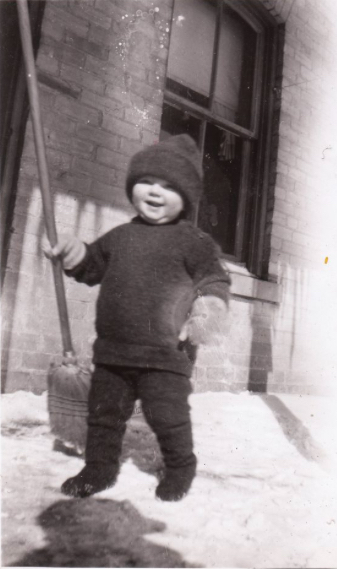
    James Reaney, age 1 1/2 years, on his front porch (summer kitchen side) January 1928.

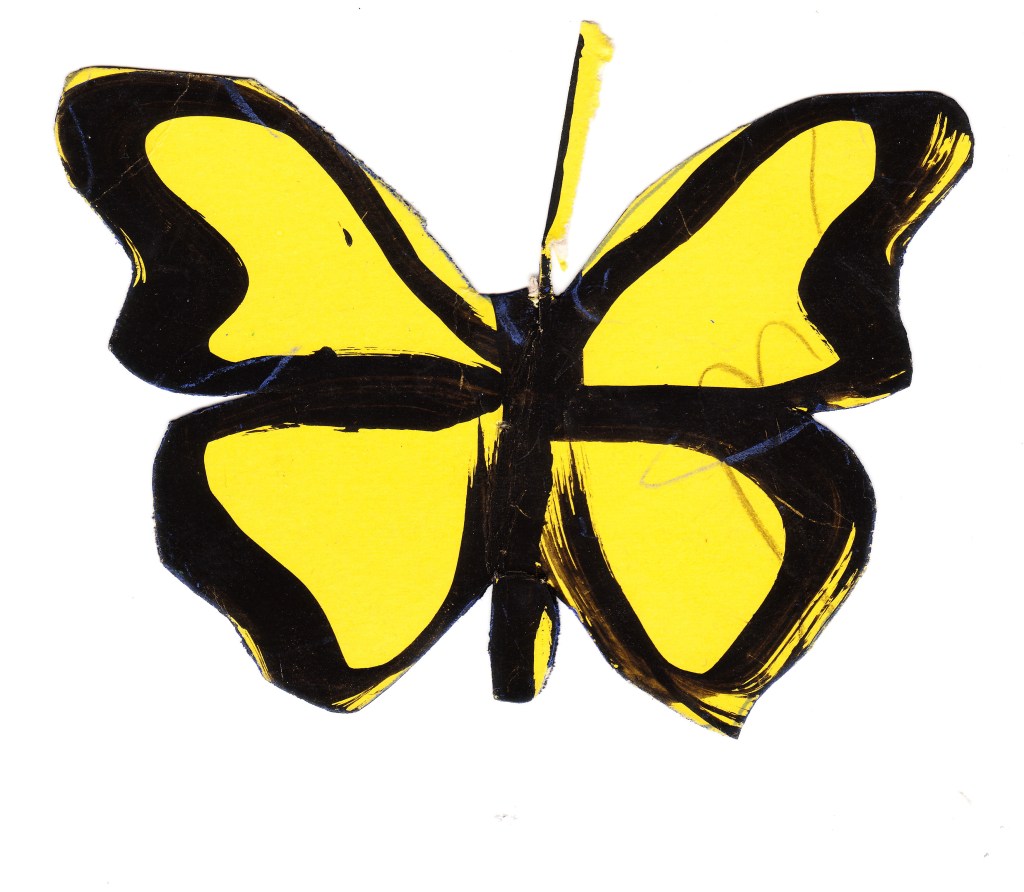
    Butterfly decoration by James Reaney, September 1947 (ink on yellow paper)
  • James Reaney and Music: Musical bees, marching bands, and dandelion horns

    November 28th, 2016
    “All the Bees and All the Keys” (1973); illustration by Ross MacDonald.

    In his November 5 talk on “James Reaney and Music”, composer John Beckwith recalls their collaboration on a children’s story with symphonic music, All the Bees and All the Keys: “He said he had always wanted to write about a) bees and bee-keeping and b) small-town Ontario marching bands.” Beckwith also mentioned a scene in James Reaney’s play I, The Parade, where a penniless band with no instruments has to perform with dandelion horns.

    I, The Parade tells the story of bandmaster and composer Charles F. Thiele (1884-1954), bandmaster of the Waterloo Musical Society (1919-1951) and Father of Canadian Band Music.* Commissioned as part of the City of Waterloo’s 125th anniversary celebrations, the play was presented at the University of Waterloo in November 1982.

    Bandmaster C.F. Thiele leading the Waterloo Musical Society Band, 1947. Photo courtesy Waterloo Public Library (images.ourontario.ca)

    In I, The Parade, the penniless dandelion-horn band appears in a story-within-a-story (told by Charles F. Thiele’s mother and father) that hints at some of the history of the Waterloo Band and its rivalry with the Berlin [Kitchener] Band. As John Mellor notes in his memoir about Professor Thiele, “This keen rivalry between the bands of Waterloo and Berlin/Kitchener became so intense that for a long period no Berlin musicians played in the Waterloo band and vice versa.”**

    In this scene from Act I, trumpeter Albert Nafzinger is blackballed from joining the Music Society Band because he lives in the rival village. His sister, Gretel, desperate to play in a band but without an instrument, forms a band of her own: “… and they played with the stems of dandelions — which they called dandelion horns […]”

    MARCHING SONG

    One two three together
    Let’s hear it from the drum
    Never mind if it’s a rusty kettle
    Down the street we come
    Down Park Street, down Union Street,
    Turning right on King
    Up Albert Street, up Margaret
    Playing, playing

    Buzzing like a bumble bee
    Our music’s easy come by.
    Break your horn, we’ll never mind:
    On Park Street &c. A PASSERBY PUTS A PENNY IN THEIR DRUM.

    [Angry at not getting into the band, Albert plots his revenge:]

    ALBERT: Gretel, how much would you give me for my trumpet.
    GRETEL: Albert. (PAUSE) You didn’t get into the village band.
    ALBERT: I’ll get them. I’m not getting mad, no I’m getting even. […]
    GRETEL: I’d give anything, do anything to have a trumpet that was my own.
    ALBERT: Listen – this is what you must do then. First of all I have Sunday morning rights to practise – I can’t quite give it up, but there’s lots of lonely places outside town I can practise. But – cut your hair real short, put on a suit of my clothes and audition for the empty place in the band and. (PAUSE) It’s all yours.
    GRETEL: Do you think I’d get in the band?
    ALBERT: If you do, I’ll have my revenge on them. But – if they keep you out – I still keep the trumpet.
    GRETEL: And my hair grows back and I can wear a dress again. Albert. (PAUSE) Albert, let me play a bit. Please.
    HE DANGLES IT OVER HER HEAD, THEN RUNS OFF WITH IT.

    Two pages from the draft manuscript for “I, The Parade” (1981-1982) courtesy Western University Archives, James Reaney Fonds AFC 18.

    Note from Susan Reaney: This scene is excerpted from a draft manuscript version of I, The Parade, which is part of the James Reaney fonds at Western University Archives. The title at the top reads “Sally Trombone”, which is a ragtime-influenced novelty tune from 1917 featuring a “trombone smear” (true glissando), the specialty of composer and bandleader Henry Fillmore (1881-1956).

    * For more about C.F. Thiele, see John Mellor’s book Music in the Park: C.F. Thiele Father of Canadian Band Music (1988), Waterloo, Ontario. ISBN 0-9692301-2-5
    ** John Mellor, Music in the Park, page 18.

    Illustration by Ross MacDonald from “All the Bees and All the Keys” (1973) from Scripts: Librettos for operas and other musical works (James Reaney 2004).


  • John Beckwith on “James Reaney and Music” at Words Festival

    November 8th, 2016
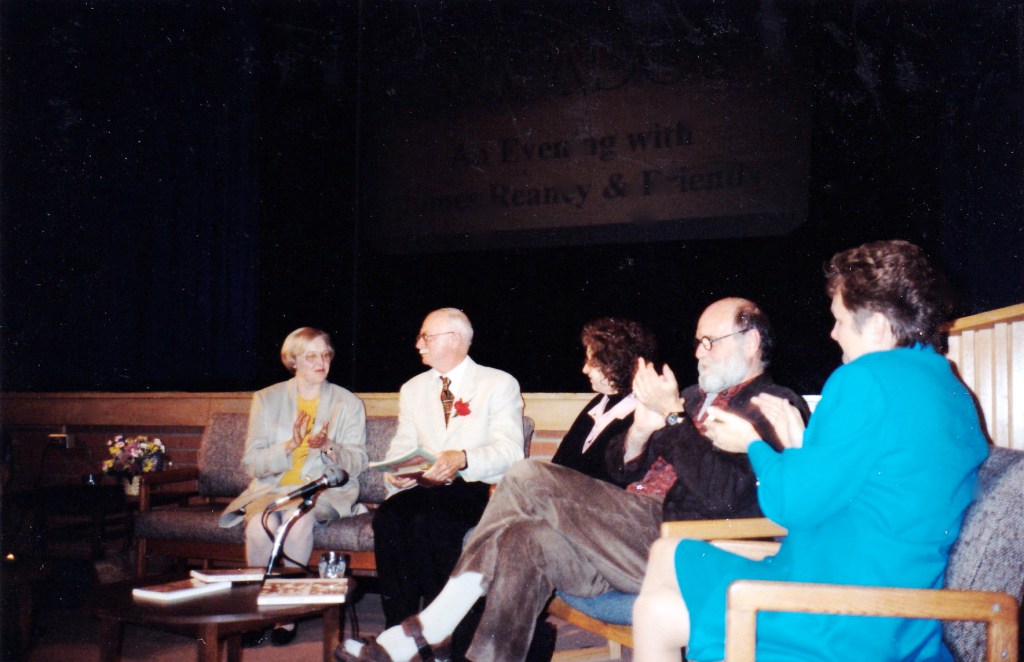
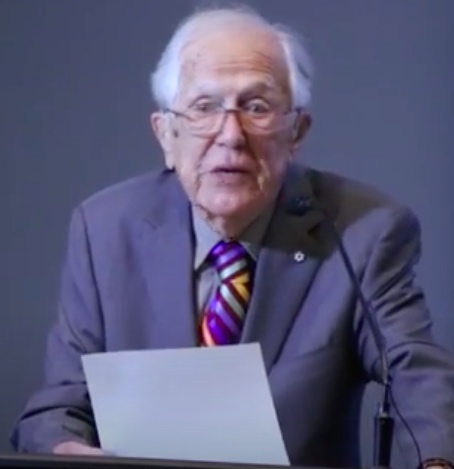
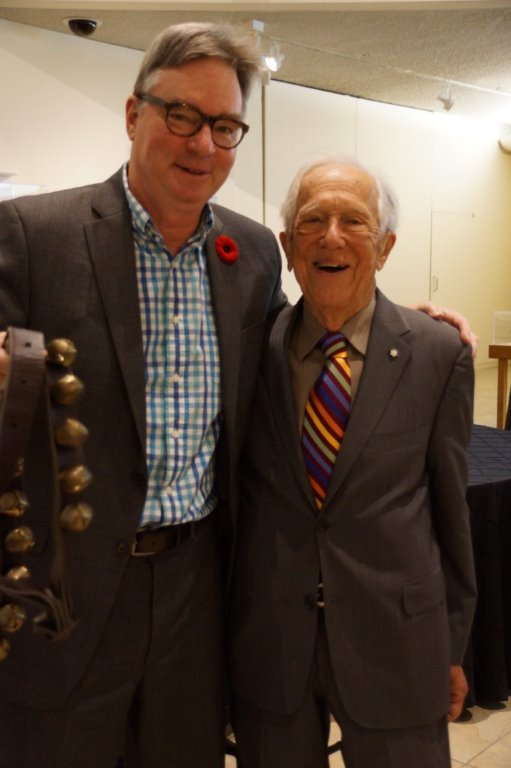
    Composer John Beckwith speaks on James Reaney and Music, November 5, 2016

    Thank you all for coming to Museum London for the Seventh Annual James Reaney Memorial Lecture to hear composer John Beckwith speak on “James Reaney and Music” and their collaborations together.

    John Beckwith was the first composer to set James Reaney’s poetry to music. Thank you, John, for sharing your memories and your music with us.

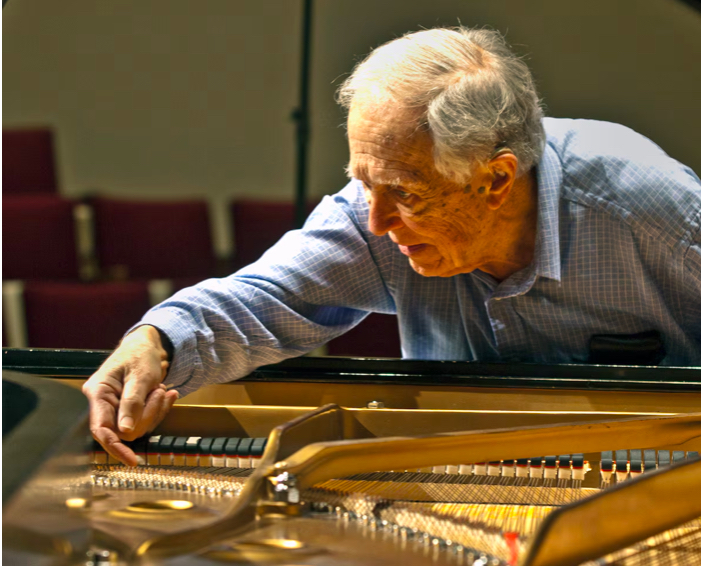
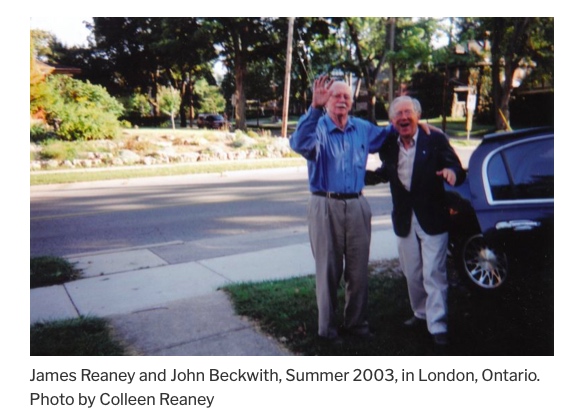
    November 5, 2016 — James Stewart Reaney and composer John Beckwith at Museum London. (Photo courtesy Cameron Paton)

    Our thanks also to our hosts Wordsfest and the London Public Library for their support in organizing this event. A video of John Beckwith’s lecture is available on YouTube: https://www.youtube.com/watch?v=h7I7cIjO4hA

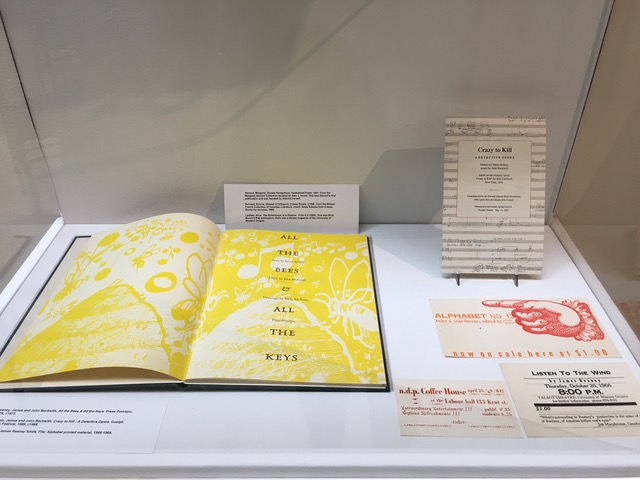
    November 5, 2016 — Western Archives display of James Reaney’s writing prepared by archivist Amanda Jamieson. (Photo courtesy Elizabeth Reaney)

    We hope to see you all again next year when author and curator Tom Smart will give a talk on James Reaney’s visual art.

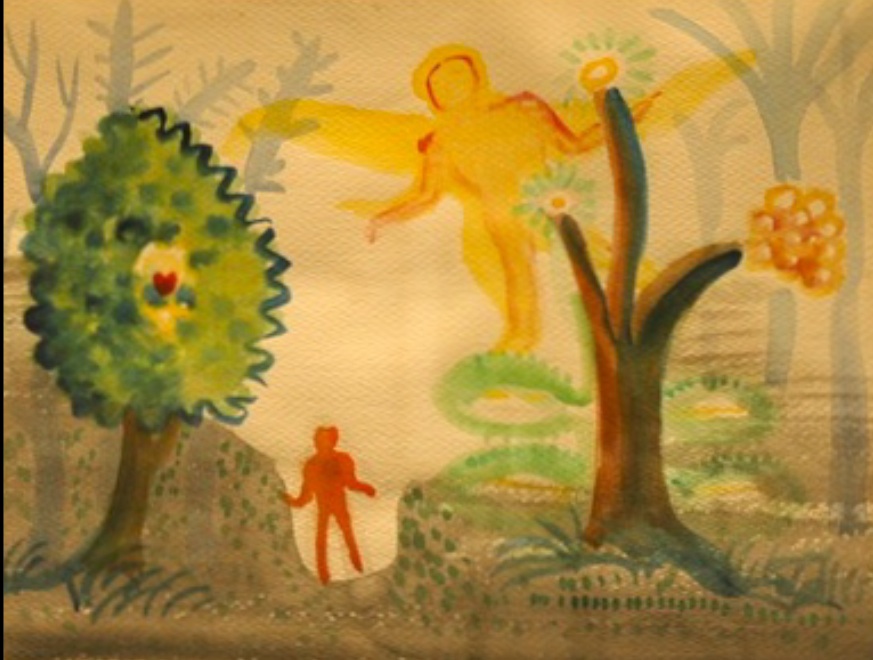
    James Reaney’s watercolour painting “David Willson Meets an Angel in the Forest”, 1962 (Photo courtesy Linda Morita, McMichael Canadian Art Collection)

    For more about composer John Beckwith, see his 2012 autobiography Unheard of: Memoirs of a Canadian Composer, available from Wilfrid Laurier University Press.

    The annual lecture series celebrates the life and work of Southwestern Ontario poet James Reaney, who was born on a farm near Stratford, Ontario.

    Butterfly decoration by James Reaney, September 1947 (ink on yellow paper)
  • James Reaney Memorial Lecture November 5 at Museum London

    October 11th, 2016

    Join us on Saturday November 5 at 4:30 pm at Museum London to hear composer John Beckwith speak about his 40-year collaboration with poet and dramatist James Reaney.

    John Beckwith and James Reaney became friends during their student days at the University of Toronto in 1946, and a shared love of music drew them to collaborate on several operas, plays, and musical collages. Four operas Night Blooming Cereus (1959), The Shivaree (1982), Crazy to Kill (1988), and Taptoo! (1994) are among the most notable.

    Composer John Beckwith: https://collections.cmccanada.org/final/Portal/Composer-Showcase.aspx?lang=en-CA

    Archived recordings of several Beckwith-Reaney works are available for streaming at the Canadian Music Centre‘s Composer Showcase.

    When: Saturday November 5 at 4:30 pm

    Where: Museum London, 421 Ridout Street North, London, Ontario

    Admission is free; James Stewart Reaney, James Reaney’s son, will introduce the speaker.

    Our thanks to Wordsfest and the London Public Library for their support of this event. The annual lecture series celebrates the life and work of Southwestern Ontario poet James Reaney, who was born on a farm near Stratford, Ontario.

    From John Beckwith’s 1997 book, Music Papers: Articles and Talks by a Canadian Composer (page 219): Page from James Reaney’s draft of the libretto for Night Blooming Cereus, with notes on the central character, Mrs. Brown (Faculty of Music Library, University of Toronto).


  • Apple Butter off to the Western Fair Summer 1965

    September 1st, 2016

    August 23-29, 1965 in Leith, Ontario — Family friend Leith Peterson shares this Polaroid photo taken by her mother, Jay Peterson (1920-1976), who invited James Reaney and family up to her cottage at Leith to create the marionettes for James Reaney’s children’s play Apple Butter.

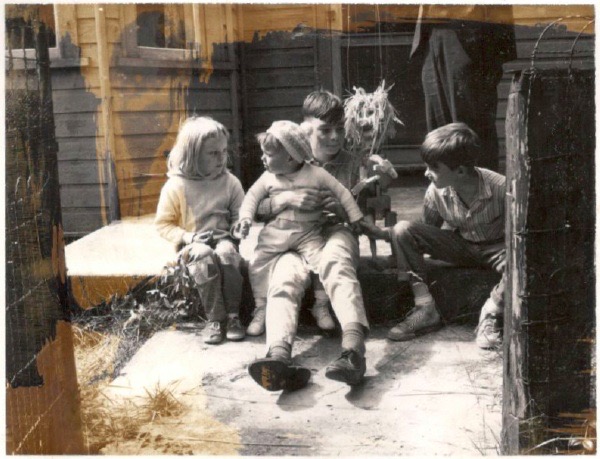
    Here are the Reaney children (James, John, and Susan) and Jay’s niece Elizabeth Tinker with new-made marionette Apple Butter, soon to make his stage debut at the Western Fair in London (September 3-12, 1965).

     August 1965 in Leith, Ontario: From left to right: Susan Reaney (age 6), James Stewart Reaney (age 12 1/2) holding Elizabeth Tinker (age 16 months), and John Andrew Reaney (age 11). James Reaney (age 38) holds Apple Butter. (Photo by Jay Peterson courtesy Leith Peterson.)

    For more about Jay Peterson and her role in commissioning the marionette plays and helping create the marionettes, see Leith Peterson’s article, “Jamie and Jay Peterson’s 1965 Apple Butter Collaboration”.

    James Reaney and family in 1965 in Leith, Ontario. Standing left to right are the adults: Colleen Reaney, Wilma McCaig (Jamie’s sister), and James Reaney. The children are John Andrew Reaney, James Stewart Reaney, and Susan Reaney (beside Applebutter). Photo by Jay Peterson.
  • Paul Thompson’s The Last Donnelly Standing at Blyth Festival

    August 26th, 2016
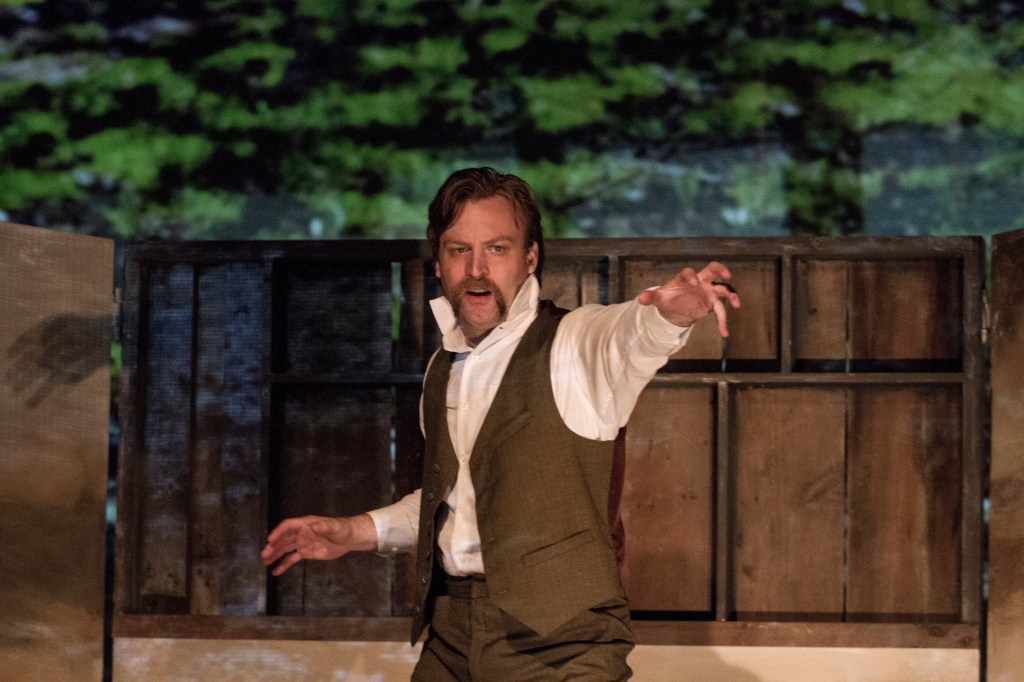
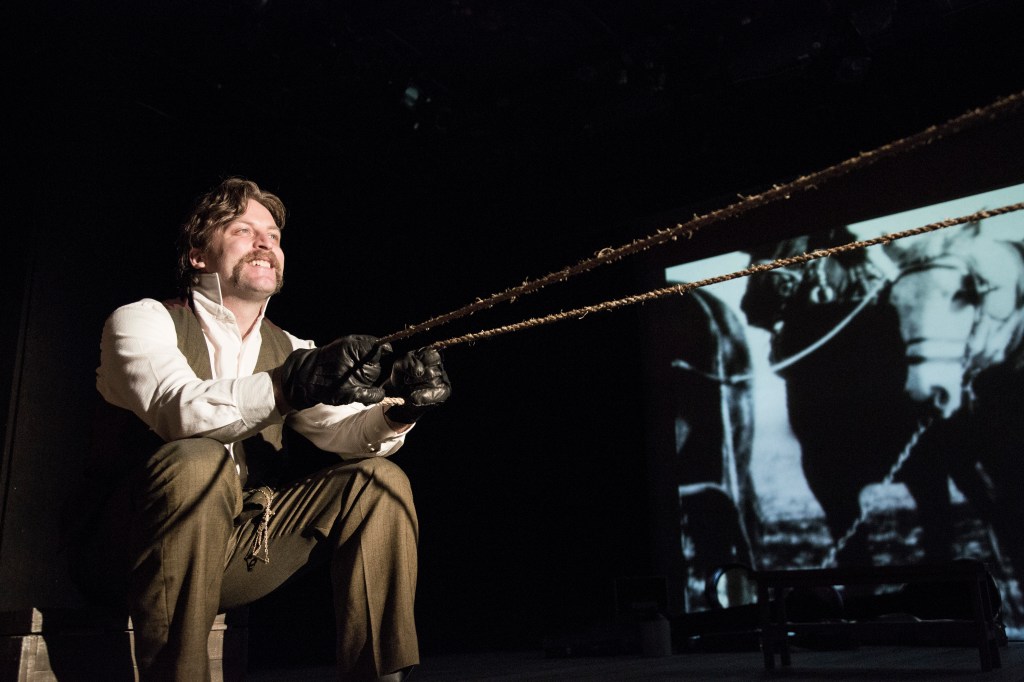
    Gil Garratt as Robert Donnelly in “The Last Donnelly Standing” at the Blyth Festival August 4 to September 2, 2016 (Photo by Terry Manzo courtesy The Blyth Festival.)

    Paul Thompson‘s new play The Last Donnelly Standing at the Blyth Festival (August 4 to September 2) tells the tale of Robert Donnelly, one of the surviving family members of The Biddulph Tragedy.

    Co-creator Gil Garratt stars as Robert Donnelly in this one-man show, a fitting sequel to Paul Thompson’s epic Outdoor Donnellys, presented at the Blyth Festival in 2001, 2002, and 2004.

    Gil Garratt as Robert Donnelly in “The Last Donnelly Standing” (Photo by Terry Manzo courtesy The Blyth Festival.)

    In The Donnelly Documents: An Ontario Vendetta, James Reaney notes that “what follows here is an account of the events that culminated in the killing of the ‘somewhat notorious Donnelly family’ [4 February 1880] and what happened to the survivors, William and Robert Donnelly, up to their departure from Lucan in 1883. Indeed, subsequent events merit another volume: their arrival in their new home in Glencoe; the fact that the Donnelly brothers retained their father’s farm in Biddulph; that in 1905, Robert came back to live in Lucan, along with his nephew, James Michael, son of the ill-fated Michael Donnelly…” (See The Donnelly Documents: An Ontario Vendetta, page xv.)

    For more about the play, see Joe Belanger in The London Free Press and JBNBlog.

    A true fan has provided a pre-show video of Gil Garratt in character as Robert Donnelly here: https://www.facebook.com/james.reaney.14?fref=pb&hc_location=friends_tab&pnref=friends.all

    See also “James Reaney on writing about the Donnellys”: https://jamesreaney.com/2019/01/04/james-reaney-on-writing-about-the-donnellys/

  • Colours in the Dark and Mr. Winemeyer

    July 17th, 2016
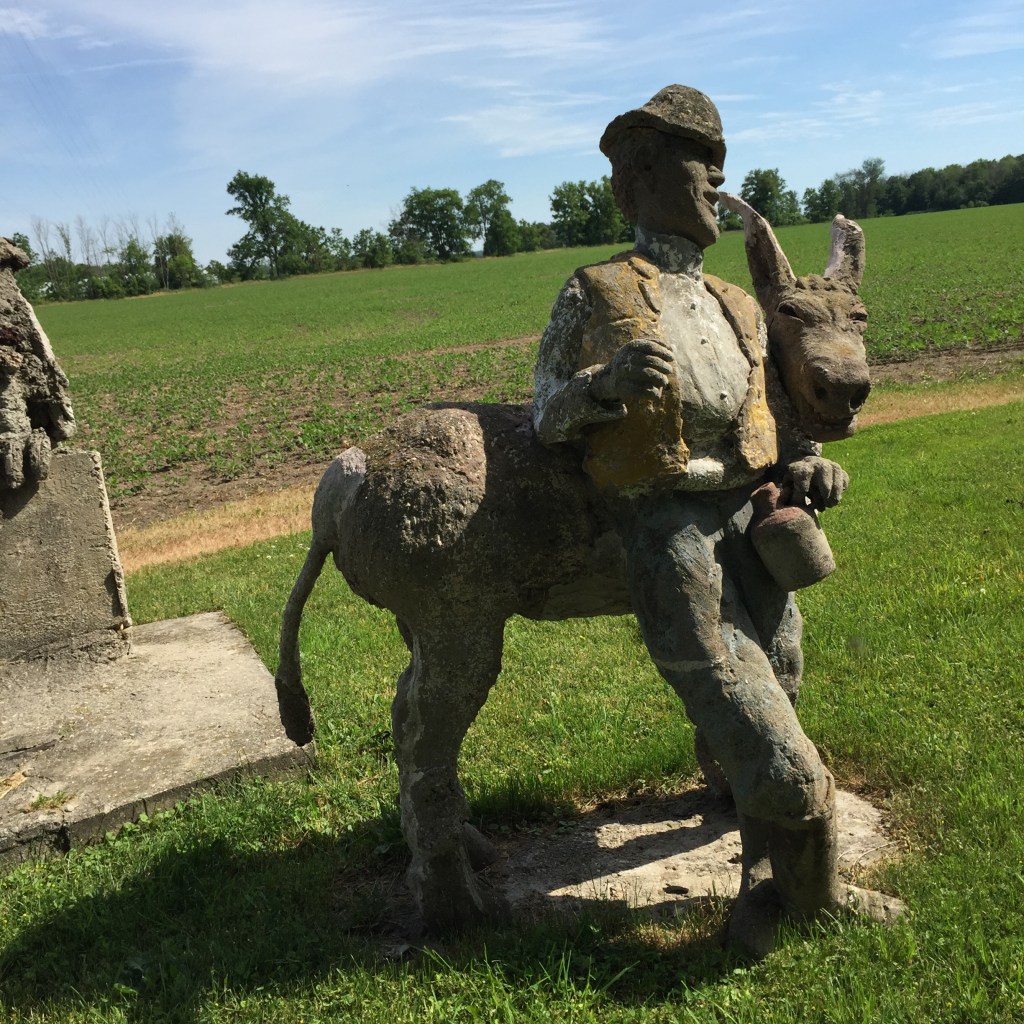
    June 2016 near Goderich, Ontario, Cement sculptures by George Laithwaite (1871-1956). (Photos courtesy JS Reaney.)

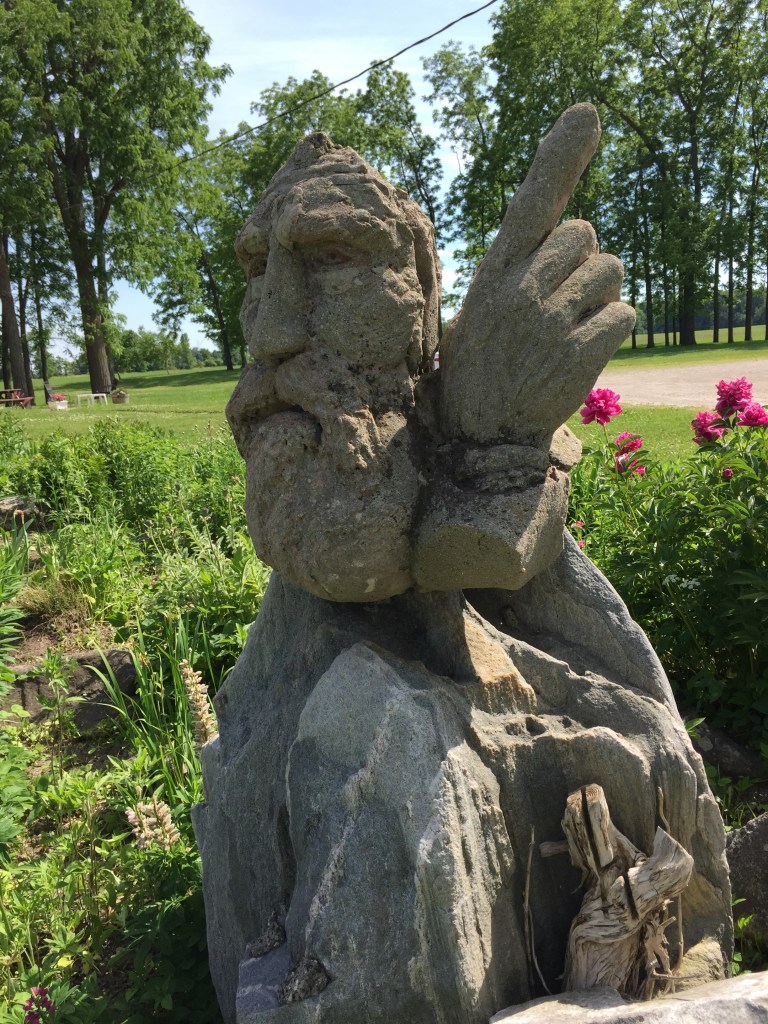
    In Act II of James Reaney’s play Colours in the Dark, two boys visit the mysterious Mr. Winemeyer, a sculptor hermit. George Laithwaite (1871-1956), a farmer near Goderich, Ontario, created cement sculptures around his farm and is the inspiration for the character Mr. Winemeyer.

    Here is an excerpt from Act II, Scenes 3 and 4, where the two boys visit the old hermit, Mr. Winemeyer, and see his sculptures.

    […]

    BOY 1: Where’d you get the peacock feather, Mr. Winemeyer?

    HERMIT: Had a pet peacock once when I was a boy. A big old sow we had had a peeve about it – and one day caught it in the orchard and devoured it. This – was all that was left of my beautiful bird. Sticking out of that beast’s mouth.

    BOY 1: holding the feather  And nothing else has happened to you lately?

    HERMIT: Well – yes – this happened. I happened to be out in the yard scraping out my frying pan when coming down through the air I saw – a falling star.

    It does. It is yellow.

    BOY 2: What are you going to do with this falling star, Mr. Winemeyer?

    June 2016 near Goderich, Ontario, “Moses” sculpture by George Laithwaite (1871-1956). (Photos courtesy JS Reaney.)

    4. CEMENT SCULPTURES

    SCREEN: Actual slides of the Goderich, Ontario, primitive sculptor Laithwaite – his cement figures.

    HERMIT: Come out with me to the orchard and see my latest cement sculptures.

    On cue, the sculpture slides appear. They could also be mimed by the Company.

    Now here’s Sir John A. at the plow!
    Here’s Snow White and the Seven Dwarfs. That’s the only film I’ve ever seen and the only one I’ll ever see. You can’t go any higher than that in film art.

    BOY 2: Who’s this?

    HERMIT: That’s the infant Riel suckled by the buffalo Manitoba.

    BOY 1: What’s this one doing, Mr. Winemeyer?

    HERMIT: I finished that last April — that’s Mackenzie King cultivating the rows of compromise. Now – here is where I’m using this falling star. Here’s Good – in a terrible combat with his brother Evil – over – this.

    He places the star between the statue-actor’s hands. The star has now become a lump of rock.

    BOY 2: Could I have a piece of that star?
    HERMIT: Why sure. These two projecting knobs will never be missed. Both have a piece.
    BOYS: Gee, thank you, Mr. Winemeyer.

    We hear music. The Windlady appears with her Rain Doll.

    HERMIT: Now there’s a good subject for a piece of sculpture.
    BOYS: What, Mr. Winemeyer?
    HERMIT: The Wind and the Rain.

    He and his statues fade slowly. BOY 1 starts playing the bicycle spokes. BOY 2 goes back and says:

    BOY 2: Mr. Winemeyer – was the pig your brother? Were you the peacock?

    Mr. Winemeyer shakes his head.

    SCREEN: Centre panel shows a large star.

    Goderich, Ontario — Sir John A. Macdonald sculpture by George Laithwaite.

    ♦ For more about James Reaney’s imaginative use of George Laithwaite’s sculptures, see James Stewart Reaney’s article, Concrete sculptures still ‘play’ well.

    ♦ For a delightful tour of George Laithwaite’s sculptures (summer and winter!), see Harrison Engle’s film “Legacy” (1960?), which features commentary by Laithwaite’s family and J.H. Neill, then Curator of the Huron County Pioneer Museum.

    Colours in the Dark by James Reaney is available from Talonbooks.

  • Tarragon Theatre’s “The Donnelly Project” May 14 in Scarborough

    May 17th, 2016

    Congratulations to the students of R.H. King and Agincourt Secondary Schools and students from the University of Toronto Scarborough for their wonderful outdoor performance of “The Donnelly Project”, a special adaptation of three scenes from James Reaney’s Sticks and Stones: The Donnellys Part I.

    Adapted by Tarragon Theatre’s Playwright-in-Residence Kat Sandler, “The Donnelly Project” gives drama students from Scarborough the chance to explore an early Tarragon Theatre script. The Tarragon Theatre celebrates its 45th anniversary this year, and James Reaney’s Sticks and Stones: The Donnellys Part I was first performed there on November 24, 1973.

    For more about the event, see “The Donnelly Project at Scarbrough Arts Park” and Eleanor Besly’s interview with co-director Zach McKendrick.

    Photos courtesy Elizabeth Reaney, Saturday May 14 at the Scarborough Arts Park, 1859 Kingston Road, Scarborough, Ontario.

    The Donnelly Project performers
    The Donnelly Project, Scarborough, Ontario
    The Donnelly Project (3)
    The Donnelly Project (3)
  • James Reaney’s A Suit of Nettles: April

    April 5th, 2016

    To celebrate National Poetry Month, here is the “April” eclogue from James Reaney’s long poem A Suit of Nettles.

    April

    ARGUMENT: With Duncan as judge the geese hold a bardic contest in honour of Spring.

    [DUNCAN  RAYMOND  VALANCY]

    Here is a kernel of the hardest winter wheat
    Found in the yard delicious for to eat.
    It I will give to that most poetic gander
    Who this season sings as well as swam Leander.
    The white geese with their orange feet on the green
    Grass that grew around the pond’s glassy sheen
    Chose then Valancy and Raymond to sing
    And to hear them gathered about in a ring.

    RAYMOND

    I speak I speak of the arable earth,
    Black sow goddess huge with birth;
    Cry cry killdeers in her fields.

    Black ogress ate her glacier lover
    When the sun killed him for her;
    The white owl to the dark crow yields.

    Caw caw whir whir bark bark
    We’re fresh out of Noah’s Ark;
    Wild geese come in arrowheads

    Shot from birds dead long ago
    Buried in your negro snow;
    Long water down the river sleds.

    Black begum of a thousand dugs,
    A nation at each fountain tugs;
    The forests plug their gaps with leaves.

    Whet whet scrape and sharpen
    Hoes and rakes and plows of iron;
    The farmer sows his sheaves.

    Mr Sword or Mr Plow
    Can settle in your haymow,
    All is the same to Mother Ground.

    Great goddess I from you have come,
    Killdeer crow geese ditch leaf plowman
    From you have come, to you return
    In endless laughing weeping round.

    VALANCY

    Your limbs are the rivers of Eden.
    From the dead we see you return and arise,
    Fair girl; lost daughter:
    The swallows stream through the skies,
    Down dipping water,
    Skimming ground, and from chimney’s foul dusk
    Their cousins the swifts tumble up as the tusk
    Of roar day
    In bright May
    Scatters them gliding from darkness to sun-cusp.

    Your face unlocks the bear from his den.
    The world has come in to the arms of the sun.
    What now sulky earth?
    All winter you lay with your face like a nun,
    But now bring forth
    From river up boxdrain underground
    Fish crawling up that dark street without sound
    To spawn
    In our pond
    Young suckers and sunfish within its deep round.

    Your body is a bethlehem.
    Come near the sun that ripened you from earth
    Pushing south winds
    Through lands without belief till its pretty birth
    The faithful finds:
    Fanatic doves, believing wrens and orioles
    Devoted redwinged blackbirds with their calls,
    Archilochus alexandri,
    Melospiza georgiana,
    All surround you with arched cries of Love’s triumphals.

    Your mind is a nest of all young things, all children
    Come to this meadow forest edge;
    Put her together
    From this squirrel corn dogtooth young sedge
    And all this weather
    Of the white bloodroots to be her skin
    The wake robin to be her shin
    Her thighs pockets
    Of white violets
    Her breasts the gleaming soft pearly everlasting.

    For her limbs are the rivers of Eden;
    Her face unlocks
    The brown merry bear from his den,
    From his box
    The butterfly and her body is a bethlehem
    Humming
    With cherubim
    And her mind is a cloud of all young things, all children.

    The prize to this one goes cried eagerly some
    And others cried that to Raymond it must come,
    So that Duncan Goose turned to the plantain leaf
    And chopped the prize in half with beak-thrust brief.

    James Reaney, 1958

    The third edition of A Suit of Nettles features charming illustrations by engraver Jim Westergard, available from The Porcupine’s Quill.
    A Suit of Nettles (3rd ed. 2010)

    For more about A Suit of Nettles, see Germaine Warkentin‘s essay “Out of Spenser and the Common Tongue”: James Reaney’s A Suit of Nettles, and Richard Stingle‘s lecture “A learned poet writes A Suit of Nettles”.

    “Geese” Photo by Elizabeth Cooke (James Reaney’s mother), 1950 near Stratford, Ontario.

    Butterfly decoration by James Reaney, September 1947 (ink on yellow paper)


  • Alice Through the Looking-Glass in Edmonton February 27 to March 20

    February 10th, 2016

    This month, Alice resumes her journey across Canada as James Reaney’s adaptation of Lewis Carroll’s Alice Through the Looking-Glass opens at the Edmonton Citadel’s Shoctor Theatre on February 27 to March 20.

    Christine Brubaker continues as the director of this Alice revival, and Ellie Heath plays Alice. The show was a hit at the 2014 Stratford Festival and has now toured across Canada in Ottawa, Charlottetown, and Winnipeg.

    To purchase tickets, call 1-888-425-1820 (780-425-1820) or order online here.

    ♥ What reviewers are saying: “Adults will love it. The eight-year-old sitting beside me was mesmerized by the whole experience.” — Colin Maclean in Gigcity.ca

    ♥ “An hilarious, over-the-top romp!” — John Richardson in Behind the Hedge

    ♥ “An all-star team of your favourite actors, Edmonton’s funniest.” — Liz Nicholls in The Edmonton Journal

    Alice Through the Looking-Glass director Jillian Keiley with actors playing Alice across Canada: Gwendolyn Collins (Winnipeg), Ellie Heath (Edmonton), Trish Lindström (Stratford Festival) and, seated, Natasha Greenblatt (Ottawa and Charlottetown). Photographed in the Palm Room of Spadina House, Toronto, June 2015.

    Lewis Carroll’s Alice Through the Looking-Glass: adapted for the stage by James Reaney is available from the Porcupine’s Quill.

←Previous Page
1 … 7 8 9 10 11 … 19
Next Page→
  • James Reaney’s Entire Horse

    Entire Horse Poems Written About The Donnellys To AssistThe Renewal of The Town Hall at Exeter, Highway #4 * IAround Borrisokane, in Eire, the roads twistAfter cowherds with willow gads, after wise woman’s spells,After chariots and the widest go-around found in a mare’s skin.But in Biddulph, Canada, in Mount Carmel’s brooder stove, St Peter’s fields,The…

  • New second edition of Colleen Thibaudeau’s Lozenges originally published by James Reaney’s Alphabet Press

    In late summer 1965, James Reaney’s Alphabet Press printed the first edition of Colleen Thibaudeau’s Lozenges: Poems in the Shapes of Things in London, Ontario. Thibaudeau’s husband James Reaney typeset the poems and also designed the cover. In fall 2024, Hilary Neary, historian and former Alphabet Magazine designer, proposed a facsimile second edition of the…

  • Peggy Roffey presents Colleen Thibaudeau’s Big Sea Vision

    Thank you for coming to the 16th annual James Reaney Memorial Lecture celebrating poet Colleen Thibaudeau’s ‘Big Sea’ Vision this past Saturday November 29th. This year’s lecture is part of Colleening 2025, a year-long celebration of Colleen Thibaudeau’s centenary. Thank you, Peggy Roffey, for leading us through a thoughtful exploration of Thibaudeau’s poetry. After getting us to…

Blog at WordPress.com.


Loading Comments...
 

    • Subscribe Subscribed
      • James Reaney
      • Already have a WordPress.com account? Log in now.
      • James Reaney
      • Subscribe Subscribed
      • Sign up
      • Log in
      • Report this content
      • View site in Reader
      • Manage subscriptions
      • Collapse this bar