Join us on November 5, 2023 at Wordsfest at Museum London for the 14th annual James Reaney Memorial Lecture — The Beckwith Connection: An Afternoon of Big Hits from the Reaney & Beckwith Songbook.
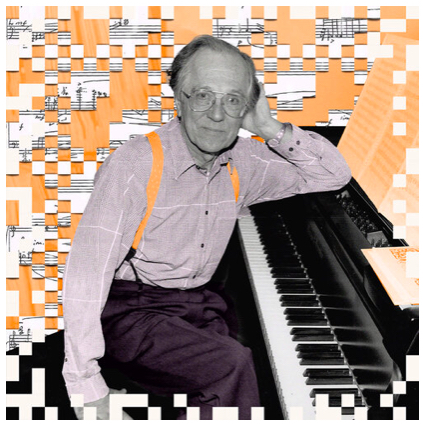
Curated by London soprano Katy Clark, the 2023 Reaney Memorial Lecture celebrates playwright and poet James Reaney’s collaborations with a great Canadian composer, the late John Beckwith (1927-2022). Katy Clark leads a chamber ensemble into wonderful music from Beckwith as well as words from James Reaney (Jamie) and Colleen Thibaudeau. We will also celebrate the friendship of two creative couples – Jamie and Colleen and John Beckwith and Pamela Terry, as well as their families. Katy will be joined by London Pro Musica Choir, Paul Grambo, and guest artists.
Beckwith wrote four operas with Reaney, whom he met at the University of Toronto in the late 1940s. They shared a deep interest in creating and telling authentically Canadian stories with local references – both literary and musical – and universal messages.
Four Beckwith-Reaney operas: Night-blooming Cereus (1960), The Shivaree (1982), Crazy to Kill (1989), and Taptoo! (2003)Screenshot
About the presenter Soprano Katy Clark has sung as a soloist and chorister with companies across North America. She is a DMA candidate at the University of Toronto, where she studies with Nathalie Paulin, and holds a Masters degree in Voice Performance from the University of Michigan. In addition to her work as a performer, Ms. Clark is the founder and artistic producer of the London-based opera company Village Opera.
When: Sunday November 5 at 2:00 pm
Where: Museum London, 421 Ridout Street, London, Ontario N6A 5H4
Night-blooming Cereus revival by Opera Nova at the University of Victoria, 1992
Night Blooming Cereus, a chamber opera in one act, is one of several musical collaborations between poet and playwright James Reaney(1926-2008), who wrote the libretto, and composer John Beckwith (1927-2022).
“Furthering my ambition to compose an opera, I had the great good luck to find a librettist — a writer who understood music. James Reaney shared my love of opera, and early in our friendship in student days we spoke of perhaps collaborating on an original work. In early 1953 I received from him a draft of Night Blooming Cereus. The one-act opera he imagined taking shape as a sort of southern Ontario miracle play. It turned out to be the first of four operatic works we produced together over succeeding decades…”[1]
“[…] We worked on it slowly through the mid-1950s, almost entirely by correspondence, while starting to raise families and work on tenure, he in Winnipeg and I in Toronto. No one seemed interested in staging it, but we were fortunate that CBC Radio offered a broadcast production, and, encouraged by its success, repeated it the following year. In the season 1959-60 we were supported by a small committee of friends to raise funds for a live staging of our own.”[2]
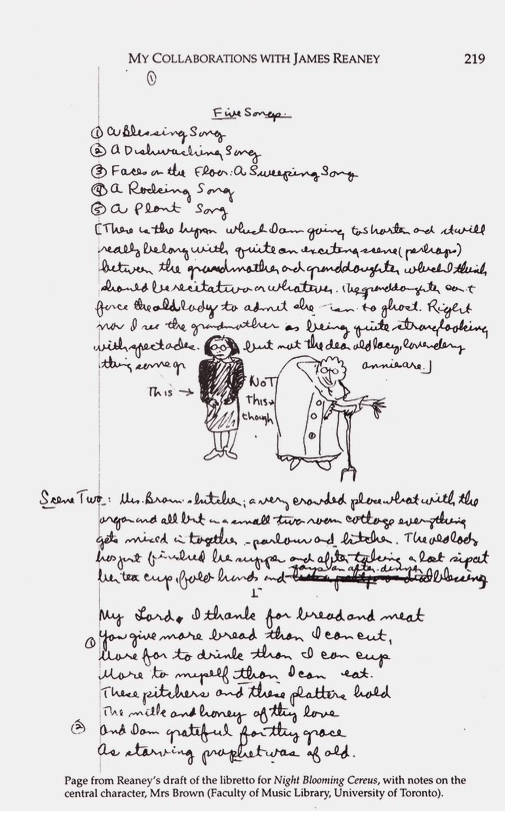
James Reaney describes meeting the demands of the composer for more variety of metre in the draft libretto of Night Blooming Cereus as being “galvanized into, at the time and for me, incredible labours of counting syllables, making parallel lines exactly the same length and finding good clean, clear and sonorous rhymes… From those Manitoba fall nights…I date my birth as a craftsman in words.” [3]
“Night Blooming Cereus” image by designer Louis de Niverville, Toronto,1960.
In Scene 2 of the opera, lonely Mrs Brown tends to her house and her Night-blooming cereus, which is due to flower that evening.
(The dishes are put away, the cupboard door closed, the dishwater somehow disposed of. She gets the broom from behind the stove.)
SWEEPING Look at the faces on the floor In the wood of the boards they are Faces of dust I sweep with a broom, Sweeping the dust in this room. Sweeping sweeping sweeping sweeping Has a sound like weeping If I kept all the dust I’ve swept It would be she I have wept Whose face appears more often than not In the dust and the fire and the knot, And the blowing rain on the window And the tree branches’ shadow Contain your face there! and again there! My lost girl in dust in the air. But it is best to go on sweeping Over the faces better than weeping. Here is the face of an old man peeping. Here is the face of a young man reaping. Here is the face of an old woman sweeping.
(A bit tired with so much activity, she sits in the rocking chair.)
ROCKING Rocking rocking, rocking rocking Very very slowly What I have been doing rocking, Most of my life lately.
Sewing at a shirt or stocking As quickly as I can And what the people to me bring I sew at while rocking
Like selling footsteps to all houses My stitches go through cloth Of caps and nightgowns and blouses Dresses, handkerchiefs and vests.
I sew for everyone here, I the restless stillness, My thread looks through cloth for tear And the butcher’s apron.
The sewing connects each one To myself except for her. She walks about beneath the sun Without my sewing snow.
As the white snow fills fields and lanes, Till they cover me all. Upon my old and long-used bones Rocking and sewing fall.
Page from Reaney’s draft of the libretto for Night Blooming Cereus (see John Beckwith’s 1997 book, Music Papers: Articles and Talks by a Canadian Composer, page 219)
Summer 2023: Sticks and Stones at Blyth’s Outdoor Harvest Stage (Photo courtesy The Blyth Festival)
Part I: STICKS & STONES Friday August 4 Tuesday August 8 Friday August 11 Tuesday August 15 Friday August 18 Tuesday August 22 Friday August 2 Tuesday August 29 Friday Sept 1
Part II: THE ST. NICHOLAS HOTEL Saturday August 5 Wednesday August 9 Saturday August 12 Wednesday August 16 Saturday August 19 Wednesday August 23 Saturday August 25 Wednesday August 30 Saturday September 2
Part III: HANDCUFFS Thursday August 3 Sunday August 6 Thursday August 10 Sunday August 13 Thursday August 17 Sunday August 20 Thursday August 24 Sunday August 27 Thursday August 31 Sunday September 3
Part I: STICKS & STONES Friday August 4 Tuesday August 8 Friday August 11 Tuesday August 15 Friday August 18 Tuesday August 22 Friday August 2 Tuesday August 29 Friday Sept 1
Part II: THE ST. NICHOLAS HOTEL Saturday August 5 Wednesday August 9 Saturday August 12 Wednesday August 16 Saturday August 19 Wednesday August 23 Saturday August 25 Wednesday August 30 Saturday September 2
Part III: HANDCUFFS Thursday August 3 Sunday August 6 Thursday August 10 Sunday August 13 Thursday August 17 Sunday August 20 Thursday August 24 Sunday August 27 Thursday August 31 Sunday September 3
Summer 2023 — The Blyth Festival is bringing James Reaney’s The Donnelly Trilogy to Blyth’s Outdoor Harvest Stage. Director Gil Garratt has adapted the three plays especially for this outdoor setting.
The three plays,Sticks and Stones, The St. Nicholas Hotel, and Handcuffs will all be performed by one single company of ten actors, who will tell the tale from the killing of Patrick Farrell, to Johannah Donnelly’s march to Goderich to save her husband from the gallows, to the Stagecoach wars, to the Queen’s Hotel, to the Vigilance Society in the Cedar Swamp Schoolhouse, to the fiery February night when justice, revenge, and murder were left indistinguishable in the ashes.
This will be the first time in decades that all three of these touchstone plays have been performed in repertory with each other, affording audiences the chance to take in the whole cycle over three nights.
Gil Garratt’s thoughts on the three plays:
“I believe 2023 is the perfect time to re-ignite the telling of the Donnelly story in Blyth. At its heart, this is a story about grit, family, betrayal, the erosion of community, the rise of secret societies, the shadow of conspiracy, and the limits of faith. The show will be filled to the brim with folk music, stagecoaches, and live fire in the night.”
The Donnelly Trilogy by James Reaney Adapted, abridged, and directed by Artistic Director Gil Garratt Part I: Sticks and Stones, June 22-September 1 Part II: The St. Nicholas Hotel, July 13-September 2 Part III: Handcuffs, August 1-September 3
The Blyth Festival’s replica of the Donnelly stagecoach from Paul Thompson’s 2001 play Artistic Director Gil Garratt as Robert Donnelly in Blyth’s 2016 show The Last Donnelly Standing.
In the 1976 Alumni Gazette (UWO) article “Souwesto Theatre: A Beginning” excerpted here, James Reaney describes the years he spent researching the Biddulph Tragedy of February 4, 1880 and how the knowledge he gained about the Donnellys’ world helped create the Donnelly trilogy.
Orlo Miller, who wrote the historical book The Donnellys Must Die (1962), had based his research on local courthouse documents of the time. Miller’s collection of relevant documents was available to Reaney at the University of Western Ontario’s Regional Archives:
“One of my early experiences back here* […] was to go with my father to hear Orlo Miller lecture at Middlesex College on his recent book The Donnellys Must Die.As a child I had heard the story of this tragic family from our hired man, and my interest was revived now, especially when I heard that Mr. Miller had, in the thirties, collected a huge heap of legal and municipal documents with relevance to the Biddulph Tragedy from the attics of the courthouses at Goderich and at London […]. [In the archives] I entered the really magic world of the past which can only be reached through such fragile ladders and windows as bundles of counterfoils from Sheriff’s cheque books, Court Criers’ Bills, Surveyors’ Notebooks, Chattel Mortgages (whole inventories of people’s furniture and beasts and implements), Jury Lists, Assessment Rules, Crown Attorney Letterbooks and, last of all, mountains of blue paper containing an endless stream of Information and Complaint – the term used for the form you had to fill out when some fellow pioneer had dogged your cattle, tried to pour boiling water on you, torn down your fence, milked your cow furtively or torn down your house with you inside. [Alumni Gazette 1976, pages 14-15]
One of my first research lessons was to train myself to read nineteenth century handwriting and abbreviations; for example, for about a year I somehow assumed that “Inft” meant “infant” so that when you read “.… and poured boiling water over the Inft” I naturally saw the very darkest picture imaginable; suddenly one day it dawned on me that the early Huron District backwoods scene was indeed horrible, but that “Inft” did at least stand for an Informant fifty years old and perfectly capable of running away! Now these documents where a Plaintiff accuses a Defendant of doing something are extremely dramatic, partly because of the variety of things accused, and I made them into one of the choral passages in Sticks and Stones (Part One) in order to show the social situation at its tumultuous litigious mad worst, which is always the dramatic best! [.…] Propelled by the magnetic names “Donnelly” and “Biddulph” I read all the Huron District and County Archives from the beginning to 1863 when Biddulph Township leaves Huron County; I knew that I wanted to write a play about these people, but I wanted to get inside their world first and those hundreds of boxes filled with blue paper – it gets white about 1870 – were the keys to this state. Whoever filed away things in the Huron County Courthouse filed away everything, and I am eternally grateful […]. [H]ere you often get pictures of whole families talking at each other in a way that no history book ever thinks of showing you: one of my favourite lines from the trilogy – “It’s not enough that we should starve, but we must freeze to death as well” – comes right out of a Chancery document. [Alumni Gazette 1976, page 15]
Now there is probably a reason for this material being dear to a dramatist’s heart; a court case is after all a drama – with its lawyers arguing so one-sidedly against each other, with its witnesses opposing each other too and with a Judge, who quite frequently in the early days, climaxes everything with a knock on the head or wallet all around! If at the time you were to have taken a Constable’s Bill to the constable who had just filled it out and told him that it would make a good scene in a play he would have laughed at such foolishness. But time going by changes all that and scholars and artists have as their duty the finding out of just how time does give ordinary things meaning. After the five years were over and I found myself with Five Legal Blue Binders with transcribed material, I found that the three plays of The Donnellys corresponded to three of these binders. All – all!?, I had to do was pare things down from 200 hours of dialogue and action to three hours per binder! [Alumni Gazette 1976, page 15]
After a series of workshops with my own group, the Listeners, at Alpha Centre and Mini-Theatre, where we used this material in prototypes of the Donnelly plays called “Antler River” and “Sticks and Stones”, I did some more shaping until in 1972 I was invited down to Halifax to work with Keith Turnbull, a former student here on the material using local children and professional actors. The actors wolfed down the contents of the binders – and I think that in their performances you can see that they have genuinely touched some area of time not our own […]. [Alumni Gazette 1976, page 15]
This article originally appeared in Western’s Alumni Gazette in 1976 (pages 14-16). Read the full article here.
Miriam Greene, Patricia Ludwick, Jerry Franken, and David Ferry in James Reaney’s Sticks and Stones at the Tarragon Theatre in Toronto, 1973.
* In 1960 James Reaney left his first teaching post at the University of Manitoba and came to teach in the Faculty of English at the University of Western Ontario in London, Ontario: “One of the reasons I decided to leave my first teaching post in Manitoba and come to this campus was that I wanted to find out more about the land of my birth – Southwestern Ontario, or as Greg Curnoe very aptly calls it – Souwesto.” [page 14]
Souwesto history continues to inspire local playwrights: Jeff Culbert has written a one-man musical version The Donnelly Sideshow, Chris Doty restaged The Donnelly Trial in 2006, and Paul Thompson wrote The Outdoor Donnellys (2001) and The Last Donnelly Standing (2016).
Gil Garratt as Robert Donnelly in The Last Donnelly Standing (Photo by Terry Manzo courtesy The Blyth Festival 2016.)
Thank you for joining us at Wordsfest on November 6th to hear author Terry Griggs read the late Stan Dragland’s essay on his forthcoming bookJames Reaney On the Grid. We were honoured to have Terry give voice to Stan’s words and illuminate his thoughts on James Reaney.
Terry Griggs at Museum London, November 6, 2023
Many thanks to Wordsfest for hosting the lecture and to Josh Lambier and Greg de Souza for their help in launching the presentation.
November 6, 2023: Moderator James Stewart Reaney takes questions for Terry Griggs.
( ( ( 0 ) ) ) Link to an archived recording of the lecture here. The text for Stan Dragland’s essay is available here.
Stan Dragland (1942-2022)Stan Dragland’s book James Reaney on the Grid will be published in 2023
The James Reaney Memorial Lecture series celebrates the life and work of Southwestern Ontario poet and dramatist James Reaney, who was born on a farm near Stratford, Ontario and found a creative home in London, Ontario.
Our thanks to Wordsfest and the London Public Library for their support of the lecture series, and to Poetry Stratford and the Stratford Public Library for their support in hosting the earlier lectures (2010-2015).
“Near Fraserburg” Watercolour painting by James Reaney, Fall 1985September 1975: James Reaney at the Nihilist Picnic, Poplar Hill, Ontario
There are two events celebrating the work of dramatist James Reaney this month and next:
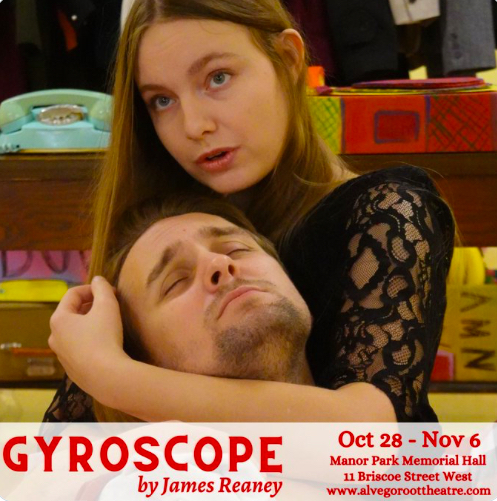
Patricia Nacamoto as Mattie Medal in Gyroscope: “Is it true, Gregory La Selva, is it true that one of the conditions of your marriage was that, were that you were never, never to read her stuff?”
October 28-30 and November 4-6: James Reaney’s play Gyroscope, directed by Adam Corrigan Holowitz and presented by AlvegoRoot Theatre.
All performances at Manor Park Memorial Hall, 11 Briscoe Street, London, Ontario.
( ( 0 ) ) Listen to an interview with Adam Corrigan Holowitz and Janis Nickleson (who played Hilda La Selva in the 1981 production of Gyroscope!): Gyroscope Conversations on Soundcloud
November 6 at 12:00 noon at Wordsfest: The James Reaney Memorial Lecture at Museum London. Terry Griggs, author and former student of the late Stan Dragland (1942-2022), will present “James Reaney Off the Grid”, the lecture Stan had planned to give.
Wordsfest is at Museum London, 421 Ridout Street North, London, Ontario.
Sunday November 6 at 12:00 pm EDT — Join us in-person or by webinar at Wordsfest for the 13th Annual James Reaney Memorial Lecture. We are honoured to have Terry Griggs, author and former student of the late Stan Dragland, present “James Reaney Off the Grid”, the lecture Stan had planned to give.
Stan Dragland (1942-2022)
For Dragland, the lecture he gave at Wordsfest in 2019 only scratched the surface of what he wanted to say about James Reaney’s work. “In my previous lecture I pointed out that he was only sometimes limited as an artist by the grids he so loved. Today I want to stress the Reaney who knew how important it is to be able to pry or bounce one’s mind outside of inherited, imprisoning systems, who knew how to improvise, who could make plays out of the simplest things he found in his own environment.”
When: Sunday November 6 at 12:00 pm Where: Wordsfest at Museum London, 421 Ridout Street North, London, Ontario
The James Reaney Memorial Lecture series celebrates the life and work of Southwestern Ontario poet and dramatist James Reaney, who was born on a farm near Stratford, Ontario and found a creative home in London, Ontario.
October 28 to November 6 — Don’t miss AlvegoRoot Theatre‘s production of James Reaney’s play Gyroscope later this month. For Director Adam Corrigan Horowitz, this play is “a shape-shifting comedy of marriage, art and passion!”
About the play: When poet Hilda La Selva got married, she made her husband Greg swear to never read any of her poetry, a vow he inevitably fails to keep. As their relationship lists and tilts, they are pursued by an intrepid PhD student intent on putting their marriage under the microscope.
The performers are Kydra Ryan, Steven Barber, Patricia Nacamoto, Elizabeth Durand, and Dan Ebbs.
Content Advisory: Gyroscope contains sensitive content including references of suicide. If you would like more information before purchasing a ticket please contact AlvegoRoot.
To celebrate National Poetry Month, here is the “April” eclogue from James Reaney’s long poem A Suit of Nettles. April ARGUMENT: With Duncan as judge the geese hold a bardic contest in honour of Spring. [DUNCAN RAYMOND VALANCY] Here is a kernel of the hardest winter wheat Found in the yard delicious for to eat.…
The Farm ( ( ( 0 ) ) ) For more about James Reaney’s poems and a look back at the family farm where James Reaney grew up, see the 1971 TVOntario documentary “James Reaney” in the Canadian Writers series. The Farm There was a farm divided in two1/2 of it surly brick maker ownedswale…
2026 — James Reaney’s centenary year — is off to a good start with two plays based on his work from London’s AlvegoRoot Theatre. On February 20-21, AlvegoRoot presents two encore performances of Sleigh Without Bells: A Donnellys Story — a short story by James Reaney from The Box Social and Other Stories (1996). Adam Corrigan Holowitz reprises his solo…










 James Reaney