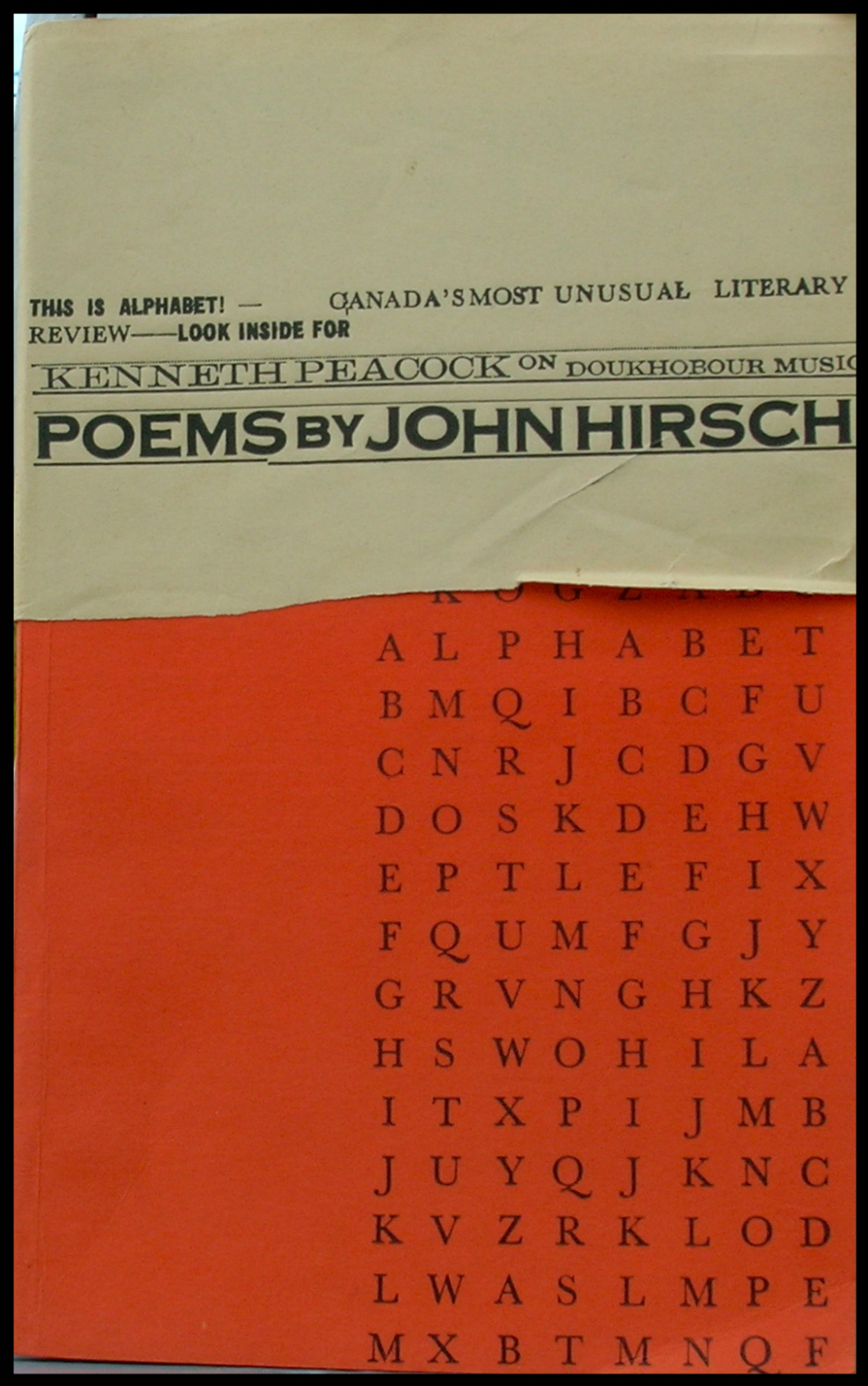
From Alphabet Issue 11 (1966), here is John Hirsch’s poem “My Grandfather”:
My Grandfather
Old men love the sun. My Grandfather, eighty four, in black bowler, black overcoat, in the same chair through Spring, Summer and Fall always against the same white-washed wall sat soaking up the sun. Hands spread on his knees— Skin like dried guts cracked with veins like the indigo ink he dipped his pen in to write in velvet covered, silver-locked ledgers.
Dozing in the sun his skin drew the heat till he seemed to glow like a black swathed mummy of a gold-leafed Pharaoh.
John Hirsch, 1966
John Hirsch (1930-1989) lost his family in the Holocaust and came to Winnipeg, Canada as a war orphan in 1947. With the help of his foster family, he pursued his love of the theatre and became one of Canada’s most renowned directors. John Hirsch directed James Reaney’s play Names and Nicknames at the Manitoba Theatre Centre in Winnipeg in October, 1963.
Here is James Reaney’s poem “The Bicycle” — the Twelfth Letter from Twelve Letters to a Small Town, a suite of poems James Reaney wrote for composer John Beckwith in 1962.
The Bicycle
Halfway between childhood & manhood,
More than a hoop but never a car,
The bicycle talks gravel and rain pavement
On the highway where the dead frogs are.
Like sharkfish the cars blur by,
Filled with the two-backed beast
One dreams of, yet knows not the word for,
The accumulating sexual yeast.
Past the house where the bees winter,
I climb on the stairs of my pedals
To school murmuring irregular verbs
Past the lion with legs like a table’s.
Autumn blows the windfalls down
With a twilight horn of dead leaves.
I pick them up in the fence of November
And burs on my sweater sleeves.
Where a secret robin is wintering
By the lake in the fir grove dark
Through the fresh new snow we stumble
That Winter has whistled sharp.
The March wind blows me ruts over,
Puddles past, under red maple buds,
Over culvert of streamling, under
White clouds and beside bluebirds.
Fireflies tell their blinking player
Piano hesitant tales
Down at the edge of the bridge through the swamp
Where the ogre clips his rusty nails.
Between the highschool & the farmhouse
In the country and the town
It was a world of love and of feeling
Continually floating down
On a soul whose only knowledge
Was that everything was something,
This was like that, that was like this–
In short, everything was
The bicycle of which I sing.
September 1966: James Reaney on Richmond Street bicycling to Middlesex College (from William Ronald’s CBC arts magazine show “The Umbrella”)September 1966: James Reaney bicycling to Middlesex College on the campus of the University of Western Ontario (from William Ronald’s CBC arts magazine show “The Umbrella”)
Twelve Letters to a Small Town was first published in 1962 by the Ryerson Press. The poems were specially written for composer John Beckwith, who then set them to music for broadcast on CBC Radio’s “Wednesday Night” program.
These photos are from September 1966, when painter and broadcaster William Ronald brought a CBC TV crew to London, Ontario to interview Greg Curnoe, Jack Chambers, and James Reaney for the arts magazine show “The Umbrella.” In ¨The Umbrella¨ segment on London, Ontario’s art scene, William Ronald praises James Reaney as “the best known bike rider in London.″
James Reaney’s drawing for the poem “The Bicycle” from Twelve Letters to a Small Town (1962)
Many thanks to the editors of Brick (Issue 89, page 182) for printing this poem by Colleen Thibaudeau.
This Elastic Moment
Yes we are that too: we are everything who feel it.
Everything that has meaning has the same meaning as angels: these
hoverers and whirrers: occupied with us.
Men may be in the parkgrass sleeping: or be he who sits in his
shirtsleeves every blessed Sunday: rasping away at his child who
is catching some sunshine: from the sticky cloud hanging over the
Laura Secord factory: and teetering on the pales of the green
iron fence: higher up than the briary bushes.
I pass and make no sound: but the silver and whirr of my bicycle
going round: but must see them who don’t see: get their fit, man
and child: let this elastic moment stretch out in me: till that
point where they are inside and invisible.
It is not to afterward eat a candy: picket that factory: nor to
go by again and see that rickety child on the fence.
When the band of the moment breaks there will come angelic
recurrence.
Colleen Thibaudeau, 1977
Also in Issue 89 of Brick, Stan Dragland remembers Applegarth Follies, another London, Ontario publisher:
“… Colleen Thibaudeau’s Ten Letters, the first chapbook I published [under the forerunner of Brick Books], was printed offset by Mike Niederman at Applegarth Follies. I had set the text in the Baskerville type donated by James Reaney to The Belial Press at the university after he completed his ten-year run of Alphabet. One of Applegarth’s presses was the old foot-pumped jobber on which Reaney had printed his magazine. There was plenty of literary interconnection in London back then.”
By special request — and in honour of mothers and grandmothers everywhere — here is a poem by Colleen Thibaudeau.
My Granddaughters Are Combing Out Their Long Hair
my granddaughters are combing out their long hair sitting at night
on the rocks in Venezuela they have watched their babes
falling like white birds from the last of the treetop cradles
they have buried them in their hearts where they will never forget
to keep on singing them the old songs
brought down to earth they use twigs, flint scrapers acadian
their laughter underground makes the thyme flower in darkness
my granddaughters are thin as fishbones & hornfooted but they are
always beautiful under the stars: like little asian paperthings
they seem to open outward into their own waterbowl
mornings they waken to Light’s chink ricocheting
off an old Black’s Harbour sardinecan.
Reduce them the last evangelines make them part of the stars.
my granddaughters are coming out by night combing their burr
coloured hair by the rocks and streamtrickle in Venezuela
they are burnt out as falling stars but they laugh
and keep on singing them the old songs.
Colleen Thibaudeau, 1977
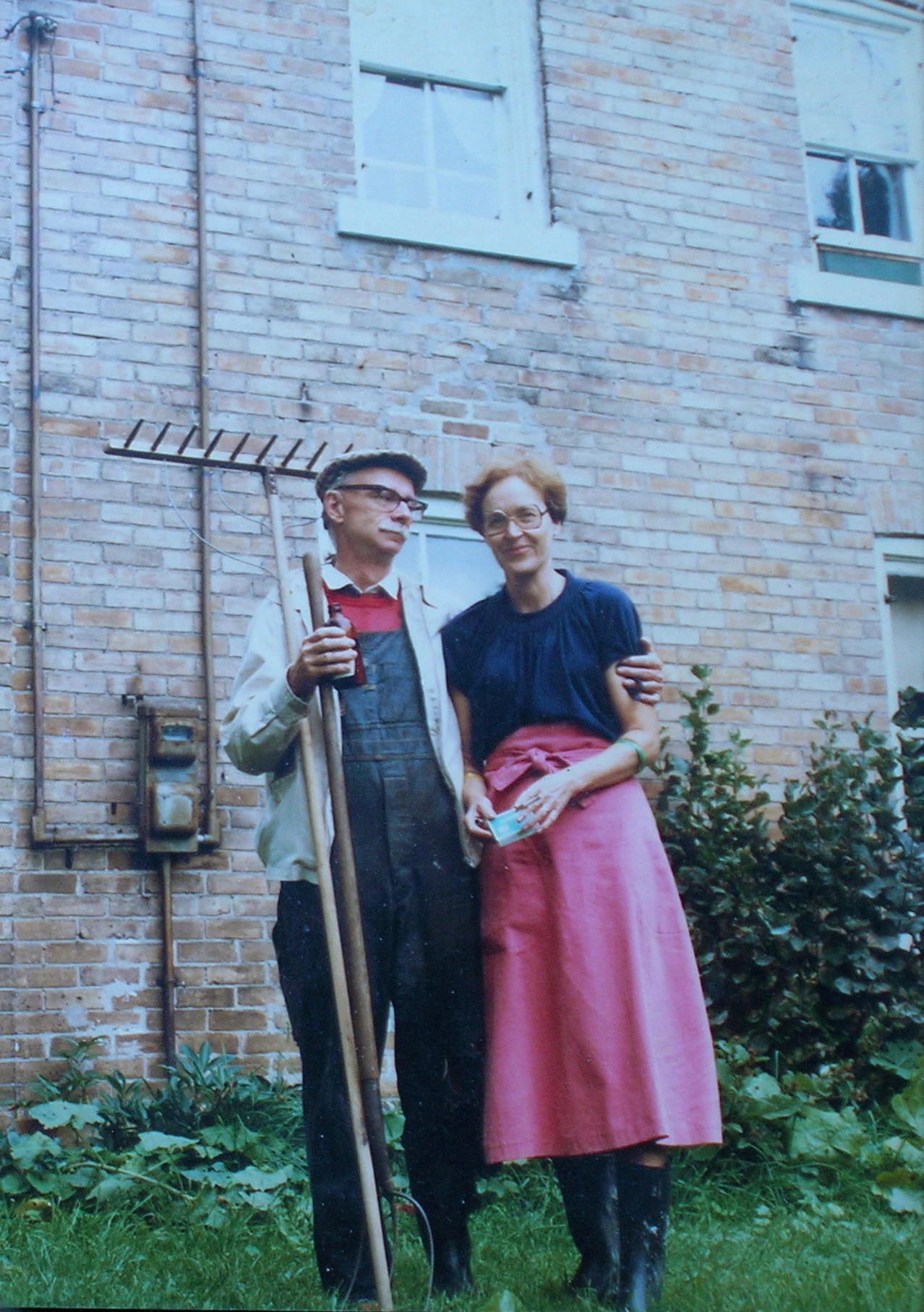
Colleen Thibaudeau, Summer 1977 in London, Ontario
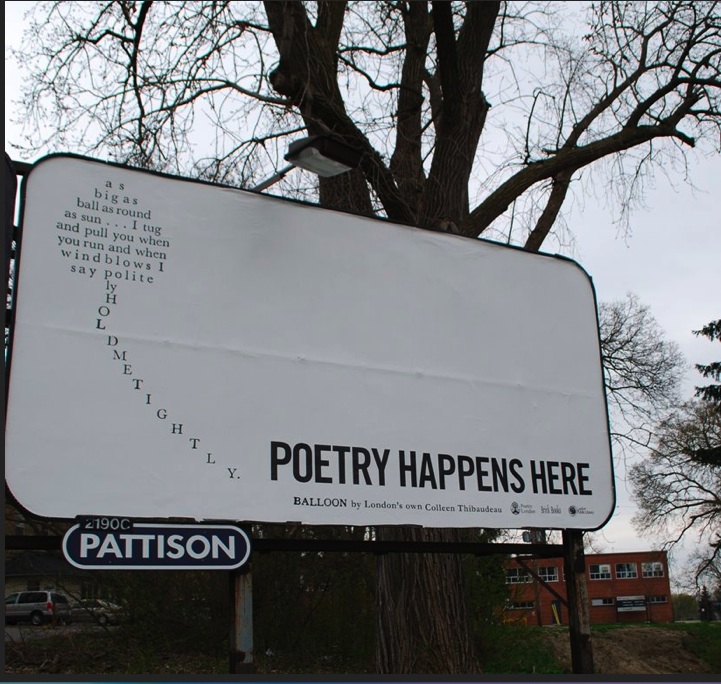
“Balloon” by Colleen Thibuadeau in London, Ontario. Photo by Chrsitine Walde, 2012
Colleen knew about the plan to put her poem on a billboard earlier this year before she passed away and was thrilled to think that her poem would be writ large for all to see. Thank you so much!
“Balloon” is a concrete poem and was first published in 1965 in Colleen’s book Lozenges: Poems in the Shapes of Things by James Reaney’s Alphabet Press. For this month only, the London Public Library has free postcards of “Balloon.”
Colleen Thibaudeau Reaney, 1925-2012 Photo by Diane Thompson, 1997
We are sad to learn of the passing of Jay Macpherson, who was a longtime friend of James and Colleen Reaney and their family. Jay was a poet and University of Toronto professor who first came to know the Reaneys in the 1950s. She passed away on March 21, 2012.
Jay Macpherson, 1931-2012
Jay Macpherson will long be remembered for her kindness and intelligence, and her brilliant poetry. Here are two poems by Jay Macpherson that James Reaney published in the first issue of Alphabet in September 1960.
The Love-Song of Jenny Lear
Come along, my old king of the sea,
Don’t look so pathetic at me:
We’re off for a walk
And a horrid long talk
By the beautiful banks of the sea.
I’m not Arnold’s Margaret, the pearl
That gleamed and was lost in a whirl,
Who simpered in churches
And left him on porches,
But more of a hell of a girl.
Poor old fish, you’re no walker at all,
Can’t you spank up that elderly crawl?
I’ll teach you to hurdle,
Led on by my girdle,
With whalebone, elastic and all.
We’ll romp by the seashore, and when
You’ve enough, shut your eyes and count ten.
I’ll crunch down your bones,
Guts marrow and stones,
Then raise you up dancing again.
Love-Song II of Jenny Lear
Were I a Shakespearean daughter,
Safe restored through fire and water,
You the party in the crown
—Someone get the curtain down.
Jay Macpherson, 1960
“Six Toronto Poets”, Folkways Records, 1958
Jay Macpherson won the Governor General’s Award for Poetry in 1957 for her book The Boatman. She can be heard reading her poem “The Boatman” on “Six Toronto Poets,” a recording made in 1958 on Folkways Records. (James Reaney also reads his work on this album, along with Margaret Avison, W.W. Eustace Ross, Raymond Souster, and Anne Wilkinson.)
Perhaps the best way to conclude what should be said in praise of The Boatman is that it shows you how to get from “here to there”. If “here” is this world and “there” the world of Eternity, then this book of poems shows the reader all the necessary steps of the way. These are steps that I am sure an increasingly great number of readers and writers in Canada are going to find very exciting to take.
(Excerpted from James Reaney, “The Third Eye: Jay Macpherson’s The Boatman“, published in Canadian Literature, Issue No. 3, pages 24-24, Winter 1960, page 34.)
Colleen Thibaudeau Reaney, poet and beloved wife of James Reaney, passed away on February 6, 2012 in London, Ontario. Colleen will long be remembered by her family, neighbours, and many friends.
The Star Over the House Quilt (Last night I dreamed…)
Last night I dreamed about you all under the Star Over the House Quilt;
I remember mother making it: the little squares of jonquil window lit
The doors, shutters often green. Your block has still the hollyhock (french knots)
Mine has the lilac (front yard), looking hard the lilacs still are blooming there,
The real ones down — time and town development don’t affect the quilt.
Each of us, house body, and the star, the star-filled head;
Each of us bedded down lifetime dreams the star-filled town
Waking goes walking the houses of our own making, talking the blocks away.
I might move into you taking on hollyhock but it’s not
Me really just the dreaming of the star-filled head.
The Star Over the House Quilt she made it extra size;
Her eyes puzzled out each stitch; she declared her fingers to be all pricked
And she licked the blood from roofs, sidewalks, from the small yards
With the ever-blooming trees pointing to the stars
Of the Star Over the House Quilt.
Sheila and Colleen in St. Thomas, Ontario, 1942
Colleen Thibaudeau and James Reaney, 1949
James Reaney and Colleen Thibaudeau near Stratford, Ontario, 1982.
Update March 3, 2012: In tribute to Colleen Thibaudeau and her work, the London Public Library, Brick Books, and Poetry London have commissioned a billboard with her poem “Balloon”. The billboard will go up sometime in the week of March 26, and there will be a a “Balloon” billboard launch on Saturday April 14 at 3:00 pm.The library is also printing postcards of “Balloon” to hand out during April, which is National Poetry Month.
Here is a poem James Reaney wrote about the 1939 Royal Visit to Canada by Their Majesties King George VI and Queen Elizabeth.
The Royal Visit
When the King and Queen came to Stratford
Everyone felt at once
How heavy the Crown must be.
The Mayor shook hands with their Majesties
And everyone presentable was presented
And those who weren’t have resented
It, and will
To their dying day.
Everyone had almost a religious experience
When the King and Queen came to visit us
(I wonder what they felt!)
And hydrants flowed water in the gutters
All day.
People put quarters on the railroad tracks
So as to get squashed by the Royal train
And some people up the line at Shakespeare
Stayed in Shakespeare, just in case—
They did stop too,
While thousands in Stratford
Didn’t even see them
Because the Engineer didn’t slow down
Enough in time.
And although,
But although we didn’t see them in any way
(I didn’t even catch the glimpse
The teacher who was taller did
Of a gracious pink figure)
I’ll remember it to my dying day.
Their Majesties King George VI and Queen Elizabeth on board the royal train, May 31, 1939.
The Royal Visit is included in James Reaney’s first collection of poems The Red Heart (1949). The poem also appears in James Reaney’s 1967 play Colours in the Dark, where it follows an actual letter a child wrote to his father describing how the Royal train failed to slow down on that day (see Act I Scene 13).
Thank you all for coming to the lecture on Sunday afternoon to hear Colleen Thibaudeau, James Reaney’s widow, talk about their early days together and read from some of his works.
For those of you who were unable to attend, Stratford Beacon Herald reporter Mike Beitz wrote about Thibaudeau’s talk here.
Our thanks also to the organizers of the lecture at the Stratford Public Library, Charles Mountford, Anne Marie Heckman, and Sam Coghlan. Colleen Thibaudeau especially appreciated all the help she has had from her family and others; she couldn’t have done it without you.
One of James Reaney’s poems that Colleen Thibaudeau read was “White Grumphies, white snow” from Souwesto Home, published by Brick Books.
“White Grumphies, white snow…”
The students of Agricultural Diploma, their fathers
Grow square miles of blue flowering flax near
Pilot Mound and square miles of yellow mustard which
I saw as I drove out from Minnesota,
Well knowing that in the fall, in the autumn,
We would be teaching them Robert Penn Warren’s Understanding Poetry, Austen’s Pride and Prejudice,
Somerset Maugham, Joseph Conrad, Emily Dickinson.
As I climbed the stairs to their classroom
Over the Rupertsland Agricultural Auditorium,
Prepared to teach them “I heard a fly buzz when I died,”
I heard them splitting desk into kindling
For a bonfire in a waste paper basket where they
Burnt the texts on the course one by one,
Rainbow-coloured poems and prose they burnt,
Book by book, as I taught them.
As verbal virgins they were tougher
Than such pastoral nymphs as Diana or urban ones
Such as Athena.
However, a day or two later, taking a random stroll
Across the winter campus, I saw,
Around the corner of the Swine Barn, a herd
Of white, white pigs being driven into the barn
By my Aggie Dip students each with
A very proper and even beautiful pig-driving stick.
Was it their mid-term test in pig-herding?
It must have been.
The whiteness of the piggies against the whiteness of the snow
Presented them with optical problems.
They had trouble seeing me as well.
In fact not one of them did, for I
Was wearing this poem.
James Reaney, 2005
My editor, Stan Dragland, wishes me to explain “White Grumphies, white snow.” They are white pigs herded by agricultural students on a snowy day.
James Reaney and Colleen Thibaudeau near Stratford, Ontario, 1982.
Richard Stingle, a long-time friend and colleague of James Reaney, has kindly given us permission to share his talk about A Suit of Nettles, which he presented at the book launch on May 25, 2010 in London, Ontario. (A new edition of A Suit of Nettles is available from The Porcupine’s Quill.)
Richard Stingle at the London Public Library on May 25, 2010
A learned poet writes A Suit of Nettles
By Richard M. Stingle, May 25, 2010
In 1948, Jamie, Colleen and I were graduated from the Honours English programme at the University of Toronto, a programme that was centred on learning in several different areas of the Humanities. Ironically, in that same year of 1948, a history of English literature, edited by A. C. Baugh, included a study of eighteenth-century literature in which George Sherburn states that
“At the beginning of Alexander Pope’s career a hostile critic could assure him: ‘You have not that sufficient learning necessary to make a poet.’ The idea of learning as essential to a poet perished in the eighteenth century. Stephen Duck, the thresher poet, Anne Yearsley, the milkmaid and Thomas Chatterton all aspired to the role of natural genius — and to the grief of possible sponsors seemed deficient in quality.”
Even Robert Burns sang:
“Gie me a spark o’ Nature’s fire,
That’s a’ the learning I desire;
Then, though I drudge thro dub and mire
At pleugh or cart,
My Muse, tho hamely in attire,
May touch the heart.
But surely Sherburn overstated the case in saying that learning was no longer essential. As Jay Macpherson has rightly said, Jamie was “of the learned kind of poet.” The tension between those in the learned tradition and those who confine poetry to the theme and language of the inspired “common man” has continued for two centuries and sometimes within the same poet. Wordsworth may champion the language such as men do use but proceeds to pull out all the stops of the epic in The Prelude and The Excursion. Tennyson’s preface The Epic has one character destroying his own attempt at epic, “Why take the style of those heroic times” (34), “And why should any man/Remodel models” (35-36). But Tennyson immediately proceeds to remodel Morte d’Arthur and later the whole Arthurian epic in Idylls of the King. William Morris also remodeled Nordic epic in his Sigurd the Volsung and Yeats, Joyce, Pound and Eliot continued this process as well. And Jamie was, as Germaine Warkentin has also affirmed, a learned poet.
A Canadian poet said once of Jamie that he was a poet (especially in the lyrical first volume of The Red Heart), but Northrop Frye killed him. This was nonsense. Frye and Jamie were both products of the old Honours programme at the University of Toronto. In Honours English, the student took nine courses in each year and reinforced his central study (English) with courses in three other Honours areas: in Frye’s case, Latin, Greek and Philosophy; in Jamie’s case, Latin, Greek and History. Both men were also very competent in playing the piano. I remember Jamie’s playing Bach, Debussy and his own “Penny Arcade.” And Jamie was painting while Frye was writing on painting in Canadian Forum. It is true that at first Jamie thought that the Modern era was slighted in the Honours programme (as it was) and that concepts were emphasized over the metaphors of mythos (as they were), but when Jamie went to teach at the University of Manitoba in 1949, he filled out what he had found lacking. He eagerly read Frye’s Fearful Symmetry, studied Blake and was writing furiously and telescoping his development in forms from lyric to epic to drama. When, a couple of years later, I joined him teaching in Winnipeg, Jamie was developing as a learned poet, and beginning to work with John Hirsch and Tom Hendry. Like Virgil, Spenser and Pope, who all began by writing pastoral eclogues, he was beginning to write dialogues combining romance and satire in his remodeling of Spenser’s Shepherd’s Calendar and, like Virgil, Spenser and Pope, he proceeded to writing epic works. In A Suit of Nettles, he was already becoming more complex, in entwining the eclogue with that very Canadian genre, the beast-fable, used by Ernest Thompson Seton, Sir Charles D. Roberts and others, the most recent being Yann Martel. As in the Canadian version of the form, Jamie’s geese remain geese as well as acting out human ideas, as Jim Westergard’s engravings in the new issue show. Jamie was, of course, adapting the folk-tale of The Seven Swans of the Brothers Grimm for the central metaphor of Branwell’s suit of nettles and the unchanged swan’s wing.
In the mid-fifties Jamie went back to Toronto, to strengthen his professional position with a Ph.D., but even more to bring all that he had learned and experienced earlier into Frye’s liberating idea that all literature is made out of literature, all art out of art. As Frye wrote in Myth and Freedom (1985): “But we can never understand the poet’s authority without Vico’s principles of verum factum, that reality is in the world we make and not in the world we stare at” (122). Frye’s modal criticism (Romance, Irony, Tragedy and Comedy) allowed Jamie to shape and contain what he knew into circles that become so important in Jamie’s work. He studied Blake with Frye, and wrote his Ph.D. dissertation, “Spenser’s Influence on Yeats,” under Frye’s direction.
Within the whirling circle of the year in A Suit of Nettles are circles within which speakers with opposed visions of language and poetry contend, as in the “July” eclogue in which Anser, the “progressive” teacher, derides Valancy (Isabella Valancy Crawford of Paisley) for praising Strictus, the teacher in her youth who taught his goslings knowledge of science, myth, history, biblical patterns and metaphors and the novels of Bronte and the poetry of Milton. Anser scornfully replies “how useless so far as the actual living of life is concerned.” In the “August” eclogue, this approach is reinforced in Jamie’s attack on Scrutumnus (representing F. R. Leavis) as the literary critic who is behind Anser’s point of view — a confining of literary experience to the “felt experience” of essentially rudimentary feeling and language. Reaney, of course, could also depict what A Suit of Nettles presents as Scrutumnus’ ideal of “Pigs in the sties of Venus,” but Jamie refused to confine his poetry or limit his language to one level. Jamie could present a flower in a corner fence on the farm more precisely than Tennyson could his “flower in the crannied wall” and as precisely as any Imagist poet. But he moves out to include all levels of experience and, instead of limiting language to the simplest level, brings all levels of language into multiple relations through complex counterpoint.
Many of his central metaphors are circles revolving within the cycle of the year on an Ontario farm (Jamie’s farm near Stratford). At the fall fair (Stratford Fall Fair) the circle of Western philosophy revolves in the merry-go-round and on the ferris wheel the creation myths of mankind rise and fall. It is not surprising that Jamie rejoiced in the visions of wheels within wheels a-turning in the Book of Ezekiel, Chapter I.
The dominant stanza of A Suit of Nettles is the Spenserian Sestina, but Jamie is encyclopaedic in his use of other stanzas as well. So is he in his use of metrical variation from the alliterative pounding of Beowulf, as in the “Drunken Preacher’s” sermon in “September” —
Lo, it was the last supper, I leader from gutter
Tell you tall and short tinkery folk gathered.
What did those white souls eat while their Lord talked:
I don’t know indeed I don’t, maybe sandwiches.
— to the light graceful elegiac song of dimeters and trimeters of the first poem in “October” —
Sing to us for the frost
Is closing the pond,
The elms their leaves have lost
And the singing birds are gone.
— and through other variants such as hexameter and pentameter, as in the “May” Eclogue. I think that Jamie, like Wagner, was striving to achieve a “Gesamtkunstwerk,” a union of all the arts, the expression of all creativity, and he certainly wrote through form after form and finally reached drama and opera to find such appropriate encyclopaedic media. In A Children’s Story, the latest novel by A. S. Byatt, two characters are also striving to realize Wagner’s desire:
Anselm Stern said what was needed was music like Richard Strauss. No, no, said Steyning, something fairy-like, something between “Greensleeves” and The Ring of the Nibelungs (515).
And sometimes we hear in Jamie’s work this intricate, encyclopaedic sound, and hear it first in A Suit of Nettles. Certainly we hear it clearly in The Donnellys, in Gyroscope and in Crazy to Kill.
In Imprecations in 1984, Jamie pronounces a resounding series of curses through three female voices, those of “Edith Sitwell, Judith Donnelly, and a whore on Queen St. in Toronto.” From their energy, the speaker-poet derives the power to lay waste to those who abuse the planet and their fellow creatures, those who destroyed the Honours programme at Toronto, those traitorous teachers who tell their students not to memorize anything and rely on their own opinion, and those who use the political power of the Ministry of Education to expel poetry from the schools. Note the emphasis upon the Honours programme — I think that I shall read that section —
Oh ye hippies and merry draft dodgers who in the sixties
Came to University College stampeding my dear old professors,
Mobbing them till they scrapped the old Honours English Course,
And gave you anything at any time:
No down payment on Emily Bronte; Virginia Woolf now,
Beowulf later on. Communitas delenda est!
May you in Heaven be presented with harps tuned in this order:
A 2 octaves below Middle C, next F natural 5 octaves above High C …
— and note, as well, the emphasis on the duty of the genuine student to connect with the learned tradition. Twenty-six years after A Suit of Nettles, in Imprecations, Jamie is remaining true to the original power of A Suit of Nettles, and for another 24 years after that, he continued to proclaim its truths. And I have continued to be through all these years overwhelmed by the honour Jamie did me 52 years ago by dedicating A Suit of Nettles — “To RMS” — to me.
1950: Richard Stingle, Bob Patchell, and James Reaney