All day cars mooed and shrieked,
Hollered and bellowed and wept
Upon the road.
They slid by with bits of fur attached,
Fox-tails and rabbit-legs,
The skulls and horns of deer,
Cars with yellow spectacles
Or motorcycle monocle,
Cars whose gold eyes burnt
With a too-rich battery,
Murderous cars and manslaughter cars,
Chariots from whose foreheads leapt
Silver women of ardent bosom.
Ownerless, passengerless, driverless,
They came to anyone
And with headlights full of tears
Begged for a master,
For someone to drive them
For the familiar chauffeur.
Limousines covered with pink slime
Of children’s blood
Turned into the open fields
And fell over into ditches,
The wheels kicking helplessly.
Taxis begged trees to step inside
Automobiles begged of posts
The whereabouts of their mother.
But no one wished to own them anymore,
Everyone wished to walk.
James Reaney, 1949
“Klaxon” is included in The Red Heart (1949), the first collection of James Reaney’s poems, and you can also find the poem in The Essential James Reaney, available from The Porcupine’s Quill.
((( • )))Listen to James Reaney read “Klaxon” in Poets on Film No. 1 from the NFB’s animated film collection.
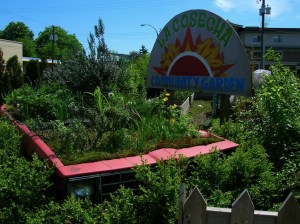
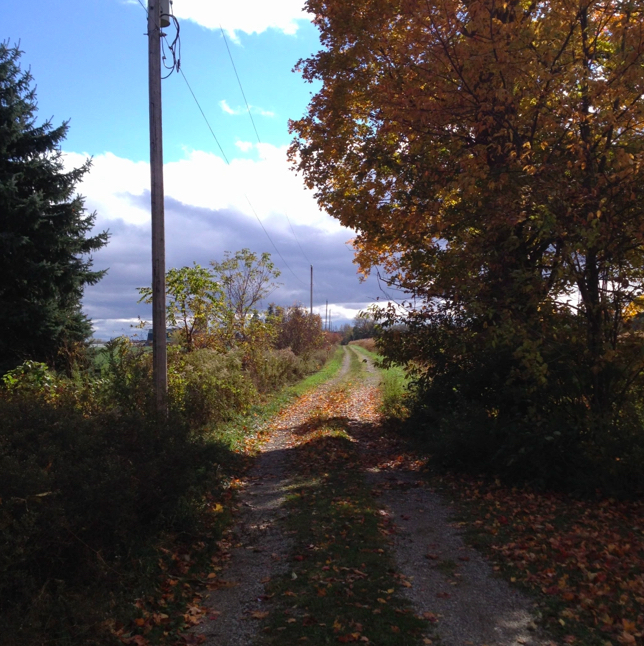
From “Klaxon”: “No one wished to own them anymore, // Everyone wished to walk.” (July 2017, Vancouver, BC)La Cosecha Community Garden, Vancouver, BC
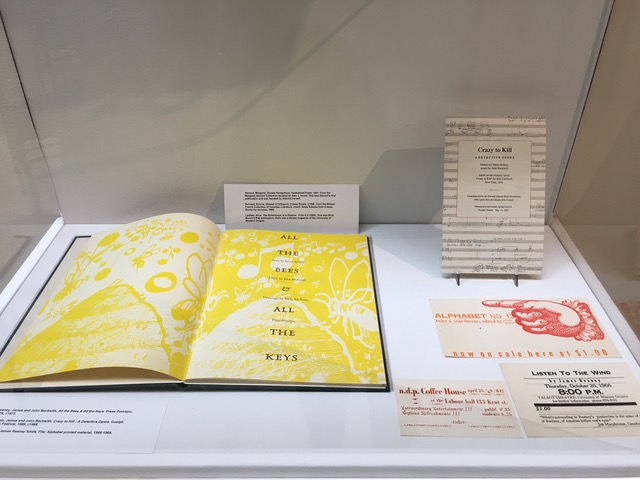
November 5, 2016 — Western Archives display of James Reaney’s writing prepared by archivist Amanda Jamieson. (Photo courtesy Elizabeth Reaney)
We hope to see you all again next year when author and curator Tom Smart will give a talk on James Reaney’s visual art.
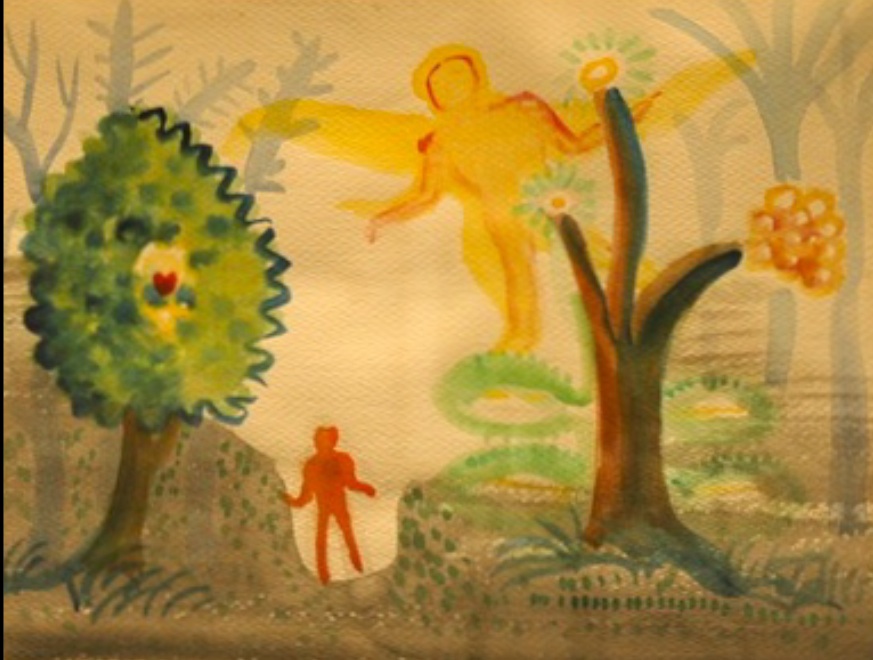
James Reaney’s watercolour painting “David Willson Meets an Angel in the Forest”, 1962 (Photo courtesy Linda Morita, McMichael Canadian Art Collection)
To celebrateNational Poetry Month, here is the “April” eclogue from James Reaney’s long poem A Suit of Nettles.
April
ARGUMENT: With Duncan as judge the geese hold a bardic contest in honour of Spring.
[DUNCAN RAYMOND VALANCY]
Here is a kernel of the hardest winter wheat
Found in the yard delicious for to eat.
It I will give to that most poetic gander
Who this season sings as well as swam Leander.
The white geese with their orange feet on the green
Grass that grew around the pond’s glassy sheen
Chose then Valancy and Raymond to sing
And to hear them gathered about in a ring.
RAYMOND
I speak I speak of the arable earth,
Black sow goddess huge with birth;
Cry cry killdeers in her fields.
Black ogress ate her glacier lover
When the sun killed him for her;
The white owl to the dark crow yields.
Caw caw whir whir bark bark
We’re fresh out of Noah’s Ark;
Wild geese come in arrowheads
Shot from birds dead long ago
Buried in your negro snow;
Long water down the river sleds.
Black begum of a thousand dugs,
A nation at each fountain tugs;
The forests plug their gaps with leaves.
Whet whet scrape and sharpen
Hoes and rakes and plows of iron;
The farmer sows his sheaves.
Mr Sword or Mr Plow
Can settle in your haymow,
All is the same to Mother Ground.
Great goddess I from you have come,
Killdeer crow geese ditch leaf plowman
From you have come, to you return
In endless laughing weeping round.
VALANCY
Your limbs are the rivers of Eden.
From the dead we see you return and arise,
Fair girl; lost daughter:
The swallows stream through the skies,
Down dipping water,
Skimming ground, and from chimney’s foul dusk
Their cousins the swifts tumble up as the tusk
Of roar day
In bright May
Scatters them gliding from darkness to sun-cusp.
Your face unlocks the bear from his den.
The world has come in to the arms of the sun.
What now sulky earth?
All winter you lay with your face like a nun,
But now bring forth
From river up boxdrain underground
Fish crawling up that dark street without sound
To spawn
In our pond
Young suckers and sunfish within its deep round.
Your body is a bethlehem.
Come near the sun that ripened you from earth
Pushing south winds
Through lands without belief till its pretty birth
The faithful finds:
Fanatic doves, believing wrens and orioles
Devoted redwinged blackbirds with their calls,
Archilochus alexandri,
Melospiza georgiana,
All surround you with arched cries of Love’s triumphals.
Your mind is a nest of all young things, all children
Come to this meadow forest edge;
Put her together
From this squirrel corn dogtooth young sedge
And all this weather
Of the white bloodroots to be her skin
The wake robin to be her shin
Her thighs pockets
Of white violets
Her breasts the gleaming soft pearly everlasting.
For her limbs are the rivers of Eden;
Her face unlocks
The brown merry bear from his den,
From his box
The butterfly and her body is a bethlehem
Humming
With cherubim
And her mind is a cloud of all young things, all children.
The prize to this one goes cried eagerly some
And others cried that to Raymond it must come,
So that Duncan Goose turned to the plantain leaf
And chopped the prize in half with beak-thrust brief.
James Reaney, 1958
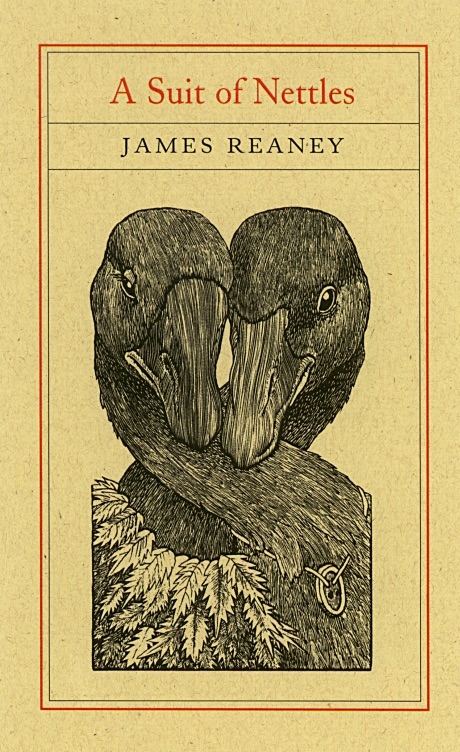
The third edition of A Suit of Nettles features charming illustrations by engraver Jim Westergard, available fromThe Porcupine’s Quill.
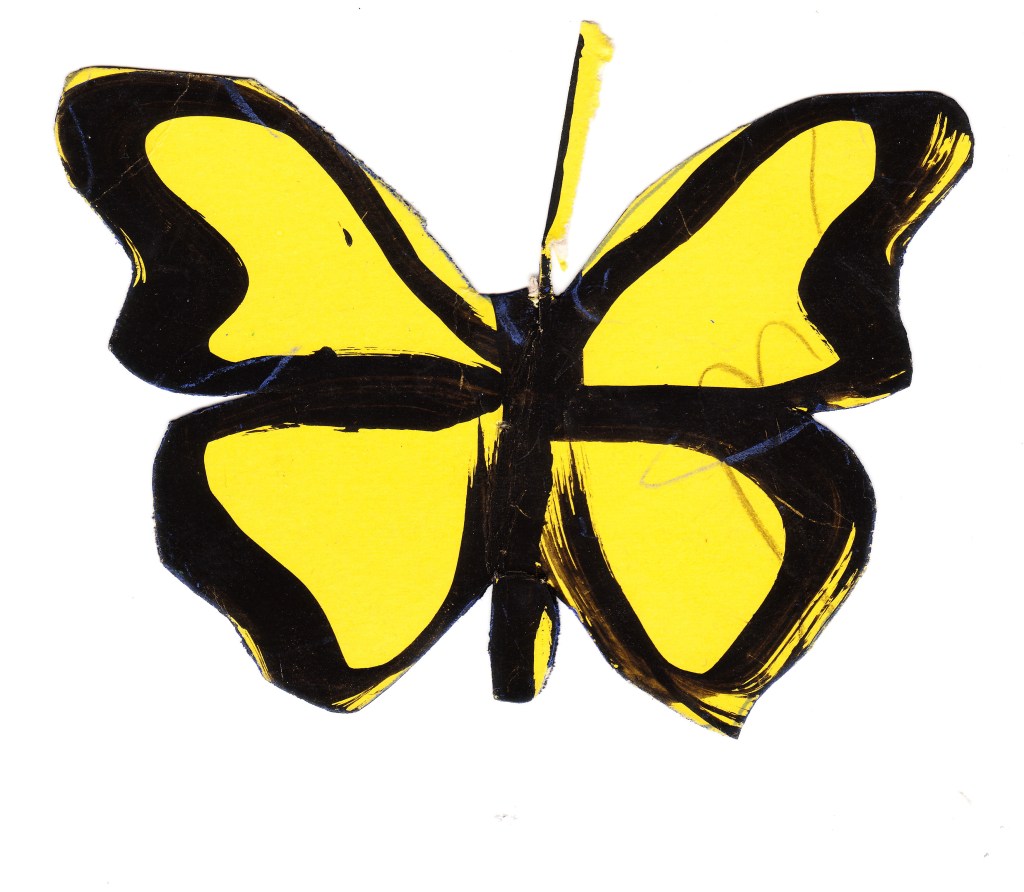
“Geese” Photo by Elizabeth Cooke (James Reaney’s mother), 1950 near Stratford, Ontario.Butterfly decoration by James Reaney, September 1947 (ink on yellow paper)
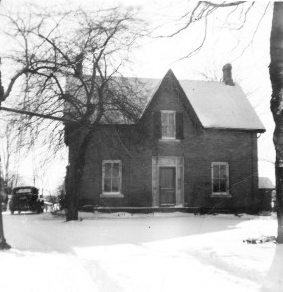
Front entrance to James Reaney’s birthplace and childhood home near Stratford, Ontario, February 1954. Photo by Elizabeth Cooke (née Crerar)
The Windyard
I built a windyard for the wind;
The wind like a wild vast dog came up
To play with the weathervanes and corners
My keyholes and my chinks.
And for the sea I built a well;
The brookish tomcat gurgled in,
Waterfell and sprung about
Hunting throats and boots.
I stood a house up for the earth;
The mappy girl came in
With rut and footstep path
That wind the traveler up.
A stove I hammered for the sun;
In flew the golden oriole
To crackle the sticks of time
And sing the loaves of space.
Come girl well yard and stove,
Come Flesh Heart Mind and Lyre,
Come Earth Water Wind and Fire.
Well, when they came
Barking, meowing, talking and caroling,
I stepped above both house and yard
Into myself.
In his recent book The Emblems of James Reaney, Thomas Gerry notes the connection between “The Windyard” and a later emblem poem“Windlady” from 1970:
“Windlady” by James Reaney. First published in Armadillo 2 1970.
“‘Windlady’ magnetically attracts two in particular of Reaney’s other works: the 1956 poem ‘Windyard’ and the play Listen to the Wind, first performed in 1966.” − Thomas Gerry in The Emblems of James Reaney, page 130, The Porcupine’s Quill, 2013.
“Hark! Who knocks at our door so late?” Watercolour sketch by James Reaney, undated. (Possibly from 2001 and perhaps based on a childhood drawing or an illustration for a story. The old house, the tree, and the windmill are like the farmhouse near Stratford where James Reaney grew up.)
Thank you all for coming to the Stratford Public Library on Sunday October 18 to hear Thomas Gerry speak on “Theatrical Features of James Reaney’s Emblem Poems”. Professor Gerry focused in particular on the metaphor of perspective in James Reaney’s “Egypt” emblem poem.
“When we were taught [as children] to draw railway tracks as meeting at a point, our world views shrank and were subjected to artificial limits. This analysis of perspective explains for readers of Reaney’s emblems a good deal about the emblems’ style. They require their readers to ‘make a visionary correction’, and to see the world, in Blake‘s word, as ‘infinite’. — Thomas Gerry in The Emblems of James Reaney, page 73.
“Egypt” by James Reaney. First published in Poetry (Chicago) 115.3, December 1969.
Professor Gerry explained the tradition of the emblem poem in literature and its use of allegorical meaning to rouse the faculties. He also compared the pyramid structure from “Egypt” to the “family tree pyramid” poem that appears in James Reaney’s play Colours in the Dark:
It takes
Two parents
Four Grandparents
Eight Great grandparents
Sixteen Great great grandparents
Thirty-two Great great great grandparents
Sixty-four Great great great great grandparents
One hundred and twenty-eight Great great great great great grandparents
Two hundred and fifty-six Great great great great great great grandparents
Five hundred and twelve Great great great great great great great grandparents
One thousand and twenty-four Great great great great great great great great grandparents
He then led us in performing the poem and explained how “the pyramid shape recurs as an emblematic feature of the play” (The Emblems of James Reaney, page 84).
October 18, 2015, Stratford Public Library Auditorium
Thank you, Thomas Gerry, for your spirited lecture, and thank you also to the staff of the Stratford Public Library — Sally Hengeveld, Julia Merritt, Krista Robinson, and Robyn Godfrey — for your support of this event.
October 18, 2015 — Susan Reaney, Susan Wallace, Thomas Gerry, and James Stewart Reaney (Photo by Elizabeth Reaney)
Next year’s speaker will beJohn Beckwith, composer, who collaborated with James Reaney on many musical works. The annual lecture is a project developed by The Stratford Public Library and Poetry Stratford, and features a talk by a person who is knowledgeable about the life and work of Stratford poet and playwright James Reaney and of writing in the Southwestern Ontario region, which is such a strong element in Reaney’s writing.
Here are photographs from our happy afternoon near Stratford, courtesy Elizabeth Reaney:
In celebration of Brick Books 40th anniversary, here is one of the 26 stanzas from James Reaney’s poem “Brush Strokes Decorating a Fan”.
(u)
A Useful List:
Hermes
Hera
Apollo
Zeus
Venus
Vulcan
Mars
Athena
Vesta
Hades
Poseidon
Ceres.
Useful for what?
Well, I don’t quite know yet,
But I swear that as an infant,
Born near the Little Lakes,
I met them.
Every morning in our house,
Vesta used to light the stove
James Reaney, 2005
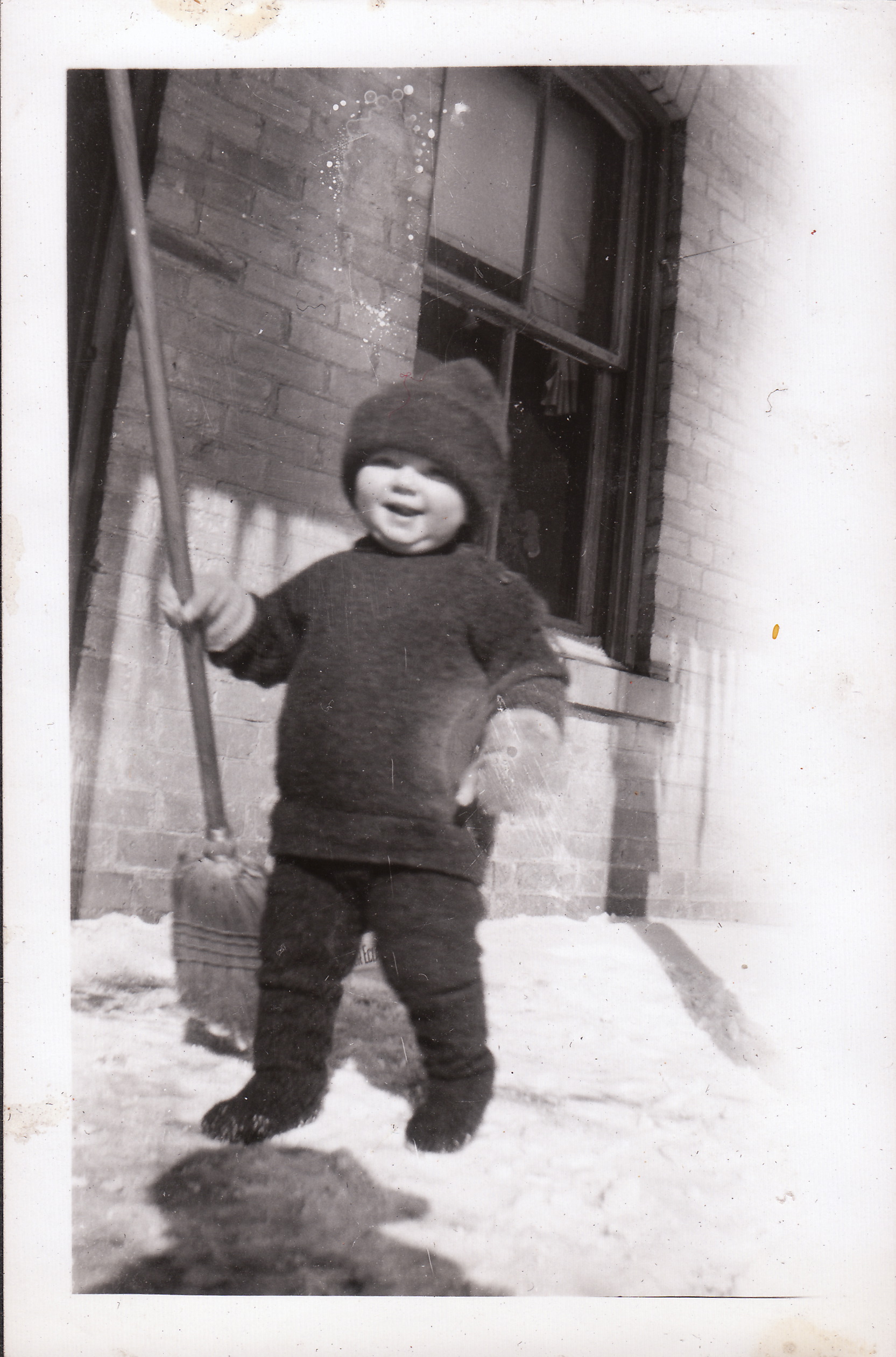
James Reaney at home, age 1 1/2 years, January 1928.
Ten of the stanzas from “Brush Strokes Decorating a Fan” (including “(u) A Useful List”) were set to music by Oliver Whitehead and Stephen Holowitz and performed by the Antler River Project in 2008.
Small babe, tell me
As you sat in your mother’s cave
What did you build there,
Little baby mine?
Sir, I made the tooth
I invented the eye
I played out hair on a comb-harp
I thought up the sigh.
I pounded the darkness to
Guts, Heart and Head:
America, Eurasia and Africa
I out of chaos led.
I fought the goblins
For the heart;
‘Twas a jewel they desired,
But I held it.
I fought off the rats
From the guts.
They nibbled but I
Smashed the mutts.
I choked the bat so intent
For the diamond of my mind;
I caught him in the ogre’s cellar
The tub of blood behind.
And the darkness gave me
Two boneless wands or swords:
I knew not their meaning then
Whether traps or rewards.
One was the vorpal phallus
Filled with jostling army,
Henhouse and palace
Street crowds and history.
Two was the magic tongue
Stuffed with names and numbers,
The string of song,
The waker from fallen slumbers.
My mother opened her grave,
I sprang out a giant
Into another cave
Where I was a seed again.
Hapless and wriggly small
As in my father’s groin:
My Shakespeare’s tongue a wawl
And impotent my loin.
The sun-egg I must reach
Was steeples far away,
The world that I must name
Was shapeless, sneaky gray.
Is it wonder then I rage
An old man one hour old,
A bridegroom come to a bride
Careless, unready and cold.
My wedding cake’s still in the field;
My bride is ninety and maggoty;
My groomsmen glaring hangmen;
My bridal bed bouldery.
Small babe, tell me
As you sit in your mother’s cave
What did you build there,
Little baby mine?
James Reaney, 1959
“The Baby” is part of a sequence of poems from James Reaney’s play One-man Masque, first performed by the author on April 5-6, 1960 at the Hart House Theatre in Toronto. You can also find the poem in The Essential James Reaney (2009), available from The Porcupine’s Quill.
The chough, said a dictionary,
Is a relation of the raven
And a relative of the crow.
It’s nearly extinct,
But lingers yet
In the forests about Oporto.
So read I as a little child
And saw a young Chough in its nest,
Its very yellow beak already tasting
The delicious eyes
Of missionaries and dead soldiers;
Its wicked mind already thinking
Of how it would line its frowsy nest
With the gold fillings of dead men’s teeth.
When I grew older I learned
That the chough, the raven and the crow
That rise like a key signature of black sharps
In the staves and music of a scarlet sunset
Are not to be feared so much
As that carrion bird, within the brain,
Whose name is Devouring Years,
Who gobbles up and rends
All odds and ends
Of memory, good thoughts and recollections
That one has stored up between one’s ears
And whose feet come out round either eye.
James Reaney, 1949
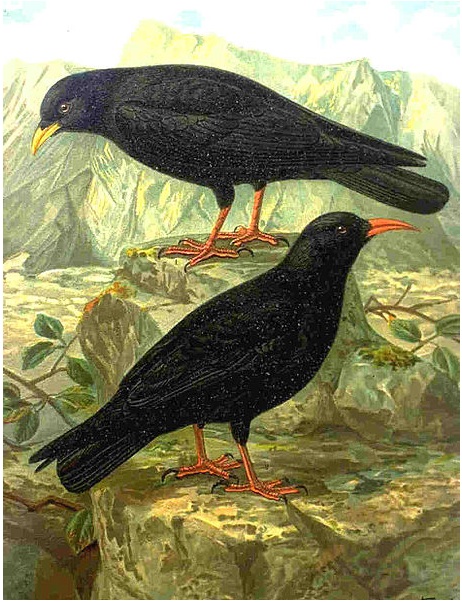
The Yellow-billed or Alpine Chough and the Red-billed Chough of the Corvidae family. Illustration by Johann Friedrich Naumann (1780–1857) courtesy Wikipedia.
To go where I first saw maps
Is almost too simple perhaps.
Find Pork Street or Hessestrasse
And come up McKone’s sideroad past Cardwell’s
Till you hit Elmhurst School
Where time is reckoned by a Pequenaut clock
Manufactured in Kitchener, alias Berlin.
And space is taught by gray green windows
Unrolled from their special “map” cupboard
And hung upon the wall with us looking up
At continents Mercatorized,
Anything British vermilionized,
With funny stripes for Palestine
And Egypt, Iraq, Persia and Danzig,
Places only half imperialized,
Or spheres of influence;
However, just over the map cupboard,
Was a wall of continuous windows
That contained my uncle’s fields,
When school was over
Basically my way home landscape.
It was a map too!
Its scale was an inch to an inch,
A mile to a mile.
There was no map to guide me home
Save this one and a path.
Teaching itself, white with snow, gray sky,
Blurred tree sticks, ditch, swamp,
Forest, meadow, yard, home.
Inside my school — the whole world
In a round globe, or flat maps;
Outside our school — a part of the world
Too big to be taught.
The Elmhurst School mentioned in “Maps” was a one-room schoolhouse where James Reaney attended elementary school from 1933-1939. Elmhurst School was northeast of Stratford, Ontario, and about one mile from the farm where James Reaney grew up. In his autobiography (1992), James Reaney describes his walk to school:
“To go to school, I left the house by its formal front door, not much used, going by a hall dresser whose combination chest with seat-lid was filled with powerfully sweet-smelling grass seed. The way to public school lay first through the relic of a Victorian dooryard, uncut locust hedge reaching up farther every year, four apple trees shaded by big maples where once, very early (1870) had been a garden. Then, the gables of the house still visible behind me, a field, the edge of a bush [woods] and swamp, Cardwell’s flats — difficult to cross with high water after floods — and a ditch across which my father had sort of established a floating, single log bridge.”
(This excerpt is from James Crerar Reaney, Contemporary Authors Autobiography Series, Volume 15, page 297, Gale Research Inc., Detroit, 1992.)
James Reaney off to Elmhurst School in 1936The pupils of Elmhurst School with their teacher, Miss Helen Coveney, in 1936. James Reaney (age 10) is in the top row, third from the left.
May I help you? You want a Jesus?
We have a different style for each of our four
Floors, for
Example, in the basement we stock the demonic Jesus
with the hardware & the mousetraps and the col
-chicum bulbs & the rat poison.
Demonic Jesus, yes—
As portrayed in Martin Scorsese’s film where Christ giggles,
An efficient young carpenter apprenticed to his dad,
Helps his father make crosses for the Romans to use.
As portrayed in a Handmade film bankrolled by one of the Beatles
He says: “Blessed are the Cheesemakers”
And his much more attractive rival is a well-endowed male,
Amiable, but not too interested in changing the world,
Named Brian.
Now, let’s take the escalator
To the First Floor where you may prefer
Christ as He really was,
Classified with Kodak film, notions, perfumes,
Stationery & Men’s Wear.
This historical Jesus is made up of verifiable only facts,
Of which there are practically none;
Do you know there is a serious doubt that he even existed,
But finding his grave would help.
They’ve just found that of Caiaphas, the Chief Priest of his time.
The archeologists are busy.
Water-walker, speed baker & fisher? Virgin birth?
We’ve scrubbed him clean of all that midrash rubbish.
After all, can you cure leprosy, blindness & death
That easily?
Meanwhile, a monastery in Turkey has coughed up
A rather interesting Gnostic scrap with regard to
A hitherto obscure passage—Mark IX: 51, 52.
At last our suspicions about his sexuality may be—
Explained.
Let us take the Elevator to the Second Floor
Where the Christ of the creeds & the New Testament
Is still available
(Buyers, not many lately)
Among the patterned china, the records for gramophones,
The furniture & dining room suites.
Now this model was born to a Virgin, raised the dead,
Often corpses not so recently deceased,
Bent reality with his magic, died,
Then, like Snow White, came alive again:
Dared to be a crucified wretch on a cross;
Somehow destroyed & renewed a large empire,
Is, no doubt, our only hope for translating us out of here.
But, you know, we get a lot of returns
And customers asking for something really true this time,
Not so exciting & poetic, more real.
A man who walks on rain
Is too great a stretch for their brain.
Others say they are more than happy, but you can tell
They’re not by the funny look in their eyes,
And, of course, we provide a booklet, one of many,
Just in case your difficulty is, say, the Ascension,
Speaking of which, let us climb these stairs
Up to the roof of this Department Store.
On the roof of this Department Store
Having a cigarette on his break,
I saw a young floorwalker
Leaning against the elevator shaft.
By the sudden flash, I recognized Him,
Yes, by the moment glimpse
Of the nailmarks
On His hands.
James Reaney, 2005
“Department Store Jesus” is from Souwesto Home, a collection of James Reaney’s poems from 2005 and published by Brick Books. Listen to Jeff Culbert perform “Department Store Jesus” here.