Summer 2023 — The Blyth Festival is bringing James Reaney’s The Donnelly Trilogy to Blyth’s Outdoor Harvest Stage. Director Gil Garratt has adapted the three plays especially for this outdoor setting.
The three plays,Sticks and Stones, The St. Nicholas Hotel, and Handcuffs will all be performed by one single company of ten actors, who will tell the tale from the killing of Patrick Farrell, to Johannah Donnelly’s march to Goderich to save her husband from the gallows, to the Stagecoach wars, to the Queen’s Hotel, to the Vigilance Society in the Cedar Swamp Schoolhouse, to the fiery February night when justice, revenge, and murder were left indistinguishable in the ashes.
This will be the first time in decades that all three of these touchstone plays have been performed in repertory with each other, affording audiences the chance to take in the whole cycle over three nights.
Gil Garratt’s thoughts on the three plays:
“I believe 2023 is the perfect time to re-ignite the telling of the Donnelly story in Blyth. At its heart, this is a story about grit, family, betrayal, the erosion of community, the rise of secret societies, the shadow of conspiracy, and the limits of faith. The show will be filled to the brim with folk music, stagecoaches, and live fire in the night.”
The Donnelly Trilogy by James Reaney Adapted, abridged, and directed by Artistic Director Gil Garratt Part I: Sticks and Stones, June 22-September 1 Part II: The St. Nicholas Hotel, July 13-September 2 Part III: Handcuffs, August 1-September 3
The Blyth Festival’s replica of the Donnelly stagecoach from Paul Thompson’s 2001 play Artistic Director Gil Garratt as Robert Donnelly in Blyth’s 2016 show The Last Donnelly Standing.
In the 1976 Alumni Gazette (UWO) article “Souwesto Theatre: A Beginning” excerpted here, James Reaney describes the years he spent researching the Biddulph Tragedy of February 4, 1880 and how the knowledge he gained about the Donnellys’ world helped create the Donnelly trilogy.
Orlo Miller, who wrote the historical book The Donnellys Must Die (1962), had based his research on local courthouse documents of the time. Miller’s collection of relevant documents was available to Reaney at the University of Western Ontario’s Regional Archives:
“One of my early experiences back here* […] was to go with my father to hear Orlo Miller lecture at Middlesex College on his recent book The Donnellys Must Die.As a child I had heard the story of this tragic family from our hired man, and my interest was revived now, especially when I heard that Mr. Miller had, in the thirties, collected a huge heap of legal and municipal documents with relevance to the Biddulph Tragedy from the attics of the courthouses at Goderich and at London […]. [In the archives] I entered the really magic world of the past which can only be reached through such fragile ladders and windows as bundles of counterfoils from Sheriff’s cheque books, Court Criers’ Bills, Surveyors’ Notebooks, Chattel Mortgages (whole inventories of people’s furniture and beasts and implements), Jury Lists, Assessment Rules, Crown Attorney Letterbooks and, last of all, mountains of blue paper containing an endless stream of Information and Complaint – the term used for the form you had to fill out when some fellow pioneer had dogged your cattle, tried to pour boiling water on you, torn down your fence, milked your cow furtively or torn down your house with you inside. [Alumni Gazette 1976, pages 14-15]
One of my first research lessons was to train myself to read nineteenth century handwriting and abbreviations; for example, for about a year I somehow assumed that “Inft” meant “infant” so that when you read “.… and poured boiling water over the Inft” I naturally saw the very darkest picture imaginable; suddenly one day it dawned on me that the early Huron District backwoods scene was indeed horrible, but that “Inft” did at least stand for an Informant fifty years old and perfectly capable of running away! Now these documents where a Plaintiff accuses a Defendant of doing something are extremely dramatic, partly because of the variety of things accused, and I made them into one of the choral passages in Sticks and Stones (Part One) in order to show the social situation at its tumultuous litigious mad worst, which is always the dramatic best! [.…] Propelled by the magnetic names “Donnelly” and “Biddulph” I read all the Huron District and County Archives from the beginning to 1863 when Biddulph Township leaves Huron County; I knew that I wanted to write a play about these people, but I wanted to get inside their world first and those hundreds of boxes filled with blue paper – it gets white about 1870 – were the keys to this state. Whoever filed away things in the Huron County Courthouse filed away everything, and I am eternally grateful […]. [H]ere you often get pictures of whole families talking at each other in a way that no history book ever thinks of showing you: one of my favourite lines from the trilogy – “It’s not enough that we should starve, but we must freeze to death as well” – comes right out of a Chancery document. [Alumni Gazette 1976, page 15]
Now there is probably a reason for this material being dear to a dramatist’s heart; a court case is after all a drama – with its lawyers arguing so one-sidedly against each other, with its witnesses opposing each other too and with a Judge, who quite frequently in the early days, climaxes everything with a knock on the head or wallet all around! If at the time you were to have taken a Constable’s Bill to the constable who had just filled it out and told him that it would make a good scene in a play he would have laughed at such foolishness. But time going by changes all that and scholars and artists have as their duty the finding out of just how time does give ordinary things meaning. After the five years were over and I found myself with Five Legal Blue Binders with transcribed material, I found that the three plays of The Donnellys corresponded to three of these binders. All – all!?, I had to do was pare things down from 200 hours of dialogue and action to three hours per binder! [Alumni Gazette 1976, page 15]
After a series of workshops with my own group, the Listeners, at Alpha Centre and Mini-Theatre, where we used this material in prototypes of the Donnelly plays called “Antler River” and “Sticks and Stones”, I did some more shaping until in 1972 I was invited down to Halifax to work with Keith Turnbull, a former student here on the material using local children and professional actors. The actors wolfed down the contents of the binders – and I think that in their performances you can see that they have genuinely touched some area of time not our own […]. [Alumni Gazette 1976, page 15]
This article originally appeared in Western’s Alumni Gazette in 1976 (pages 14-16). Read the full article here.
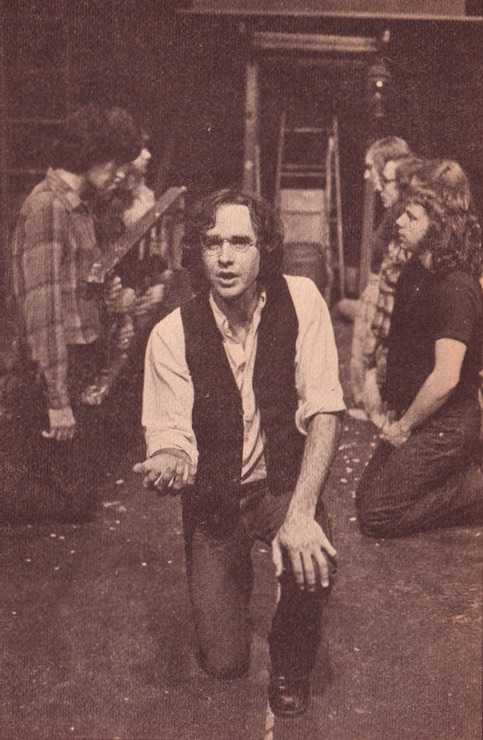
Miriam Greene, Patricia Ludwick, Jerry Franken, and David Ferry in James Reaney’s Sticks and Stones at the Tarragon Theatre in Toronto, 1973.
* In 1960 James Reaney left his first teaching post at the University of Manitoba and came to teach in the Faculty of English at the University of Western Ontario in London, Ontario: “One of the reasons I decided to leave my first teaching post in Manitoba and come to this campus was that I wanted to find out more about the land of my birth – Southwestern Ontario, or as Greg Curnoe very aptly calls it – Souwesto.” [page 14]
Souwesto history continues to inspire local playwrights: Jeff Culbert has written a one-man musical version The Donnelly Sideshow, Chris Doty restaged The Donnelly Trial in 2006, and Paul Thompson wrote The Outdoor Donnellys (2001) and The Last Donnelly Standing (2016).
Gil Garratt as Robert Donnelly in The Last Donnelly Standing (Photo by Terry Manzo courtesy The Blyth Festival 2016.)
There are two events celebrating the work of dramatist James Reaney this month and next:
Patricia Nacamoto as Mattie Medal in Gyroscope: “Is it true, Gregory La Selva, is it true that one of the conditions of your marriage was that, were that you were never, never to read her stuff?”
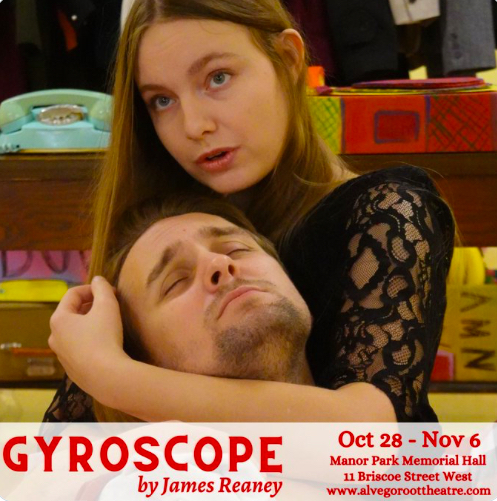
October 28-30 and November 4-6: James Reaney’s play Gyroscope, directed by Adam Corrigan Holowitz and presented by AlvegoRoot Theatre.
All performances at Manor Park Memorial Hall, 11 Briscoe Street, London, Ontario.
( ( 0 ) ) Listen to an interview with Adam Corrigan Holowitz and Janis Nickleson (who played Hilda La Selva in the 1981 production of Gyroscope!): Gyroscope Conversations on Soundcloud
November 6 at 12:00 noon at Wordsfest: The James Reaney Memorial Lecture at Museum London. Terry Griggs, author and former student of the late Stan Dragland (1942-2022), will present “James Reaney Off the Grid”, the lecture Stan had planned to give.
Wordsfest is at Museum London, 421 Ridout Street North, London, Ontario.
October 28 to November 6 — Don’t miss AlvegoRoot Theatre‘s production of James Reaney’s play Gyroscope later this month. For Director Adam Corrigan Horowitz, this play is “a shape-shifting comedy of marriage, art and passion!”
About the play: When poet Hilda La Selva got married, she made her husband Greg swear to never read any of her poetry, a vow he inevitably fails to keep. As their relationship lists and tilts, they are pursued by an intrepid PhD student intent on putting their marriage under the microscope.
The performers are Kydra Ryan, Steven Barber, Patricia Nacamoto, Elizabeth Durand, and Dan Ebbs.
Content Advisory: Gyroscope contains sensitive content including references of suicide. If you would like more information before purchasing a ticket please contact AlvegoRoot.
In this excerpt from James Reaney’s play Gyroscope, Gregory La Selva, lab technician, seeks to restore his self-esteem and win back the love of his wife, Hilda, a famous poet. To win Hilda’s respect, he must prove to her that he too can write poetry. He enlists the help of Mattie Medal, PhD student, to help him write a poem that will win him a place at the Harpers’ Poetry Guild alongside Hilda.
Scene Six: The Husband Takes a Chance on Being Skinned by Apollo*
PUZZLE gets down from the chair. We focus on MATTIE, with wagon, who is talking to GREG.
GREG: Look, is there some sort of crash course in writing poetry? I’d like to crack that bunch of Harp Guild Workshop Poetry ladies wide open. MATTIE: You’re a man; the contest is open to women only. GREG: I’m desperate enough for a sex-change operation. MATTIE: You’re just jealous of your wife. GREG: I’m even more ashamed of my sterility. I have no dreams. She is virile. I am not. HILDA: Gregory La Selva couldn’t write a poem if he tried. He should stick to being a poem. GREG: She’ll be sorry she said that. I’m going to do as you say and start remembering things from childhood, keep a diary, get a pen and an ink bottle. MATTIE: A typewriter is okay. GREG: I’m so dull, why hasn’t she left me ages ago? How do I get more introverted? Is there anything I could take? NICHOLAS: Did you look at my scrapbook of intoxicating mushrooms? GREG: Nicholas, it’s no use — showing me pictures of mushrooms. I want to see the mushrooms in person before I start collecting. NICHOLAS: Opium. GREG: Opium. MATTIE: Awfully good at first — friend did a thesis on it about it. Your mind starts out being a palace; then… the palace turns into a boarding house, then a flophouse for tramps, then the tenements of criminals whose windows are striped with bars. The palace has turned into a prison. GREG: I don’t care. Show me the palace, Nicholas, get me a dress. NICHOLAS: What’s your size? GREG: In a dress? (gives NICHOLAS a slip of paper) MATTIE: For a start, Mr. La Selva, underline the words you really like in this forty-thousand-word dictionary. Nicholas, go to Agnes Dactyl’s place and see what she has in second-hand dresses. Let’s see these measurements. Very well.
She gives them to NICHOLAS, who slowly proceeds to AGNES’s store.
Oh boy, this is a new part of my thesis – the birth of a poet…
∞♥∞♥∞
*Note: “Being skinned by Apollo” is a reference to the fate of Marsyas, the satyr who challenges Apollo to a musical contest with the Muses as judges. In 1963 James Reaney wrote an adaptation of Euripides’ play The Bacchae (405 BCE), which was never produced. In Gyroscope, Gregory La Selva disguises himself as a woman to enter Hilda’s poetry contest, just as Pentheus goes dressed as a woman to spy on the Bacchae’s Dionysian rites. Gregory wins the poetry contest and avoids the gruesome fate of Pentheus at the hands of the Bacchae.
Gyroscope was produced in a workshop at Western University in early 1980, and performed in a rehearsed reading at Blue Mountain Poetry Festival that summer. Keith Turnbull later directed the play at Tarragon Theatre in Toronto, May 14 to June 21, 1981. The cast members were Jerry Franken, Janis Nickleson, Rita Jiminez, Brian Dooley, and Nancy Palk.
James Reaney (holding mug of tea) with members of the Tarragon Theatre production of Gyroscope: Keith Turnbull, Dorothy Chamberlin, Nancy Palk, Suzanne Turnbull, and Janis Nickleson, May 1981. Photo courtesy Les Kohalmi.
Gyroscope is available in Reaney Days in the West Room: Plays of James Reaney (2009), edited by David Ferry and published by Playwrights Canada Press.
Summer 1937: James Reaney (age 10) picking gooseberries with his cousins in Erin Township in Wellington County, Ontario.
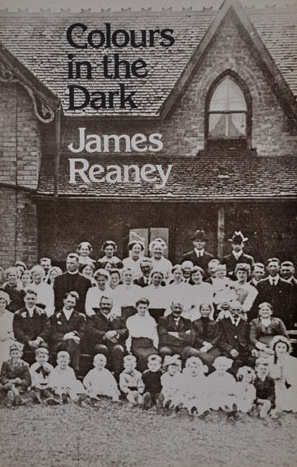
The “Berry-picking” scene from Act I of James Reaney’s 1967 play Colours in the Dark uses a pattern poem in the shape of a family tree pyramid to help the berry-pickers bring back the lost child.
8. BERRY-PICKING
MOTHER: The Story of the Berry-Picking Child and the Bear.
SCREEN: A child’s drawing of a berry-picking woods.
PA: This happened early near the Little Lakes.
KIDS: Darting about with berry pails
Look at the raspberries Wild Gooseberries Huckleberries Over here! Look at the raspberries Wild currants. Don’t eat them. They’re poison. Bunch berries (ugh!)
One child is left busily picking. Her name is SADIE.
GRAMP: as a bear. Enters and lifts up a child. Child my cubs need nurse. I need your blood. SADIE: Wouldn’t blood-red berries do instead? GRAMP: No. Flesh must be my bread.
SADIE: Put me down Mr. Bear. I do thee dread.
Bear runs off with child, kids enter shrieking.
KIDS: A bear ran off with Sadie! A bear ran off with Sadie! And it takes a lot of people to produce one child.
They form a family tree pyramid with a reappearing Sadie.
KIDS:
It takes Two parents Four Grandparents Eight Great grandparents Sixteen Great great grandparents Thirty-two Great great great grandparents Sixty-four Great great great great grandparents One hundred and twenty-eight Great great great great great grandparents Two hundred and fifty-six Great great great great great great grandparents Five hundred and twelve Great great great great great great great grandparents One thousand and twenty-four Great great great great great great great great grandparents
It would take over a thousand people to do this scene: at Listeners’ Workshop we did it with thirty-two people: the children here are suggested by a triangle arrangement, the thousand ancestors behind each human being. Have one group of players in charge of chanting “Great great” & “grandparents”.
SADIE: Are you there 1,024 ancestors?
A feeble rustle
Are you there 512 Are you there 256
Are you there 128
Sound gets louder, less ghost-like and more human.
Are you there 64
Are you there 32
Are you there 16
More recent ancestors step forward and say firmly and clearly what we have only dimly heard: “We’re here.”
Are you there 8
Are you there 4
Are you there Mother and Father?
GRAMP, MA and PA step forward and establish the next scene as the kids fade away
For more about James Reaney’s use of shape poems or pattern poems as theatrical devices, see Thomas Gerry’s bookThe Emblems of James Reaney (2013) and Gerry’s article “Marvellous Playhouses The Emblems of James Reaney” in the Summer 2019 issue of Queen’s Quarterly.
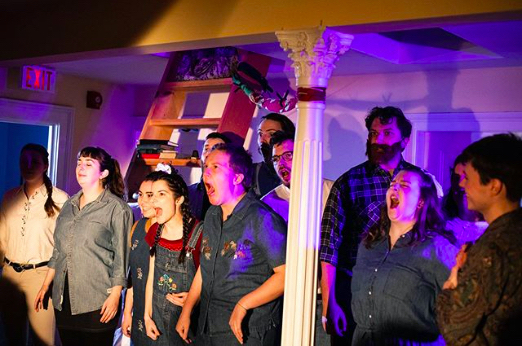
February 5, 2020 — Congratulations to Steady Theatre Collective and director Julia Schultz for your ingenious production of James Reaney’s 1966 play Listen to the Wind.
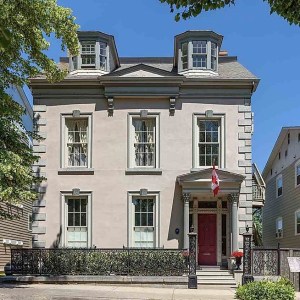
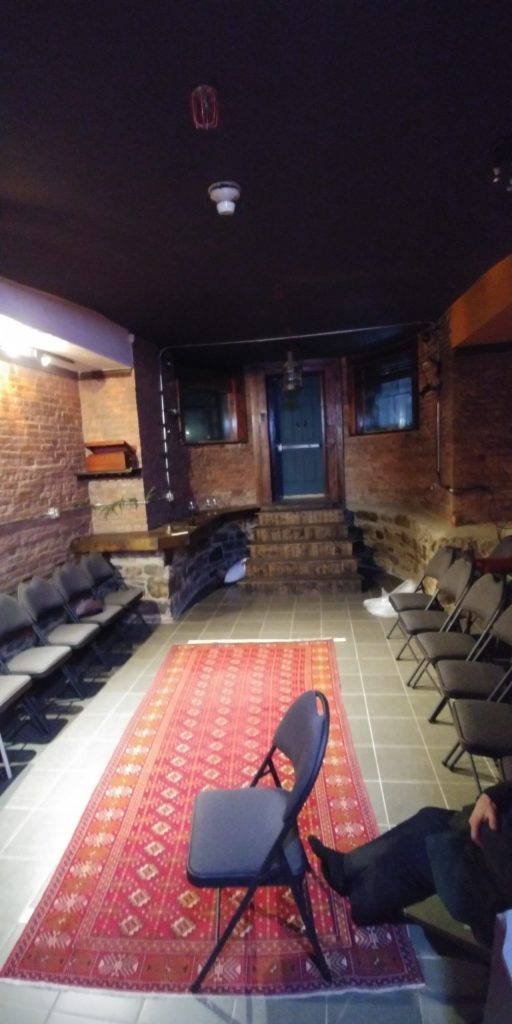
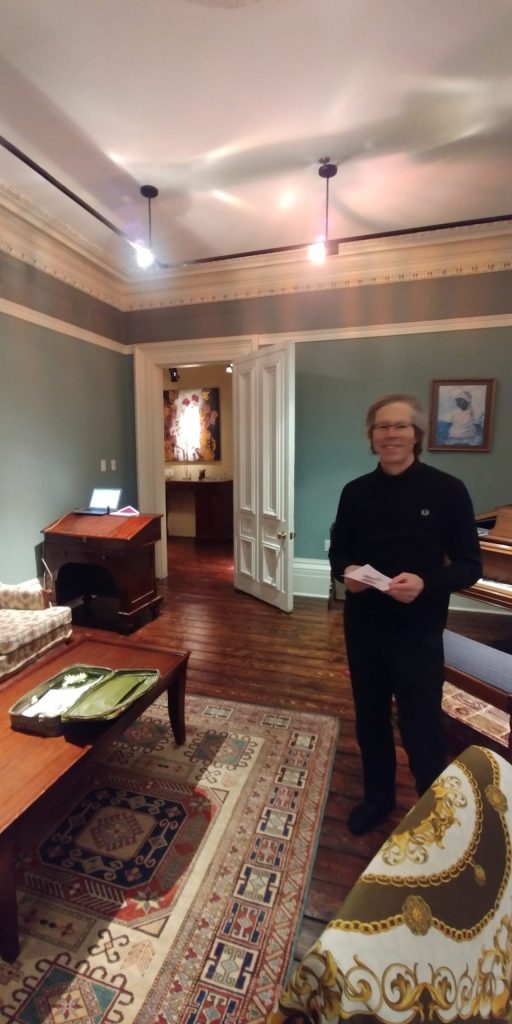
The production was staged at McCully House, an old Halifax mansion, allowing the audience to move through the house and through the play – Act I in the attic, down to the lower floor for Act II, and back up to the attic for Act III.
McCully House, 2507 Brunswick Street in Halifax, Nova Scotia
The web of actors, music, and intimate setting kept us close to the action and drew us into the world of Owen, Harriet, Ann, and Jenny, the four children who put on the play. Four chairs can be anything!
Producer: Kirsten Bruce Director: Julia Schultz Music: Edie Reaney Chunn Stage Manager: Sophie Schade Set and Costume Designer: Emma Roode Fight Choreographer: Anika Riopel Weathervane designed and crafted by Kelly Trout
Cast: Lou Campbell, Henricus Gielus, Kyle Gillis, Stepheny Hunter, Brittany Kamras, Michael Kamras, Rachel Lloyd, Briony Merritt, Noella Murphy, Peter Sarty, and Sam Vigneault
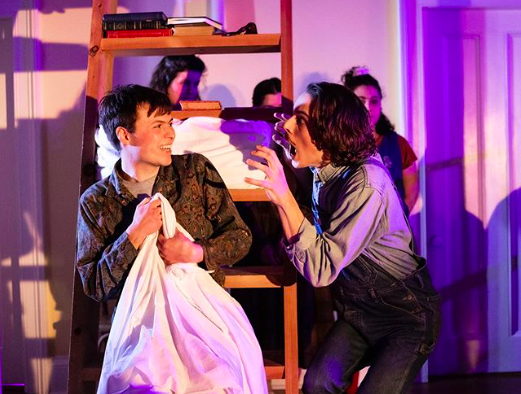
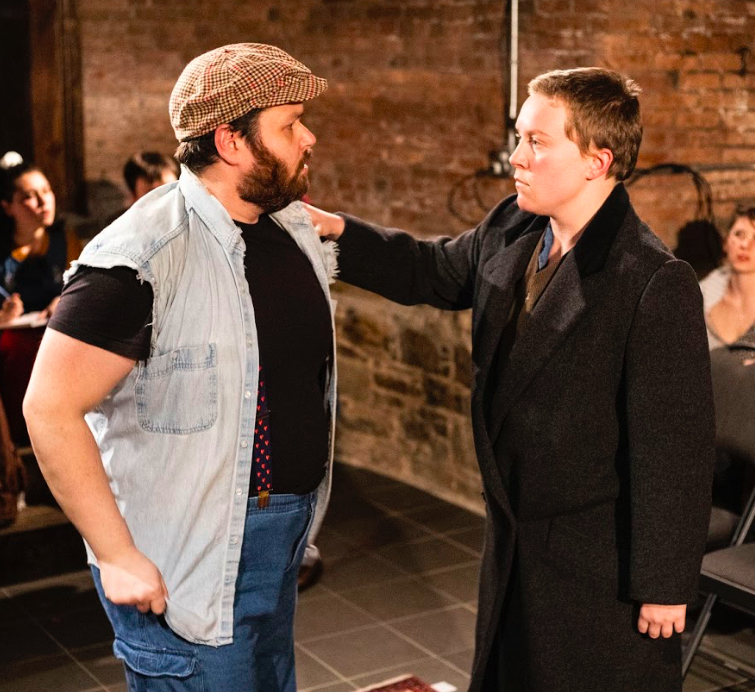
Act I Scene 2: Owen & Chorus: Let’s hear the North Wind. (Rehearsal photographs courtesy Steady Theatre)Act III Scene 44: Sam Vigneault as Owen and Peter Sarty as Mitch
OWEN: … Mitch, sit down and talk to me. MITCH: Will I do your favourite cartoon? OWEN: Yes. Now you rock in the rocking chair and I say… (gets off the bed) Grandma, how about a dime so I can get an ice cream cone and cool myself off? MITCH: Ah, I’ll tell you a ghost story instead son. It’ll freeze your bones and chill you off twice as fast. Listen!
More about Steady Theatre Collective and the play
Steady Theatre Collective’s Kirsten Bruce and Julia Schultz
Listen to the Wind Act II: Rogue and DouglasListen to the Wind Act II: Angela, Arthur & Sir EdwardListen to the Wind: Lower floor McCully HouseListen to the Wind: Front of house reception areaJames Reaney’s illustrated story The Boy Who Lived in the Sun on view in the reception area
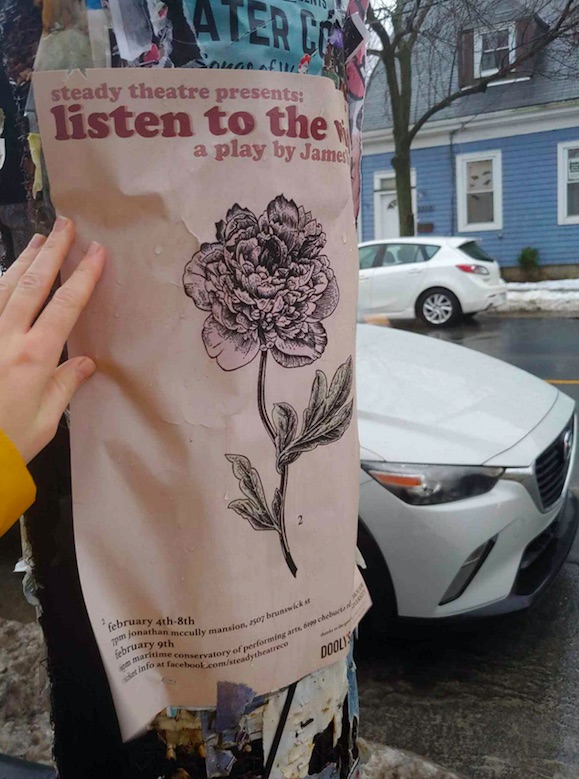
On February 4-9 in Halifax, Steady Theatre will present Listen to the Wind, a play by James Reaney.
With the help of their families and neighbours, four children put on The Saga of Caresfoot Court – a melodrama set in a old manorhouse.
“… We watch a double story: Owen fighting illness and trying to get his parents together again; Angela Caresfoot threading her way through a world of evil manorhouses and sinister Lady Eldreds. The two stories illuminate each other….” James Reaney, 1966 Program Notes
When & Where:February 4 to 8 at 7:00 pm at the Jonathan McCully Mansion, 2507 Brunswick Street, Halifax B3K 2Z5
February 9 at 6:00 pm at the Maritime Conservatory for the Performing Arts, 6199 Chebucto Road, Halifax B3L 1K7
Saturday November 2, 2019 — Thank you all for joining us at Wordsfest at Museum London for the Tenth Annual James Reaney Memorial Lecture, and thank you, Stan Dragland, for coming all the way from St. John’s, Newfoundland to share your thoughts on James Reaney’s use of structure or “grids of meaning.”
Stan Dragland’s lecture “James Reaney on the grid” November 2, 2019 at Wordsfest in London, Ontario.
In his lecture James Reaney on the grid, Stan Dragland explains how Reaney drew material from the local and particular and used archetypal patterns to link and clarify it:
What about the grids? “Grid” is not Reaney’s own word, of course. He picked it up from others at the long-liner’s conference [a 1984 conference on the Canadian long poem], and the literal meaning, with all those right angles, is not the best image for what he does. He’d be more likely to say pattern, or formula, or catalogue, or paradigm, or list. Also backbone. I’ll keep on with grid here, but really list is the better word.
“There is something about lists that hypnotizes me,” Reaney says, introducing the “Catalogue Poems” section of Performance Poems [1990]. Now watch how he slides disparate things together in metaphor as he goes on: “I think this fascination is connected with our joy in the rainbow’s week of colours, in the 92 element candle you see in a physics lab at school, but then see all around you like a segmented serpent we’re all tied together by. Our backbones, with their xylophone vertebrae, are such sentences; lists of symbolic objects in some sort of mysterious, overwhelming progression I have elsewhere called the backbones of whales, and indeed they are, for they are capable of becoming a paradigm . . . used as a secret structure.” His play, Canada Dash, Canada Dot [1965] is built on lists of various sorts. So is Colours in the Dark [1967]. In fact lists or catalogues are everywhere in his work…
A video of Stan Dragland’s lecture is available here, and the full text version is here.
About the speaker
Stan Dragland’s immersion in James Reaney’s work began in 1970when he arrived in London to teach at the University of Western Ontario. One of the first courses he taught was English 138 Canadian Literature and Culture, a team-taught course designed by James Reaney. Stan Dragland is also a co-founder of Brick Books, a local poetry press now celebrating its 45th anniversary.
Souwesto Home by James Reaney, 2005, Brick Books.
The James Reaney Memorial Lecture series celebrates the life and work of Southwestern Ontario poet and dramatist James Reaney, who was born on a farm near Stratford, Ontario and found a creative home in London, Ontario.
Our thanks toWordsfestand theLondon Public Libraryfor their support of the lecture series, and toPoetry Stratfordand theStratford Public Libraryfor their support in hosting the earlier lectures (2010-2015).
2010: Colleen Thibaudeau 2011: Marion Johnson and Peter Denny 2012: Jean McKay 2013: David Ferry 2014: Tim Inkster 2015: Thomas Gerry 2016: John Beckwith 2017: Tom Smart 2018: James Stewart Reaney 2019: Stan Dragland
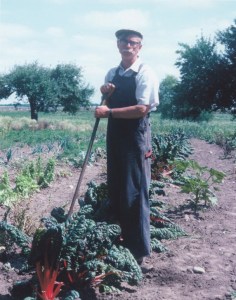
James Reaney at the farm near Stratford, Ontario, Summer 1979. (Photo by Les Kohalmi)
Join us at Wordsfest on November 2, 2019 at 12:00 pm at Museum London’s Lecture Theatre for the 10th annual James Reaney Memorial Lecture.
Stan Dragland, poet, novelist, and literary critic, will speak on James Reaney’s love of lists and how he uses them to express his vision, particularly in plays like The Donnellys.
Styling his lecture as “James Reaney on the grid”, Dragland explores how Reaney’s immersion in his local environment brings forth the universal in his art.
James Reaney’s The Donnellys: Sticks and Stones Act I Mr Donnelly: And this earth in my hand, the earth of my farm That I fought for and was smashed and burnt for (Jerry Franken as Mr Donnelly, Tarragon Theatre, 1973)
When: Saturday November 2 at 12:00 pm Where: Wordsfest at Museum London, 421 Ridout Street, London, Ontario Admission is free.
The James Reaney Memorial Lecture series celebrates the life and work of Southwestern Ontario poet and dramatist James Reaney, who was born on a farm near Stratford, Ontario and found a creative home in London, Ontario.
Our thanks to Wordsfest and the London Public Library for their support of the lecture series, and to Poetry Stratford and the Stratford Public Library for their support in hosting the earlier lectures (2010-2015).










 James Reaney