From 1969 to 1970, Earle Toppings, broadcaster and editor at the Ontario Institute for Education (OISE), organized a series of interviews and recordings with 16 Canadian authors for use as a resource in high schools and colleges.
Literary Titans Revisited: The Earle Toppings Interviews with CanLit Poets and Writers of the Sixties, edited by Professor Anne Urbancic, presents exact transcripts of Earle Toppings’s interviews with Canadian authors Margaret Laurence, Morley Callaghan, Hugh Garner, Hugh MacLennan, Mordecai Richler, Sinclair Ross, Dorothy Livesay, Gwendolyn MacEwen, Al Purdy, Earle Birney, F.R. Scott, Irving Layton,Miriam Waddington, Raymond Souster, Eli Mandel, and James Reaney.
James Reaney (Photo courtesy Talonbooks)
On December 14, 1970, James Reaney met interviewer Earle Toppings and asked that his recording session for the Canadian Poets on Tape series be recorded at a piano, and fortunately the basement studio of the OISE building in Toronto had one. Reaney then played musical excerpts (for example, “Beulah Land” and “The Maple Leaf Rag”) and also read poems from The Red Heart, A Suit of Nettles, Twelve Letters to a Small Town, Night Blooming Cereus, The Dance of Death at London, Ontario, One Man Masque, and Colours in the Dark. He begins this way:
[Reaney performs “Beulah Land,” a fragment of an old hymn, on the piano.]
That’s the first poem I ever heard, at an early denominational Sunday school. I’m sitting at a piano on Bloor Street near a subway that you’ll hear thundering by occasionally, and I’ve got… sort of… my collected works around me. I’m going to read from The Red Heart first of all, and I’m going to occasionally call forth from the piano pieces of music that really make a comment on the poems in a sort of way. […] [See pages 286-287.]
♦ A special evening to launch the book will be held on October 5from 6-8 pm at the EJ Pratt Library, 71 Queen’s Park Crescent East, Toronto, Ontario.
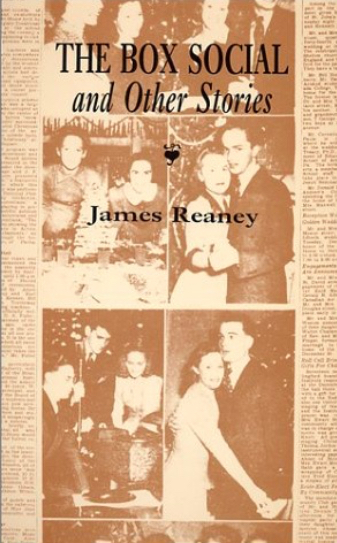
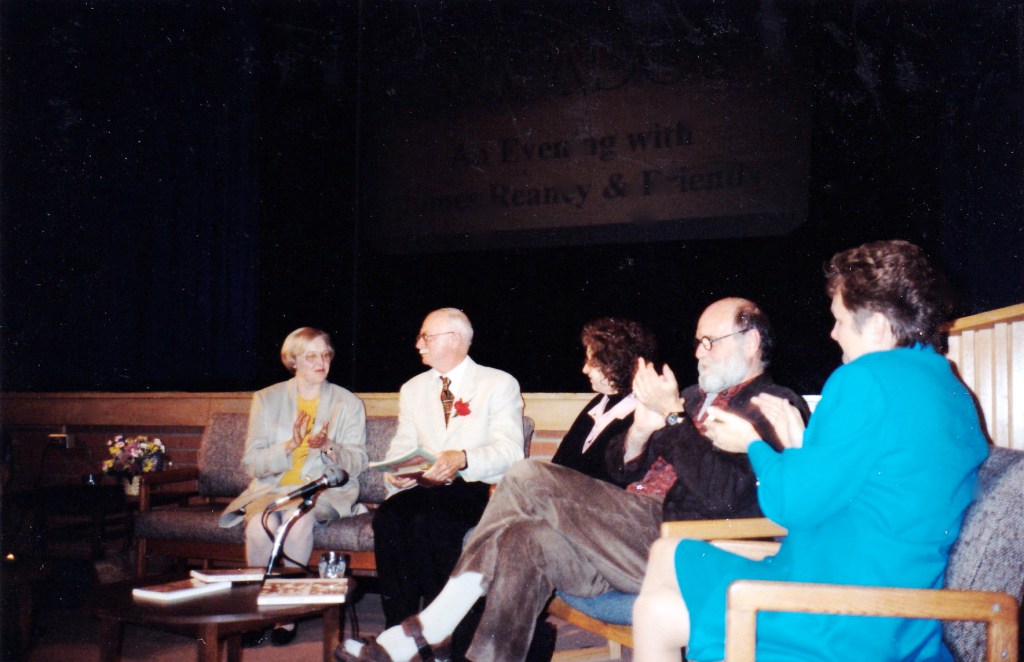
On May 30, 1996, “An Evening with James Reaney & Friends” was held at the G.A. Wheable Adult Education Centre in London, Ontario to celebrate the publication of The Box Social and Other Stories, a collection of James Reaney’s short fiction.
May 30, 1996 in London, Ontario — James Reaney with Margaret Atwood, “An Evening with James Reaney & Friends” (Photo courtesy London Free Press)
I was a student at the University of Toronto in the last years of the 1950s, and James Reaney — who had been cutting an odd swath there several years before — was still an oral tradition. He was known as an enfant terrible who’d published a scandalous story called “The Box Social,” which dealt with gynecological matters unmentionable at that time, and dealt with them in a shocking fashion. (Inside the box of the title — supposed to contain a lunch — there was a fetus.) Nobody seemed to know where this story could actually be read, so its reputation was in consequence tremendous. (I’m happy to say it has now finally been republished.) Reaney was also remembered as having staged a production of Beowulf in which Beowulf himself turned out to be the monster who was murdering and eating his own faithful followers. The more you think about that, the more plausible it becomes.
I was in the Honours English course, and as a consequence we read almost no Canadian literature; but my older brother was in Honours Biology, which included a Canadian literature course. You may ponder the logic of that — why them and not us? Maybe the biologists took CanLit because it was thought to have a lot of animals in it. However, I was in the habit of reading my brother’s books, and it was in the first Robert Weaver short-story anthology that I came across Reaney’s story “The Bully.” It made a big impression on me — it seemed a way of writing about Canadian reality that did not confine itself to the strict social realism that was mostly the fashion then. I went on to read all of Reaney’s poetry available at the time: here was a fresh, brilliant, and quirky literary landscape in the process of being formed and, I should say, against considerable odds…. [Excerpted from Margaret Atwood, “Remembering James Reaney”, Brick Issue 82 (Winter 2009), page 160.]
Note from Susan Reaney: The event was part of the For the Love of Literacy Writers Festival organized by London educator Win Schell to bring local writers to the school. (James Reaney: Listening to the Wind, a film biography of James Reaney produced by Nancy Johnson of Lockwood Films, was to have had its premiere that night, but had to be delayed to the fall.)
After the introduction by Margaret Atwood, James Reaney had planned to read “The Box Social” for the audience, but decided not to and read “The Bully” instead. We were disappointed that he did not give voice to the long-lost story, but a friend from school days said that “The Bully” was an entirely appropriate story to read in a high school.
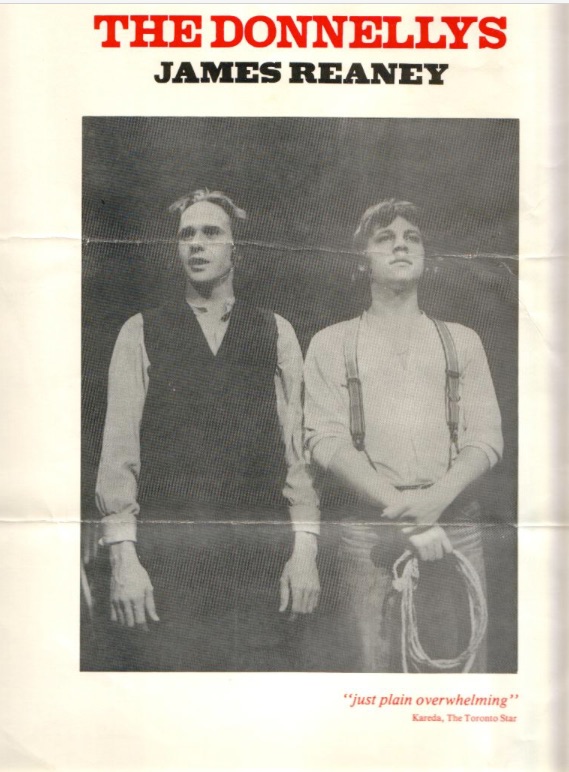
“James Reaney’s plays — Colours in the Dark (1969), Baldoon (1976), and The Donnellys (1974-7) — as well as his short stories “The Bully” and “The Box Social” (reprinted in The Box Social and Other Stories in 1996), also assume Gothic elements of the macabre rooted in nightmarish families and uncanny action. […]
What makes this locale so prone to Gothic tales is the failure of communication between family members or social groups. In the absence of communication, strange projections and psychological grotesqueries spring up and rapidly grow to unmanageable proportions. Malevolent fantasies are the source and sustenance of the Gothic tradition.”
— Michael Hurley and Allan Hepburn in The Concise Oxford Companion to Canadian Literature, pages 593-594. William Toye, Ed., Oxford University Press, 2011.
May 30, 1996 in London, Ontario — Writers Colleen Thibaudeau, James Reaney, Margaret Atwood and Graeme Gibson, and producer Nancy Johnson of Lockwood Films.
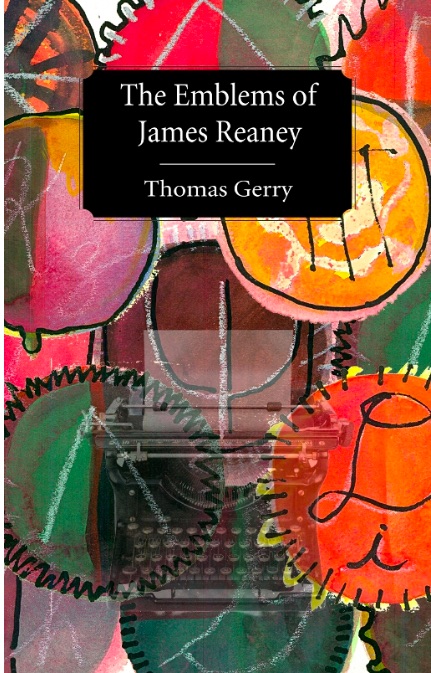
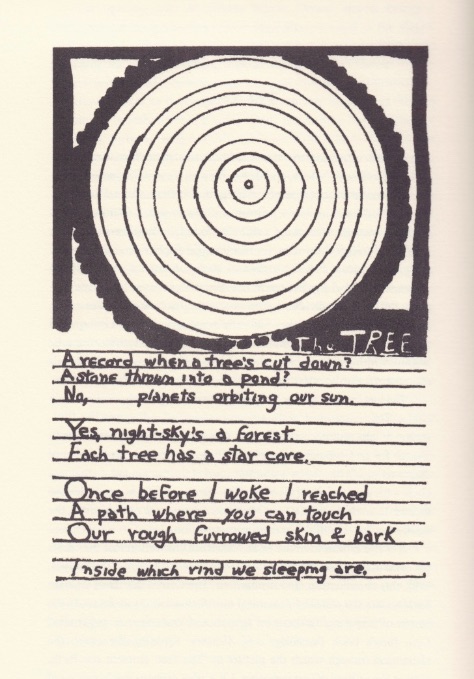
Former doctoral student of James Reaney’s and now professor of literature at Laurentian University, Thomas Gerry explores the history of the literary emblem, and explains the meanings behind ten of James Reaney’s emblem poems.
“The Tree” and “The Riddle” are two of Reaney’s emblem poems featured in The Emblems of James Reaney:
“The Riddle” by James Reaney. First published in Armadillo 2 1970.“The Tree” by James Reaney. First published in Poetry (Chicago) 115.3, December 1969.
The annual lecture is a project developed by The Stratford Public Library and Poetry Stratford, and features a talk by a person who is knowledgeable about the life and work of Stratford poet and playwright James Reaney and of writing in the Southwestern Ontario region, which is such a strong element in Reaney’s writing.
Join us on Sunday, October 19 at 2:30 pm at The Atrium (behind Café Ten) in Stratford, Ontario, for a talk about graphic design in James Reaney’s work by publisher Tim Inkster.
Tim Inkster is particularly intrigued by the excellence of the design in James Reaney’s first book, The Red Heart(1949), one of the nine titles in McClelland & Stewart’s Indian File series (1948-1958) and designed by Paul Arthur (1924-2001).
Cover and title page from James Reaney’s The Red Heart (1949). The Red Heart was the third title in McClelland & Stewart’s Indian File poetry series.
Café Ten is located at
10 Downie Street,
Stratford, Ontario
N5A 7K4
Tel: (519) 508-2233
The annual lecture is a project developed by The Stratford Public Library and Poetry Stratford, and features a talk by a person who is knowledgeable about the life and work of Stratford poet and playwright James Reaney and of writing in the Southwestern Ontario region, which is such a strong element in Reaney’s writing.
To celebrate the new Stratford Festival production of James Reaney’s adaptation of Lewis Carroll’s Alice Through the Looking-Glass, the Porcupine’s Quill is offering a chance to win a free copy of the book!
Page 15: Alice rehearsal drawing by James Reaney, 1993.
Jillian Keiley’s new production ofAlice Through the Looking-Glasscontinues this summer at theStratford Festival, May 31 to October 12. To buy tickets, contact the box office at1.800.567.1600 or visit stratfordfestival.ca
Trish Lindström as Alice in “Alice Through the Looking-Glass”, May 31 to October 12 at the Avon Theatre in Stratford, Ontario. (Ruby Joy is the Alice Double.)“Alice’s Dinner Party” scene from Alice Through the Looking-Glass, Avon Thetare, Stratford, Ontario 2014. Photo courtesy The Stratford Festival.
Former doctoral student of James Reaney’s and now professor of literature at Laurentian University, Thomas Gerry explores the history of the literary emblem, and explains the meanings behind ten of James Reaney’s emblem poems.
“The Tree” and “The Riddle” are two of Reaney’s emblem poems featured in The Emblems of James Reaney:
“The Tree” by James Reaney. First published in Poetry (Chicago)“The Riddle” by James Reaney. First published in Armadillo 2 1970.
On the same evening, Tom Smart, author and former executive director of the McMichael Canadian Art Collection, will read from his new book Jack Chambers’ Red and Green. Red and Green is a collection Jack Chambers (1931-1978) made of hundreds of quotations that set out his ideas on art and the nature of reality.
Both The Emblems of James Reaney and Jack Chambers’ Red and Green are available from The Porcupine’s Quill.
For more about the book launch, see JBNBlog‘s review.
Actor and director Jeff Culbert performedOne-man Masqueand directed James Reaney’s 1997 playGentle Rain Food Co-opon November 21-30, 2002 at the Grand Theatre (McManus Studio) in London, Ontario. In the preface to his book,Two Plays, James Reaney shared his enthusiasm for Jeff Culbert: “His superb work as both director and performer moved the audiences at seven performances… to stand-ups, tears, laughter, and exclamations. There were even screams for the last image of One-man Masque when Jeff took a tray of five candles, lit them, and balanced the tray on his head! It was electrifying.”
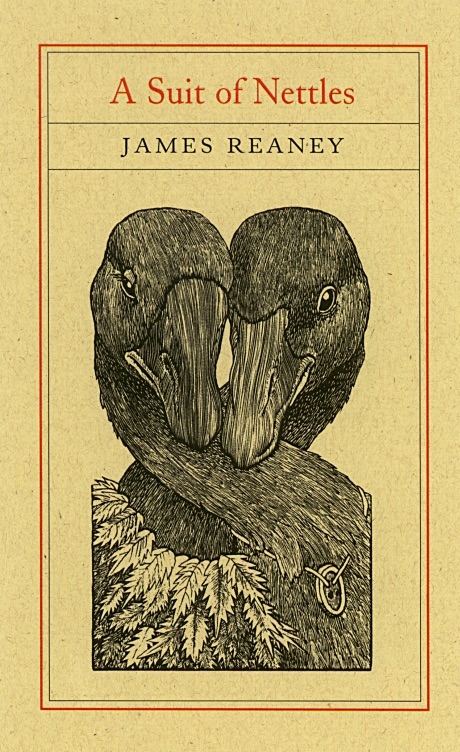
Richard Stingle, a long-time friend and colleague of James Reaney, has kindly given us permission to share his talk about A Suit of Nettles, which he presented at the book launch on May 25, 2010 in London, Ontario. (A new edition of A Suit of Nettles is available from The Porcupine’s Quill.)
Richard Stingle at the London Public Library on May 25, 2010
A learned poet writes A Suit of Nettles
By Richard M. Stingle, May 25, 2010
In 1948, Jamie, Colleen and I were graduated from the Honours English programme at the University of Toronto, a programme that was centred on learning in several different areas of the Humanities. Ironically, in that same year of 1948, a history of English literature, edited by A. C. Baugh, included a study of eighteenth-century literature in which George Sherburn states that
“At the beginning of Alexander Pope’s career a hostile critic could assure him: ‘You have not that sufficient learning necessary to make a poet.’ The idea of learning as essential to a poet perished in the eighteenth century. Stephen Duck, the thresher poet, Anne Yearsley, the milkmaid and Thomas Chatterton all aspired to the role of natural genius — and to the grief of possible sponsors seemed deficient in quality.”
Even Robert Burns sang:
“Gie me a spark o’ Nature’s fire,
That’s a’ the learning I desire;
Then, though I drudge thro dub and mire
At pleugh or cart,
My Muse, tho hamely in attire,
May touch the heart.
But surely Sherburn overstated the case in saying that learning was no longer essential. As Jay Macpherson has rightly said, Jamie was “of the learned kind of poet.” The tension between those in the learned tradition and those who confine poetry to the theme and language of the inspired “common man” has continued for two centuries and sometimes within the same poet. Wordsworth may champion the language such as men do use but proceeds to pull out all the stops of the epic in The Prelude and The Excursion. Tennyson’s preface The Epic has one character destroying his own attempt at epic, “Why take the style of those heroic times” (34), “And why should any man/Remodel models” (35-36). But Tennyson immediately proceeds to remodel Morte d’Arthur and later the whole Arthurian epic in Idylls of the King. William Morris also remodeled Nordic epic in his Sigurd the Volsung and Yeats, Joyce, Pound and Eliot continued this process as well. And Jamie was, as Germaine Warkentin has also affirmed, a learned poet.
A Canadian poet said once of Jamie that he was a poet (especially in the lyrical first volume of The Red Heart), but Northrop Frye killed him. This was nonsense. Frye and Jamie were both products of the old Honours programme at the University of Toronto. In Honours English, the student took nine courses in each year and reinforced his central study (English) with courses in three other Honours areas: in Frye’s case, Latin, Greek and Philosophy; in Jamie’s case, Latin, Greek and History. Both men were also very competent in playing the piano. I remember Jamie’s playing Bach, Debussy and his own “Penny Arcade.” And Jamie was painting while Frye was writing on painting in Canadian Forum. It is true that at first Jamie thought that the Modern era was slighted in the Honours programme (as it was) and that concepts were emphasized over the metaphors of mythos (as they were), but when Jamie went to teach at the University of Manitoba in 1949, he filled out what he had found lacking. He eagerly read Frye’s Fearful Symmetry, studied Blake and was writing furiously and telescoping his development in forms from lyric to epic to drama. When, a couple of years later, I joined him teaching in Winnipeg, Jamie was developing as a learned poet, and beginning to work with John Hirsch and Tom Hendry. Like Virgil, Spenser and Pope, who all began by writing pastoral eclogues, he was beginning to write dialogues combining romance and satire in his remodeling of Spenser’s Shepherd’s Calendar and, like Virgil, Spenser and Pope, he proceeded to writing epic works. In A Suit of Nettles, he was already becoming more complex, in entwining the eclogue with that very Canadian genre, the beast-fable, used by Ernest Thompson Seton, Sir Charles D. Roberts and others, the most recent being Yann Martel. As in the Canadian version of the form, Jamie’s geese remain geese as well as acting out human ideas, as Jim Westergard’s engravings in the new issue show. Jamie was, of course, adapting the folk-tale of The Seven Swans of the Brothers Grimm for the central metaphor of Branwell’s suit of nettles and the unchanged swan’s wing.
In the mid-fifties Jamie went back to Toronto, to strengthen his professional position with a Ph.D., but even more to bring all that he had learned and experienced earlier into Frye’s liberating idea that all literature is made out of literature, all art out of art. As Frye wrote in Myth and Freedom (1985): “But we can never understand the poet’s authority without Vico’s principles of verum factum, that reality is in the world we make and not in the world we stare at” (122). Frye’s modal criticism (Romance, Irony, Tragedy and Comedy) allowed Jamie to shape and contain what he knew into circles that become so important in Jamie’s work. He studied Blake with Frye, and wrote his Ph.D. dissertation, “Spenser’s Influence on Yeats,” under Frye’s direction.
Within the whirling circle of the year in A Suit of Nettles are circles within which speakers with opposed visions of language and poetry contend, as in the “July” eclogue in which Anser, the “progressive” teacher, derides Valancy (Isabella Valancy Crawford of Paisley) for praising Strictus, the teacher in her youth who taught his goslings knowledge of science, myth, history, biblical patterns and metaphors and the novels of Bronte and the poetry of Milton. Anser scornfully replies “how useless so far as the actual living of life is concerned.” In the “August” eclogue, this approach is reinforced in Jamie’s attack on Scrutumnus (representing F. R. Leavis) as the literary critic who is behind Anser’s point of view — a confining of literary experience to the “felt experience” of essentially rudimentary feeling and language. Reaney, of course, could also depict what A Suit of Nettles presents as Scrutumnus’ ideal of “Pigs in the sties of Venus,” but Jamie refused to confine his poetry or limit his language to one level. Jamie could present a flower in a corner fence on the farm more precisely than Tennyson could his “flower in the crannied wall” and as precisely as any Imagist poet. But he moves out to include all levels of experience and, instead of limiting language to the simplest level, brings all levels of language into multiple relations through complex counterpoint.
Many of his central metaphors are circles revolving within the cycle of the year on an Ontario farm (Jamie’s farm near Stratford). At the fall fair (Stratford Fall Fair) the circle of Western philosophy revolves in the merry-go-round and on the ferris wheel the creation myths of mankind rise and fall. It is not surprising that Jamie rejoiced in the visions of wheels within wheels a-turning in the Book of Ezekiel, Chapter I.
The dominant stanza of A Suit of Nettles is the Spenserian Sestina, but Jamie is encyclopaedic in his use of other stanzas as well. So is he in his use of metrical variation from the alliterative pounding of Beowulf, as in the “Drunken Preacher’s” sermon in “September” —
Lo, it was the last supper, I leader from gutter
Tell you tall and short tinkery folk gathered.
What did those white souls eat while their Lord talked:
I don’t know indeed I don’t, maybe sandwiches.
— to the light graceful elegiac song of dimeters and trimeters of the first poem in “October” —
Sing to us for the frost
Is closing the pond,
The elms their leaves have lost
And the singing birds are gone.
— and through other variants such as hexameter and pentameter, as in the “May” Eclogue. I think that Jamie, like Wagner, was striving to achieve a “Gesamtkunstwerk,” a union of all the arts, the expression of all creativity, and he certainly wrote through form after form and finally reached drama and opera to find such appropriate encyclopaedic media. In A Children’s Story, the latest novel by A. S. Byatt, two characters are also striving to realize Wagner’s desire:
Anselm Stern said what was needed was music like Richard Strauss. No, no, said Steyning, something fairy-like, something between “Greensleeves” and The Ring of the Nibelungs (515).
And sometimes we hear in Jamie’s work this intricate, encyclopaedic sound, and hear it first in A Suit of Nettles. Certainly we hear it clearly in The Donnellys, in Gyroscope and in Crazy to Kill.
In Imprecations in 1984, Jamie pronounces a resounding series of curses through three female voices, those of “Edith Sitwell, Judith Donnelly, and a whore on Queen St. in Toronto.” From their energy, the speaker-poet derives the power to lay waste to those who abuse the planet and their fellow creatures, those who destroyed the Honours programme at Toronto, those traitorous teachers who tell their students not to memorize anything and rely on their own opinion, and those who use the political power of the Ministry of Education to expel poetry from the schools. Note the emphasis upon the Honours programme — I think that I shall read that section —
Oh ye hippies and merry draft dodgers who in the sixties
Came to University College stampeding my dear old professors,
Mobbing them till they scrapped the old Honours English Course,
And gave you anything at any time:
No down payment on Emily Bronte; Virginia Woolf now,
Beowulf later on. Communitas delenda est!
May you in Heaven be presented with harps tuned in this order:
A 2 octaves below Middle C, next F natural 5 octaves above High C …
— and note, as well, the emphasis on the duty of the genuine student to connect with the learned tradition. Twenty-six years after A Suit of Nettles, in Imprecations, Jamie is remaining true to the original power of A Suit of Nettles, and for another 24 years after that, he continued to proclaim its truths. And I have continued to be through all these years overwhelmed by the honour Jamie did me 52 years ago by dedicating A Suit of Nettles — “To RMS” — to me.
1950: Richard Stingle, Bob Patchell, and James Reaney
Thank you all for coming to our launch for the new edition of A Suit of Nettles on May 25.
Special thanks to London actor Jeff Culbert, for capturing the spirit of the geese characters, and to Richard Stingle, long-time friend and colleague of James Reaney, for his thoughts about the poem and the poet.
Thanks also to our wonderful hosts, the London Public Library, who made us all feel at home.
From the January eclogue:
January
With the other geese within the goosehouse
There lived, I know not how, various kinds
Of geese: some like a cat, some like a mouse,
Some like a groundhog and some like lions,
Some like two straight parallel lines,
Others more circular in character,
Some shallow and some deep as mines,
Others than chaos far more muddier,
And whether you should parcel fast or loose
Some could not be but simply described ‘Goose’.
Jeff Culbert animates Branwell, George, and Dorcas from A Suit of NettlesRichard Stingle shares his thoughts on the poem.Prize winners collect their Jim Westergard engraving from A Suit of Nettles.