At The Congress Café in Austin, Texas, A group of men & women came in, Workers in some state office. They ordered drinks, then meals. After just twenty minutes, You could hear the drink they’d drunk Suddenly, happily, speak out in them. This sound of community went on until we left. I have no doubt that afterwards The drink they had taken Coupled some of them in matching ecstasies On Murphy beds.
How many things seek their voice in us? Unsuspected demons & angels Wait for the arrangement we provide Of gut, enzyme, funny bone, nervous system, mind.
Blood we lost long ago? (On Frederick’s great battle field When first he conquered Angria) Seeking to recirculate once more?
The apples of the orchard young Elmer Scheerer’s Father planted Which his son pressed into cider barrels, then drank Which then became his wild mouth organ music Played from a Pippin tree top, or (husband) on wilder bed spring, Printing press of his sons, Stanley & Geordie, Early friends of mine, O Congress Café.
James Reaney, 2005
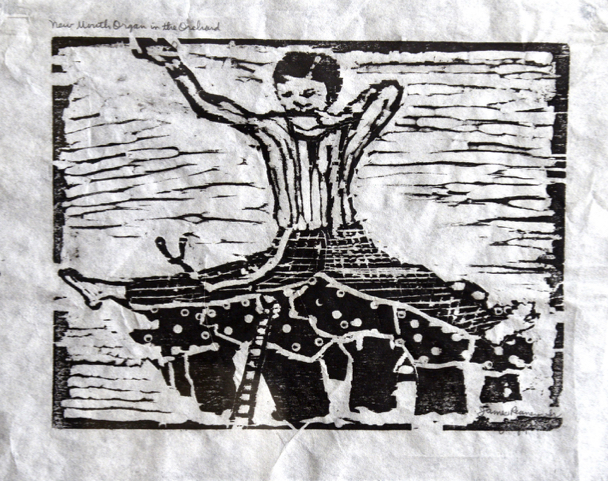
“New mouth organ in the orchard” Woodcut on paper by James Reaney (1988)
“The Congress Café” is from Souwesto Home, a collection of James Reaney’s poems from 2005 available from Brick Books.
( ( ( 0 ) ) ) Listen to Jeff Culbert read “The Congress Café” and other poems from Souwesto Home here.
He gives to me: a pebble
He gives to me: a dewdrop
He gives to me: a piece of string
He gives to me: a straw
Pebble dewdrop piece of string straw
The pebble is a huge dark hill I must climb
The dewdrop’s a great storm lake you must cross
The string was a road he could not find
The straw will be a sign whose meaning they forget
Hill lake road sign
What was it that changed the scene
So desert fades into meadows green?
The answer is that they met a Tiger
The answer is that he met a Balloon,
A Prostitute of Snow, A Gorgeous Salesman
As well as a company of others such as
Sly Tod, Reverend Jones, Kitty Cradle and so on
Who was the Tiger? Christ
Who was the Balloon? Buddha
Emily Bronte and the Emperor Solomon
Who sang of his foot in the doorway.
All these met him. They were hopeful and faithful.
Now the mountain becomes a pebble in my hand
The lake calms down to a dewdrop in a flower
The weary road is a string around your wrist
The mysterious sign is a straw that whistles “Home”
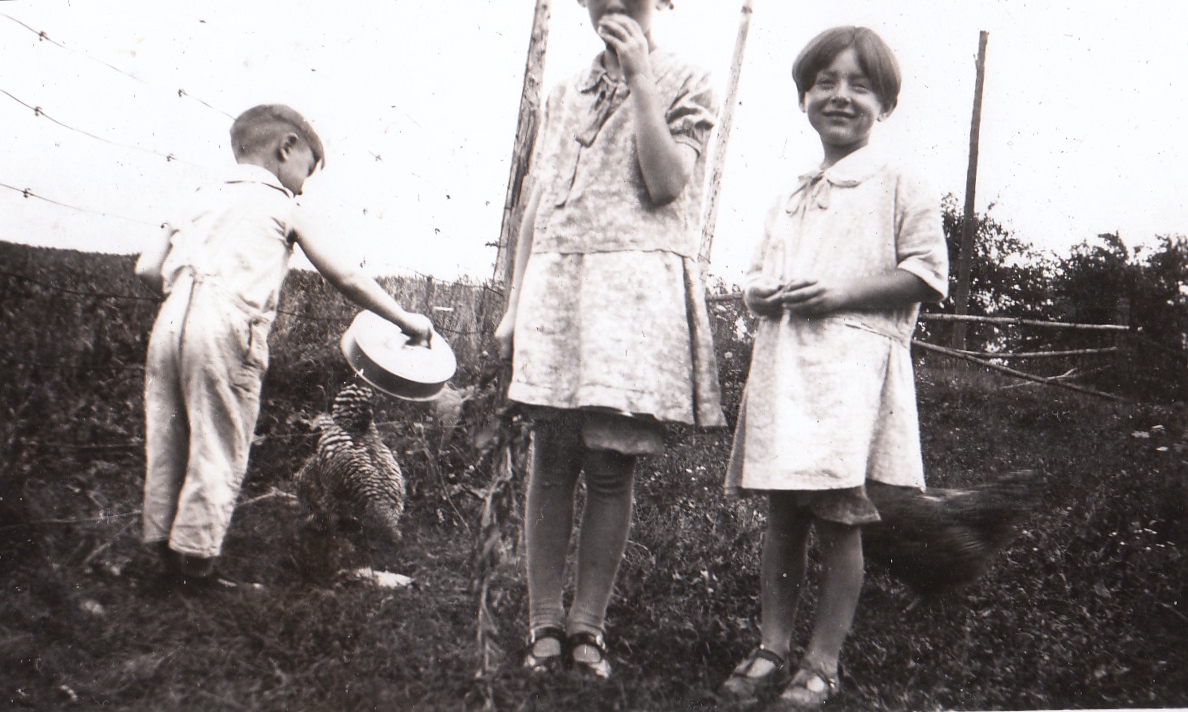
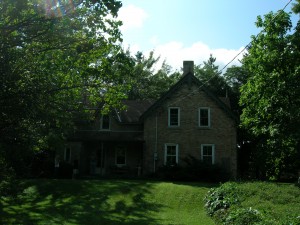
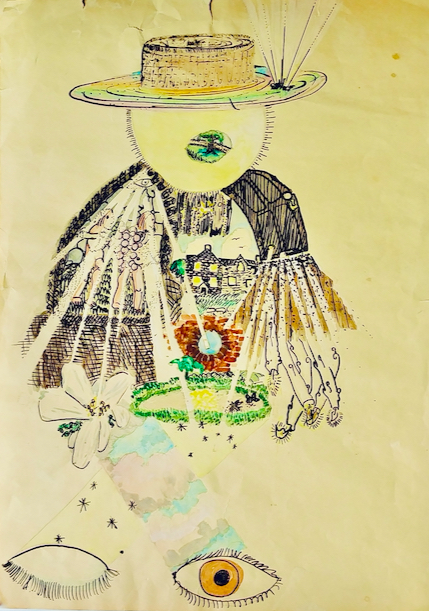
James Reaney (far right) with his cousins, Elsie, Kathleen, and Mary, Summer 1930 near Stratford, Ontario.James Reaney feeding the chickens (age 5) with his cousins Mary and Elsie (1931)James Reaney’s childhood home near Stratford, Ontario“Sun Clown” watercolour and ink drawing by James Reaney, 1960
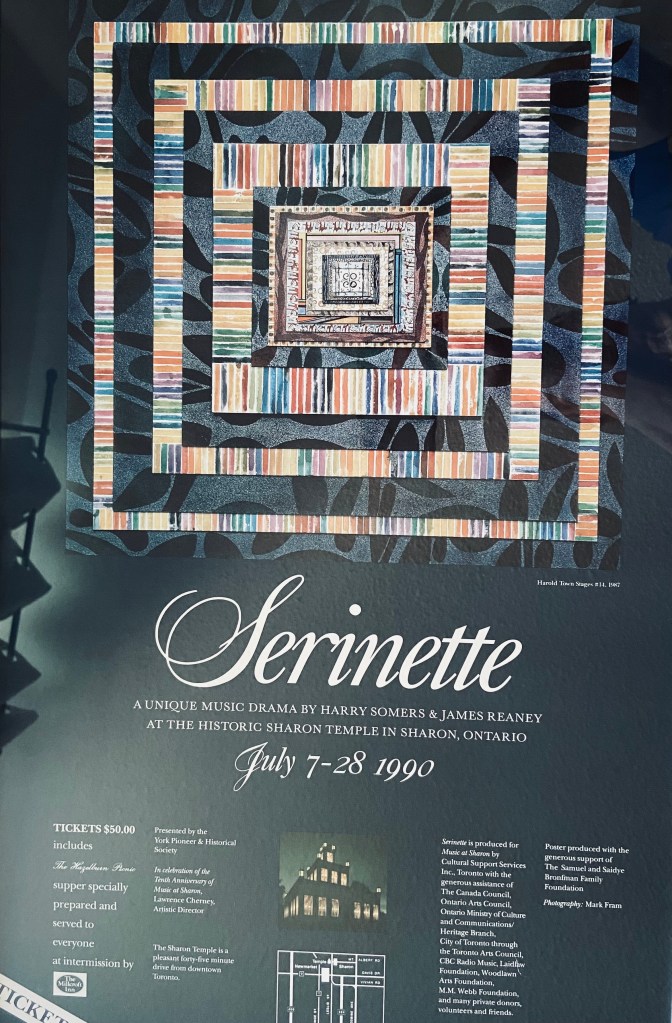
Composer Harry Somers (1925-1999) was commissioned by Lawrence Cherney, Artistic Director of Music at Sharon, to write the music in 1983. The story was to draw on the colonial era history of the Sharon Temple and the Quaker sect the Children of Peace. Seven years later, Serinette was complete and premiered on July 7, 1990 at the Sharon Temple.
July 7, 1990: Harry Somers celebrates at the Serinette premiere
Serinette July 7-28, 1990: Conductor: Victor Feldbrill, Director: Keith Turnbull Costume and Set Designer: Sue LePage Singers: Kristine Anderson, Lynn Blaser, Benjamin Butterfield, Jeffrey Carl, André Clouthier, Leslie Fagan, John Fanning, Carol Ann Feldstein, Dennis Giesbrecht, Aline Kutan, Brian McIntosh, Erik Oland, Jackalyn Pipher, Laura Pudwell
Harry Somers chose James Reaney to write the libretto: “Knowing James Reaney’s plays and his exceptional collaborations with John Beckwith, I was absolutely confident that he would produce a libretto that was suitable for setting to music. I knew that it would be dramatically rich in character and situation, and eminently theatrical. I’ve often been struck by how he uses simple and basic means to achieve a wide variety of theatrical effects, and how he uses a comparatively small cast with the greatest versatility.” [1]
James Reaney first learned about the Sharon Temple and the Children of Peace on a summer visit: “In 1944, while working at a farm labour camp in Holland Marsh, I received permission to walk into nearby Newmarket on business. Curiosity led me to take back roads; I was soon lost, and suddenly a pivot, a spiritual one, whirled into my life. Yes, I had lost my way, but I had also discovered an old square building made of wood and hundreds of panes of glass. It was the Sharon Temple, and as the years went by, its culture and religion became an obsession with me.”
“From John Beckwith, Keith MacMillan and Helmut Kallmann, I learnt that the musical and poetic tradition, as well as the left wing politics, of anglophone Canada started here. This was the site of the first commune based on Christian principles in Ontario, and these people created many original hymns, built the first organ, were the first to educate women in the crafts, and were the first to break down the barrier between artisan and artist. David Willson will always be one of my great folk heroes. [….] So, when Harry Somers asked me to write a libretto about nineteenth century life in Sharon, I leapt at an oft wished project, but decided not to be solemn.” [2]
Notes: [1] and [3] Harry Somers quoted in Serinette Program Notes, June 3, 1990. [2] James Reaney quoted in Serinette Program Notes, June 7, 1990.
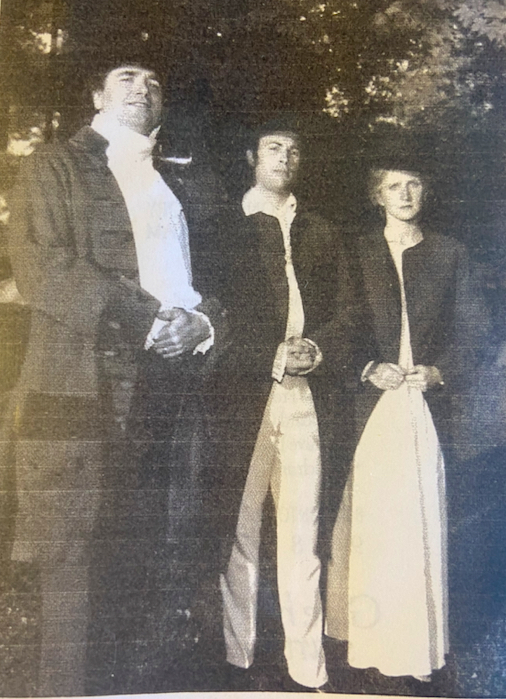
From Act I Scene 4: Three Quakers: John Fanning, Benjamin Butterfield, Jackalyn Pipher, July 1990Serinette Act I Scene 3: Leslie Fagan, the Bird Girl, among the Jarvis guests, July 1990Wild finch (The Bird Girl) design by Sue LePage (1990)
From Act I: Scene 3 The Bird Box
MRS. JARVIS: Mr. Jarvis, don’t let them start dancing. Quiet! I was about to show the ladies how this small barrel organ – the serinette you gave me, remember? – has taught our wild finch over there in that cage to sing Rossini. Sam Junior – take that sheet off that cage. Shhh!
(With great authority, Sam Jr. starts pulling the cover off the cage. The serinette begins to play, but its music goes wild as Sam inadvertently opens the door of the cage and the Bird Girl escapes. From being a bunch of voyeurs around a bird prison, the cast fan out to catch that bird! Improvise or compose chase music here. Colin and Ann do not take part in the chase. Eventually, Sam Jr. catches the bird and she is brutally shoved back into her prison and her cage is covered. As before, Sam Jr. ceremoniously pulls off the cover and as he does so, a singer in yellow dances in and repeats vocally the Rossini aria. Applause. Cover restored. Dancer off.)
LADY TWO: What else can it sing, Mrs. Jarvis? MRS. JARVIS: A month ago, that bird could not sing a thing worth listening to. LADY ONE: Oh, play another one, Mrs. Jarvis. Pray do. How many do you have on each barrel? Of this bird box? MRS. JARVIS: Two per barrel and we got twelve barrels! This is ‘O cessate di piagarmi, togliatemi la vita ancor.’ Hush!
(As the Lilliputian music sounds, the men retreat a bit.)
( ( ( 0 ) ) ) Audio excerpt from the 2001 revival recording
A concert revival of Serinette was held at St. James’ Cathedral, Toronto, Ontario with performances on May 31 and June 2, 2001, and a subsequent recording made at the Glenn Gould Studio is available from the Canadian Music Centre.
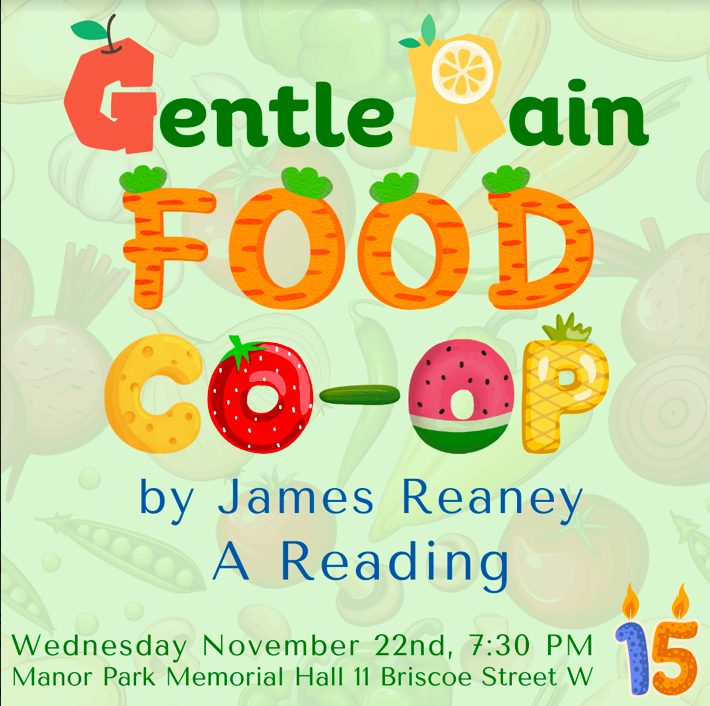
Admission is by donation to The Manor Park Food Bank — non-perishable food or cash accepted. Reserve your seathere. Where: The Manor Park Memorial Hall, 11 Briscoe Street W, London, Ontario
A plot is afoot to change the very DNA of the Gentle Rain Food Co-op !! James Reaney’s comic delight celebrates the eccentricities of community and lampoons fanaticism.
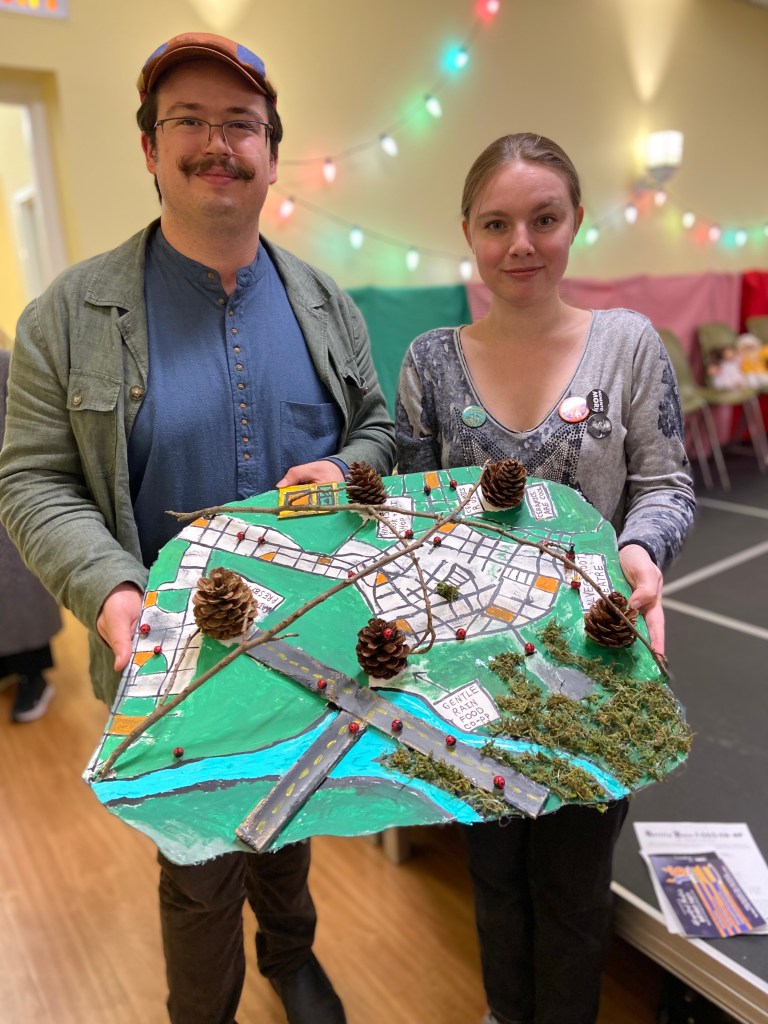
November 22, 2023 —AdamCorrigan Horowitz and Kydra Ryan in Gentle Rain Food Co-op: Evil Professor Skimwater commissions a model of St. David’s Ward from unsuspecting Jones: “By the way, Jones, my graduate class is waiting next door. I wonder if you’d mind brining your model of St. David’s Ward in for me so they can have a look at it too?”
November 5, 2022 — Katy Clark (soprano) accompanied by Charmaine Fopoussi (piano) at Museum London.
November 5, 2023 —Thank you all for coming to Wordsfest at Museum London to hear Dr. Katy Clark and ensembleperform selections from John Beckwith and James Reaney’s musical works, including four operas, poems set to music, and radio collages.
Dr. Clark drew on her research from her thesis on “Regionalism in the Operas of John Beckwith and James Reaney” to eloquently lead us though the six decades of Beckwith and Reaney’s musical collaboration.
Congratulations to the singers — Katy Clark (soprano), Paul Gambo (baritone), Charmaine Iormetti (soprano), and London Pro Musica— and musicians —Charmaine Fopoussi (piano),Gary McCumber (clarinet), and Patrick Theriault (cello) — for their wonderful work on these selections:
The Great Lakes Suite (1949) — Lake Superior, Lake Michigan, Lake Huron (poems by James Reaney) “Serenade” (1950) (poem by Colleen Thibaudeau) Night Blooming Cereus (1959) — A Plant Song, Houses in Heaven, Scene 3 Recitative (James Reaney) The Killdeer (1960/1961) — Waltz, Excerpt from Act 2, Scene 4, Credits music (James Reaney) Twelve Letters to a Small Town (1961) — To the Avon River above Stratford, Canada, Instructions: How to Make a Model of a Town (James Reaney) The Shivaree (1979) — Daisy’s Aria (James Reaney) Crazy to Kill (1989) — Down the Avenue of Trees (James Reaney) Taptoo! (1994) — Loyalists’ Song (James Reaney)
The James Reaney Memorial Lecture series celebrates the life and work of Southwestern Ontario poet and dramatist James Reaney, who was born on a farm near Stratford, Ontario and found a creative home in London, Ontario.
Join us on November 5, 2023 at Wordsfest at Museum London for the 14th annual James Reaney Memorial Lecture — The Beckwith Connection: An Afternoon of Big Hits from the Reaney & Beckwith Songbook.
Curated by London soprano Katy Clark, the 2023 Reaney Memorial Lecture celebrates playwright and poet James Reaney’s collaborations with a great Canadian composer, the late John Beckwith (1927-2022). Katy Clark leads a chamber ensemble into wonderful music from Beckwith as well as words from James Reaney (Jamie) and Colleen Thibaudeau. We will also celebrate the friendship of two creative couples – Jamie and Colleen and John Beckwith and Pamela Terry, as well as their families. Katy will be joined by London Pro Musica Choir, Paul Grambo, and guest artists.
Beckwith wrote four operas with Reaney, whom he met at the University of Toronto in the late 1940s. They shared a deep interest in creating and telling authentically Canadian stories with local references – both literary and musical – and universal messages.
Four Beckwith-Reaney operas: Night-blooming Cereus (1960), The Shivaree (1982), Crazy to Kill (1989), and Taptoo! (2003)Screenshot
About the presenter Soprano Katy Clark has sung as a soloist and chorister with companies across North America. She is a DMA candidate at the University of Toronto, where she studies with Nathalie Paulin, and holds a Masters degree in Voice Performance from the University of Michigan. In addition to her work as a performer, Ms. Clark is the founder and artistic producer of the London-based opera company Village Opera.
When: Sunday November 5 at 2:00 pm
Where: Museum London, 421 Ridout Street, London, Ontario N6A 5H4
Night-blooming Cereus revival by Opera Nova at the University of Victoria, 1992
Night Blooming Cereus, a chamber opera in one act, is one of several musical collaborations between poet and playwright James Reaney(1926-2008), who wrote the libretto, and composer John Beckwith (1927-2022).
“Furthering my ambition to compose an opera, I had the great good luck to find a librettist — a writer who understood music. James Reaney shared my love of opera, and early in our friendship in student days we spoke of perhaps collaborating on an original work. In early 1953 I received from him a draft of Night Blooming Cereus. The one-act opera he imagined taking shape as a sort of southern Ontario miracle play. It turned out to be the first of four operatic works we produced together over succeeding decades…”[1]
“[…] We worked on it slowly through the mid-1950s, almost entirely by correspondence, while starting to raise families and work on tenure, he in Winnipeg and I in Toronto. No one seemed interested in staging it, but we were fortunate that CBC Radio offered a broadcast production, and, encouraged by its success, repeated it the following year. In the season 1959-60 we were supported by a small committee of friends to raise funds for a live staging of our own.”[2]
James Reaney describes meeting the demands of the composer for more variety of metre in the draft libretto of Night Blooming Cereus as being “galvanized into, at the time and for me, incredible labours of counting syllables, making parallel lines exactly the same length and finding good clean, clear and sonorous rhymes… From those Manitoba fall nights…I date my birth as a craftsman in words.” [3]
“Night Blooming Cereus” image by designer Louis de Niverville, Toronto,1960.
In Scene 2 of the opera, lonely Mrs Brown tends to her house and her Night-blooming cereus, which is due to flower that evening.
(The dishes are put away, the cupboard door closed, the dishwater somehow disposed of. She gets the broom from behind the stove.)
SWEEPING Look at the faces on the floor In the wood of the boards they are Faces of dust I sweep with a broom, Sweeping the dust in this room. Sweeping sweeping sweeping sweeping Has a sound like weeping If I kept all the dust I’ve swept It would be she I have wept Whose face appears more often than not In the dust and the fire and the knot, And the blowing rain on the window And the tree branches’ shadow Contain your face there! and again there! My lost girl in dust in the air. But it is best to go on sweeping Over the faces better than weeping. Here is the face of an old man peeping. Here is the face of a young man reaping. Here is the face of an old woman sweeping.
(A bit tired with so much activity, she sits in the rocking chair.)
ROCKING Rocking rocking, rocking rocking Very very slowly What I have been doing rocking, Most of my life lately.
Sewing at a shirt or stocking As quickly as I can And what the people to me bring I sew at while rocking
Like selling footsteps to all houses My stitches go through cloth Of caps and nightgowns and blouses Dresses, handkerchiefs and vests.
I sew for everyone here, I the restless stillness, My thread looks through cloth for tear And the butcher’s apron.
The sewing connects each one To myself except for her. She walks about beneath the sun Without my sewing snow.
As the white snow fills fields and lanes, Till they cover me all. Upon my old and long-used bones Rocking and sewing fall.
Page from Reaney’s draft of the libretto for Night Blooming Cereus (see John Beckwith’s 1997 book, Music Papers: Articles and Talks by a Canadian Composer, page 219)
Poems Written About The Donnellys To Assist The Renewal of The Town Hall at Exeter, Highway #4 *
I Around Borrisokane, in Eire, the roads twist After cowherds with willow gads, after wise woman’s spells, After chariots and the widest go-around found in a mare’s skin. But in Biddulph, Canada, in Mount Carmel’s brooder stove, St Peter’s fields, The roads cross at right angles, a careful Euclidean net, roods, rods Spun by surveyors out of Spider stars – Mirzak, Spicula, Thuban, Antares. Like serpents, twitchgrass roots, dragons – the Irish roads twist, The old crooked roads twist in the cage of the straight new.
II We were horsemen, dressed well and from my brother’s entire horse, From his entire horse came the colt fast fleet hoofhand with which We seized and held onto the path through Exeter down to London. We lifted the hills, creeks, rivers, slaughterhouses, taverns, We lifted their travellers and those who were asleep when we passed And those who saw us rattle by as they plowed mud or whittled. We lifted them like a graveldust pennant, we swung them up and out Till they yelled about wheels falling off, unfair competition, yah! And we lie here now – headless, still, dead, waggonless, horseless, Sleighless, hitched, stalled.
III As the dressmaker hems my muslin handkerchiefs, The night the Vigilantes burnt down one of their own barns, As I sit waiting for a cake to bake and my gentle niece with me I realize I am not doing what you want me to do. You – bored with your Calvinist shoes chewed to pieces By streets of insurance, streets of cakemix, packages, soap, sermonettes. You want me to – you project a more exciting me on me. She should be burning! Clip! Ax! Giantess! Coarse, I should curse! Why should I accept these handcuffs from you?
James Reaney, 2005
* Respectively, the three speakers of these poems are William Porte, the Lucan postmaster, Tom Donnelly and Mrs. Donnelly.
“Entire Horse” is from Souwesto Home, a collection of James Reaney’s poems from 2005 available from Brick Books.
( ( 0 ) )Listen to Jeff Culbert read “Entire Horse” and other poems from Souwesto Homehere.
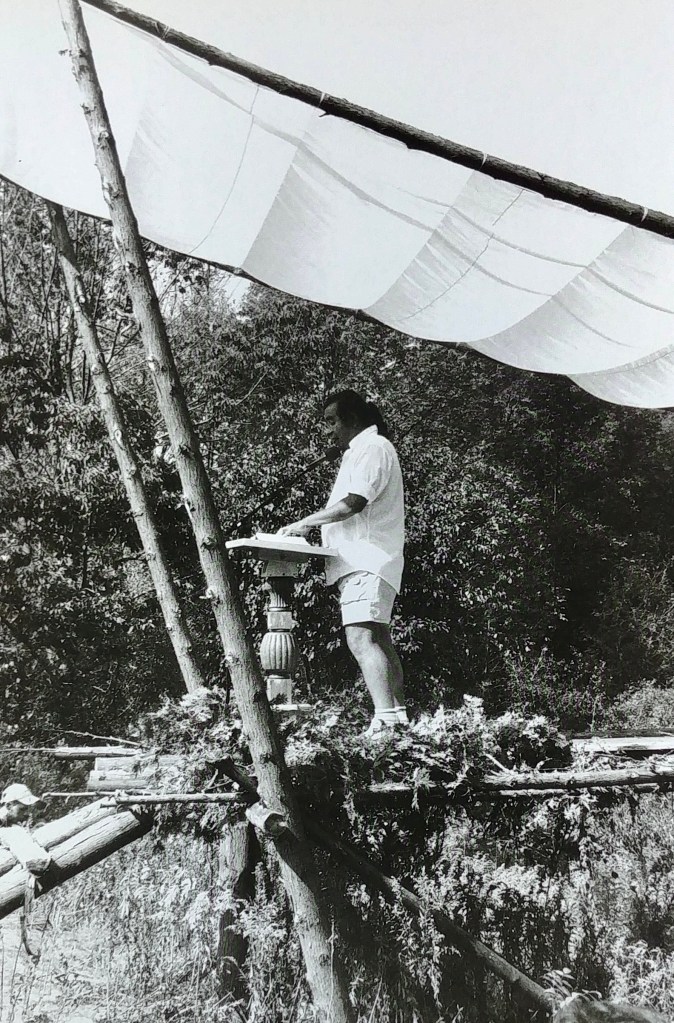
All three plays from James Reaney’s The Donnelly Trilogy — Sticks and Stones, The St. Nicholas Hotel, and Handcuffs — were performed at the Blyth Festival this summer at Blyth’s Outdoor Harvest Stage.
“Are there any more ladies and gentlemen for Calamity Corners as ’tis sometimes called, St. John’s, Birr — my old friend Ned here calls it Bobtown, the more elegant name is Birr. Elginfield known to some as Ryan’s Corners, Lucan that classic spot if it’s not all burnt down, Clandeboye, Mooretown, Exeter and Crediton. If Ned here hasn’t sawn it to pieces, the coach is waiting for you at the front door and it pleases you.”
Summer 2023 — On the way to the Outdoor Harvest Stage on the old Blyth Fairgrounds. Photo courtesy The Blyth Festival.
Summer 2023: Sticks and Stones at Blyth’s Outdoor Harvest Stage (Photo courtesy The Blyth Festival)
Part I: STICKS & STONES Friday August 4 Tuesday August 8 Friday August 11 Tuesday August 15 Friday August 18 Tuesday August 22 Friday August 2 Tuesday August 29 Friday Sept 1
Part II: THE ST. NICHOLAS HOTEL Saturday August 5 Wednesday August 9 Saturday August 12 Wednesday August 16 Saturday August 19 Wednesday August 23 Saturday August 25 Wednesday August 30 Saturday September 2
Part III: HANDCUFFS Thursday August 3 Sunday August 6 Thursday August 10 Sunday August 13 Thursday August 17 Sunday August 20 Thursday August 24 Sunday August 27 Thursday August 31 Sunday September 3
Part I: STICKS & STONES Friday August 4 Tuesday August 8 Friday August 11 Tuesday August 15 Friday August 18 Tuesday August 22 Friday August 2 Tuesday August 29 Friday Sept 1
Part II: THE ST. NICHOLAS HOTEL Saturday August 5 Wednesday August 9 Saturday August 12 Wednesday August 16 Saturday August 19 Wednesday August 23 Saturday August 25 Wednesday August 30 Saturday September 2
Part III: HANDCUFFS Thursday August 3 Sunday August 6 Thursday August 10 Sunday August 13 Thursday August 17 Sunday August 20 Thursday August 24 Sunday August 27 Thursday August 31 Sunday September 3
Summer 2023 — The Blyth Festival is bringing James Reaney’s The Donnelly Trilogy to Blyth’s Outdoor Harvest Stage. Director Gil Garratt has adapted the three plays especially for this outdoor setting.
The three plays,Sticks and Stones, The St. Nicholas Hotel, and Handcuffs will all be performed by one single company of ten actors, who will tell the tale from the killing of Patrick Farrell, to Johannah Donnelly’s march to Goderich to save her husband from the gallows, to the Stagecoach wars, to the Queen’s Hotel, to the Vigilance Society in the Cedar Swamp Schoolhouse, to the fiery February night when justice, revenge, and murder were left indistinguishable in the ashes.
This will be the first time in decades that all three of these touchstone plays have been performed in repertory with each other, affording audiences the chance to take in the whole cycle over three nights.
Gil Garratt’s thoughts on the three plays:
“I believe 2023 is the perfect time to re-ignite the telling of the Donnelly story in Blyth. At its heart, this is a story about grit, family, betrayal, the erosion of community, the rise of secret societies, the shadow of conspiracy, and the limits of faith. The show will be filled to the brim with folk music, stagecoaches, and live fire in the night.”
The Donnelly Trilogy by James Reaney Adapted, abridged, and directed by Artistic Director Gil Garratt Part I: Sticks and Stones, June 22-September 1 Part II: The St. Nicholas Hotel, July 13-September 2 Part III: Handcuffs, August 1-September 3
The Blyth Festival’s replica of the Donnelly stagecoach from Paul Thompson’s 2001 play Artistic Director Gil Garratt as Robert Donnelly in Blyth’s 2016 show The Last Donnelly Standing.
Thank you for coming to the 16th annual James Reaney Memorial Lecture celebrating poet Colleen Thibaudeau’s ‘Big Sea’ Vision this past Saturday November 29th. This year’s lecture is part of Colleening 2025, a year-long celebration of Colleen Thibaudeau’s centenary. Thank you, Peggy Roffey, for leading us through a thoughtful exploration of Thibaudeau’s poetry. After getting us to…
This year, in the spirit of metaphor, the 2025 James Reaney Memorial Lecture steps to the side and shows the “she” beside the “he”: James Reaney’s wife, poet Colleen Thibaudeau (1925-2012). Join us on Saturday November 29th at the London Public Library Central Branch for poet Peggy Roffey’s presentation “Colleen Thibaudeau’s Big Sea Vision”. In a combination…
On October 22-26, AlvegoRoot Theatre presents Sleigh Without Bells: A Donnellys Story — a short story by James Reaney from The Box Social and Other Stories (1996). In 2021, AlvegoRoot performed “The Bully” and “The Box Social,” two other stories by James Reaney. Adam Corrigan Holowitz, AlvegoRoot’s Artistic Director, was sure that “Sleigh Without Bells,”…