Skip to content
  • About
    • Awards
  • Publications
    • Books in print
  • Contact

James Reaney

  • Winter’s Tales by James Reaney, 1949

    January 11th, 2010
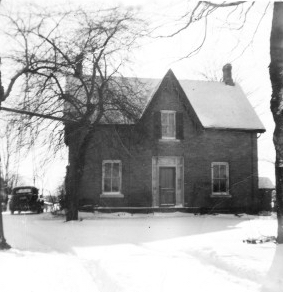
    Front entrance to James Reaney’s birthplace and childhood home near Stratford, Ontario, February 1954. Photo by Elizabeth Cooke (née Crerar)

    Winter’s Tales

    As planets love an ancient star
    And move in far dances round its fire
    So the farmer and his children sit
    About their stove whose flamey wit
    Giggles in red and yellow laughter
    Like a small sun caught in iron armour.
    When outside the winter winds are loud
    Close by their summery stove they crowd.

    Through the windows they may see
    The cold wind herd a river of snow
    Beneath the moon, across the land
    All locked in Winter’s frog-cold hand.
    And sometimes the wind does shove
    Between the window sill and window
    Beneath the door and across the floor
    White whisks and brooms of snow.
    Through every little crack
    At the front door and the back
    Came the soft white hands of snow
    That, with its heat, the stove does smash
    Into a harmless flat thin splash.
    Then down the chimney the wind came
    Till the fire seemed somewhat lame
    Until someone poked at it
    Or put on another stick
    And it blazed up again.
    The wind, the cold snow and the rain
    Could not put that stove out
    But in a furious dance
    They kept a safe distance
    Always beyond the window pane
    So that the farmer and his children
    By the stove sitting tight
    Only heard the wind and never felt
    Its sharp cold bite.
    Then the farmer told them stories
    That his father had told him
    Of the massacre at Lucan
    Where the neighbours killed all of the McKilligans dead
    Except one little boy who crawled under a bed;
    Of the little boy carried off by a bear
    And, “a ball of fire leaped out of the earth
    At him and vanished into thin air.
    Your grandmother saw
    Tecumseh’s head on a pole;
    Had also dined with him once
    And when she looked into her soup
    At the bottom of the bowl
    She saw a groundhog’s paw.
    And Indian Sal who picked flax
    And drank vinegar and had attacks
    And Granny Crack
    Who wandered the countryside
    With seven petticoats to her back.
    And Towser Smith who
    When it rained for five days in a row
    Went out and shook his fist at the sky,
    His fist at God in the sky.
    And how when I was a child
    You stood at the table
    And ate off a pie-tin
    Not sit on chairs and eat off a plate
    As you do now.
    And how bricks and mortar
    Couldn’t keep her from marrying him.”

    Then the farmer and his children grow drowsy
    With the heat of the fire so blowsy
    And the stories their father tells them
    Of the good and bad old days
    Grow shorter and shorter
    Till the fire alone seems to talk.
    Its ripening red now seeming
    A massive convulsive giant’s heart
    A Robin’s red breast.
    A sunset in summer,
    The rising and large Harvest Moon
    When she walks out of the east, –
    All these things seems the fire
    Which, with their father’s stories
    Will long be remembered
    And protect them from growing old.
    Winter’s tales that like gold
    In the purses of their hearts
    Will ring and shine forever
    Warming them in the long winter’s cold.

    James Reaney, 1949

    This poem first appeared in Contemporary Verse, 30, Winter 1949.

  • Merry Christmas!

    December 22nd, 2009

    Snowflake woodcut by James Reaney, 1970

    All the best for the holidays and for 2010.

  • Welcome to our new website

    November 28th, 2009


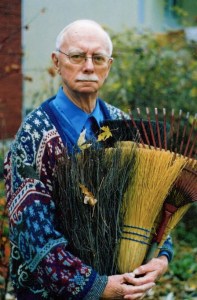
    James Reaney at home in London, Ontario, October 2005 (Photo by Jeff Culbert)

    Welcome to our new website celebrating the life and work of James Reaney.  We look forward to sharing news and resources about James Reaney with you.

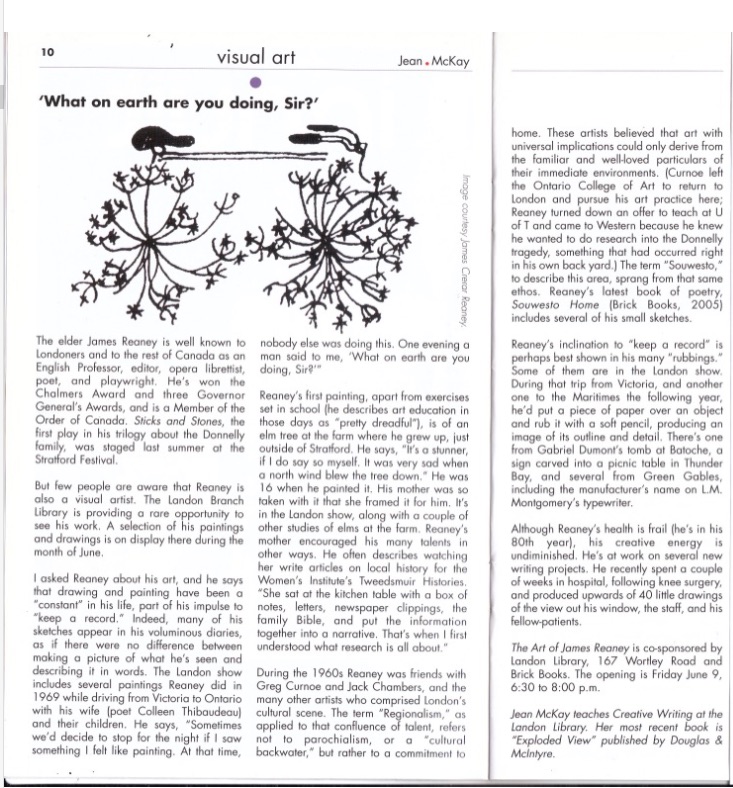
  • Jean McKay on “The Art of James Reaney” at the Landon Library, June 2006

    November 10th, 2009

    From London’s Artscape magazine (Issue 5, June 2006), here is Jean McKay’s article on James Reaney’s visual art.

    “The Art of James Reaney” was held at the London Public Library, Landon Branch, June 9-23, 2006.
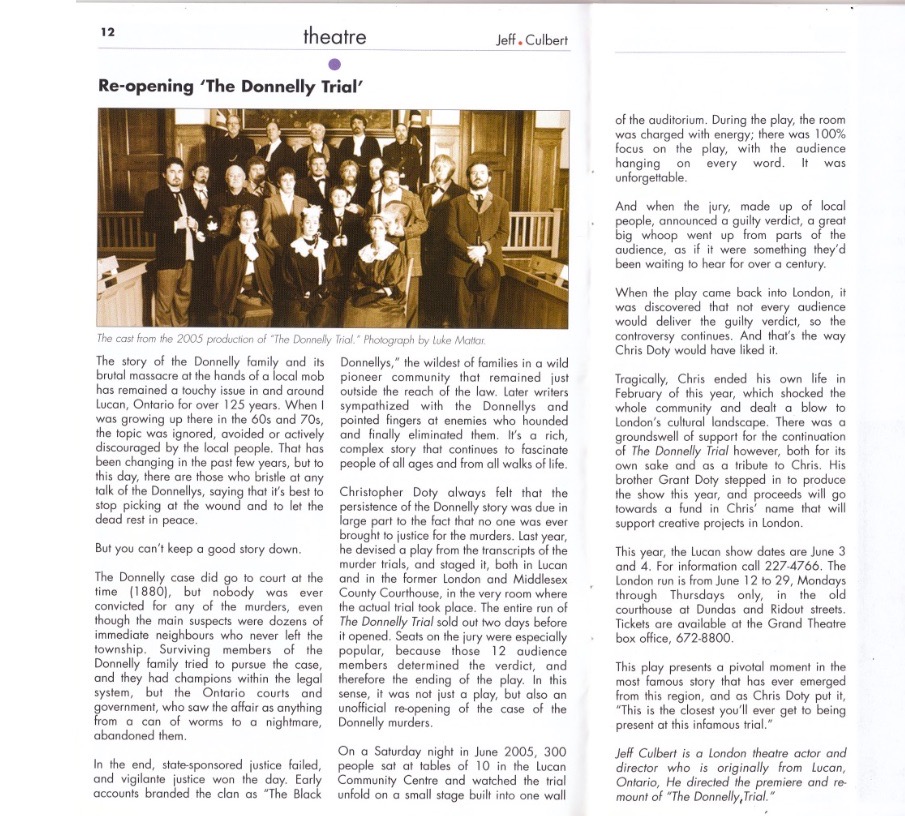
  • Jeff Culbert on Chris Doty’s play The Donnelly Trial

    November 8th, 2009

    From London’s Artscape magazine (Issue 5, June 2006), here is Jeff Culbert’s article on Chris Doty’s play The Donnelly Trial.

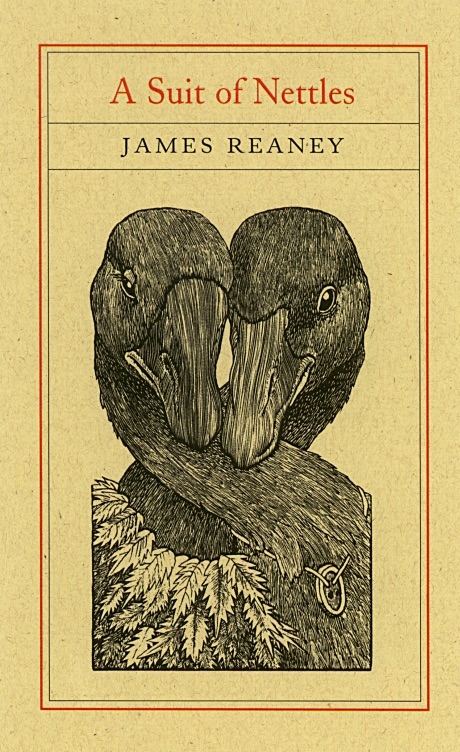
  • The Porcupine’s Quill is reissuing A Suit of Nettles

    November 7th, 2009

    The Porcupine’s Quill is reissuing A Suit of Nettles, winner of the 1958 Governor General’s Award for Poetry. Details of the launch to follow in April 2010.

    A Suit of Nettles (3rd ed. 2010)

  • One Man Masque (1960)

    January 5th, 2009

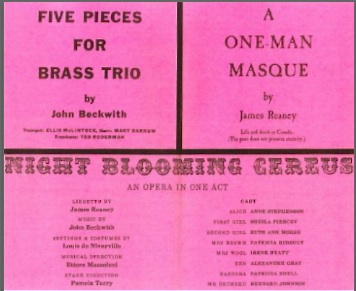
    James Reaney’s One Man Masque was first performed by the author as part of “An Evening with James Reaney and John Beckwith” at the Hart House Theatre in Toronto on April 5, 1960. Originally planned as the premiere of Beckwith and Reaney’s opera Night Blooming Cereus, One Man Masque and Beckwith’s Five Pieces for Brass Trio were added to form the first half of the program.

    One Man Masque first performed by James Reaney on April 5, 1960. “A ONE-MAN MASQUE by James Reaney — Life and death in Canada (The poet does not promise eternity.)”

    In his article “An Evening With Babble and Doodle: Presentations on Poetry” (Canadian Literature 12 Spring 1962, pages 37-43), James Reaney describes his ideas for presenting the poems as a masque:

    Since the opera was to last only an hour John suggested that I read some poems to raise the curtain. I decided that something more than just a reading was called for, [… and] I ended up writing another libretto for a masque — masque in the sense of a series of tableaux and spectacles, or stage images. I had been working on a series of poems that presented a subject in various keys: you start out with a Dwarf, modulate to a poem about a Baby, proceed to one about a Dauphin (baby Prince) and eventually fly from it all with that baby among the birds — the humming-bird. This suggested a stage picture that started out with a cradle, proceeded through chair, table, bed, rocking-chair to coffin… [pages 41-42]

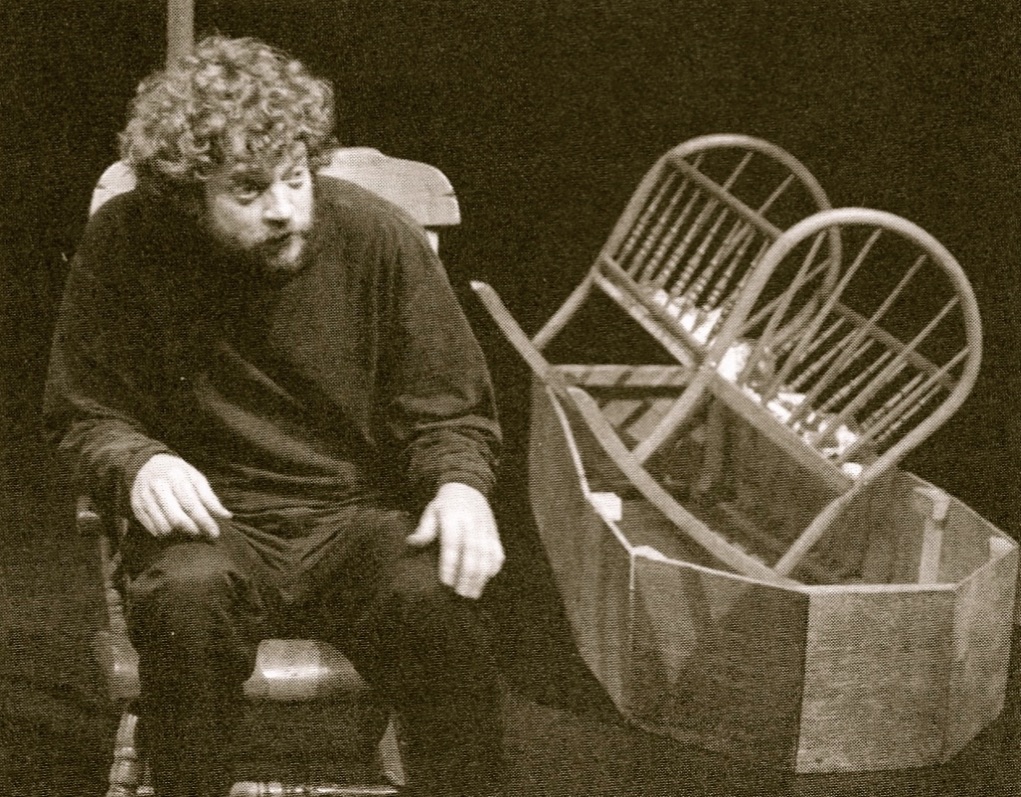
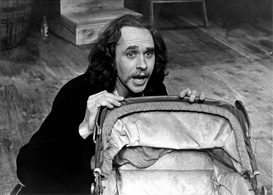
    One Man Masque has been performed by Jerry Franken in 1974 at the Tarragon Theatre, Jeff Culbert at the Grand Theatre in 2002, and by Larry Beckwith at Nuit Blanche in 2010.

    Jeff Culbert in One-Man Masque, Grand Theatre McManus Studio, London, Ontario, 2002
    Jerry Franken in James Reaney’s One Man Masque, 1974 at the Tarragon Theatre in Toronto.


  • Night Blooming Cereus (1959)

    January 4th, 2009

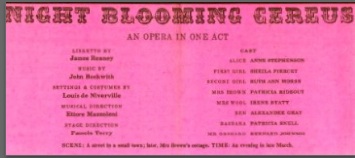
    “Night Blooming Cereus” image by designer Louis de Niverville and adapted by William Toye for the program for the first stage production (April 5 and 6, 1960 in Toronto).

    Night Blooming Cereus, a chamber opera in one act, is one of several musical collaborations between poet and playwright James Reaney, who wrote the libretto, and composer John Beckwith. In his autobiography Unheard of: Memoirs of a Canadian Composer, John Beckwith had this to say about his first opera:

    “Furthering my ambition to compose an opera, I had the great good luck to find a librettist — a writer who understood music. James Reaney shared my love of opera, and early in our friendship in student days we spoke of perhaps collaborating on an original work. In early 1953 I received from him a draft of Night Blooming Cereus. The one-act opera he imagined taking shape as a sort of southern Ontario miracle play. It turned out to be the first of four operatic works we produced together over succeeding decades…” [Unheard Of, page 246]

    Night Blooming Cereus calls for eight singers and an instrumental ensemble of fourteen players, and lasts about sixty minutes.[…] The image of a flower that blooms once a year — or by poetic licence once a century — stands for human hope and renewal…” [Unheard Of, page 247]

    John Beckwith completed the music and orchestration in the summer of 1958, and CBC Radio commissioned a broadcast for the “Wednesday Night” program in April 1959 and again in 1960. The first stage production of Night Blooming Cereus was at the Hart House Theatre in Toronto on April 5, 1960 with the following cast:

    ALICE: Anne Stephenson
    FIRST GIRL: Shelia Piercey
    SECOND GIRL: Ruth Ann Morse
    MRS. BROWN: Patricia Rideout
    MRS. WOOL: Irene Byatt
    BEN: Alexander Gray
    BARBARA: Patricia Snell
    MR. ORCHARD: Bernard Johnson

    Settings and costumes were by Louis de Niverville, musical direction by Ettore Mazzoleni and stage direction by Pamela Terry.

    Program for Night Blooming Cereus designed by William Toye, 1960. SCENE: A street in a small town; later Mrs. Brown’s cottage. TIME: An evening in late March.

    To listen to archived sound recordings of music by John Beckwith, see the complete catalogue holdings at the Canadian Music Centre.

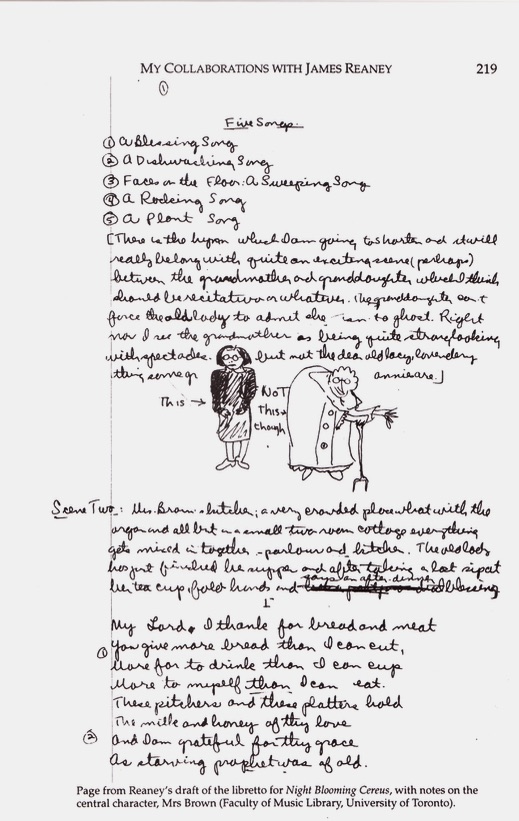
    Page from Reaney’s draft of the libretto for Night Blooming Cereus (see John Beckwith’s 1997 book, Music Papers: Articles and Talks by a Canadian Composer, page 219)

  • Zamorna! And The House By the Churchyard

    January 1st, 2009

    From Zamorna, April 17, 1999. Photo by Henry Xiong

    Zamorna! And The House By the Churchyard, which was performed by students of the George Brown Theatre School in 1999, has been published for the first time in Reaney Days in the West Room: Plays of James Reaney, edited by David Ferry.

    The play blends the real world of the Brontë family with a creation from their literary juvenilia, Branwell’s fantasy world of Zamorna. On April 17, 1999, James Reaney attended a performance of the play at George Brown College. Afterwards, he and David Ferry, the play’s director, participated in a discussion with members of the audience.

    From Scene 4, 1831 Heatherbell:

    BRANWELL Well, you see, girls… I’m a poet.

    EMILY (with a book) There’s an old Welsh law, Branwell, that says—

    GIRLS There are three things it is death to be:

    CHARLOTTE death to be a king

    ANNE fall in love with a fairy woman

    EMILY death to be a poet

    Sewing music swells up.

    GIRLS Death… it is death to be a poet.

    Zamorna (2)

    Zamona (3)

    Zamona (4)

    April 17, 1999: James Reaney speaks with the audience after the show. (Photo by Henry Xiong)

    April 17, 1999: James Reaney chatting after the show. (Photo by Henry Xiong)

←Previous Page
1 … 17 18 19
  • James Reaney’s emblem poem “The Farm”

    The Farm ( ( ( 0 ) ) ) For more about James Reaney’s poems and a look back at the family farm where James Reaney grew up, see the 1971 TVOntario documentary “James Reaney” in the Canadian Writers series. The Farm There was a farm divided in two1/2 of it surly brick maker ownedswale…

  • AlvegoRoot Theatre presents two Reaney plays in 2026

    2026 — James Reaney’s centenary year — is off to a good start with two plays based on his work from London’s AlvegoRoot Theatre. On February 20-21, AlvegoRoot presents two encore performances of Sleigh Without Bells: A Donnellys Story —  a short story by James Reaney from The Box Social and Other Stories (1996). Adam Corrigan Holowitz reprises his solo…

  • James Reaney’s Entire Horse

    Entire Horse Poems Written About The Donnellys To AssistThe Renewal of The Town Hall at Exeter, Highway #4 * IAround Borrisokane, in Eire, the roads twistAfter cowherds with willow gads, after wise woman’s spells,After chariots and the widest go-around found in a mare’s skin.But in Biddulph, Canada, in Mount Carmel’s brooder stove, St Peter’s fields,The…

Blog at WordPress.com.


Loading Comments...
 

    • Subscribe Subscribed
      • James Reaney
      • Already have a WordPress.com account? Log in now.
      • James Reaney
      • Subscribe Subscribed
      • Sign up
      • Log in
      • Report this content
      • View site in Reader
      • Manage subscriptions
      • Collapse this bar