2026 — James Reaney’s centenary year — is off to a good start with two plays based on his work from London’s AlvegoRoot Theatre.
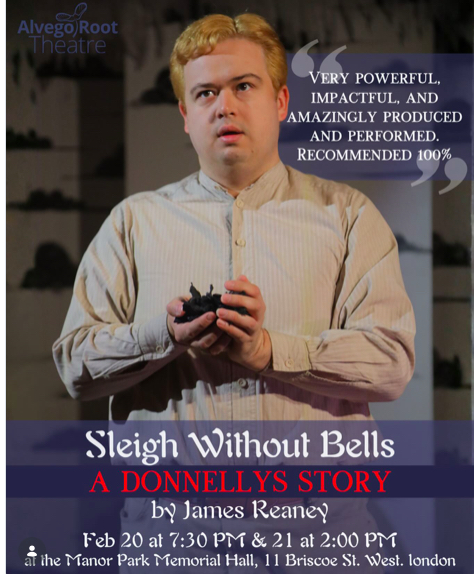
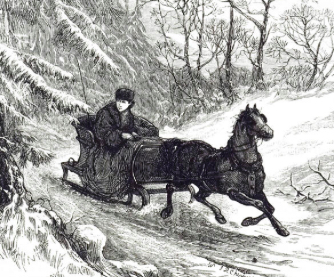
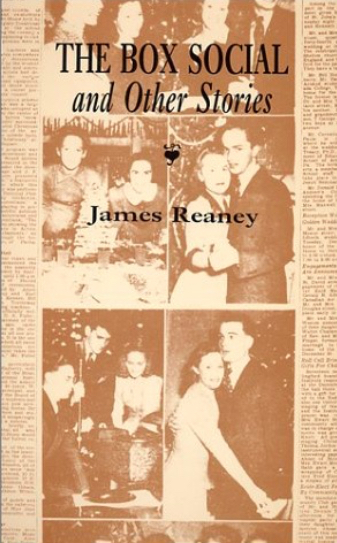
On February 20-21, AlvegoRoot presents two encore performances of Sleigh Without Bells: A Donnellys Story — a short story by James Reaney from The Box Social and Other Stories (1996). Adam Corrigan Holowitz reprises his solo performance as Ephraim, a young traveller lost in a blizzard who strays into Donnelly country. Directed by Kydra Ryan.
AlvegoRoot Theatre reprises James Reaney’s Sleigh Without Bells on February 20-21 in London, Ontario.
Where: The Manor Park Memorial Hall, 11 Briscoe Street W, London, Ontario When:February 20 at 7:30 pm and February 21 at2 pm.
Tickets: $30 at the door or call 519-615-2210 or order online from OnStageDirect.
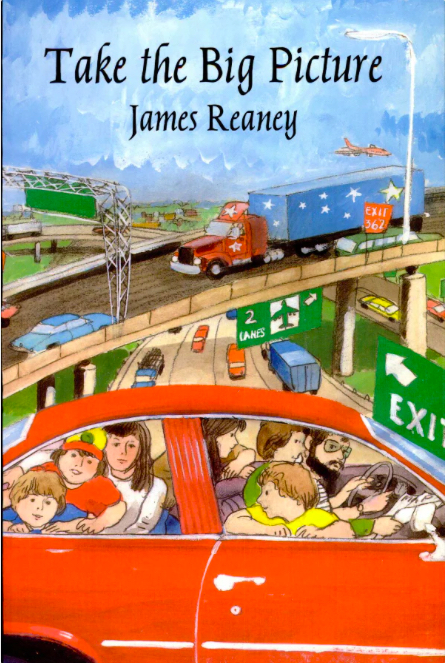
AlvegoRoot’s second Reaney production this year is an adaptation of Take the Big Picture, James Reaney’s 1986 children’s novel. Take the Big Picture will be presented at Fanshawe Pioneer Village from June 10 to June 14.
Cast announcements are expected soonfor Take the Big Picture — an epic tale of six children, their parents, their grandmother, and a host of others. It appears that a sasquatch has followed the Delahay family all the way back to Antler River, Ontario after their year away in British Columbia – but quién sabe?
James Reaney’s children’s novel Take the Big Picture from 1986.
Poems Written About The Donnellys To Assist The Renewal of The Town Hall at Exeter, Highway #4 *
I Around Borrisokane, in Eire, the roads twist After cowherds with willow gads, after wise woman’s spells, After chariots and the widest go-around found in a mare’s skin. But in Biddulph, Canada, in Mount Carmel’s brooder stove, St Peter’s fields, The roads cross at right angles, a careful Euclidean net, roods, rods Spun by surveyors out of Spider stars – Mirzak, Spicula, Thuban, Antares. Like serpents, twitchgrass roots, dragons – the Irish roads twist, The old crooked roads twist in the cage of the straight new.
II We were horsemen, dressed well and from my brother’s entire horse, From his entire horse came the colt fast fleet hoofhand with which We seized and held onto the path through Exeter down to London. We lifted the hills, creeks, rivers, slaughterhouses, taverns, We lifted their travellers and those who were asleep when we passed And those who saw us rattle by as they plowed mud or whittled. We lifted them like a graveldust pennant, we swung them up and out Till they yelled about wheels falling off, unfair competition, yah! And we lie here now – headless, still, dead, waggonless, horseless, Sleighless, hitched, stalled.
III As the dressmaker hems my muslin handkerchiefs, The night the Vigilantes burnt down one of their own barns, As I sit waiting for a cake to bake and my gentle niece with me I realize I am not doing what you want me to do. You – bored with your Calvinist shoes chewed to pieces By streets of insurance, streets of cakemix, packages, soap, sermonettes. You want me to – you project a more exciting me on me. She should be burning! Clip! Ax! Giantess! Coarse, I should curse! Why should I accept these handcuffs from you?
James Reaney, 2005
* Respectively, the three speakers of these poems are William Porte, the Lucan postmaster, Tom Donnelly and Mrs. Donnelly.
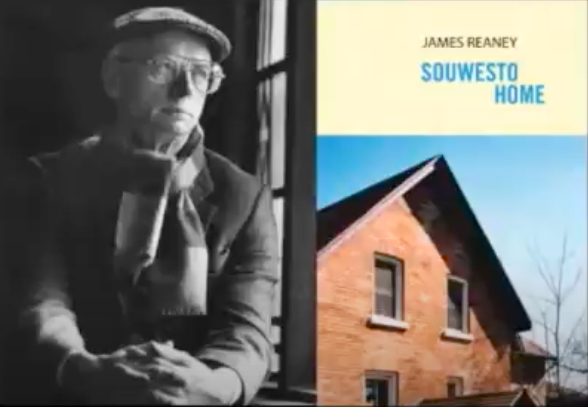
“Entire Horse” is from Souwesto Home, a collection of James Reaney’s poems from 2005 available from Brick Books.
( ( 0 ) )Listen to Jeff Culbert read “Entire Horse” and other poems from Souwesto Homehere.
All three plays from James Reaney’s The Donnelly Trilogy — Sticks and Stones, The St. Nicholas Hotel, and Handcuffs — were performed at the Blyth Festival in 2023 at Blyth’s Outdoor Harvest Stage.
“Are there any more ladies and gentlemen for Calamity Corners as ’tis sometimes called, St. John’s, Birr — my old friend Ned here calls it Bobtown, the more elegant name is Birr. Elginfield known to some as Ryan’s Corners, Lucan that classic spot if it’s not all burnt down, Clandeboye, Mooretown, Exeter and Crediton. If Ned here hasn’t sawn it to pieces, the coach is waiting for you at the front door and it pleases you.”
(Opening lines from James Reaney’s The St. Nicholas Hotel)
Summer 2023 — On the way to the Outdoor Harvest Stage on the old Blyth Fairgrounds. Photo courtesy The Blyth Festival.
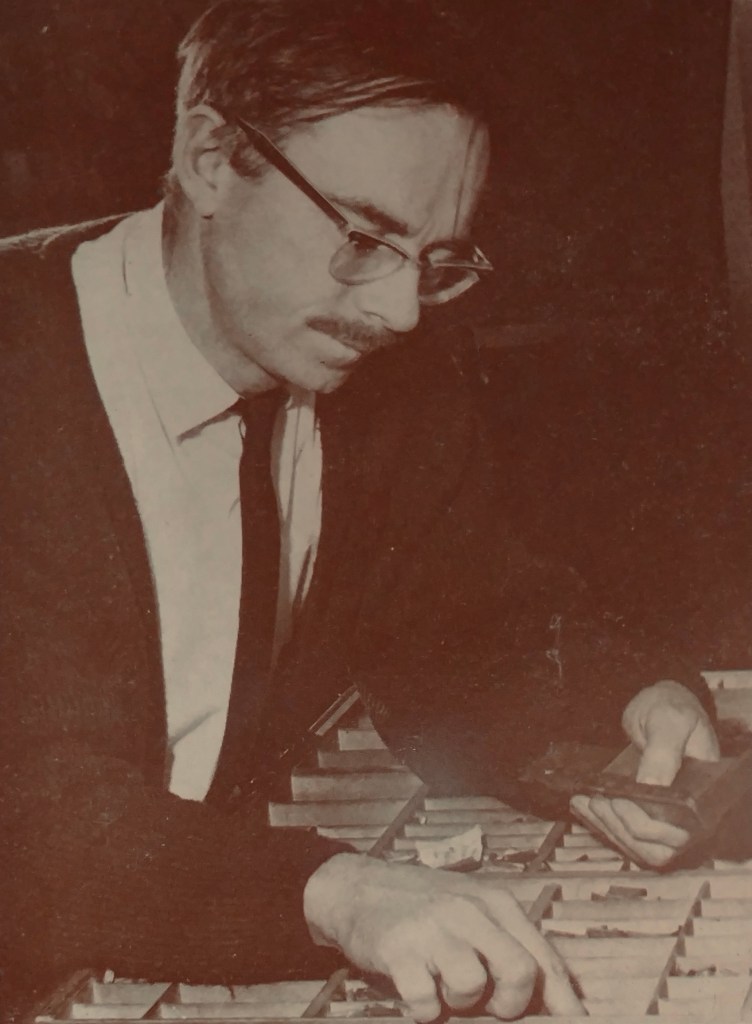
James Reaney printing at the Alphabet Press print shop at 430 Talbot Street in London, Ontario (mid-1960s). Credit: London Free Press/Sun Media Corporation.
In late summer 1965, James Reaney’s Alphabet Press printed the first edition of Colleen Thibaudeau’s Lozenges: Poems in the Shapes of Things in London, Ontario. Thibaudeau’s husband James Reaney typeset the poems and also designed the cover.
In fall 2024, Hilary Neary, historian and former Alphabet Magazine designer, proposed a facsimile second edition of the original Lozenges for Colleening 2025, a celebration of the centenary of Colleen Thibaudeau (1925-2012).
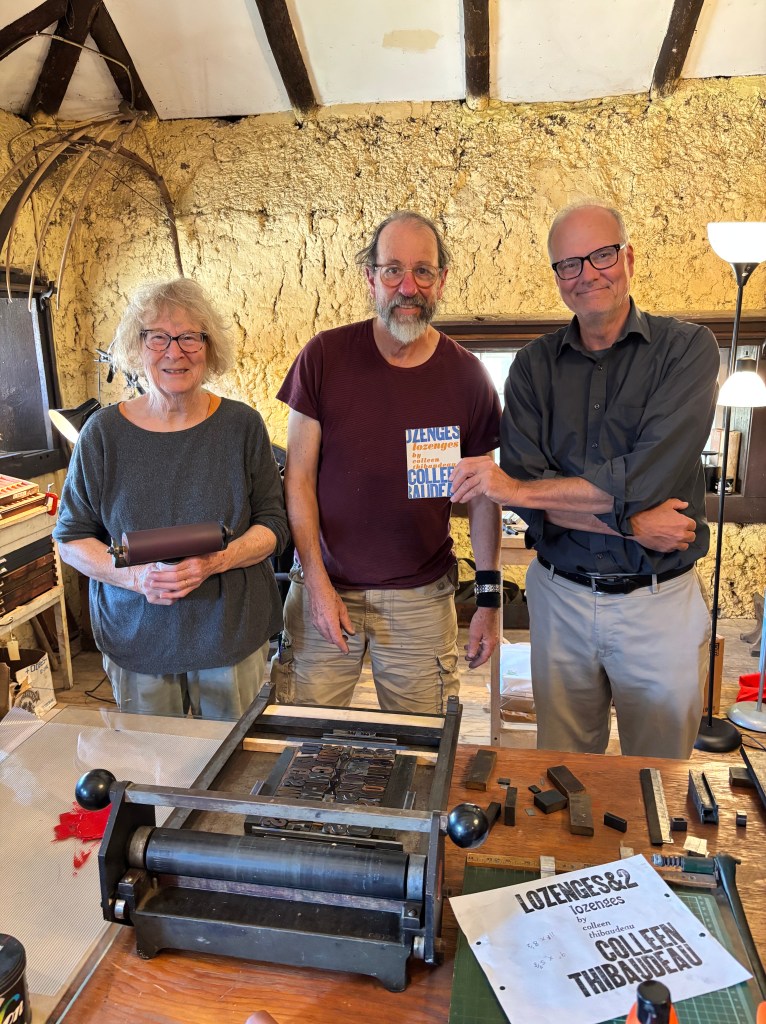
Printers Hilary Neary, Stephen Sword, and Mike Baker at The Forge and Anvil Museum in Sparta, Ontario. (Photo by James Stewart Reaney)
On August 27, 2025, after many months coordinating and resourcing this venture, printers and compositors Hilary Neary, Stephen Sword, and Mike Baker (pictured above) gathered at The Forge and Anvil Museum in Sparta, Ontario to print the new second edition. The photo shows a proof from the new 2025 edition’s cover design in the foreground, and Mike Baker holding the original 1965 classic by Colleen Thibaudeau.
Copies of the new Lozenges: Poems in the Shape of Things were given out at Colleening 2025 events in London and St. Thomas.
( ( ( 0 ) ) ) Listen to Hilary Neary and Mike Baker read poems from Lozenges.
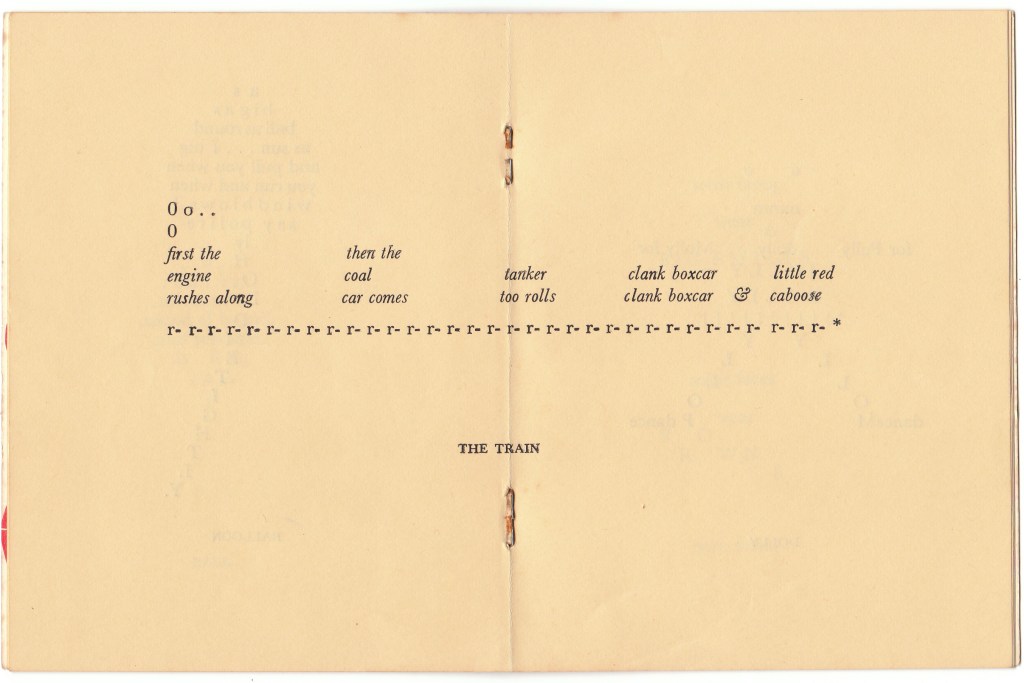
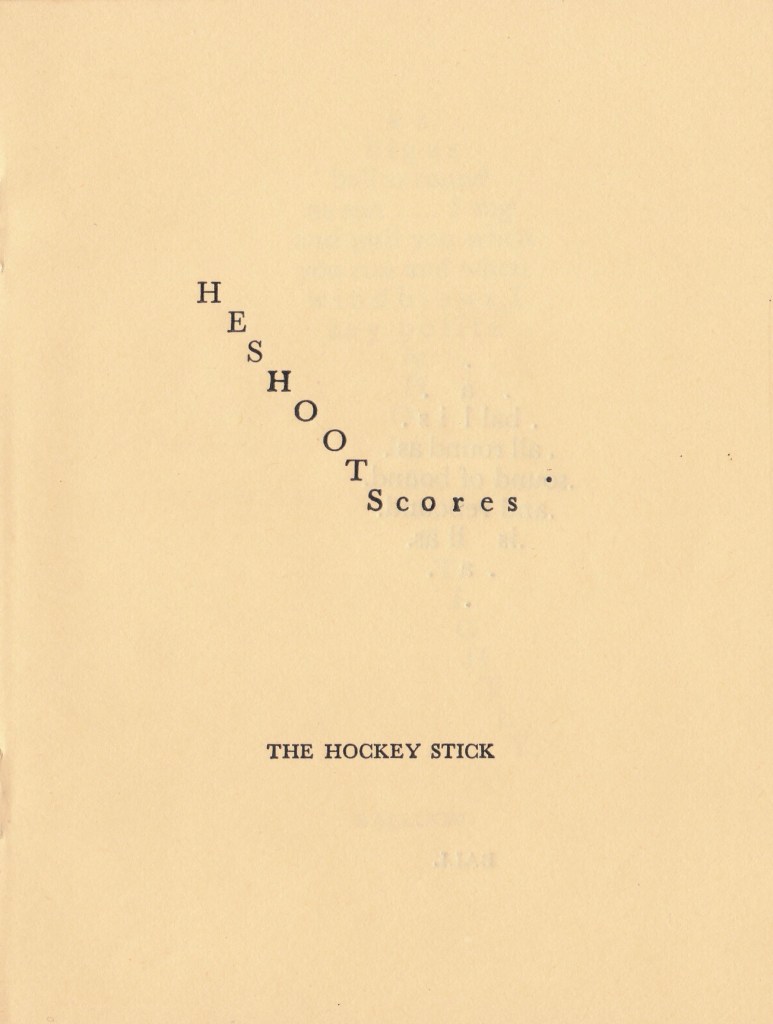
Colleen Thibaudeau’s poem “The Train” from Lozenges (1965)Colleen Thibaudeau’s poem “The Hockey Stick” from Lozenges (1965)
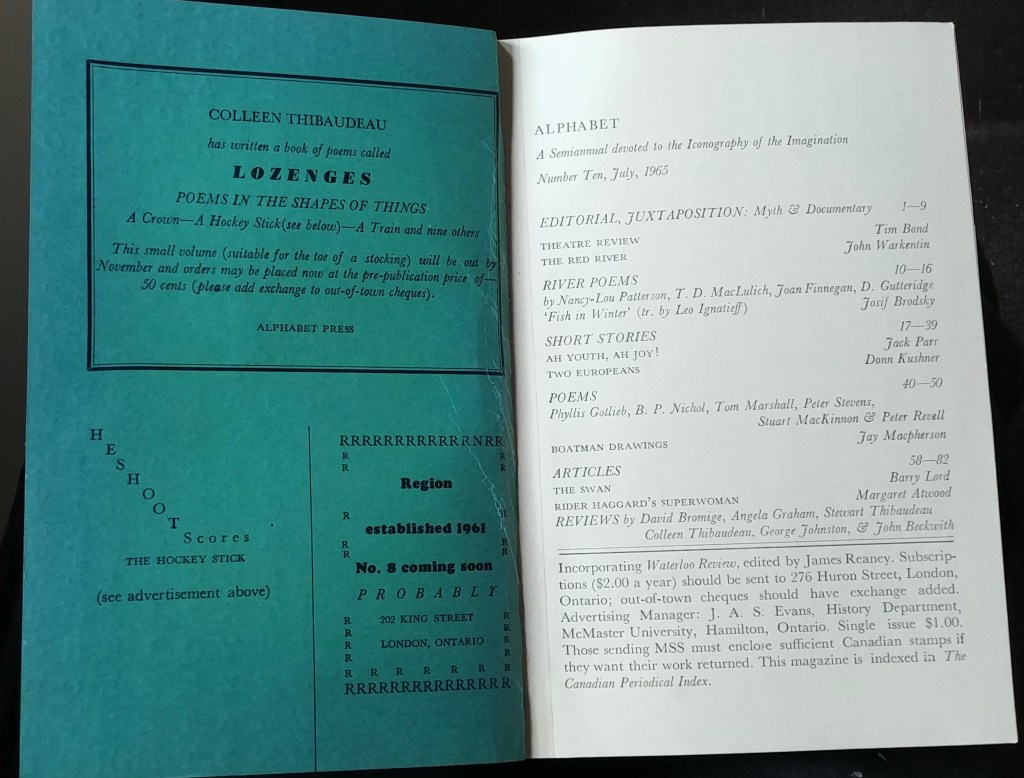
Alphabet Issue 10 from July 1965 shows an announcement for Lozenges by Colleen Thibaudeau and one of her poems “The Hockey Stick” on the inside front cover.
AlvegoRoot Theatre presents Sleigh Without Bells: A Donnellys Story, October 22-26
On October 22-26, AlvegoRoot Theatre presents Sleigh Without Bells: A Donnellys Story — a short story by James Reaney from The Box Social and Other Stories (1996).
“The story strikes me as an interesting coda to the Donnelly Trilogy, and a few people I have talked to say they thought that it feels a bit like a portrait of the artist diving into the Donnelly story, falling in love with the people/characters and then having to leave them behind in the land of the dead/purgatory.”
Where: The Manor Park Memorial Hall, 11 Briscoe Street W, London, Ontario When:October 22, 23, and 24 at 7:30 pm and matinees at 2 pm on Saturday October 25 and Sunday October 26.
Tickets: $30 at the door or online from OnStageDirect.
James Reaney (left) directing Tomson Highway and others in a scene from Wacousta, Fall 1976 (Image courtesy Western University Archives, James Reaney fonds AFC 18)
In 1976, James Reaney began working on Wacousta!, a new play based on John Richardson’s 1832 novel. Londoners, NDWT actors, and Western students helped develop the play through a series of workshops directed by Reaney at the University of Western Ontario’s Drama Workshop.
Playwright Tomson Highway, who was studying at Western that fall, was a member of the workshop and the Cree language coach for the play. In a later reflection on “Our Own Literature,” he recalls his early days and how the impetus to write plays came from the discovery that other Canadian writers such as Margaret Laurence wrote about what they knew.
“I was born into an oral culture and an oral language (Cree). Up where I come from, caribou country, the extreme far north of the province of Manitoba […] there is no written language, certainly no English, French, or any other European language. […]”
At age 20 while studying at the University of Manitoba, he “…came upon the writings of Margaret Laurence, whose stories took place in Neepawa, Manitoba, mere miles west of Winnipeg, a town I’d travelled through and whose cemetery I’d seen, from a distance many times and I thought that that stone angel in the imagined cemetery (never having seen it up close) must surely be the most magical stone angel in the history of the universe. […]”
“And then later on of course I met him in the flesh – shook his hand! – I met the poet/playwright James Reaney who wrote about London, Ontario where I was going to university. And then there was Michel Tremblay, over in Montreal, with that country-and-western goddess Carmen, singing her songs of love and sorrow on “the Main.”
“Well that was it. I decided that when I grew up I was gonna be like James Reaney and Michel Tremblay and Margaret Laurence and all the rest of them. I was gonna write stories that took place among my people inside the mythology of my people, vibrant, colourful – every bit as vibrant and colourful and passionate (yes, and tragic, sometimes) as people in New York and London (England) and Paris and Moscow. Yes, I decided, we were gonna have our own literature…in Cree.” [Excerpted from Reading Writers Reading: Canadian Authors” Reflections, Danielle Schaub – Photographer and Editor, University of Alberta Press and The Hebrew University Magnes Press, 2006, page 48.]
For more about Tomson Highway and his plays The Rez Sisters, Dry Lips Oughta Move to Kapuskasing, and Kiss of the Fur Queen, see tomsonhighway.ca and the Canadian Theatre Encyclopedia.
For more about the Wacousta Workshops (Fall 1976 to Spring 1977) at Western in London, Ontario, see James Reaney’s play Wacousta![A melodrama in three acts with a description of its development in workshops], Press Porcepic Limited, 1979.
Tomson Highway: lacrosse scene for Wacousta, Fall 1976 (Image courtesy Western University Archives, James Reaney fonds AFC 18)Tomson Highway and others — Wacousta workshops, Fall 1976 (Image courtesy Western University Archives, James Reaney fonds AFC 18)
Sometimes when I hold Our faded old globe That we used at school To see where oceans were And the five continents, The lines of latitude and longitude, The North Pole, the Equator and the South Pole— Sometimes when I hold this Wrecked blue cardboard pumpkin I think: here in my hands Rest the fair fields and lands Of my childhood Where still lie or still wander Old games, tops and pets; A house where I was little And afraid to swear Because God might hear and Send a bear To eat me up; Rooms where I was as old As I was high; Where I loved the pink clenches, The white, red and pink fists Of roses; where I watched the rain That Heaven’s clouds threw down In puddles and rutfuls And irregular mirrors Of soft brown glass upon the ground. The school globe is a parcel of my past, A basket of pluperfect things. And here I stand with it Sometime in the summertime All alone in an empty schoolroom Where about me hang Old maps, an abacus, pictures, Blackboards, empty desks. If I raise my hand No tall teacher will demand What I want. But if someone in authority Were here, I’d say Give me this old world back Whose husk I clasp And I’ll give you in exchange The great sad real one That’s filled Not with a child’s remembered and pleasant skies But with blood, pus, horror, death, stepmothers, and lies.
James Reaney, 1949
“The School Globe” is from The Red Heart (1949), James Reaney’s first book of poems.
At The Congress Café in Austin, Texas, A group of men & women came in, Workers in some state office. They ordered drinks, then meals. After just twenty minutes, You could hear the drink they’d drunk Suddenly, happily, speak out in them. This sound of community went on until we left. I have no doubt that afterwards The drink they had taken Coupled some of them in matching ecstasies On Murphy beds.
How many things seek their voice in us? Unsuspected demons & angels Wait for the arrangement we provide Of gut, enzyme, funny bone, nervous system, mind.
Blood we lost long ago? (On Frederick’s great battle field When first he conquered Angria) Seeking to recirculate once more?
The apples of the orchard young Elmer Scheerer’s Father planted Which his son pressed into cider barrels, then drank Which then became his wild mouth organ music Played from a Pippin tree top, or (husband) on wilder bed spring, Printing press of his sons, Stanley & Geordie, Early friends of mine, O Congress Café.
James Reaney, 2005
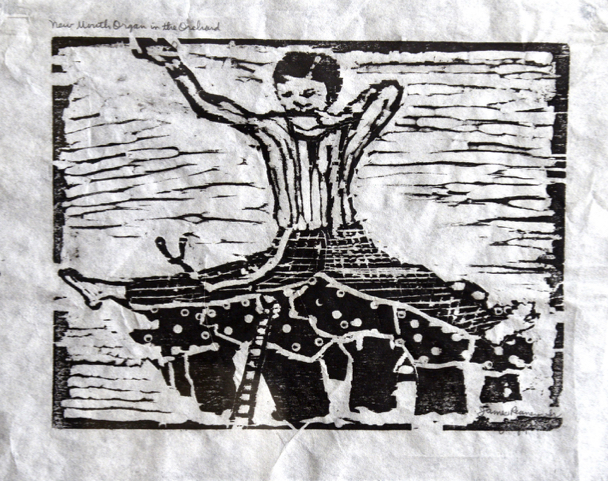
“New mouth organ in the orchard” Woodcut on paper by James Reaney (1988)
“The Congress Café” is from Souwesto Home, a collection of James Reaney’s poems from 2005 available from Brick Books.
( ( ( 0 ) ) ) Listen to Jeff Culbert read “The Congress Café” and other poems from Souwesto Home here.
In the 1976 Alumni Gazette (UWO) article “Souwesto Theatre: A Beginning” excerpted here, James Reaney describes the years he spent researching the Biddulph Tragedy of February 4, 1880 and how the knowledge he gained about the Donnellys’ world helped create the Donnelly trilogy.
Orlo Miller, who wrote the historical book The Donnellys Must Die (1962), had based his research on local courthouse documents of the time. Miller’s collection of relevant documents was available to Reaney at the University of Western Ontario’s Regional Archives:
“One of my early experiences back here* […] was to go with my father to hear Orlo Miller lecture at Middlesex College on his recent book The Donnellys Must Die.As a child I had heard the story of this tragic family from our hired man, and my interest was revived now, especially when I heard that Mr. Miller had, in the thirties, collected a huge heap of legal and municipal documents with relevance to the Biddulph Tragedy from the attics of the courthouses at Goderich and at London […]. [In the archives] I entered the really magic world of the past which can only be reached through such fragile ladders and windows as bundles of counterfoils from Sheriff’s cheque books, Court Criers’ Bills, Surveyors’ Notebooks, Chattel Mortgages (whole inventories of people’s furniture and beasts and implements), Jury Lists, Assessment Rules, Crown Attorney Letterbooks and, last of all, mountains of blue paper containing an endless stream of Information and Complaint – the term used for the form you had to fill out when some fellow pioneer had dogged your cattle, tried to pour boiling water on you, torn down your fence, milked your cow furtively or torn down your house with you inside. [Alumni Gazette 1976, pages 14-15]
One of my first research lessons was to train myself to read nineteenth century handwriting and abbreviations; for example, for about a year I somehow assumed that “Inft” meant “infant” so that when you read “.… and poured boiling water over the Inft” I naturally saw the very darkest picture imaginable; suddenly one day it dawned on me that the early Huron District backwoods scene was indeed horrible, but that “Inft” did at least stand for an Informant fifty years old and perfectly capable of running away! Now these documents where a Plaintiff accuses a Defendant of doing something are extremely dramatic, partly because of the variety of things accused, and I made them into one of the choral passages in Sticks and Stones (Part One) in order to show the social situation at its tumultuous litigious mad worst, which is always the dramatic best! [.…] Propelled by the magnetic names “Donnelly” and “Biddulph” I read all the Huron District and County Archives from the beginning to 1863 when Biddulph Township leaves Huron County; I knew that I wanted to write a play about these people, but I wanted to get inside their world first and those hundreds of boxes filled with blue paper – it gets white about 1870 – were the keys to this state. Whoever filed away things in the Huron County Courthouse filed away everything, and I am eternally grateful […]. [H]ere you often get pictures of whole families talking at each other in a way that no history book ever thinks of showing you: one of my favourite lines from the trilogy – “It’s not enough that we should starve, but we must freeze to death as well” – comes right out of a Chancery document. [Alumni Gazette 1976, page 15]
Now there is probably a reason for this material being dear to a dramatist’s heart; a court case is after all a drama – with its lawyers arguing so one-sidedly against each other, with its witnesses opposing each other too and with a Judge, who quite frequently in the early days, climaxes everything with a knock on the head or wallet all around! If at the time you were to have taken a Constable’s Bill to the constable who had just filled it out and told him that it would make a good scene in a play he would have laughed at such foolishness. But time going by changes all that and scholars and artists have as their duty the finding out of just how time does give ordinary things meaning. After the five years were over and I found myself with Five Legal Blue Binders with transcribed material, I found that the three plays of The Donnellys corresponded to three of these binders. All – all!?, I had to do was pare things down from 200 hours of dialogue and action to three hours per binder! [Alumni Gazette 1976, page 15]
After a series of workshops with my own group, the Listeners, at Alpha Centre and Mini-Theatre, where we used this material in prototypes of the Donnelly plays called “Antler River” and “Sticks and Stones”, I did some more shaping until in 1972 I was invited down to Halifax to work with Keith Turnbull, a former student here on the material using local children and professional actors. The actors wolfed down the contents of the binders – and I think that in their performances you can see that they have genuinely touched some area of time not our own […]. [Alumni Gazette 1976, page 15]
This article originally appeared in Western’s Alumni Gazette in 1976 (pages 14-16). Read the full article here.
Miriam Greene, Patricia Ludwick, Jerry Franken, and David Ferry in James Reaney’s Sticks and Stones at the Tarragon Theatre in Toronto, 1973.
* In 1960 James Reaney left his first teaching post at the University of Manitoba and came to teach in the Faculty of English at the University of Western Ontario in London, Ontario: “One of the reasons I decided to leave my first teaching post in Manitoba and come to this campus was that I wanted to find out more about the land of my birth – Southwestern Ontario, or as Greg Curnoe very aptly calls it – Souwesto.” [page 14]
Souwesto history continues to inspire local playwrights: Jeff Culbert has written a one-man musical version The Donnelly Sideshow, Chris Doty restaged The Donnelly Trial in 2006, and Paul Thompson wrote The Outdoor Donnellys (2001) and The Last Donnelly Standing (2016).
Gil Garratt as Robert Donnelly in The Last Donnelly Standing (Photo by Terry Manzo courtesy The Blyth Festival 2016.)
Thank you for joining us at Wordsfest on November 6th to hear author Terry Griggs read the late Stan Dragland’s essay on his forthcoming bookJames Reaney On the Grid. We were honoured to have Terry give voice to Stan’s words and illuminate his thoughts on James Reaney.
Terry Griggs at Museum London, November 6, 2023
Many thanks to Wordsfest for hosting the lecture and to Josh Lambier and Greg de Souza for their help in launching the presentation.
November 6, 2023: Moderator James Stewart Reaney takes questions for Terry Griggs.
( ( ( 0 ) ) ) Link to an archived recording of the lecture here. The text for Stan Dragland’s essay is available here.
Stan Dragland (1942-2022)Stan Dragland’s book James Reaney on the Grid will be published in 2023
The James Reaney Memorial Lecture series celebrates the life and work of Southwestern Ontario poet and dramatist James Reaney, who was born on a farm near Stratford, Ontario and found a creative home in London, Ontario.
Our thanks to Wordsfest and the London Public Library for their support of the lecture series, and to Poetry Stratford and the Stratford Public Library for their support in hosting the earlier lectures (2010-2015).
“Near Fraserburg” Watercolour painting by James Reaney, Fall 1985September 1975: James Reaney at the Nihilist Picnic, Poplar Hill, Ontario
There are two events celebrating the work of dramatist James Reaney this month and next:
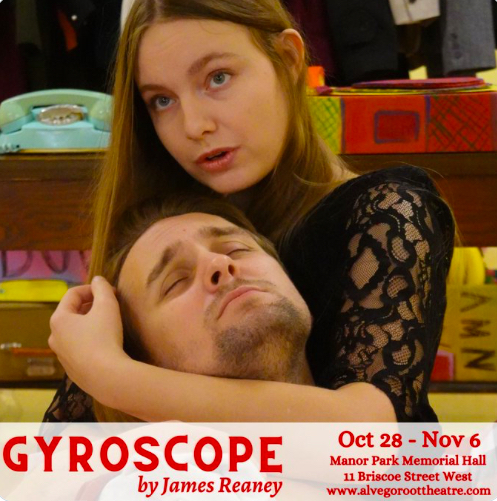
Patricia Nacamoto as Mattie Medal in Gyroscope: “Is it true, Gregory La Selva, is it true that one of the conditions of your marriage was that, were that you were never, never to read her stuff?”
October 28-30 and November 4-6: James Reaney’s play Gyroscope, directed by Adam Corrigan Holowitz and presented by AlvegoRoot Theatre.
All performances at Manor Park Memorial Hall, 11 Briscoe Street, London, Ontario.
( ( 0 ) ) Listen to an interview with Adam Corrigan Holowitz and Janis Nickleson (who played Hilda La Selva in the 1981 production of Gyroscope!): Gyroscope Conversations on Soundcloud
November 6 at 12:00 noon at Wordsfest: The James Reaney Memorial Lecture at Museum London. Terry Griggs, author and former student of the late Stan Dragland (1942-2022), will present “James Reaney Off the Grid”, the lecture Stan had planned to give.
Wordsfest is at Museum London, 421 Ridout Street North, London, Ontario.













 James Reaney