

In 1979, Stratford Central Secondary School commissioned James Reaney to write a play about Stratford in honour of the school’s centennial.
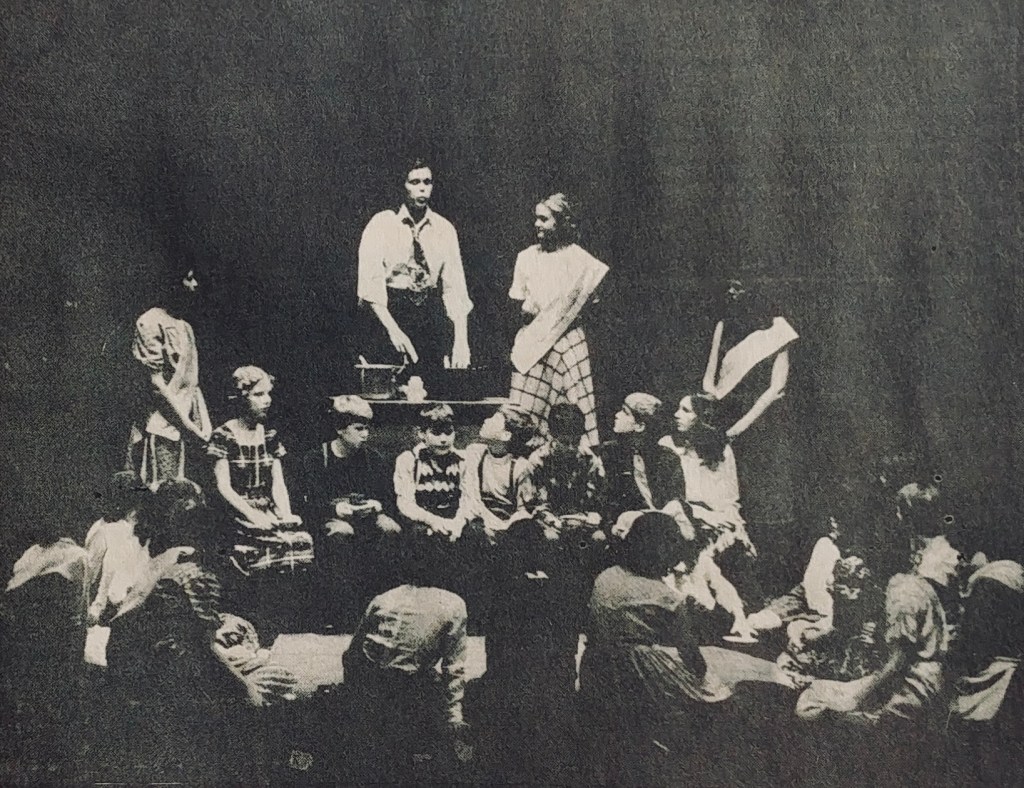
James Reaney, a student from 1939-1944, chose the 1933 Stratford Strike when hundreds of workers at six of Stratford’s seven furniture factories and workers from Swift poultry-processing plant went on strike for two months during the Great Depression, a time of low wages and dire economic prospects. King Whistle! was directed by Jerry Franken of the NDWT Theatre Company and performed by Stratford Central students on November 15, 16, 17, 1979 at the Avon Theatre in Stratford, Ontario.
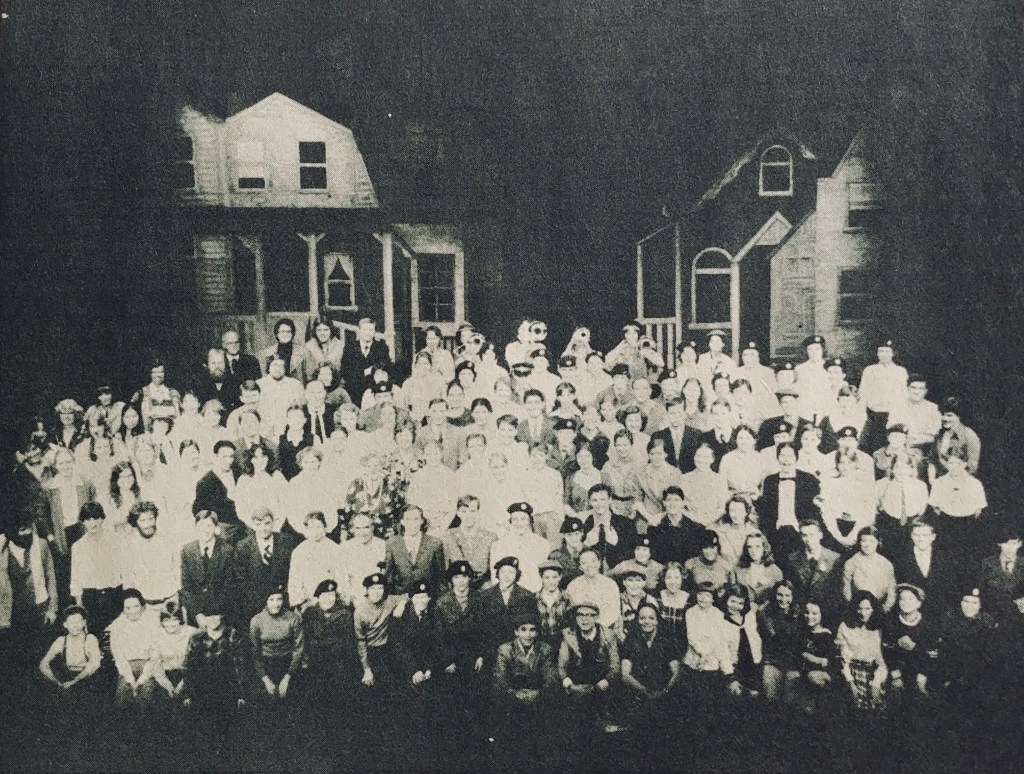
Ron Dodson, drama teacher at the school, was the Producer of the play. At James Reaney’s 100th birthday celebration last month, Dodson shared his memory about the mammoth undertaking King Whistle! was, with 103 cast members – 66 actors and 47 musicians in the Striker’s Band and the Militia Band – which were needed for the confrontation scenes in the two-month strike involving 600 workers. The play cost a lot to produce, but made $10,000, and that money was used to create an arts bursary that has endured to this day and has helped many students. Jamie Cottle, one of the original cast members, shared his memory of celebrating the play’s 40th anniversary at a reunion in 2019 – here’s to 2029 and King Whistle’s 50th anniversary reunion!
In a 1980 article “The Story Behind King Whistle!,”[1] James Reaney recalls how he chose the 1933 Stratford Strike as the story: “But ever since as a kid of seven I’d actually seen the strikers parading down Ontario Street with a Union Jack at their head, I had wanted to handle this great story; particularly when my father told me a story about someone involved in the strike who had been fired from a bank for being secretly married! I had to do this story and the more we researched its depths, the more the feeling grew…” [The Story Behind King Whistle!, page 51]
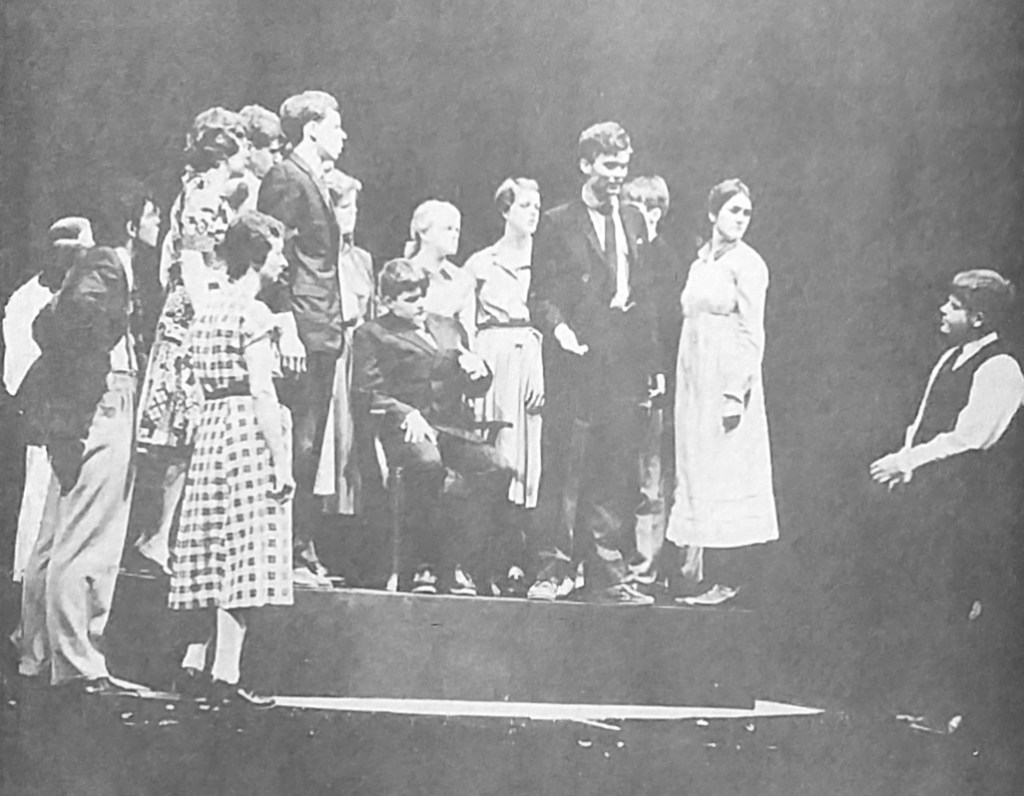
Reaney describes the process that began early in 1979 to involve the students and teachers in a play about their community: “As long ago as last February NDWT actors and myself started a series of workshops at [the school] in Stratford. We visited every classroom, we sent home a questionnaire, we held two workshops with 600 students apiece in the gymnatorium; if you’re going to write a play about a community, particularly a Stratford which in 1933 came out on the streets and shouted what it wanted, then you have to persuade the students and teachers to do likewise, to explore the roots of the community in every way possible. Students and local citizens brought in gorgeous material from the interviews they conducted with men and women who took part in the strike; also from the microfilm reader at the library, also from the Perth County Archives superbly organized by a childhood friend of mine, James Anderson.[…] [The Story Behind King Whistle!, pages 50-51]
Fortunately, the school had a strong drama and music department who were able to support the creation of a musical play: “[…The] form we decided on was that of a thirties musical comedy […] Ron Dodson, one of the teachers who had the idea of asking me to write the play, brought in a copy of the Busby Berkley film, Gold Diggers of 1933, and showed it at one of the late spring workshops. That film was a turning point for me; it handles grim material both frivolously and deeply; it rings the changes on a collapsing society which nevertheless is still laughing, still scrunching each other’s knees under tables, still has dreams, still refuses to believe that poverty is the answer. What we were going to do was take the reality of 1933 and, like this film, pour all that sadness and economic puzzle into a form that has tap dances, ballets, songs: a Grade 12 student [Mark Verwymeren] composed the music for ten songs! [….] [The Story Behind King Whistle!, page 51]
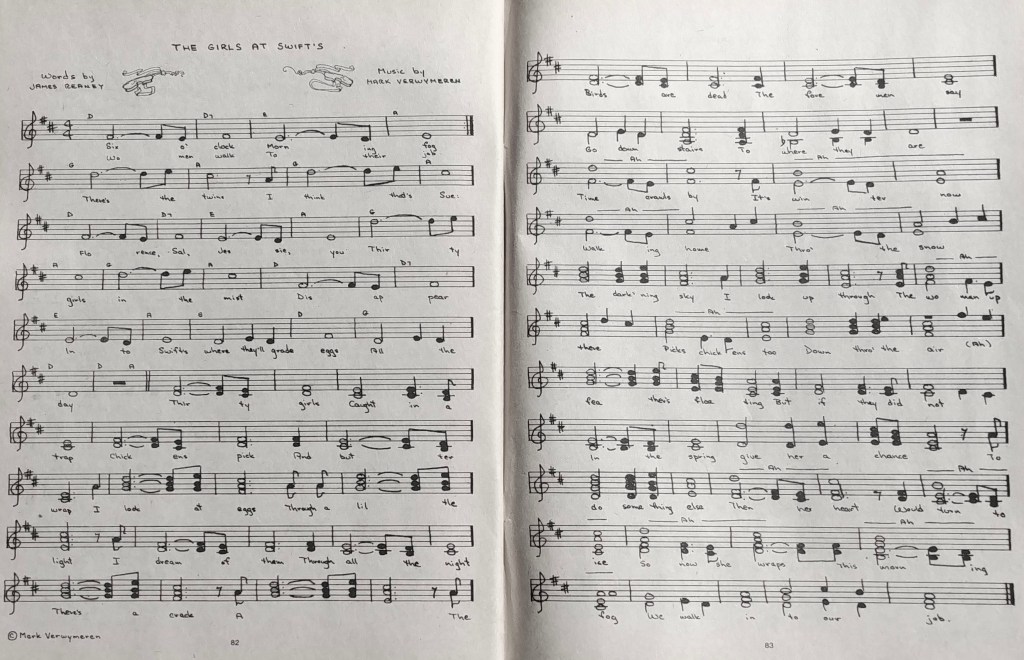
Music teacher James E. Storms both arranged and conducted the music for the play and composed the music for “The Money Song” to words by James Reaney. Grade 12 student Mark Verwymeren worked with Reaney on other songs for the play: “I told Mark Verwymeren to write a song about Swift’s in the fog of an early morning – that is, the tune for such an idea; he did and we started to work on nine other songs. What finally worked out best was for me and Jerry [Franken] to talk about the concept with Mark, then he’d bring in the melody on a tape, I’d take it home and add the words. There were many sessions in Mark’s basement pad in his parents’ house on Birmingham Street with his synthesizer and, on view, the tape recorder he was given for his eighth birthday.” [The Story Behind King Whistle!, page 60]
James Reaney also mentions the closing night cast party at Virgil Burnett’s place (the old Macpherson Orphanage): “Some really touching presentations – I got a big red pencil, really big; Jerry got a director’s chair, Jan a golden slipper, Jim Storms a small piano…” [The Story Behind King Whistle!, page 63]
Notes
[1] Excerpted from James Reaney, “The Story Behind King Whistle!,” in Brick: a journal of reviews, Issue 8, Winter 1980, pages 50-63. (This article is the revised text of a paper presented in the Faculty of Arts Lecture Series at the University of Western Ontario, November 20, 1979.)
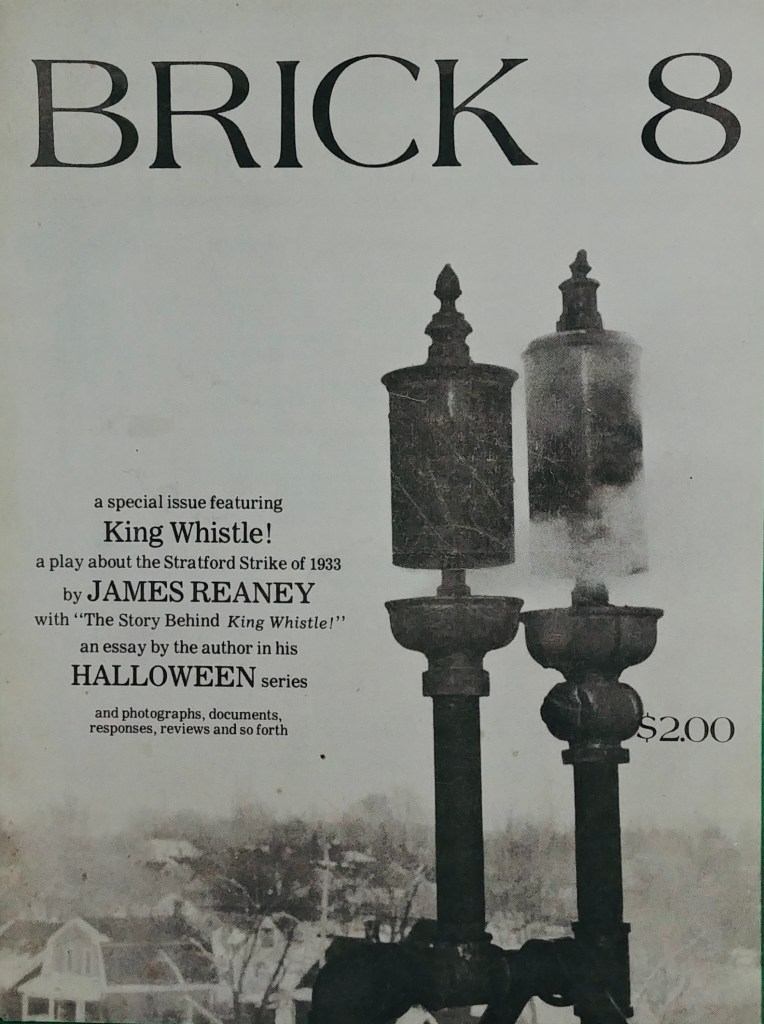
Brick Issue 8 also has the full text for the play, photos of the production and photos of 1930s Stratford, reviews, and words and music for two of the songs.
For more about the play and the 1933 Stratford Strike, see the Stratford Strike page at https://www.streetsofstratford.ca/strike-spa and the King Whistle! page at https://www.streetsofstratford.ca/king-whistle

