Summer 2023 — The Blyth Festival is bringing James Reaney’s The Donnelly Trilogy to Blyth’s Outdoor Harvest Stage. Director Gil Garratt has adapted the three plays especially for this outdoor setting.
The three plays,Sticks and Stones, The St. Nicholas Hotel, and Handcuffs will all be performed by one single company of ten actors, who will tell the tale from the killing of Patrick Farrell, to Johannah Donnelly’s march to Goderich to save her husband from the gallows, to the Stagecoach wars, to the Queen’s Hotel, to the Vigilance Society in the Cedar Swamp Schoolhouse, to the fiery February night when justice, revenge, and murder were left indistinguishable in the ashes.
This will be the first time in decades that all three of these touchstone plays have been performed in repertory with each other, affording audiences the chance to take in the whole cycle over three nights.
Gil Garratt’s thoughts on the three plays:
“I believe 2023 is the perfect time to re-ignite the telling of the Donnelly story in Blyth. At its heart, this is a story about grit, family, betrayal, the erosion of community, the rise of secret societies, the shadow of conspiracy, and the limits of faith. The show will be filled to the brim with folk music, stagecoaches, and live fire in the night.”
The Donnelly Trilogy by James Reaney Adapted, abridged, and directed by Artistic Director Gil Garratt Part I: Sticks and Stones, June 22-September 1 Part II: The St. Nicholas Hotel, July 13-September 2 Part III: Handcuffs, August 1-September 3
The Blyth Festival’s replica of the Donnelly stagecoach from Paul Thompson’s 2001 play Artistic Director Gil Garratt as Robert Donnelly in Blyth’s 2016 show The Last Donnelly Standing.
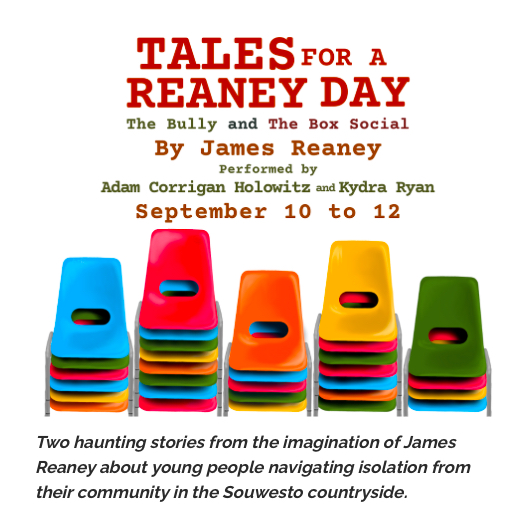
On September 10, 11, and 12th, Alvego Root Theatre will present Tales for a Reaney Day – a double bill featuring two of James Reaney’s short stories, “The Bully” and “The Box Social”. Adam Corrigan Holowitz and Kydra Ryan are the co-directors and performers.
More about James Reaney’s “neo-Gothic” short stories
“While an undergraduate at the University of Toronto [BA 1948, MA 1949], James Reaney published two stories, “The Bully” and “The Box Social,” that are not only classic Canadian short stories but are the first examples of a modern tradition called Southern Ontario Gothic (having its origin in the novels of John Richardson and some of the stories Susanna Moodie tells) that make use of Gothic elements of the macabre. In the four-page “The Box Social,” for example, a young man bids for a prettily wrapped shoe box, from a girl he made pregnant, that contains “the crabbed corpse of a stillborn child wreathed in bloody newspaper.” Margaret Atwood has remarked that “without ‘The Bully,’ my fiction would have followed other paths.” (The Concise Oxford Companion to Canadian Literature, William Toye, Ed., Oxford University Press, 2011, page 511.)
“The Box Social” was originally published in 1947 in The Undergrad at the University of Toronto, and then in the popular magazine The New Liberty. Here’s what Reaney had to say about why he wrote the story in his autobiography from 1992:
“Out of the deep past it somehow came to me, I think from my mother talking about the way men treated women in our neighbourhood. They never struck back; well, in my story one of them did.” (James Crerar Reaney, Contemporary Authors Autobiography Series, Volume 15, page 304.)
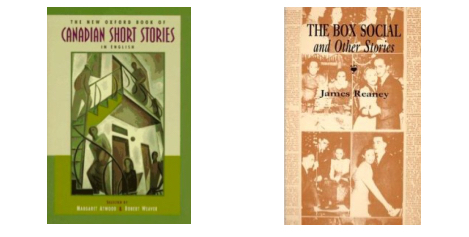
“The Bully” was broadcast in 1950 on CBC Radio and later published in Canadian Short Stories (1952) edited by Robert Weaver. While at university in the late 1950s, Margaret Atwood remembers discovering “The Bully” in Weaver’s anthology. “It made a big impression on me — it seemed a way of writing about Canadian reality that did not confine itself to the strict social realism that was mostly the fashion then.” (Excerpted from Margaret Atwood, “Remembering James Reaney”, Brick Issue 82 (Winter 2009), page 160.)
May 30, 1996 in London, Ontario — James Reaney with Margaret Atwood, “An Evening with James Reaney & Friends” (Photo courtesy London Free Press)
James Reaney and Southern Ontario Gothic
“James Reaney’s plays — Colours in the Dark (1969), Baldoon (1976), and The Donnellys (1974-7) — as well as his short stories “The Bully” and “The Box Social” (reprinted in The Box Social and Other Stories in 1996), also assume Gothic elements of the macabre rooted in nightmarish families and uncanny action. […]
What makes this locale so prone to Gothic tales is the failure of communication between family members or social groups. In the absence of communication, strange projections and psychological grotesqueries spring up and rapidly grow to unmanageable proportions. Malevolent fantasies are the source and sustenance of the Gothic tradition.” (Michael Hurley and Allan Hepburn in The Concise Oxford Companion to Canadian Literature, William Toye, Ed., Oxford University Press, 2011, pages 593-594.)
What do you mean by Gothic?
“…It’s the spirit of solitude, the isolated person rattling around, usually in an old dark castle in the early Gothic novels, but then in Faulkner in an old plantation house. In Ontario we can’t afford plantation houses so we have a farmhouse or an apartment building that has a lot of empty rooms in it, as in The Edible Woman…. It’s filled with the nightmare of life, but it’s this isolation that is at the bottom of it, I think, because of science. The whole Gothic tradition is already in Hamlet.” (Interview with James Reaney from July 23, 1991 from In the Writers’ Words: Conversations with Eight Canadian Poets, Laurence Hutchman, Guernica Editions, 2011, pages 173-174.)
More on the tradition of Gothic fiction
“Gothic fictionis a genre obsessively focused on the house. ‘Last night I dreamt I went to Manderley again’ is the famous first sentence of Daphne du Maurier’s Rebecca (1938). In some other kinds of stories, the house is a place of safety, a sanctuary from the world. But not in gothic fiction, where interior spaces become prisons for imperiled heroines or represent a domestic happiness from which the scarred male protagonist is excluded. Naturally the house in question is not just any house but sometimes a monastery, convent, prison, or insane asylum. In the female-centered gothic, the male owner of the castle is an older man with a piercing glance – aristocratic, obsessed, moody, and secretive, with qualities that mark him as a literary descendant of Satan in Paradise Lost….”(Catherine Sheldrick Ross, The Pleasures of Reading: A Booklover’s Alphabet, Libraries Unlimited, 2014, page 65.)
♦ Jane Urqhart: Fifth Business by Robertson Davies ♦ Monika Lee: The Donnellys by James Reaney ♦ Michael Hurley: Perpetual Motion by Graeme Gibson ♦ Shani Mootoo: All the Broken Things by Kathryn Kuitenbrouwer
“James Reaney is one of our best Gothic writers from Southern Ontario, and he is one of the most influential. He’s had a huge impact on a lot of writers who are more famous than he is, like Alice Munro and Margret Atwood,” says Monika Lee, Professor of English Literature at Brescia College.
“James Reaney’s plays — Colours in the Dark (1969), Baldoon (1976), and The Donnellys (1974-7) — as well as his short stories “The Bully” and “The Box Social” (reprinted in The Box Social and Other Stories in 1996), also assume Gothic elements of the macabre rooted in nightmarish families and uncanny action. […]
What makes this locale so prone to Gothic tales is the failure of communication between family members or social groups. In the absence of communication, strange projections and psychological grotesqueries spring up and rapidly grow to unmanageable proportions. Malevolent fantasies are the source and sustenance of the Gothic tradition.” —Michael Hurley and Allan Hepburn in The Concise Oxford Companion to Canadian Literature, pages 593-594. William Toye, Ed., Oxford University Press, 2011.




 James Reaney