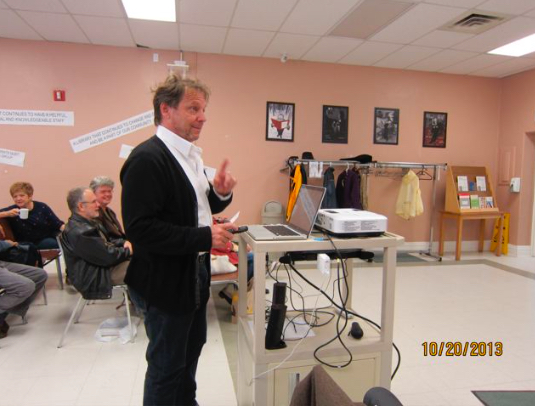
The Fourth Annual James Reaney Memorial Lecture was given by David Ferry on October 20, 2013 at the Stratford Public Library in Stratford, Ontario.
Below is the full version of David Ferry’s lecture and the images (but not the videos) he used. Our grateful thanks to David Ferry for supplying us with a transcript; a video of the lecture made at the time is no longer available.
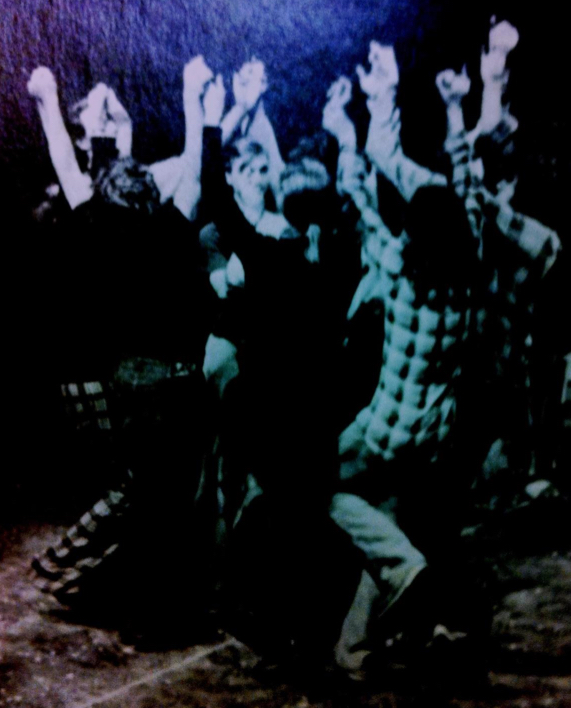
When Sticks and Stones, The Donnellys, Part One first opened at Tarragon Theatre in Toronto in 1973, its effect on the theatrical life of the city and country was profound. As the Toronto Star opined, it was “just plain overwhelming.” Its success led to the production of the next two parts of the trilogy the following season at Tarragon, St. Nicholas Hotel and Handcuffs, and then all three plays toured from sea to sea.
As a young actor in that original Sticks and Stones forty years ago, I was in so many ways formed as an artist by that experience, and I still self-identify as a Reaney-ite. Doing the Donnelly plays certainly confirmed me in my Canadian nationalism.
It’s ironic that I am giving this lecture exactly forty years after the first day of rehearsals for that production. A few months ago, I celebrated this fortieth anniversary by directing a production of Sticks and Stones in Quebec with a young cast of actors. And we lost an actor day before opening, so guess who went on as Pat Farl and Donavan and others?
It was so weird saying those lines, dancing that fight in that play 40 years later, which I had also directed.
At the end of the third act dream sequence, after Mrs Donnelly says “Jennie, your father and I will never leave Biddulph” — we freeze frame on that snapshot and then from the gods two dead oak leaves float to the ground … dead leaf, float light… [Video A]
It is a special moment.
It was humbling for me to see what a profound effect the play had on that group of young artists [in Lennoxville]. What a great training ground the play can be, and how 40 years on the experience of staging the play served as a unifier for a new community, a new generation of theatre artists.
Today, I would like to share some thoughts on the evolution of community in Reaney’s Donnelly Trilogy. I title this Fourth Annual Reaney lecture: Blackfeet to Main Street.
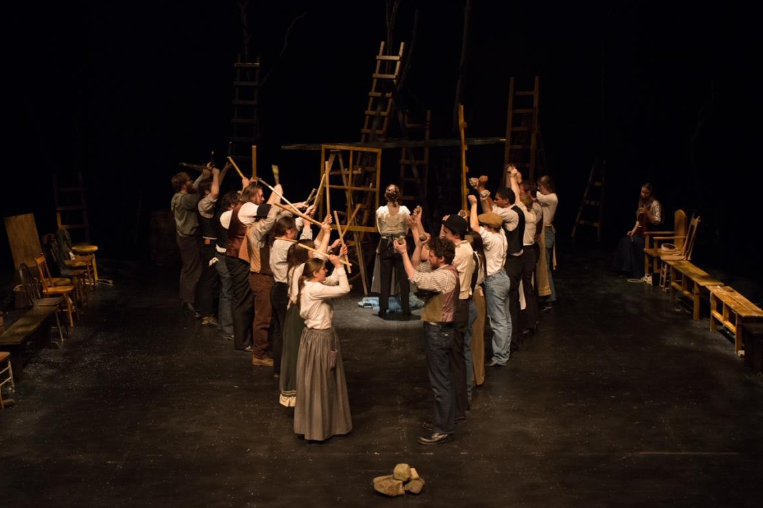
Some years prior to the initial Tarragon Theatre production of Sticks and Stones, The Donnellys, Part One, James Reaney had written an earlier draft of his Donnelly opus subtitled Clappers and Stampers. This play was workshopped unsuccessfully by John Hirsch at The Stratford Festival in 1969 or 1970.
In that draft Reaney listed 69 characters to be played by 16 actors. The sticks and stones of the first part of the Trilogy we have come to know, are here called clappers and stampers, and the Stratford workshop script has chicken-scratch-like markings to indicate each faction and when they clap or stamp [parenthesis ((( indicated claps, backslashes /// indicated stamps].
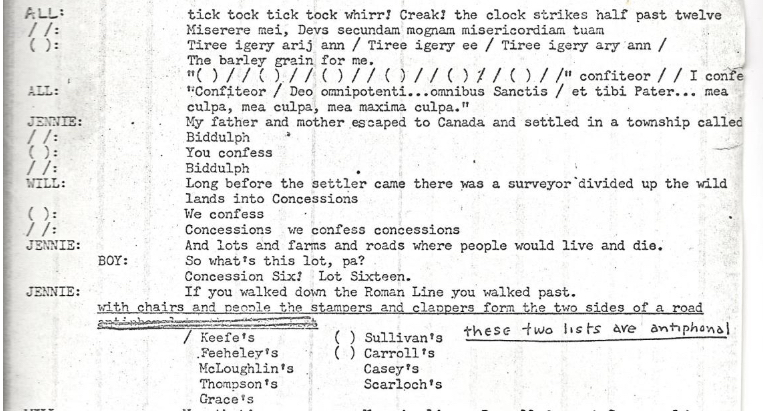
All images used in the lecture are courtesy David Ferry and used with his permission.
It was a confusing and jumbled script, and the actors at Stratford apparently rebelled during the workshop, complaining of the lack of character through-line, role-switching confusion and incomprehensible script. Actors used to playing one character (Laertes or Rosalind) were here being asked to play five or more, not to mention the odd horse or cow. Thus was its fate sealed as a Stratford development property.
However Reaney’s “Further Note” that follows the cast breakdown in that draft script shows a clear writer’s vision of what the story was to be: “As I read through the play again I get three or four basic scene feelings. The Ceremony of the Mass enfolds almost all the time; we are constantly preparing a sacrifice — not Christ, but the Donnellys….The First Act is also a wake and one that the people there are praying that the dead people safely cross some land of the dead with bridges, groves, mountains. Then if Jennie can stay awake she can pray her mother and father to Heaven. The Second Act is almost filled with the Mass of the Initiated; it takes place in a Church. Act One took place in a house. At the very end we are in a wheat field…. The John Barleycorn song… also ties the play together…. To go at quite a clip. No lingering — despite the thick texture it’s a very simple story about a man who wouldn’t kneel.” [Video C]
Reaney decided to take his thickly textured play (and its six-hour length) and break it into more manageable pieces. In 1973 he again went into workshop, this time in an unused spice warehouse in Halifax with a group of volunteer actors who had arranged to be in Halifax (many working at Neptune Theatre) in order to work with Reaney and director Keith Turnbull on the Donnelly project. The script for that workshop bears far more resemblance to the published Sticks and Stones.
Nonetheless it still weighed in at about four-and-a-half hours at first read-through, and was eventually whittled down to three. This workshop process was far more successful than its Stratford predecessor and it is important to mention because it became the template for the development of all three parts of the trilogy.
Initially the Schwartz Spice Factory workshop got off to a bit of a rocky start as well. Several of the more experienced professional actors balked at playing Reaney-style theatre, which was not simpatico to their theatre aesthetic, which again was determined by the more common “one actor: one part” naturalistic tradition. Also the Halifax workshop was in reality a two-workshop process. Mornings would be spent doing a Reaney Listeners’ Workshop (based on his earlier workshops in London, Ontario, which themselves were central to the development of Listen to the Wind, a play that was a stylistic breakthrough) with actors, children, local teachers, musicians, and writers. Afternoons would be spent with professional actors on Sticks and Stones. The one influenced the other. In a huge sunlit room filled with aromatic cinnamon/cloves/ginger dust Reaney would cavort about the room leading all the adults back into the child’s imaginative world: creating big whopping imagistic patterns from the Greek alphabet (“Alpha and Omega, the beginning and the end”) and the Book of Genesis (five children gleefully running around as the fingers on the left hand of God). These morning workshops truly separated the men/women from the boys/girls. If the afternoon workshop script for Sticks and Stones seemed incomprehensible to some of the actors who dropped out, the morning play sessions in fundamental make-believe techniques were irrelevant.
However that first Halifax Listeners’ Workshop was essential in beginning a process that was to have a huge impact on the development of Reaney’s trilogy of Donnelly plays. The actors who came through that crucible of childlike imaginative fire were, for the most part, young and fresh, not yet too jaundiced by the Canadian regional theatre experience. Over the three-year development that culminated in the NDWT Company’s national tour of the Donnelly Trilogy, the company that evolved became a community. The evolution of the community mirrored the evolution of Community in the three plays. The artists evolved from rowdy band of disparate individuals into a complex, sophisticated and integrated company unit. As the company grew, so the writing was influenced in important ways to incorporate the new-found strengths of the group. Of course, paradoxically, as the company evolved, issues of equality and equity inside the community of the company created tensions that further informed the work on the plays.
I need to spend a bit of time on this theme before moving on to a discussion of the evolution of community in the plays themselves, because I believe it is important to understand the organic dramaturgical influence of a company of actors in the context — rare in Canada — of commitment to a body of work. Seldom do we see a group of theatre artists come together for an extended and committed period of time to focus on a writer’s storytelling vision. The Stratford and Shaw festivals don’t really count, because the writers are dead and the instinct to start those festivals was both director- and designer-centric and economically motivated (specifically the tourism economic that Graham Holderness and others have discussed in The Shakespeare Myth [1] and elsewhere). I certainly don’t mean to imply that Reaney’s Donnelly Trilogy could not have been written without the company that initially performed the plays, but I do believe that as Reaney observed the group’s work he was influenced (particularly in Parts Two and Three) in the use of Actor colours that infused his canvas.
In Part One, Sticks and Stones, Reaney was getting to know a group of actors that had somehow braved the journey through the waters of the chaotic Listeners’ workshop to commit fully to his vision of theatre making. This group accepted without hesitation his invitation to dance his dance of what Gerald Parker calls “history, story and story style.” [2]
Many of these actors had turned down other opportunities to take the pilgrimage to Halifax at the bequest of director Keith Turnbull. Turnbull had talent-spotted these actors, having worked with many of them in other contexts, and he had a sense of what this play needed in terms of physical energy and creative mindset. Reaney had been burned by professional experiences before, and not just in the Stratford workshop of the Clappers and Stampers draft. Though the influential production of Names and Nicknames by John Hirsch in Winnipeg had featured actors playing pigs and cows or pretending to be a bear by putting on a fur coat backwards [3], the mainstream Canadian Theatres weren’t there yet. In some ways Reaney had a bias toward amateur actors and children — although amateurs often frustrated him too.
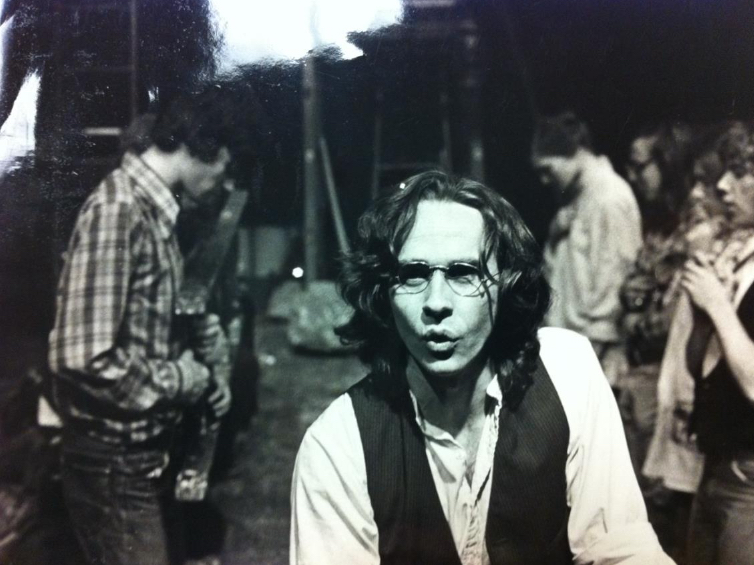
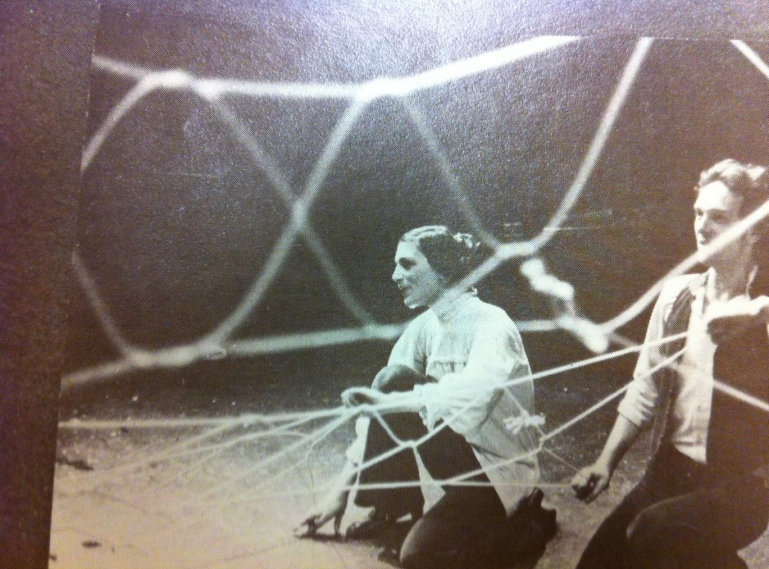
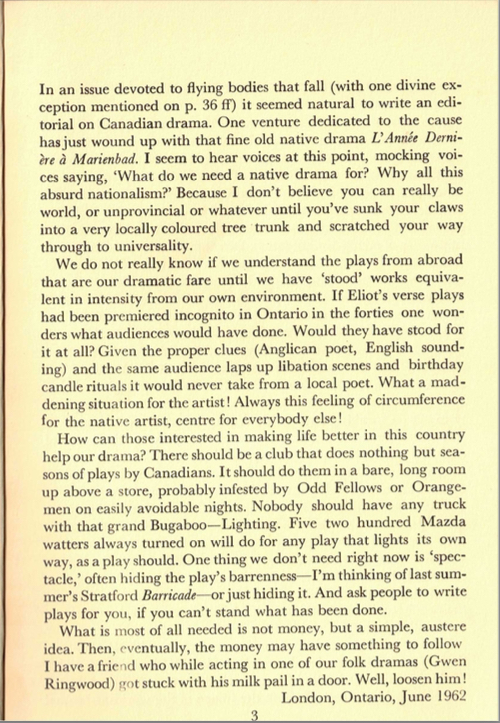
Led by Jerry Franken and Patricia Ludwick (actors who had been exposed to Reaney’s Listen to the Wind) the crowd that workshopped Sticks and Stones were all new generation actors (circa 1970). Theatre-school trained with a commitment to a disciplined physical and vocal training and a willingness to experiment. They were influenced by Peter Brook’s The Empty Space and the work of Grotowski towards a Holy Theatre. Can’t we find common ground with those practitioners in Reaney’s June1962 Alphabet edict demanding:
“ …seasons of plays by Canadians.” Which should be done: in “bare long room[s] above [stores], probably infested with Odd Fellows or Orangemen on easily avoidable nights… [where] Nobody should have any truck with that grand Bugaboo – Lighting. Five two hundred Mazda watters [4] always turned on will do for any play that lights its own way, as a play should.” ? [5]
That quote from Alphabet is so completely Jamie, isn’t it? Who here gets the “Mazda Watters” reference? Maybe some of you know that it is a reference to a line of incandescent light bulb produced by General Electric, but who catches the double meaning, as no doubt Reaney did, in the choice of branding the bulbs Mazda by GE? It was due to its association with Ahura Mazda, the transcendental and universal God of Zoroastrianism whose name means light of wisdom in the Avestan language.
But I digress. This Reaney edict found sympathy with these actors who were turned off by the “slick complacency” (my term) of Stratford. They were in Halifax because they were attracted to Reaney’s style and Turnbull’s aesthetic. They were, like the Donnelly family in Sticks and Stones, very much possessed of a pioneer mentality. Sticks and Stones’ brute energy was matched by the unbridled optimistic enthusiasm of this group of actors. Their rawness fit (and coloured) in the early workshop stages, the development and editing of the script by Reaney. This company was, fundamentally, a rookie team, full of piss and vinegar, big on physical drive and possessed of a boisterous passion: perfect for the needs of Sticks and Stones.
In Part One of the Donnelly Trilogy Reaney has focused on that part of his original Clappers and Stampers script that he likened to The Mass of the Initiated. The whole beginning features young Will Donnelly preparing for his confirmation, testing his Catechism with his mother Joanna. Of course the catechism he is being tested on is the catechism of being a Donnelly. The whole theme of initiation (initiation into secret societies; initiation into the new world; into violence and prejudice; into the pioneer life; into the Church; into Biddulph; into the Donnelly family) permeates the text of Sticks and Stones and is integral to the play’s study of a new immigrant society.
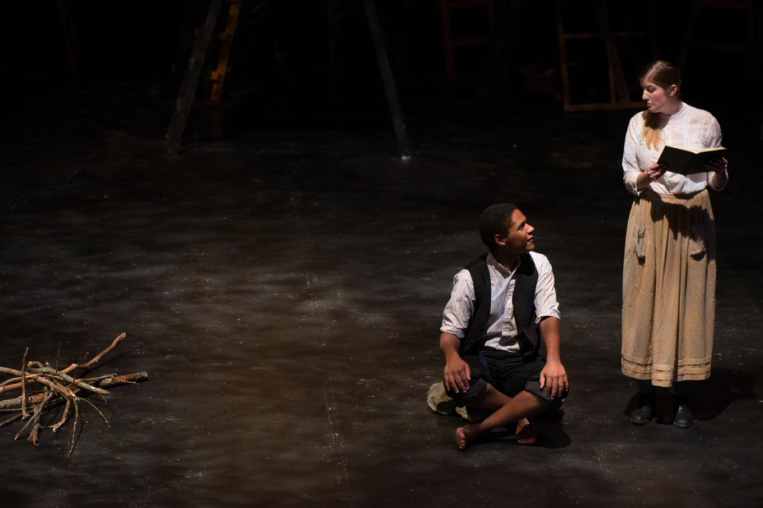
Directed by David Ferry
The staging structure within Sticks and Stones is closest to Reaney’s principle of the ideal (“bare long room”) space for Canadian plays as mentioned previously. The first “stage” direction in the script states:
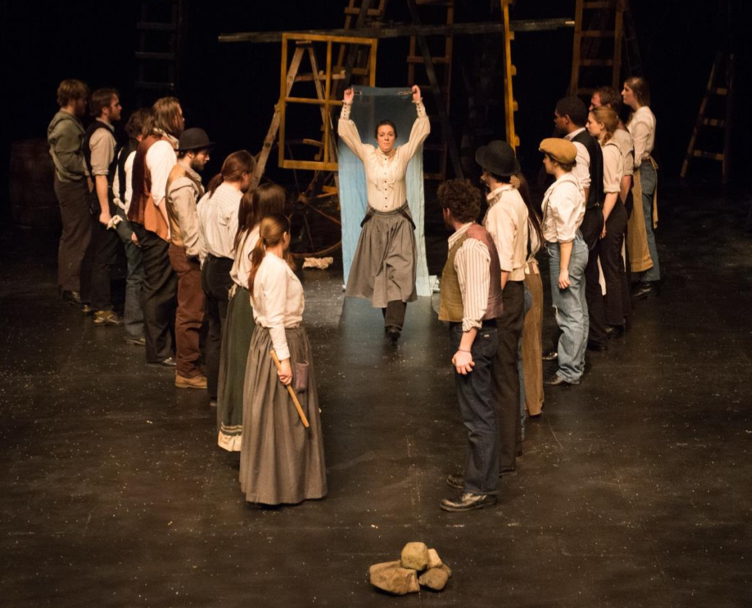
The room in which the story is presented contains all of the objects and properties required — ladders, barrels, sticks, stones, noisemakers, chairs, etc. The central area is bare except for a pile of sticks on one side and a pile of stones on the other, and possibly a pile of four boulders at the back in the centre. In the distance there is the drunken and rowdy singing of a tavern song.
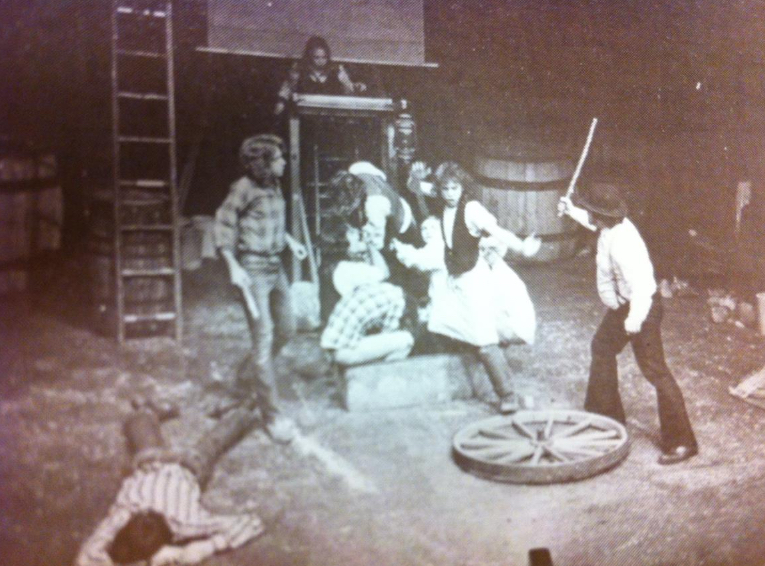
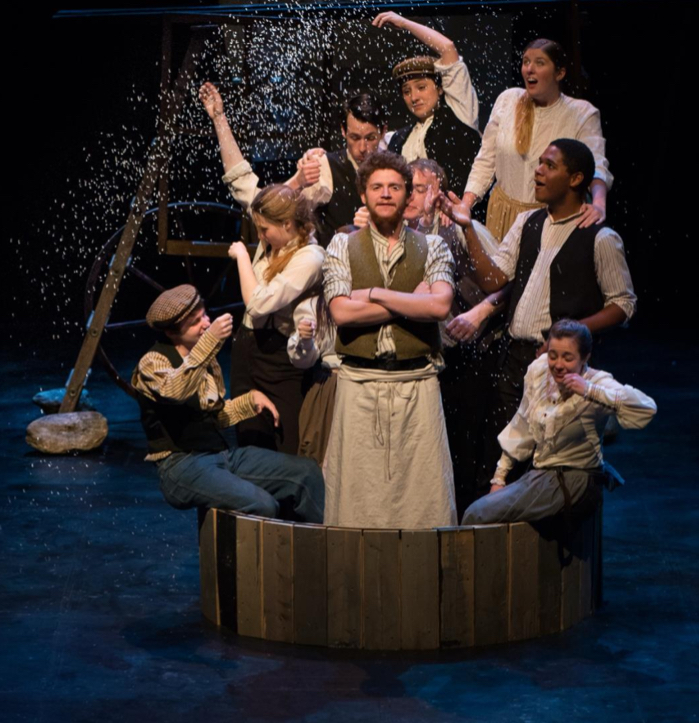
Directed by David Ferry
It is interesting that Reaney has revisited the Alpha Centre landscape of his Listen to the Wind experience. He visualizes a room not a stage. The room is bare except for the most basic and necessary of props, sharing John Hirsch’s belief in “the talismanic power of the props.” Crude and real chunks of stone and wood are lying on the floor, like a field waiting to be cleared for planting. This aesthetic of a bare room is important. It is, meta-theatrically, an insistence on inclusion of the audience as part of the Community of the play.
We all live within the walls of this bare room.
The room is the Town or Orangemen or Odd Fellows Hall of the average small-town Souwesto community, and this room is Reaney’s ideal theatre space. The word room unites audience with storyteller.
Again, looking at that first stage direction [in Act I], the last sentence states:
In the distance there is the drunken and rowdy singing of a tavern song.
We start the play in a bare room strewn with a seemingly arbitrary organization of real sticks and real stones (not ones made of papier-mâché in a prop shop, but ones lovingly sought out and picked from woods and ravines by actors jealously protective of their spirit rock or stick). [Video D1]
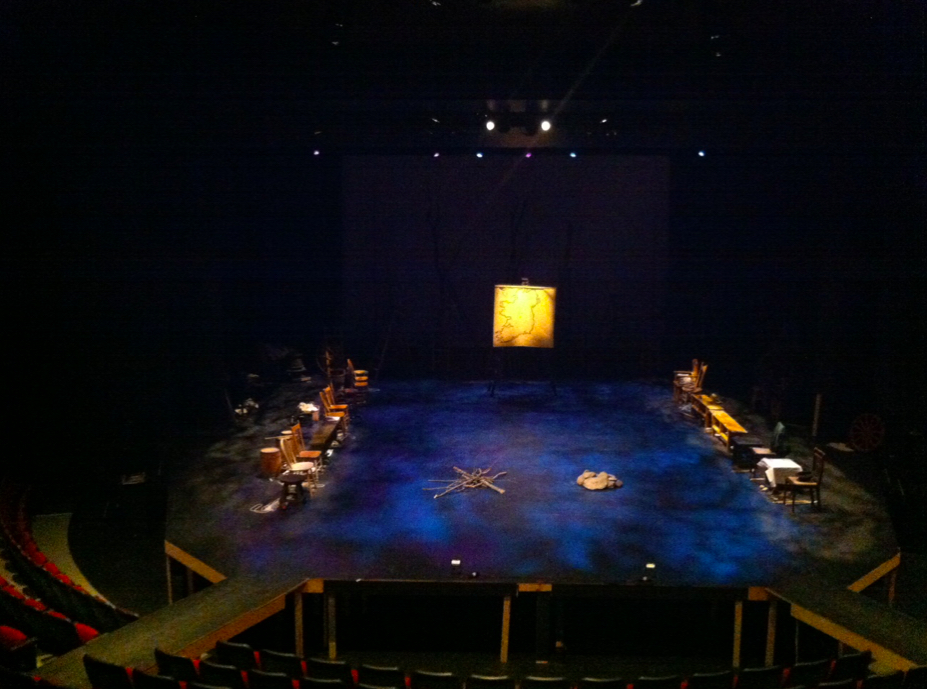
Directed by David Ferry
This is the landscape of a new world — or of chaos. There are no buildings here yet, no cutlery or plates, no beds or doors. Just an unconquered and perhaps hostile environment — but in the distance we hear the sounds of the old world — and it hints of drink-fuelled violence. This is the world the Donnellys left behind.
The staging of this play follows a pattern of confrontational lines. Sticks versus stones. Whitefeet (the secret society that attacked James Donnelly Sr. in Ireland) versus Blackfeet (those that refused to join the Whitefeet). Surveyors versus the wilderness. Squatters versus deed holders. Roman Line versus Protestant Line.
The choral pattern is one of call and answer, or catechism. The John Barleycorn Song that begins the play and ends Act Two defines it on the one hand and the catechism testing that goes on throughout the play, culminating with Jennie Donnelly’s stunning response, near the end of Act Three, to the Chorus question “Why was I a Donnelly?” defines it on the other. [Video D]
The catechism that begins the play is initially of the Catholic church but quickly turns into the catechism of an outsider, of the terms of exclusion, and finally into the catechism of definition and choice: choice to be a Donnelly. This choice is an essential one. Choice is a theme which reverberates throughout all of Reaney’s poetic and dramatic work. It is the choice to be an individual against the pressures of group conformity. It is the choice to celebrate difference instead of to persecute it. It is the choice to embrace the imagination and not stagnate. It is a choice, in the end, to embrace the concept of equality.
The turn from catechism of the church to catechism as a Donnelly begins with Will’s line:
Baptism, Confirmation, and Holy Orders can be received only once because they imprint on the soul — a spiritual mark, called a character, which lasts forever.
This leads first to a choral response:
they shouted up and they shouted down the barley grain should die.
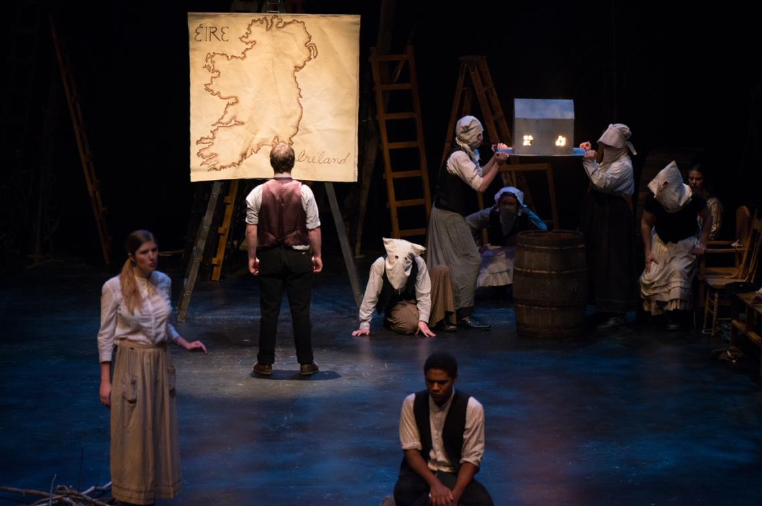
Directed by David Ferry
— and then to a discussion of the exclusion of Will from the others because of his clubfoot (another kind of marker). And he has been branded from before his own birth as a “Blackfoot” because of his father’s refusal to kneel to the secret society back in Ireland. This structure of answer/response intercut with menacing Choral chant creates an extraordinary tension in the opening sequence of Sticks and Stones. It economically presents us with the background to the conflict that followed the Donnellys to Canada, and which plagued them in their attempts to create a new life for themselves in the new world — the immigrant dream.
Immediately following this “prologue” Reaney gives us a flashback to ten years before when the township of Biddulph was being surveyed. This brief scene between a surveyor and his young son is in stark contrast to the drive and violence of the earlier scene, it looks forward to the more lyrical structure of the second play in the trilogy, The St. Nicholas Hotel. The surveyor who divides the concessions into lots, in Reaney’s hands, becomes a blind God with dominion over the fates of the mere mortals who will live on the lots he is surveying. The world here is pristine, primeval forest. It is left to the surveyor’s son to speak of the imagination — I wonder who’ll come to live here. I wonder what they’ll be like; What’ll they fight about pa?; Couldn’t you stop that?; Make the farms a different shape?
His father replies: I’m not allowed to do that, Davie. The laws of geometry are the laws of geometry. Bringing to mind William Blake’s “The man who built the pyramids.” The world of straight lines comes to define the conflict (and the play) before it even begins.
Sticks and Stones tells the immigrant story of a new life in a new world. Mr. and Mrs. Donnelly want to leave the old world behind, but it insists on recreating itself in their midst. The family struggles to break the land, to grow crops and children in a hostile environment. The world around them is a new society, primarily agrarian, and the battle is on to create a pecking order. One of the tools used to make everyone fall in line with the imported old world order is of course exclusion. The Donnellys become the targets because they refuse to take sides. They refuse to conform. They insist on maintaining an individualist attitude when the herd mentality starts to run rampant. The primary battle in this new world is for property. He who controls farmland, the roads separating the farms and the water irrigating it, controls the society.
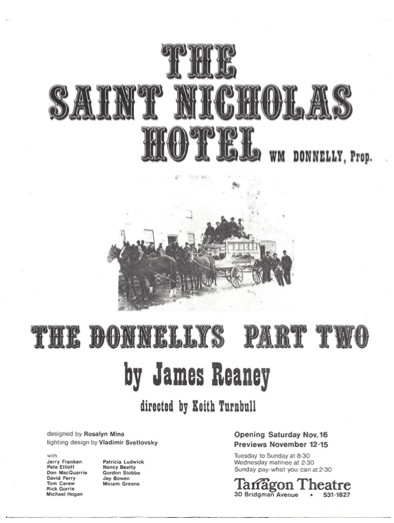
In St. Nicholas Hotel, The Donnellys Part Two Reaney moves into a more lyrical form in his telling of the story, and its structure is more sophisticated as well. The Donnelly company pursued a more rigorous approach to choral speaking in the St. Nick’s workshop. Music, movement and dance teachers were incorporated into the preparation work. The play went through a long workshop process that dovetailed into rehearsals, and the effect of this work was reflected through the subtlety of the performances.
While the first part of the trilogy was about the immigrant story, St. Nick’s deals with the family after the seven boys have grown up. The family has expanded past the hardships of establishing a farm, and now Will and Mike have set up in business with a stagecoach line. The agrarian society of Sticks and Stones has given way to a mercantile society.
The bare room of Part One has given way to a barroom of a Hotel. This is theatrically much more a “set.” There is a raised floor. A bar is the centerpiece, and the chairs we see here are more refined. The design of St. Nick’s was far more evolved. This is a world of interiors as much as of exteriors. The hotel that Will Donnelly eventually owned, and the hotel bar in which Mike Donnelly died replace the fields and logging bees of Sticks and Stones. We have beds and doors, glasses and dishes. A painting of Will Donnelly’s horse Lord Byron hangs on the wall behind the bar. A painting named after a poet … Possessions.
The immigrant family has survived and we see the second generation of new Canadians expand their horizons.
The movement patterns in this play are different. We have repetitive whirling and circular patterns in the staging. Wheels turning and spinning; and tops spinning, instead of straight lines bashing up against each other. Stagecoach races act as the motor that propels the Donnellys towards a certain crash. [Video F]
The choral pattern in the play is different too. For the original Tarragon production the actors presented a pre-show musical entertainment in the lobby of the theatre that was reflective of the choral quality of the play. They sang popular songs of the period. I Dream of Jeanie with the Light Brown Hair; Buffalo Gals; romantic songs for a play that is a romance. A play that is physically set in parlours, cake shops, a nunnery, the interior of a stage coach, waiting rooms, kitchens, marital bedrooms, sitting rooms, waiting rooms, barrooms. If Part One was suited to staging in a long bare room over a store, Part Two belongs in a Victorian sitting room or even better a period opera hall or burlesque. The actors at Tarragon serenaded the audience and then led them into the theatre proper, became passengers waiting for a stagecoach, spun tops in competition, and segued into Ned Brooks and Mike Donnelly’s dueling invitations to join the journey:
Brooks: Are there any passengers for Masonville, St. John’s, Bobtown, Ryan’s Corners, Lucan, Flanagan’s Corners, Mooretown, Exeter? Now loading at the front door please.
Mike Donnelly: Are there any more ladies and gentlemen for Calamity Corners as ’tis sometimes called, St. John’s, Birr — my old friend Ned here calls it Bobtown, the more elegant name is Birr. Elginfield known to some as Ryan’s Corners, Lucan that classic spot if it’s not all burnt down, Clandeboye, Moortown, Exeter, and Crediton. If Ned here hasn’t sawn it to pieces the coach is waiting for you at the front door and it pleases you.
This is delightful stagecraft. We have an immediate sense of bustling commerce, a rivalry between competitors, and a reiteration of Reaney’s contrast between the person of imagination and the stolid Souwesto straight-line plodder. We are also introduced to one of the romantic leads of the play, and Reaney shows Mike Donnelly to be charming, poetic and with humour.
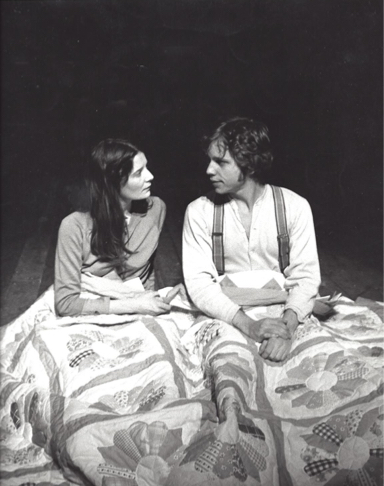
The St. Nicholas Hotel, Tarragon Theatre, 1974.
The use of language to define character is Shakespearean — compare Ned’s plain and uninspired prose with Mike’s poetic and musical incantation, complete with ’tis and the use of and for if. His speech is like a wheel itself, constantly circling round, and everything an actor needs to be Irish and yet Canadian is there. Mike is of course the tragic hero of this romance, and his presence as a ghost at the end of the play acts as harbinger to the ghost play that follows in Part Three. (Interesting that in the stage directions in the published script we find:
A top spins across the floor. Scrubbing of the remaining woman;
Ghost still there. Whistling dies away. ‘Buffalo Gals’.
But in the original production the Ghost of Mike Donnelly threw the top, and the whole cast watched the top spin and spin until it lay still on the floor before announcing the final choral line of the play:
The St. Nicholas Hotel
William Donnelly Proprietor
The Donnellys, Part Two
The play ending with the imagistic reiteration of the spinning/wheel/circular structure of the piece.)
One of the most striking examples of the choral and physical structure in the play comes in the Act One stagecoach race that ends with Ned Brooks’s death. The societal evolution from concession road agrarian Donnelly to main street mercantile Donnelly has moved the brute force straight-line confrontation along a property division fence into the circuitous wheeling dealing competition of dueling stage coach lines vying for business. This is counterpointed by the choral narrative of the chorus, often in tonal harmonies. The physical pattern is of spinning wheels, and spinning ribbon whirligigs. In the end Ned Brooks’s body is carried away on a wheel. [Video G]
In Part Three, Handcuffs, we move from opera house/burlesque/parlour to church/court house as a performance space.
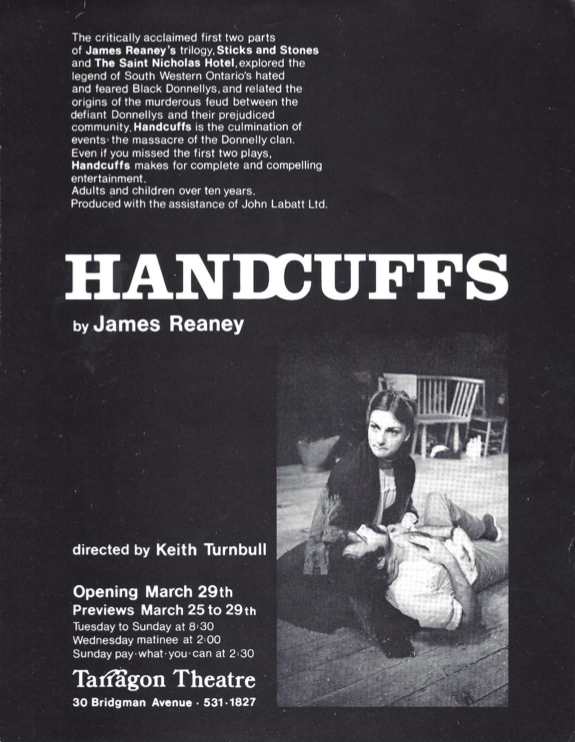
The play is a ghost story, and the rolling open circles of the wheels and tops of Part Two have become the closed and finite circle of a pair of handcuffs.
The fun popular/romantic songs from the theatre lobby of St. Nick’s are now turned to more complex part-songs/hymns/spiritual songs on stage in four-part harmony (Oh, For the Wings, the Wings of a Dove; Barnby’s Sweet and Low) and we now have a gramophone and pump organ instead of a simple fiddle. The mercantile world of St. Nick’s has been replaced with worlds of intrigue and power, the church politics and Grit/Tory politics intertwined in a murky partnership.
The form of the play is also the Mass for the Dead as opposed to the Mass of the Initiated in Part One.
The Donnellys have graduated and they are about to see four of the family pass through a fiery furnace. The four boulders that were lying on the floor of the room in Part One, are now the only things that have survived the fire-ing of James and Joanna Donnelly’s house. They are also the four burnt corpses. Patrick Donnelly takes the handcuffs that bound Tom and with his smithy’s hammer smashes them to pieces on the boulder that is his dead brother.
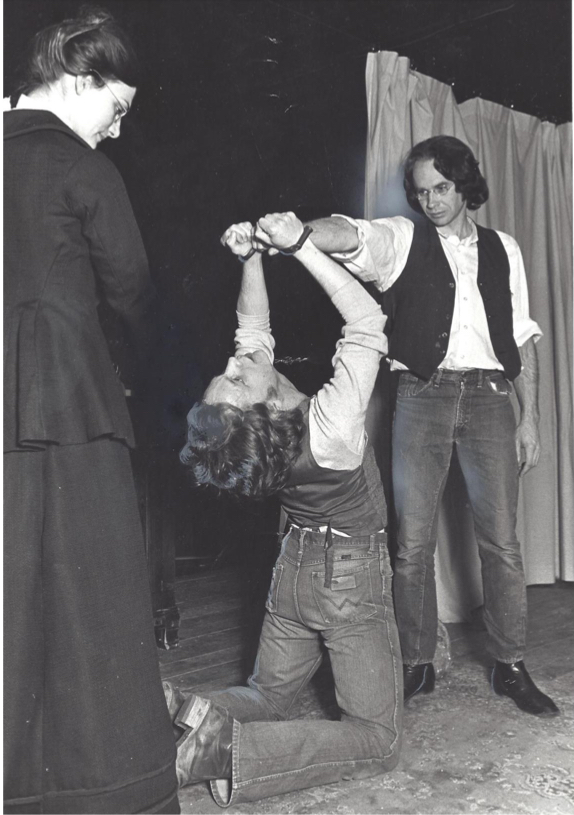
Handcuffs, Tarragon Theatre, 1975.
The physical patterns in the staging of Handcuffs are more grounded than with the first two parts. Characters are rooted like trees or poles. The physical movement of the piece, with the exception of a major dance sequence that is itself complex and nuanced, is like unto a church congregation, sitting /standing, Latin and English chanting in four parts. The air is thick with incense and pump organ chords. The chorus is predominantly liturgical.
One of the major images in the play is of curtains. What is behind the curtains? Two huge curtains divide the stage. The curtains hide the mysterious and devious cogs of power. Theatrically we are now in the most formal Theatre space of the three plays. Curtains cover the windows of Joanna Donnelly’s house through which we can see flames. They hide and reveal the maneuverings and secret meetings of the vigilantes. The bishop appears over top of the curtains on a huge ladder. James Carroll pulls back a curtain to reveal a crucified Jesus. We see shadow plays of threatening figures on a curtain. The curtains of the election polling booths that elects the wrong man thanks to Will Donnelly’s support. The doomed Donnellys are blindfolded with see-through gauze, a kind of curtain. And finally in a stunning third-act sequence we have the ghosts of Mr. and Mrs. Donnelly in the future tearing the curtain down between the past and present with a scathing denunciation of the toughs that come to dance on their graves on Halloween:
Mr. Donnelly: Make up your mind what you want then, soft tough, is it too much when the curtain between you and us, between your life and our life, between life and death starts wavering and swaying and
Mrs. Donnelly: drawing back like a foreskin from the thigh of demon lover Christ himself.
Mr. Donnelly: Like the mighty eyelid of God the Father’s eye,
Mrs. Donnelly: like the wind from the mouth of the Holy Ghost that flutters her veil as she speaks:
Both: UNDO THE HANDCUFFS.
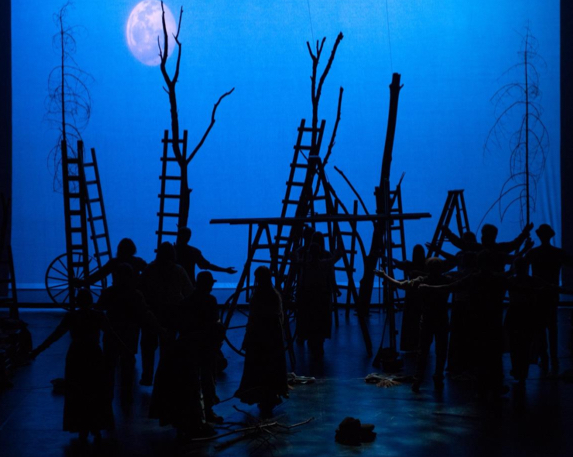
Directed by David Ferry
And of course at this point the Donnellys have transcended the handcuffs of earthly existence and are free spirits in the eternal, giving direct orders to the playwright to free them from the bonds of false report that first prompted Reaney to write the Donnelly story. On a societal level they have gone from immigrants, to merchants to politicians, and in this they have succeeded as true new Canadians.
Copyright David Ferry, 2013, 2026. Reproduced with permission of the author.
Notes
[1] Holderness, Graham. The Shakespeare Myth (Cultural Politics). Manchester University Press, 1988.
[2] Approaches to the Work of James Reaney. Ed. Stan Dragland. Downsview, ON: ECW Press, 1983.
[3] Parker, Gerald. “History, Story and Story-Style: James Reaney’s The Donnellys.” Canadian Drama / l’art dramatique canadien 4 (1978) 150-59.
[4] From interviews David Ferry conducted with Keith Turnbull on May 20, 2005 and with Heath Lamberts on March 15, 2003.
[5] See the article in Wikipedia on the origins of the Mazda light bulb:
“Mazda was a trademarked name registered by General Electric in 1909 for incandescent light bulbs. The name was used from 1909 through 1945 in the United States by General Electric and Westinghouse. Mazda brand light bulbs were made for decades after 1945 outside the USA. The company chose the name due to its association with Ahura Mazda, the transcendental and universal God of Zoroastrianism whose name means light of wisdom (Ahura = light, Mazda = wisdom) in the Avestan language.”
See the image below: James Reaney’s “Editorial” to Issue 4 of Alphabet from June 1962, page 3: