Congratulations to the singers and musicians who performed James Reaney and John Beckwith’s opera “Crazy to Kill” last weekend in Toronto, November 11-12, a Toronto Masque Theatre production. Here’s a rave review from some members of your enthusiastic audience:
We thought the production was fantastic! The opera singers can truly add “puppeteers” to their CV’s.
Loved the way everyone moved about the stage — when Agatha slowly drifted past us, it made us part of the story. A great set, with many levels (“rings”).
Loved the opening sewing scene when Agatha mimed the old treadle — and the sound effect, a great idea! Also loved her expressive face peering through the bed pillow — another great idea. The two musicians, Greg Oh (piano) and Ed Reifel (percussion), sounded like a full orchestra. We loved how they were in costume and part of the story!
You must all be exhausted, but also pleased that it was such a success. Jamie would have been delighted.
Thank you again, Susan, James, and Elizabeth
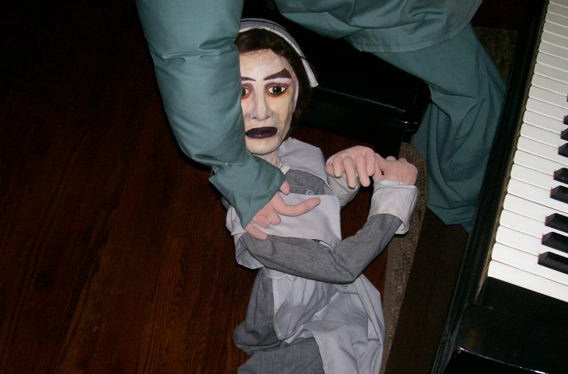
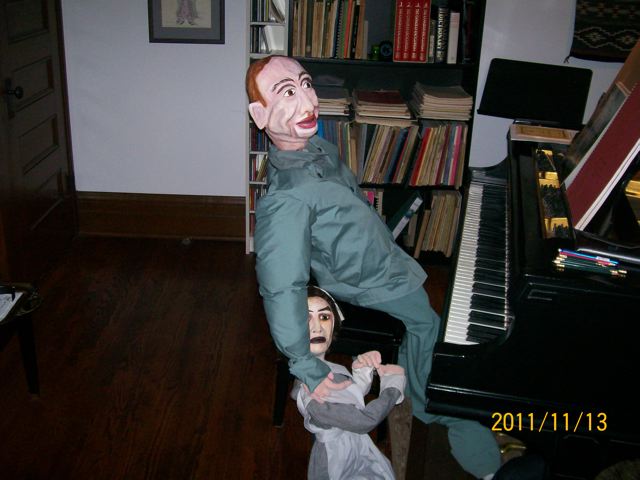
Two of the puppets from “Crazy to Kill.” The original puppets were designed and made by Anna Wagner Ott in 1989, and were refurbished by Ann and David Powell in 2011.Crazy to Kill: Miss ScarthTim O’Connor, the red-haired asylum guard, was operated by Brendan Wall. Mezzo soprano Kimberly Barber, who played Agatha, operated Miss Scarth.Costume designer Sue LePage chats with John Beckwith after the show, November 12, 2011
Pre-show talk with James Stewart Reaney, Larry Beckwith, and John Beckwith
Based on Ann Cardwell’s 1941 mystery novel about a series of murders in a mental asylum, the opera has 22 roles and requires three singers, two actors, and 18 puppets. In this production, David Ferry directs mezzo-soprano Kimberly Barber as Agatha, soprano Shannon Mercer as Mme. Dupont, Doug MacNaughton as Detective Fry, and actors Ingrid Doucet and Brendan Wall.
Crazy to Kill
Friday, Nov. 11 and Saturday, Nov. 12, 2011 at 8:00 p.m.
Pre-show chat with Artistic Director Larry Beckwith: 7:15 p.m.
Enwave Theatre at Harbourfront Centre 231 Queen’s Quay West
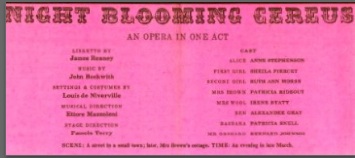
“Night Blooming Cereus” image by designer Louis de Niverville and adapted by William Toye for the program for the first stage production (April 5 and 6, 1960 in Toronto).
Night Blooming Cereus, a chamber opera in one act, is one of several musical collaborations between poet and playwright James Reaney, who wrote the libretto, and composer John Beckwith. In his autobiography Unheard of: Memoirs of a Canadian Composer, John Beckwith had this to say about his first opera:
“Furthering my ambition to compose an opera, I had the great good luck to find a librettist — a writer who understood music. James Reaney shared my love of opera, and early in our friendship in student days we spoke of perhaps collaborating on an original work. In early 1953 I received from him a draft of Night Blooming Cereus. The one-act opera he imagined taking shape as a sort of southern Ontario miracle play. It turned out to be the first of four operatic works we produced together over succeeding decades…” [Unheard Of, page 246]
Night Blooming Cereus calls for eight singers and an instrumental ensemble of fourteen players, and lasts about sixty minutes.[…] The image of a flower that blooms once a year — or by poetic licence once a century — stands for human hope and renewal…” [Unheard Of, page 247]
John Beckwith completed the music and orchestration in the summer of 1958, and CBC Radio commissioned a broadcast for the “Wednesday Night” program in April 1959 and again in 1960. The first stage production of Night Blooming Cereus was at the Hart House Theatre in Toronto on April 5, 1960 with the following cast:
ALICE: Anne Stephenson
FIRST GIRL: Shelia Piercey
SECOND GIRL: Ruth Ann Morse
MRS. BROWN: Patricia Rideout
MRS. WOOL: Irene Byatt
BEN: Alexander Gray
BARBARA: Patricia Snell
MR. ORCHARD: Bernard Johnson
Settings and costumes were by Louis de Niverville, musical direction by Ettore Mazzoleni and stage direction by Pamela Terry.
Program for Night Blooming Cereus designed by William Toye, 1960. SCENE: A street in a small town; later Mrs. Brown’s cottage. TIME: An evening in late March.
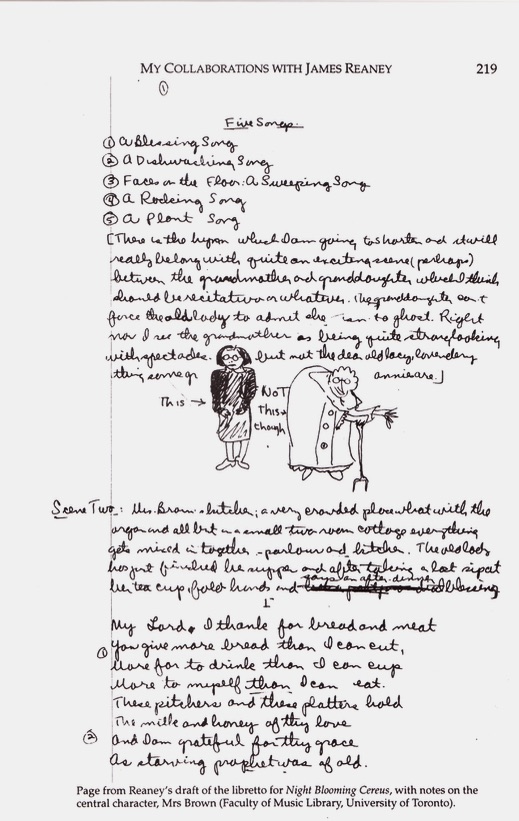
Page from Reaney’s draft of the libretto for Night Blooming Cereus (see John Beckwith’s 1997 book, Music Papers: Articles and Talks by a Canadian Composer, page 219)