Colleen Thibaudeau (1925-2012) in 1977 in London, Ontario. Colleening 2025 is a year-long celebration of Colleen Thibaudeau’s poetry.
Colleening 2025 in St. Thomas, Ontario
September 2025 — On September 18, celebrate Colleen Thibaudeau’s centenary with a feast of her St. Thomas poems read by local fans including Joe Preston, John Allen, Julie Berry, Barb Hoskins, Mike Baker & more!
Where: The Elgin County Railway Museum, 225 Wellington Street, St. Thomas When: Thursday, September 18, 2025, 7-9 pm Cash Bar — Admission is free.
Colleening 2025 in London, Ontario
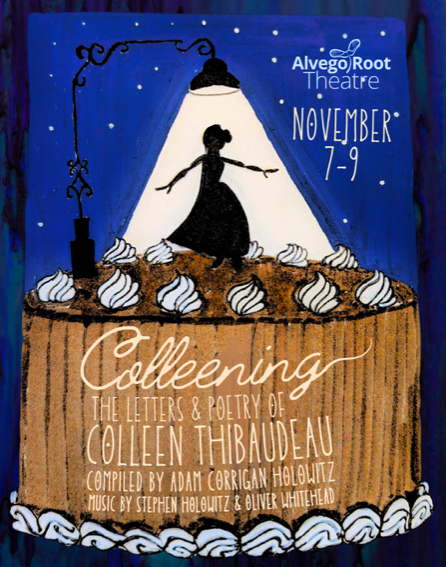
November 2025 – On November 7-9, AlvegoRoot Theatre presents a brand new concert version of Colleening: The Letters and Poetry of Colleen Thibaudeau, which premiered in 2013.
Compiled by Adam Corrigan Holowitz with music by Stephen Holowitz and Oliver Whitehead, Colleen’s letters and poems take us on a journey through childhood memories, home life, and Canadian culture. The performers are Katy Clark, Paul Grambo, and Kydra Ryan.
Where: The Manor Park Memorial Hall, 11 Briscoe Street W, London, Ontario When:Friday November 7 at 7:30 pm and matinees at 2 pm on Saturday November 8 and Sunday November 9.
Colleening: The Life & Letters of Colleen Thibaudeau, November 7-9
On Saturday November 29, poet Peggy Roffey presents “Colleen Thibaudeau’s Big Sea Vision” at the 2025 James Reaney Memorial Lecture. This year the annual lecture, in the spirit of metaphor, steps to the side and shows the “she” beside the “he”: James Reaney’s wife, poet Colleen Thibaudeau (1925-2012). Presented by London Public Library and Words Festival.
Where: London Public Library, Central Library Lawson Room, 251 Dundas Street, London, Ontario When: Saturday November 29, 1 pm. Admission is free.
On Wednesday December 3, Antler River Poetry presents Celebrating Colleen Thibaudeau: An Evening of Poetry and Memories. A lineup of well-known local poets and readers will share their favourite work by Canadian literary legend Colleen Thibaudeau. Where: The London Public Library, Landon Branch, 167 Wortley Road, London, Ontario When: Wednesday December 3, 7 pm. Admission is free.
For more about Colleen Thibaudeau and her poetry, see the biography on her website.
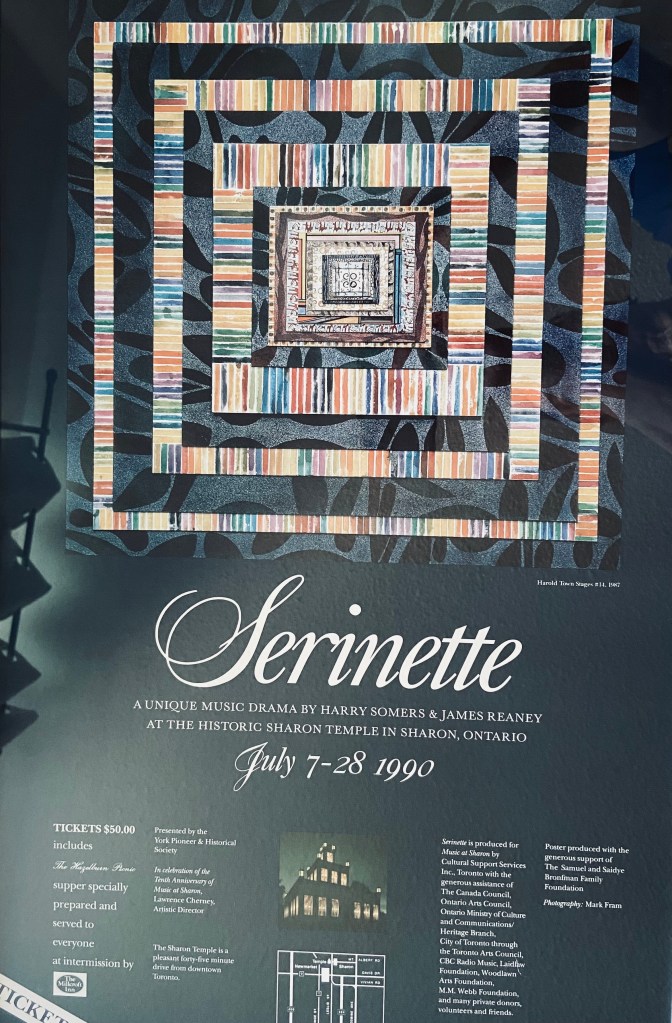
Composer Harry Somers (1925-1999) was commissioned by Lawrence Cherney, Artistic Director of Music at Sharon, to write the music in 1983. The story was to draw on the colonial era history of the Sharon Temple and the Quaker sect the Children of Peace. Seven years later, Serinette was complete and premiered on July 7, 1990 at the Sharon Temple.
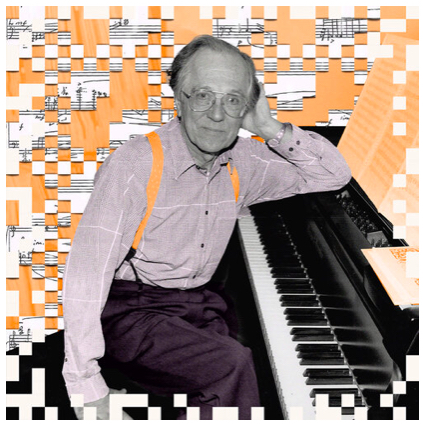
July 7, 1990: Harry Somers celebrates at the Serinette premiere
Serinette July 7-28, 1990: Conductor: Victor Feldbrill, Director: Keith Turnbull Costume and Set Designer: Sue LePage Singers: Kristine Anderson, Lynn Blaser, Benjamin Butterfield, Jeffrey Carl, André Clouthier, Leslie Fagan, John Fanning, Carol Ann Feldstein, Dennis Giesbrecht, Aline Kutan, Brian McIntosh, Erik Oland, Jackalyn Pipher, Laura Pudwell
Harry Somers chose James Reaney to write the libretto: “Knowing James Reaney’s plays and his exceptional collaborations with John Beckwith, I was absolutely confident that he would produce a libretto that was suitable for setting to music. I knew that it would be dramatically rich in character and situation, and eminently theatrical. I’ve often been struck by how he uses simple and basic means to achieve a wide variety of theatrical effects, and how he uses a comparatively small cast with the greatest versatility.” [1]
James Reaney first learned about the Sharon Temple and the Children of Peace on a summer visit: “In 1944, while working at a farm labour camp in Holland Marsh, I received permission to walk into nearby Newmarket on business. Curiosity led me to take back roads; I was soon lost, and suddenly a pivot, a spiritual one, whirled into my life. Yes, I had lost my way, but I had also discovered an old square building made of wood and hundreds of panes of glass. It was the Sharon Temple, and as the years went by, its culture and religion became an obsession with me.”
“From John Beckwith, Keith MacMillan and Helmut Kallmann, I learnt that the musical and poetic tradition, as well as the left wing politics, of anglophone Canada started here. This was the site of the first commune based on Christian principles in Ontario, and these people created many original hymns, built the first organ, were the first to educate women in the crafts, and were the first to break down the barrier between artisan and artist. David Willson will always be one of my great folk heroes. [….] So, when Harry Somers asked me to write a libretto about nineteenth century life in Sharon, I leapt at an oft wished project, but decided not to be solemn.” [2]
Notes: [1] and [3] Harry Somers quoted in Serinette Program Notes, June 3, 1990. [2] James Reaney quoted in Serinette Program Notes, June 7, 1990.
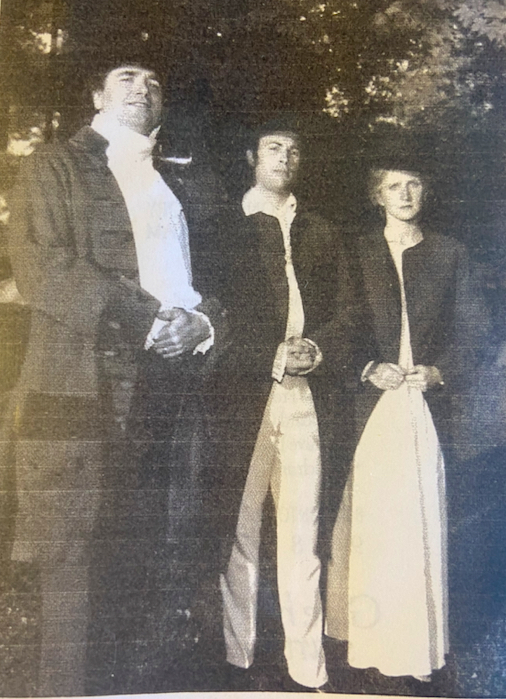
From Act I Scene 4: Three Quakers: John Fanning, Benjamin Butterfield, Jackalyn Pipher, July 1990Serinette Act I Scene 3: Leslie Fagan, the Bird Girl, among the Jarvis guests, July 1990Wild finch (The Bird Girl) design by Sue LePage (1990)
From Act I: Scene 3 The Bird Box
MRS. JARVIS: Mr. Jarvis, don’t let them start dancing. Quiet! I was about to show the ladies how this small barrel organ – the serinette you gave me, remember? – has taught our wild finch over there in that cage to sing Rossini. Sam Junior – take that sheet off that cage. Shhh!
(With great authority, Sam Jr. starts pulling the cover off the cage. The serinette begins to play, but its music goes wild as Sam inadvertently opens the door of the cage and the Bird Girl escapes. From being a bunch of voyeurs around a bird prison, the cast fan out to catch that bird! Improvise or compose chase music here. Colin and Ann do not take part in the chase. Eventually, Sam Jr. catches the bird and she is brutally shoved back into her prison and her cage is covered. As before, Sam Jr. ceremoniously pulls off the cover and as he does so, a singer in yellow dances in and repeats vocally the Rossini aria. Applause. Cover restored. Dancer off.)
LADY TWO: What else can it sing, Mrs. Jarvis? MRS. JARVIS: A month ago, that bird could not sing a thing worth listening to. LADY ONE: Oh, play another one, Mrs. Jarvis. Pray do. How many do you have on each barrel? Of this bird box? MRS. JARVIS: Two per barrel and we got twelve barrels! This is ‘O cessate di piagarmi, togliatemi la vita ancor.’ Hush!
(As the Lilliputian music sounds, the men retreat a bit.)
( ( ( 0 ) ) ) Audio excerpt from the 2001 revival recording
A concert revival of Serinette was held at St. James’ Cathedral, Toronto, Ontario with performances on May 31 and June 2, 2001, and a subsequent recording made at the Glenn Gould Studio is available from the Canadian Music Centre.
November 5, 2022 — Katy Clark (soprano) accompanied by Charmaine Fopoussi (piano) at Museum London.
November 5, 2023 —Thank you all for coming to Wordsfest at Museum London to hear Dr. Katy Clark and ensembleperform selections from John Beckwith and James Reaney’s musical works, including four operas, poems set to music, and radio collages.
Dr. Clark drew on her research from her thesis on “Regionalism in the Operas of John Beckwith and James Reaney” to eloquently lead us though the six decades of Beckwith and Reaney’s musical collaboration.
Congratulations to the singers — Katy Clark (soprano), Paul Gambo (baritone), Charmaine Iormetti (soprano), and London Pro Musica— and musicians —Charmaine Fopoussi (piano),Gary McCumber (clarinet), and Patrick Theriault (cello) — for their wonderful work on these selections:
The Great Lakes Suite (1949) — Lake Superior, Lake Michigan, Lake Huron (poems by James Reaney) “Serenade” (1950) (poem by Colleen Thibaudeau) Night Blooming Cereus (1959) — A Plant Song, Houses in Heaven, Scene 3 Recitative (James Reaney) The Killdeer (1960/1961) — Waltz, Excerpt from Act 2, Scene 4, Credits music (James Reaney) Twelve Letters to a Small Town (1961) — To the Avon River above Stratford, Canada, Instructions: How to Make a Model of a Town (James Reaney) The Shivaree (1979) — Daisy’s Aria (James Reaney) Crazy to Kill (1989) — Down the Avenue of Trees (James Reaney) Taptoo! (1994) — Loyalists’ Song (James Reaney)
The James Reaney Memorial Lecture series celebrates the life and work of Southwestern Ontario poet and dramatist James Reaney, who was born on a farm near Stratford, Ontario and found a creative home in London, Ontario.
Join us on November 5, 2023 at Wordsfest at Museum London for the 14th annual James Reaney Memorial Lecture — The Beckwith Connection: An Afternoon of Big Hits from the Reaney & Beckwith Songbook.
Curated by London soprano Katy Clark, the 2023 Reaney Memorial Lecture celebrates playwright and poet James Reaney’s collaborations with a great Canadian composer, the late John Beckwith (1927-2022). Katy Clark leads a chamber ensemble into wonderful music from Beckwith as well as words from James Reaney (Jamie) and Colleen Thibaudeau. We will also celebrate the friendship of two creative couples – Jamie and Colleen and John Beckwith and Pamela Terry, as well as their families. Katy will be joined by London Pro Musica Choir, Paul Grambo, and guest artists.
Beckwith wrote four operas with Reaney, whom he met at the University of Toronto in the late 1940s. They shared a deep interest in creating and telling authentically Canadian stories with local references – both literary and musical – and universal messages.
Four Beckwith-Reaney operas: Night-blooming Cereus (1960), The Shivaree (1982), Crazy to Kill (1989), and Taptoo! (2003)Screenshot
About the presenter Soprano Katy Clark has sung as a soloist and chorister with companies across North America. She is a DMA candidate at the University of Toronto, where she studies with Nathalie Paulin, and holds a Masters degree in Voice Performance from the University of Michigan. In addition to her work as a performer, Ms. Clark is the founder and artistic producer of the London-based opera company Village Opera.
When: Sunday November 5 at 2:00 pm
Where: Museum London, 421 Ridout Street, London, Ontario N6A 5H4
Night-blooming Cereus revival by Opera Nova at the University of Victoria, 1992
Night Blooming Cereus, a chamber opera in one act, is one of several musical collaborations between poet and playwright James Reaney(1926-2008), who wrote the libretto, and composer John Beckwith (1927-2022).
“Furthering my ambition to compose an opera, I had the great good luck to find a librettist — a writer who understood music. James Reaney shared my love of opera, and early in our friendship in student days we spoke of perhaps collaborating on an original work. In early 1953 I received from him a draft of Night Blooming Cereus. The one-act opera he imagined taking shape as a sort of southern Ontario miracle play. It turned out to be the first of four operatic works we produced together over succeeding decades…”[1]
“[…] We worked on it slowly through the mid-1950s, almost entirely by correspondence, while starting to raise families and work on tenure, he in Winnipeg and I in Toronto. No one seemed interested in staging it, but we were fortunate that CBC Radio offered a broadcast production, and, encouraged by its success, repeated it the following year. In the season 1959-60 we were supported by a small committee of friends to raise funds for a live staging of our own.”[2]
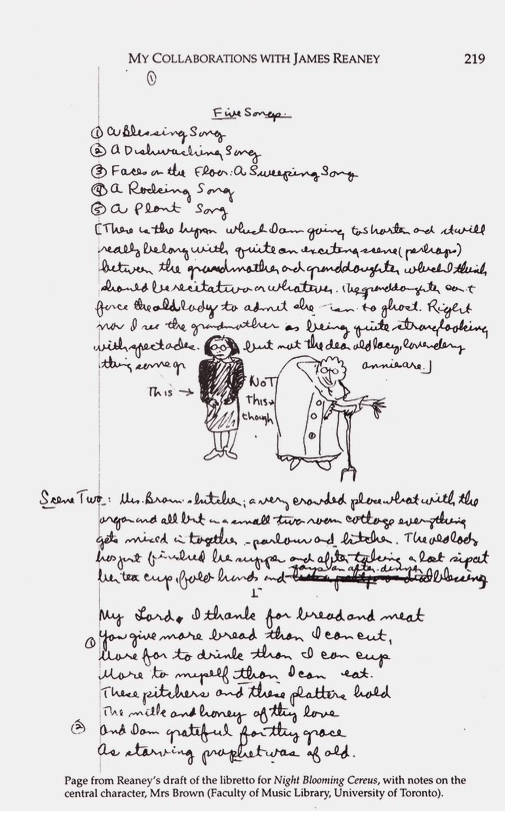
James Reaney describes meeting the demands of the composer for more variety of metre in the draft libretto of Night Blooming Cereus as being “galvanized into, at the time and for me, incredible labours of counting syllables, making parallel lines exactly the same length and finding good clean, clear and sonorous rhymes… From those Manitoba fall nights…I date my birth as a craftsman in words.” [3]
“Night Blooming Cereus” image by designer Louis de Niverville, Toronto,1960.
In Scene 2 of the opera, lonely Mrs Brown tends to her house and her Night-blooming cereus, which is due to flower that evening.
(The dishes are put away, the cupboard door closed, the dishwater somehow disposed of. She gets the broom from behind the stove.)
SWEEPING Look at the faces on the floor In the wood of the boards they are Faces of dust I sweep with a broom, Sweeping the dust in this room. Sweeping sweeping sweeping sweeping Has a sound like weeping If I kept all the dust I’ve swept It would be she I have wept Whose face appears more often than not In the dust and the fire and the knot, And the blowing rain on the window And the tree branches’ shadow Contain your face there! and again there! My lost girl in dust in the air. But it is best to go on sweeping Over the faces better than weeping. Here is the face of an old man peeping. Here is the face of a young man reaping. Here is the face of an old woman sweeping.
(A bit tired with so much activity, she sits in the rocking chair.)
ROCKING Rocking rocking, rocking rocking Very very slowly What I have been doing rocking, Most of my life lately.
Sewing at a shirt or stocking As quickly as I can And what the people to me bring I sew at while rocking
Like selling footsteps to all houses My stitches go through cloth Of caps and nightgowns and blouses Dresses, handkerchiefs and vests.
I sew for everyone here, I the restless stillness, My thread looks through cloth for tear And the butcher’s apron.
The sewing connects each one To myself except for her. She walks about beneath the sun Without my sewing snow.
As the white snow fills fields and lanes, Till they cover me all. Upon my old and long-used bones Rocking and sewing fall.
Page from Reaney’s draft of the libretto for Night Blooming Cereus (see John Beckwith’s 1997 book, Music Papers: Articles and Talks by a Canadian Composer, page 219)
James Reaney’s translation of Pierre Falcon’s “The Battle of Seven Oaks” (“La Chanson de la Grenouillère”) can be found in Margaret Arnett MacLeod’s 1960 book Songs of Old Manitoba.
Pierre Falcon (1793-1876) was a celebrated Métis balladeer and North West Company clerk. “He had a feeling for words, a sense of rhythm, and a love of a rollicking tune. He was strongly dramatic, and his idea of the importance of the Métis Nation may have been more right than his English contemporaries were ready to concede [.…]” (MacLeod, p. 2)
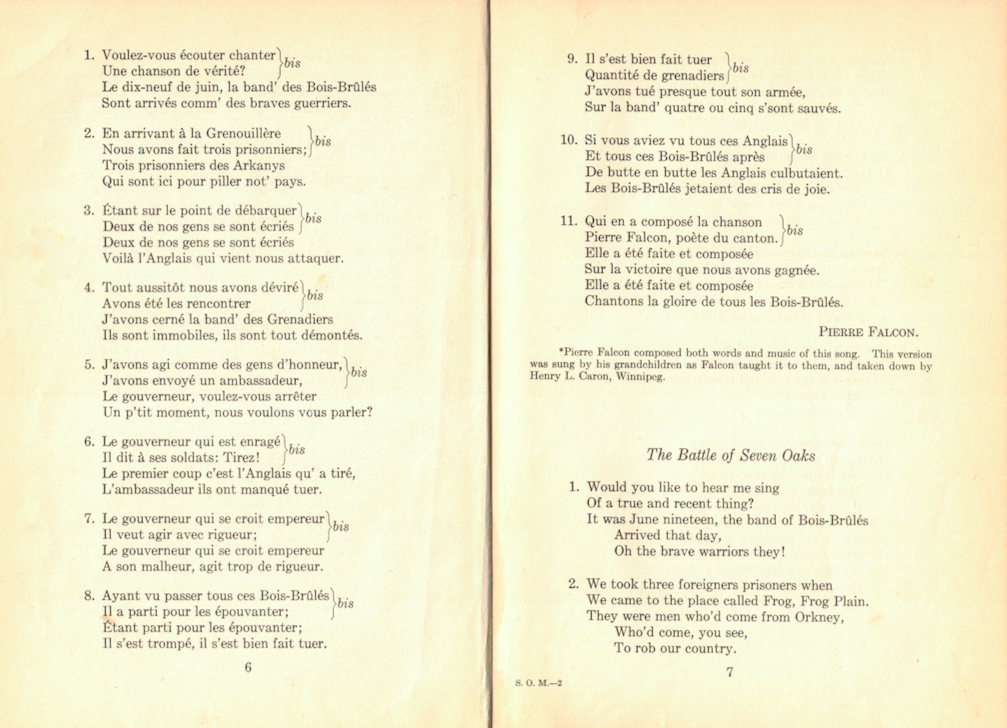
Pierre Falcon’s 1816 ballad commemorating the Métis victory at the Battle of Seven Oaks (Songs of Old Manitoba, p.5)
James Reaney offers these notes on his approach to translating the song:“This translation can be sung to Pierre Falcon’s original tune with some stretching, but no more than to sing his own words requires. In making this translation I have followed Ezra Pound’s practice. Since there can be no translation so inaccurate as that which sticks closely and literally to the surface of a song, I have attempted to make only an English equivalent of Falcon’s ballad and so translate the really important thing – its high spirits.” (MacLeod, p. 9)
1. Would you like to hear me sing Of a true and recent thing? It was June 19, the band of Bois-Brûlés Arrived that day, Oh the brave warriors they!
2. We took three foreigners prisoners when We came to the place called Frog, Frog Plain. There were men who’d come from Orkney, Who’d come, you see, To rob our country.
3. Well we were just about to unhorse When we heard two of us give, give voice. Two of our men cried, “Hey! Look back, look back! The Anglo-Sack Coming for to attack.”
4. Right away smartly we veered about Galloping at them with a shout! You know we did trap all, all those Grenadiers! They could not move Those horseless cavaliers.
5. Now we like honourable men did act, Sent an ambassador – yes, in fact! “Monsieur Governor! Would you like to stay? A moment spare — There’s something we’d like to say.”
6. Governor, Governor, full of ire. “Soldiers!” he cries, “Fire! Fire.” So they fire first and their muskets roar! They almost kill Our ambassador!
7. Governor thought himself a king. He wished an iron rod to swing. Like a lofty lord he tries to act. Bad luck, old chap! A bit too hard you whacked!
8. When we went galloping, galloping by Governor thought that he would try For to chase and frighten us Bois-Brûlés. Catastrophe! Dead on the ground he lay.
9. Dead on the ground lots of grenadiers too. Plenty of grenadiers, a whole slew. We’ve almost stamped out his whole army. Of so many Five or four left there be.
10. You should have seen those Englishmen — Bois-Brûlés chasing them, chasing them, From bluff to bluff they stumbled that day While the Bois-Brûlés Shouted “Hurray!”
11. Tell, oh tell me who made up this song? Why it’s our own poet, Pierre Falcon. Yes, she was written this song of praise For the victory We won this day. Yes, she was written, this song of praise — Come sing the glory Of the Bois-Brûlés.
( ( (0) ) ) Rufin Turcottesings the original French version on this 1963 Smithsonian Folkways Recording “Folksongs of Saskatchewan”: https://www.youtube.com/watch?v=yB1knUIOSH0
From Songs of Old Manitoba, Pierre Falcon’s original French lyrics (p. 6-7)
Note: James Reaney’s long poem “A Message to Winnipeg” (1960) includes this translation of Pierre Falcon’s 1816 song. For more about the June 19, 1816 Battle of Seven Oaks, see the entry in The Canadian Encyclopedia.
Daisy’s Aria from John Beckwith and James Reaney’s 1982 opera The Shivaree is now part of a two-volume anthology of soprano arias from Canadian operas produced by Counterpoint Music Library Services.
In collaboration with the Canadian Music Centre, Dr. Nakagawa plans to create anthologies for each voice type.
UBC Public Scholar Dr. Stephanie Nakagawa performs “I Need You Guillaume” from Victor Davies and Maureen Hunter’s 2007 opera Transit of Venus, one of the arias from her collection of music from Canadian operas: https://www.youtube.com/watch?v=XRulssBwJXw
Daisy’s Aria from The Shivaree
Caralyn Tomlin (Daisy) and Avo Kittask (Quartz) in The Shivaree, Comus Music Theatre, St. Lawrence Centre, Toronto, 1982.
In The Shivaree, Daisy is abandoned by her lover Jonathan and accepts the marriage proposal of a much older man, William Quartz. The story gives a Canadian rural setting to the Greek myth of Persephone borne off by Hades. In the aria, Daisy regrets marrying Mr. Quartz and longs for Jonathan to rescue her.
Daisy: Oh Jonathan, why have you forsaken me? Is there still time – to take me away?
ARIA Jonathan, you were a strange young man. You never could decide if I was yours, So Jonathan, I tried to make you decide By letting Mr. Quartz keep company with me. But if flowers and leaves keep company with winter, They soon find they’re stabbed with an icy splinter. My heart’s like the lane and the fields in fall, Rusting and stiffening with cold until all Lies buried in colourless snow, Jonathan! Walk above the snow Where the garden was — Walk above the snow That covers me up, Jonathan! That covers me o’er.
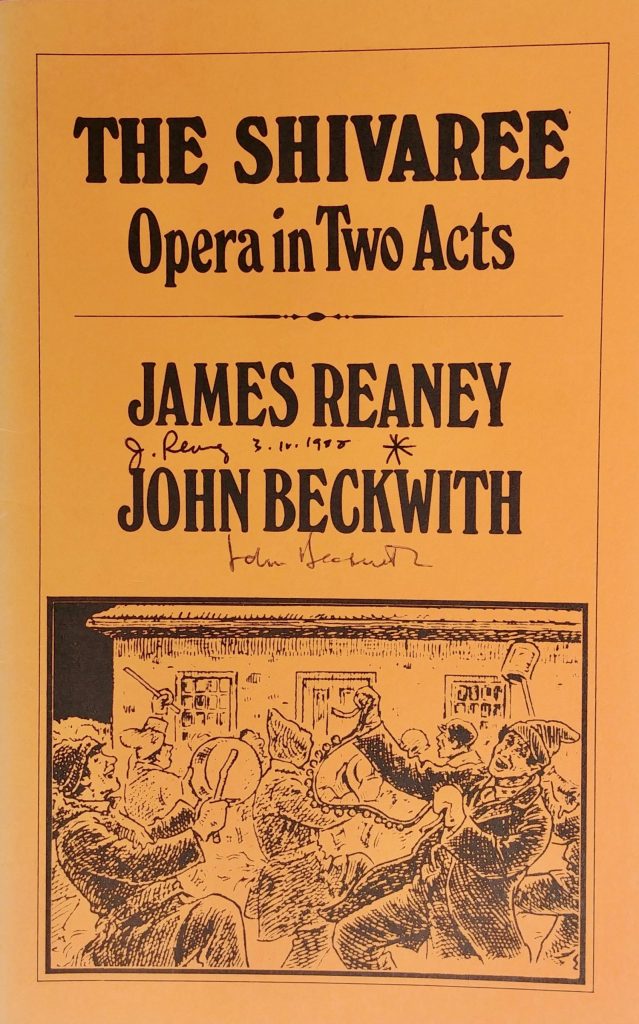
Cover for James Reaney’s libretto for The Shivaree, which premiered at the St. Lawrence Centre on April 3, 1982.
Join us on Sunday March 7 for The John Beckwith Songbook — a concert celebrating the music of Canadian composer John Beckwith in honour of his 94th birthday.
Presented on the Confluence Concerts You Tube Channel, this celebration of John Beckwith’s song repertoire features three programs encompassing nearly all of his music for solo voice, including folksongs and songs set to poems by ee cummings, Miriam Waddington, and Colleen Thibaudeau.
“Jamie lived in London and I lived in Toronto so our collaboration was almost exclusively through correspondence,” he recalls. The composer Richard Strauss and his librettist Hugo von Hofmannsthal carried on their famous collaboration much the same way. And like Strauss and Hofmannsthal, Beckwith and Reaney had their disagreements: “I wanted the leading character in our first opera to have a cat,” recalls Beckwith. Reaney replied tersely: “Cut the cat.”
Advice for potential opera composers? “You have to get a good book or you won’t have an opera. I’ve had students come up to me asking ‘What should I do for words?’ I tell them to get to know some writers.”
Page from Reaney’s draft of the libretto for Night Blooming Cereus (see John Beckwith’s 1997 book, Music Papers: Articles and Talks by a Canadian Composer, page 219)
The high school is the palace of Merlin and Cheiron Where governors and governesses teach The young Achilles and young Arthurs of the town.
The radiators teach the rule of monotony Cheep cheep cheeping in the winter classroom Timid fingers learn to turn a fire on.
A stuffed hummingbird and a stuffed Sandhill Crane. In the dusty looking glass of grammar, Number, the young see the shape of their brain.
But what and where did I learn most from? High, dark, narrow as its single window In the old high school there was a cloakroom—
A cloakroom! In winter stuffed with cloaks Soft with outside things inside Burs, mud, dead leaves on some of the coats.
At four o’clock there are forty-nine bare hooks As a hundred hands reach up And I, lingering rearranging my books
See sweeping face peer in of janitor Alone in the winter twilight The old janitor! An image to ponder over.
Of course I learnt snow dripping windows Corridors of words, cobwebs of character, The ninety-two elements in a long row, But most I learnt
The insoluble mystery of the cloakroom And the curious question of the janitor In some ways so centre and core January man and cloakroom From which the moon each month unlocks upon the wave A white bird.
James Reaney, 1962
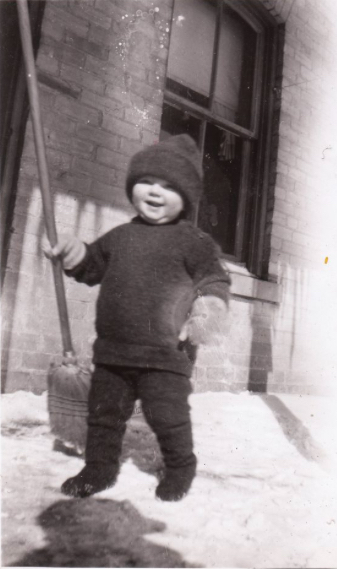
James Reaney at home, age 1 1/2 years, January 1928.











 James Reaney