Join us on November 5, 2023 at Wordsfest at Museum London for the 14th annual James Reaney Memorial Lecture — The Beckwith Connection: An Afternoon of Big Hits from the Reaney & Beckwith Songbook.
Curated by London soprano Katy Clark, the 2023 Reaney Memorial Lecture celebrates playwright and poet James Reaney’s collaborations with a great Canadian composer, the late John Beckwith (1927-2022). Katy Clark leads a chamber ensemble into wonderful music from Beckwith as well as words from James Reaney (Jamie) and Colleen Thibaudeau. We will also celebrate the friendship of two creative couples – Jamie and Colleen and John Beckwith and Pamela Terry, as well as their families. Katy will be joined by London Pro Musica Choir, Paul Grambo, and guest artists.
Beckwith wrote four operas with Reaney, whom he met at the University of Toronto in the late 1940s. They shared a deep interest in creating and telling authentically Canadian stories with local references – both literary and musical – and universal messages.
Four Beckwith-Reaney operas: Night-blooming Cereus (1960), The Shivaree (1982), Crazy to Kill (1989), and Taptoo! (2003)Screenshot
About the presenter Soprano Katy Clark has sung as a soloist and chorister with companies across North America. She is a DMA candidate at the University of Toronto, where she studies with Nathalie Paulin, and holds a Masters degree in Voice Performance from the University of Michigan. In addition to her work as a performer, Ms. Clark is the founder and artistic producer of the London-based opera company Village Opera.
When: Sunday November 5 at 2:00 pm
Where: Museum London, 421 Ridout Street, London, Ontario N6A 5H4
Night-blooming Cereus revival by Opera Nova at the University of Victoria, 1992
Night Blooming Cereus, a chamber opera in one act, is one of several musical collaborations between poet and playwright James Reaney(1926-2008), who wrote the libretto, and composer John Beckwith (1927-2022).
“Furthering my ambition to compose an opera, I had the great good luck to find a librettist — a writer who understood music. James Reaney shared my love of opera, and early in our friendship in student days we spoke of perhaps collaborating on an original work. In early 1953 I received from him a draft of Night Blooming Cereus. The one-act opera he imagined taking shape as a sort of southern Ontario miracle play. It turned out to be the first of four operatic works we produced together over succeeding decades…”[1]
“[…] We worked on it slowly through the mid-1950s, almost entirely by correspondence, while starting to raise families and work on tenure, he in Winnipeg and I in Toronto. No one seemed interested in staging it, but we were fortunate that CBC Radio offered a broadcast production, and, encouraged by its success, repeated it the following year. In the season 1959-60 we were supported by a small committee of friends to raise funds for a live staging of our own.”[2]
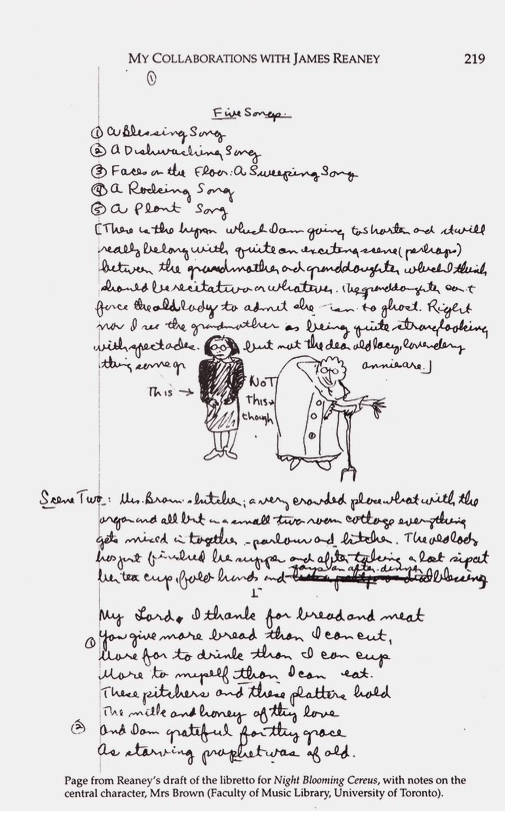
James Reaney describes meeting the demands of the composer for more variety of metre in the draft libretto of Night Blooming Cereus as being “galvanized into, at the time and for me, incredible labours of counting syllables, making parallel lines exactly the same length and finding good clean, clear and sonorous rhymes… From those Manitoba fall nights…I date my birth as a craftsman in words.” [3]
“Night Blooming Cereus” image by designer Louis de Niverville, Toronto,1960.
In Scene 2 of the opera, lonely Mrs Brown tends to her house and her Night-blooming cereus, which is due to flower that evening.
(The dishes are put away, the cupboard door closed, the dishwater somehow disposed of. She gets the broom from behind the stove.)
SWEEPING Look at the faces on the floor In the wood of the boards they are Faces of dust I sweep with a broom, Sweeping the dust in this room. Sweeping sweeping sweeping sweeping Has a sound like weeping If I kept all the dust I’ve swept It would be she I have wept Whose face appears more often than not In the dust and the fire and the knot, And the blowing rain on the window And the tree branches’ shadow Contain your face there! and again there! My lost girl in dust in the air. But it is best to go on sweeping Over the faces better than weeping. Here is the face of an old man peeping. Here is the face of a young man reaping. Here is the face of an old woman sweeping.
(A bit tired with so much activity, she sits in the rocking chair.)
ROCKING Rocking rocking, rocking rocking Very very slowly What I have been doing rocking, Most of my life lately.
Sewing at a shirt or stocking As quickly as I can And what the people to me bring I sew at while rocking
Like selling footsteps to all houses My stitches go through cloth Of caps and nightgowns and blouses Dresses, handkerchiefs and vests.
I sew for everyone here, I the restless stillness, My thread looks through cloth for tear And the butcher’s apron.
The sewing connects each one To myself except for her. She walks about beneath the sun Without my sewing snow.
As the white snow fills fields and lanes, Till they cover me all. Upon my old and long-used bones Rocking and sewing fall.
Page from Reaney’s draft of the libretto for Night Blooming Cereus (see John Beckwith’s 1997 book, Music Papers: Articles and Talks by a Canadian Composer, page 219)


 James Reaney